Schwerinsburg: A Castle-Like Residence in Windhoek, Namibia
Site at a Glance
- Popularity
- Medium
- Country
- Namibia
- Primary era
- Modern
- Eras represented
- Modern
- Civilizations
- German
- Site type
- Domestic
- Remains
- Castle
On this page9 sections
History
Schwerinsburg is a castle-like residence on a ridge in Windhoek, Namibia. Its romantic castle form was commissioned in 1913 in the historicist tradition, an approach that draws on earlier architectural styles, including the appearance of medieval fortifications. The estate developed from a German colonial signal post into an inn and then a private residence.
Signal tower and inn
In 1890, German colonial officer Curt von François had a signal tower built to provide security and connect Windhoek with Klein-Windhoek. The work took place while the Alte Feste, meaning Old Fortress, was under construction. The Witbooi Wars, conflicts between German colonial forces and the Nama led by Hendrik Witbooi, ended in 1894. The tower then fell into disrepair.
Soon afterward, a tavern and inn opened among the tower’s ruins as Sperlingslust. In 1904, architect Wilhelm Sander converted the establishment into a castle-like ruin. During the Herero uprising of 1904–05, a revolt against German colonial rule, the tower briefly served again as a lookout post.
From lookout post to private estate
After the lookout post’s use ended, the property was sold to Edgar Sentefol, who reopened a tavern there. Two bankruptcies followed. In 1913, the entire estate passed to Count Hans Bogislav von Schwerin, governor of the Gobabis District in German South-West Africa.
The Schwerin estate
Impressed by the view across the valley, Count von Schwerin commissioned Sander in 1913 to transform the property into a romantic castle. He named it Schwerinsburg after his family’s ancestral home in Western Pomerania, also called Schwerinsburg. Built in 1721, that home was where he had grown up.
The estate served as the Italian ambassador’s residence in Namibia until early 2013. It has been privately owned since that year.
Remains
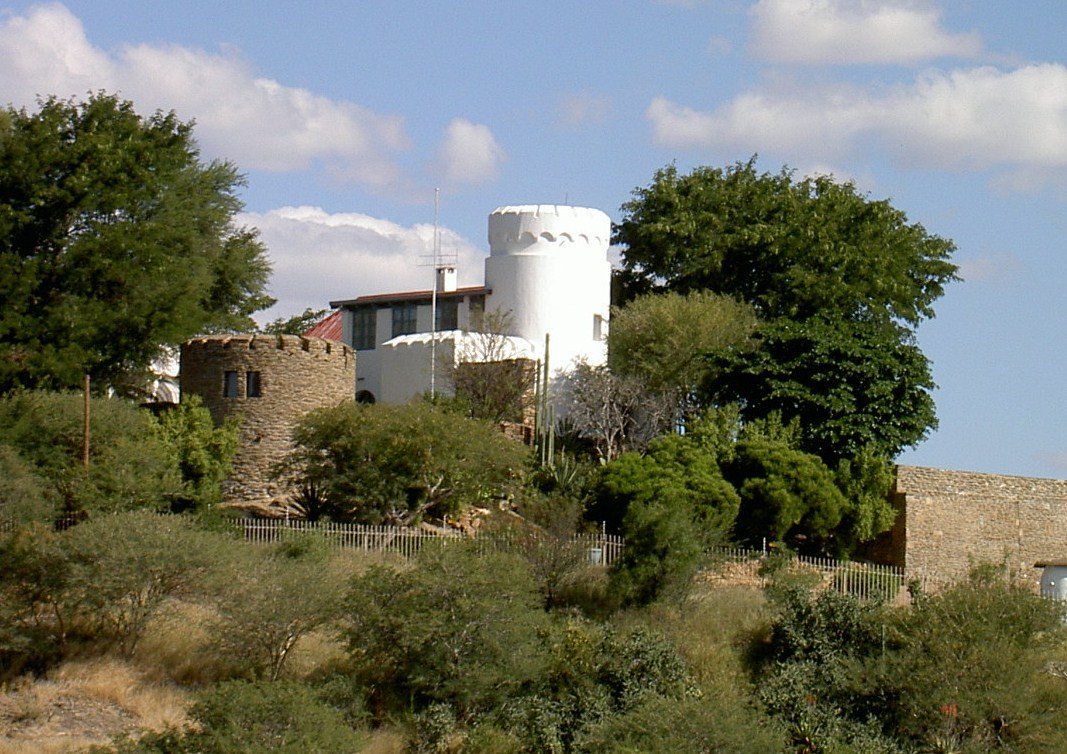
Schwerinsburg is the largest of Windhoek’s three prominent castle-like residences. The intact estate occupies a ridge in the Luxushügel district, with its principal residence enclosed by a curving defensive wall. The buildings combine stone gathered from fields with plastered surfaces, battlements, and arched details.
Buildings and enclosure
Main residence
The principal residential block is built of fieldstone and carries a three-storey fortified tower. Both are plastered and painted white. The tower has notched battlements and decorative arched bands, while a battlemented parapet runs along the south side of the main building. On the northeast side, a chapel-like section has a steep gabled roof and paired windows with a Gothic appearance.
Earlier tower and inn
The original signal tower was made of mud brick and had a thatched roof. Its stone defensive works included firing slits. During the conversion of the property, earlier stone walls were coated with clay plaster and incorporated into the castle-like ruin, and a tall round tower with battlements was built. The inn’s interior had round arches; Windhoek painter Erich Mayer decorated its walls with murals and humorous sayings.
Defensive wall and courtyard
A curving fieldstone wall encloses the estate and incorporates a two-storey projecting defensive tower. A 104-metre-deep borehole was drilled in the courtyard in an attempt to find water.