Temple of Apollo Patroos: A Hellenistic Sanctuary in Athens
Site at a Glance
- Popularity
- Medium
- Country
- Greece
- Primary era
- Classical
- Eras represented
- Iron Age, Classical
- Civilizations
- Ancient Greek
- Site type
- Religious
- Remains
- Temple
On this page15 sections
History
The Temple of Apollo Patroos is a Greek sanctuary in the western part of the Athenian Agora in Athens, Greece, probably built around 306–300 BC during the Hellenistic period, which followed the conquests of Alexander the Great. It was the later of two buildings associated with the worship of Apollo Patroos, a deity connected with Athenian family and kinship traditions.
Earlier sanctuary activity
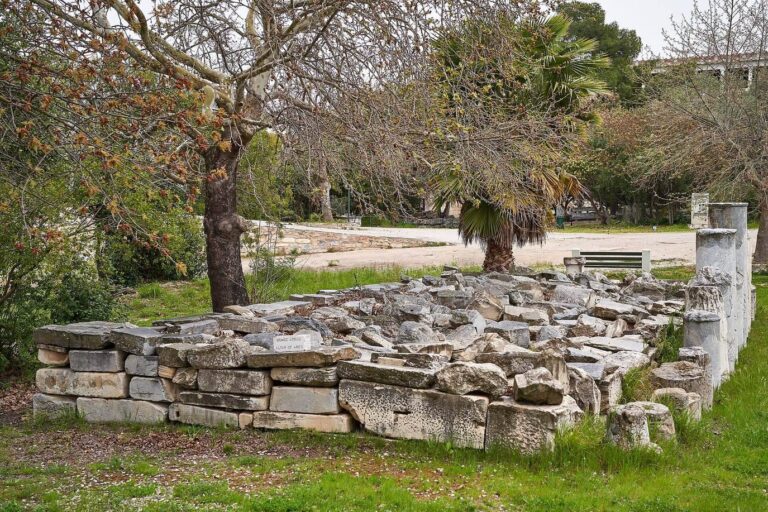
A building was erected on the site around the middle of the sixth century BC. It may have been a temple to Apollo, though that identification remains disputed. The structure probably fell during the Persian sack of Athens in 480/479 BC. Its remains were later accompanied by benches, in place by the middle of the fifth century BC, and a boundary marker dedicated to Apollo Patroos. These features have prompted differing interpretations: Homer Thompson proposed that the open area functioned as an outdoor sanctuary, while Charles Hedrick questioned whether it was sacred in the Archaic or Classical period, noting that a later wall ran across the earlier building.
Fourth-century sanctuary and temple
During the first half of the fourth century BC, the ground was levelled and a wall was built across the earlier remains. Around the middle of the century, a pit for offerings was dug in the northern part of the area. A small shrine was constructed over it in the second half of the century. Its original dedication is uncertain; Mark Lawall and Andrew Stewart proposed that it may first have been dedicated to Apollo Patroos. In the 330s or 320s BC, Neoptolemus, son of Anticles, gilded the sanctuary’s altar. An inscription reading ‘Of Apollo Patroos’ may have been part of that altar.
The larger temple was probably built around 306–300 BC. A Thasian wine jar found in its foundations indicates that construction took place after 313 BC, while the style of its pediment sculptures points to the final decade of the fourth century BC. Stewart suggested that the project promoted Athens’ ties to the Ionian cities of western Asia Minor. In 306 BC, Athens became part of the realm of Antigonus I Monophthalmus and Demetrius Poliorcetes, Hellenistic rulers in the generations after Alexander.
Cult and civic life
Apollo Patroos, meaning ‘Apollo of the fathers,’ was regarded as a guardian of families and kin groups, and as the father of Ion, the legendary ancestor of the Ionians and Athenians. The cult seems to have begun as a private practice, with public worship in Athens established by the fourth century BC. Apollo Patroos was often identified with Apollo Pythios, the form associated with Delphi. Inscriptions connect Patroos, Pythios, and Alexikakos, meaning ‘averter of evil,’ as aspects of one god, although worshippers could make separate offerings to them in the same sanctuary.
Athenian children joining a phratry, a kin-based religious association, took part in a ceremony called the Meion at a shrine of Apollo Patroos. The rite probably took place at shrines belonging to the children’s own phratries. Some phratries and gene, hereditary groups with religious functions, maintained separate sanctuaries and priests. The Salaminii probably made sacrifices to Apollo Patroos at this temple. Before taking office, an incoming archon, a senior civic magistrate, had to show that he maintained a cult of Apollo Patroos and state where it was located.
Roman period and modern identification
Pausanias, a Greek travel writer of the second century AD, described a temple of Apollo Patroos between the Stoa of Zeus and the Metroon. His account helped identify the building. He also attributed its cult statue to the sculptor Euphranor. A colossal Apollo found near the temple has been proposed as that statue, although the identification is debated. Pausanias further described statues by Leochares and Calamis in front of the temple. He associated Calamis’s Apollo Alexikakos with thanks for the end of the Plague of Athens in 427 BC, a date difficult to reconcile with evidence placing the sculptor’s career in the mid-fifth century BC. Whether these statues stood east of the temple or within its entrance porch is uncertain.
Under the emperor Claudius, who ruled from AD 41 to 54, worship of the emperor was combined with that of Apollo Patroos. Inscriptions name priests of the temple from around 100 BC to around AD 230. One man who served as priest in AD 30–37 also held a priesthood for Tiberius. The priest of Apollo Patroos had a reserved seat in the Theatre of Dionysus. The colossal Apollo statue was probably damaged during the Herulian attack on Athens in AD 267. It was later cut vertically in two, perhaps in preparation for moving it to a lime kiln.
Wilhelm Dörpfeld excavated the temple in 1895 and 1896, initially identifying it as the Stoa Basileios, or Royal Stoa. Further work by the Greek Archaeological Society in 1907 and 1908 uncovered the colossal statue. Excavations by the American School of Classical Studies at Athens from 1931 to 1935 led to the building’s identification as the Temple of Apollo Patroos in 1935.
Remains
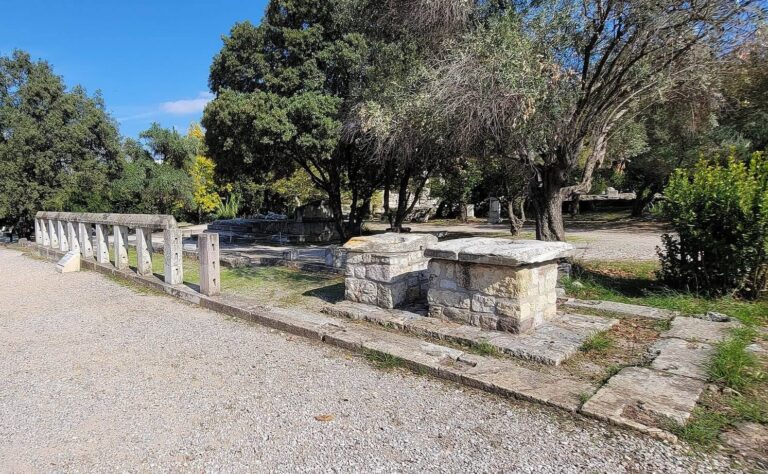
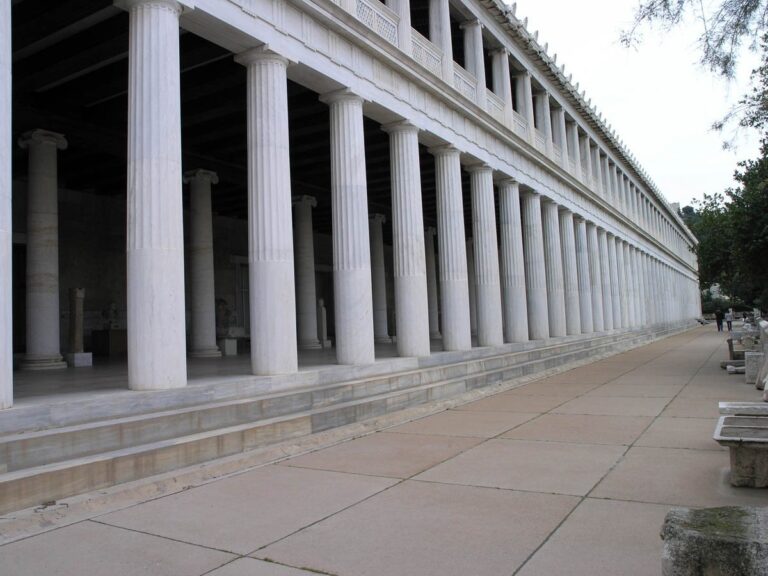
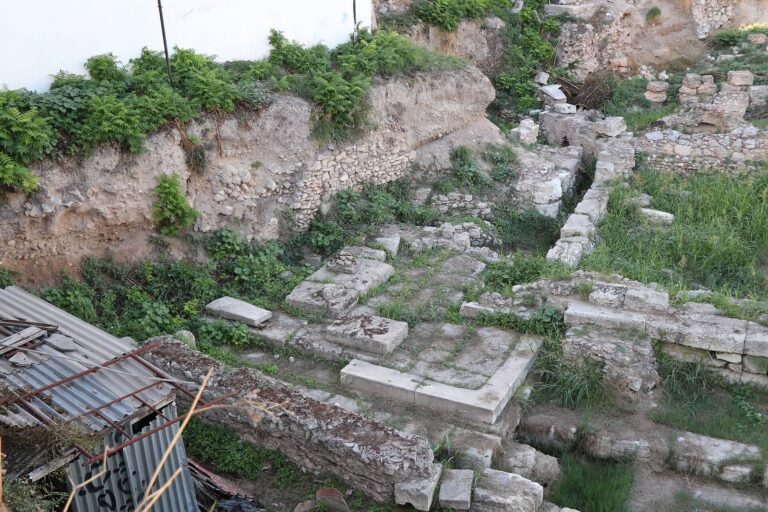
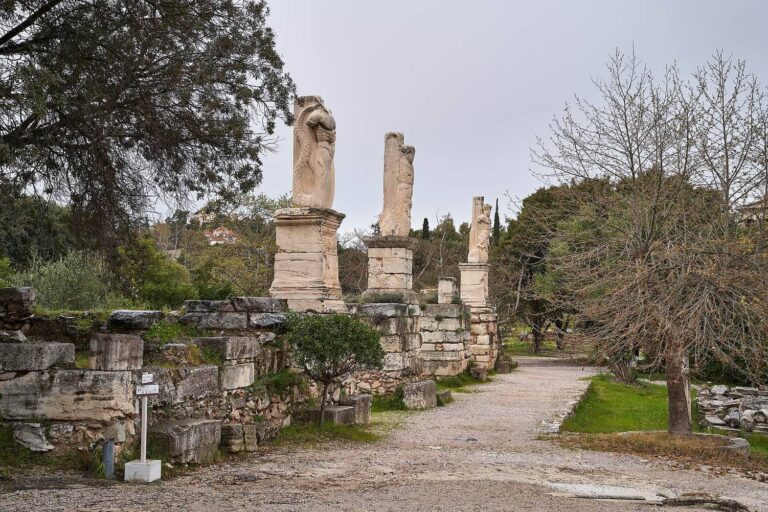
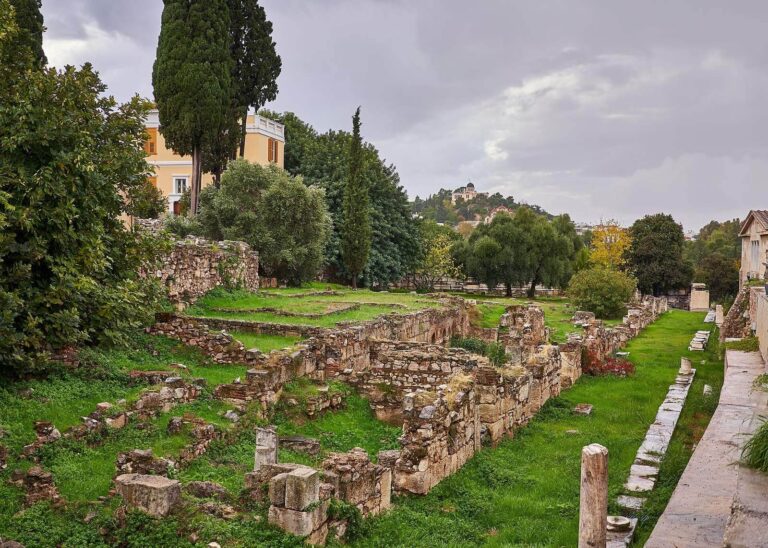
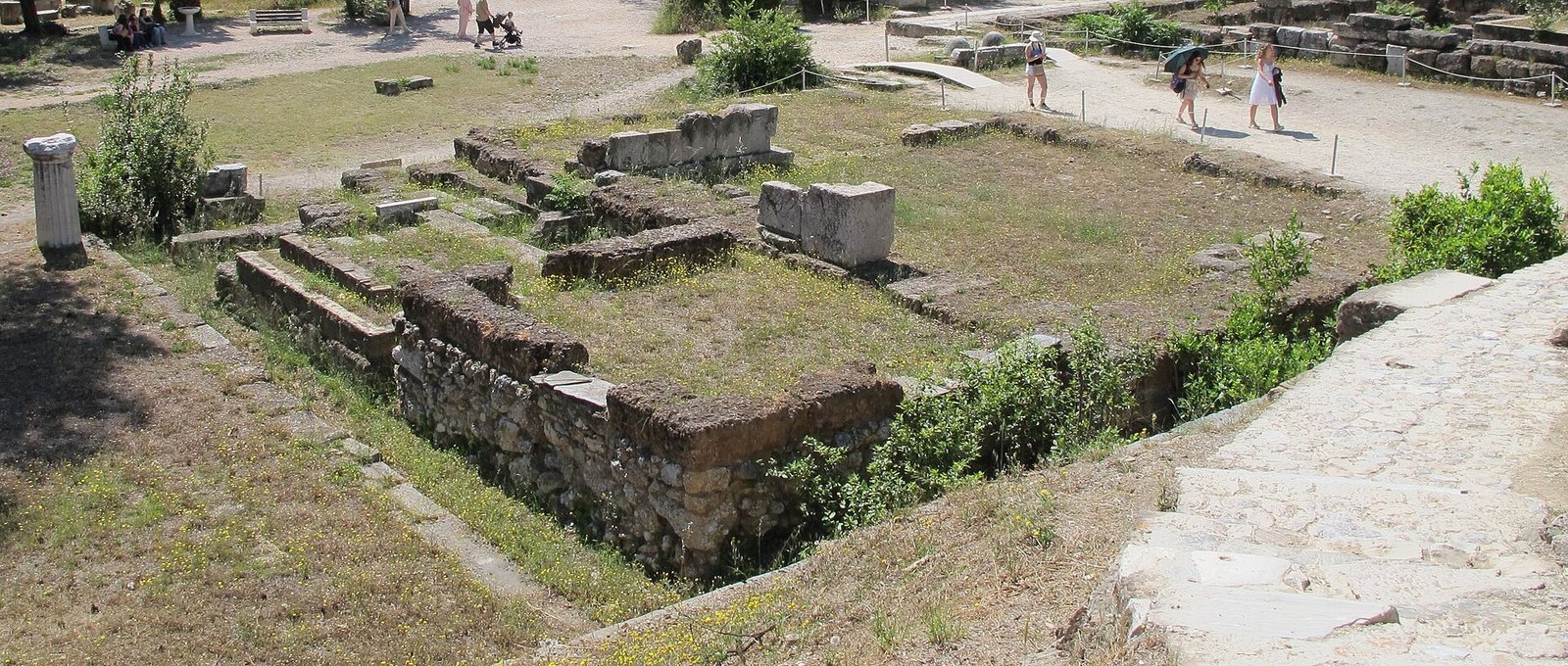
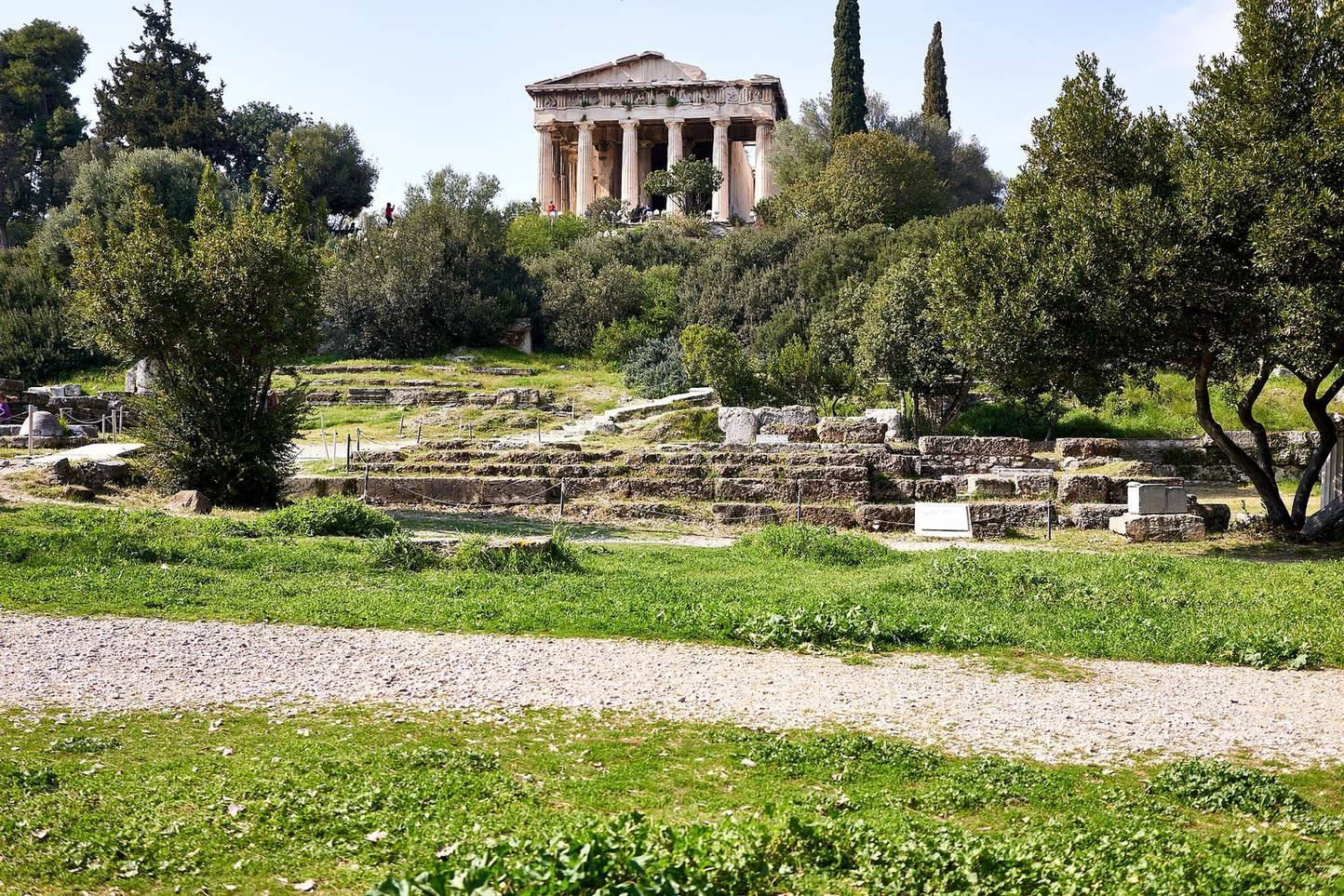
The ruined sanctuary occupies ground beneath Kolonos Agoraios, or the Agora Hill, and the Temple of Hephaestus. The Stoa of Zeus lies to its north; an open area and then the Metroon, a sanctuary of the Mother of the Gods that also housed civic records, lay to the south. The ground east of the Apollo temple remained open until the Roman-period construction of the Temple of Ares. The main temple faced east, with a smaller shrine in the space before its rear chamber.
Earlier building
Trenches cut into the bedrock held fieldstone foundations laid in clay for the earlier structure. Its eastern entrance faced away from an apse at the west end, about 8.50 metres across. A grey poros block on the apse’s central line may have supported a statue or column, and chips of Parian marble found in the fill may have come from the building. A pit to the south contained parts of a mould for casting a nude male bronze figure, perhaps the building’s cult image.
The Hellenistic temple
Plan and construction
The main building had six columns across its eastern front and a porch supported by columns. Four architectural fragments suggest an Ionic design. The principal structure measured 10.13 metres across and 16.76 metres long. Its entrance porch was 4.88 metres deep, and the main inner room measured 9.28 metres in length. A doorway at the rear right led into an adjoining chamber, measuring 4.93 metres north to south and 5.62 metres east to west. This restricted inner sanctuary, or adyton, and the main building together formed an L-shaped plan.
Unworked limestone blocks resting on bedrock formed the foundations. Above them, a conglomerate course supported the walls, with hard poros stone used beneath the visible masonry. The walls were limestone. Surviving marble pieces from the upper structure include steps from the porch, the base of an Ionic wall support, and part of the projecting cornice.
Pediment sculpture
The eastern pediment, the triangular upper end of the roof, was about 9 metres wide and 1.125 metres high at its centre. Two sculptures from the Agora have been linked to it and may show an appearance of Apollo. One is the lower part of a woman seated on a rock, wearing a tunic and cloak and looking left. The other is the lower portion of a seated male figure in similar clothing, possibly raising his arms. Thompson identified the woman as a Muse; Stewart proposed that the man represented Apollo. Stewart dates both pieces to about 310–300 BC and suggested that they may have been made by sculptors who also worked on the altar of the healing god Asclepius at Kos, probably sons of Praxiteles.
Roof ornaments
Three of the temple’s four sculpted roof ornaments, called acroteria, have been identified. They represented Apollo and Artemis killing the Niobids, the children of Niobe in Greek myth. The piece from the right corner shows a running girl in layered Greek clothing, probably one of the Niobids. Its figure type may have been related to one used on the Monument of Thrasyllos, built in 320/319 BC. Drapery fragments from the left corner belong to another fleeing figure, while a fragment of a woman’s chest, probably Artemis, likely came from the central ornament. A companion image of Apollo is thought to have been part of that group, but none of it has been identified. The sculptures are dated stylistically to the final decade of the fourth century BC.
Colossal Apollo
The colossal marble statue, probably found about 20 metres south of the temple, is often identified with the cult image Pausanias attributed to Euphranor. That connection remains uncertain. The figure wears a long tunic and cloak; its head and both arms are missing, although some long hair survives on the left shoulder. In its present state the statue stands 2.54 metres high. The original block was about 2.8 metres high, 1.2 metres wide, and 0.75 metres deep, and weighed about 6.5 tonnes. The head and left forearm were made separately. A socket beneath the left arm may have held a stringed instrument called a kithara. The statue is dated stylistically to the middle of the fourth century BC. Its roughly finished back indicates that it was intended to stand against a wall. A contemporary small offering statue from the Agora and Roman-period statues are known as imitations of the colossal figure.
Other sanctuary remains
Smaller shrine
The rectangular shrine measured 5.2 by 3.65 metres and faced east. Its remains include conglomerate foundations and grey poros blocks from the base of the walls. A platform at the rear of its main chamber, 1.5 metres wide, may have carried two statues. The earliest floor consisted of brown mortar with red-painted pebbles; a later surface used lime mortar containing Pentelic marble chips. A porch, 4 metres deep and 4.8 metres wide, was added between about 150 and 86 BC. It had a marble floor and steps leading up to it. The shrine stands 4 metres south of the Stoa of Zeus and is partly enclosed on its west and south sides by the larger temple.
The shrine is commonly identified as the Temple of Zeus Phratrios and Athena Phratria, but its dedication is disputed. The case rests on an inscribed marble altar found elsewhere in the Agora, which may fit a base in front of the shrine. Hedrick argued that the altar belonged near the north end of the Stoa of Attalos, where it was found. A boundary marker dedicated to Zeus Phratrios and Athena was also discovered in that area. Other proposed dedications for the shrine include Zeus Eleutherios, a form of Zeus associated with freedom, and Apollo Patroos. Stewart suggested that it may first have housed the colossal Apollo before being rebuilt for Zeus Phratrios and Athena Phratria.
Inscriptions and offerings
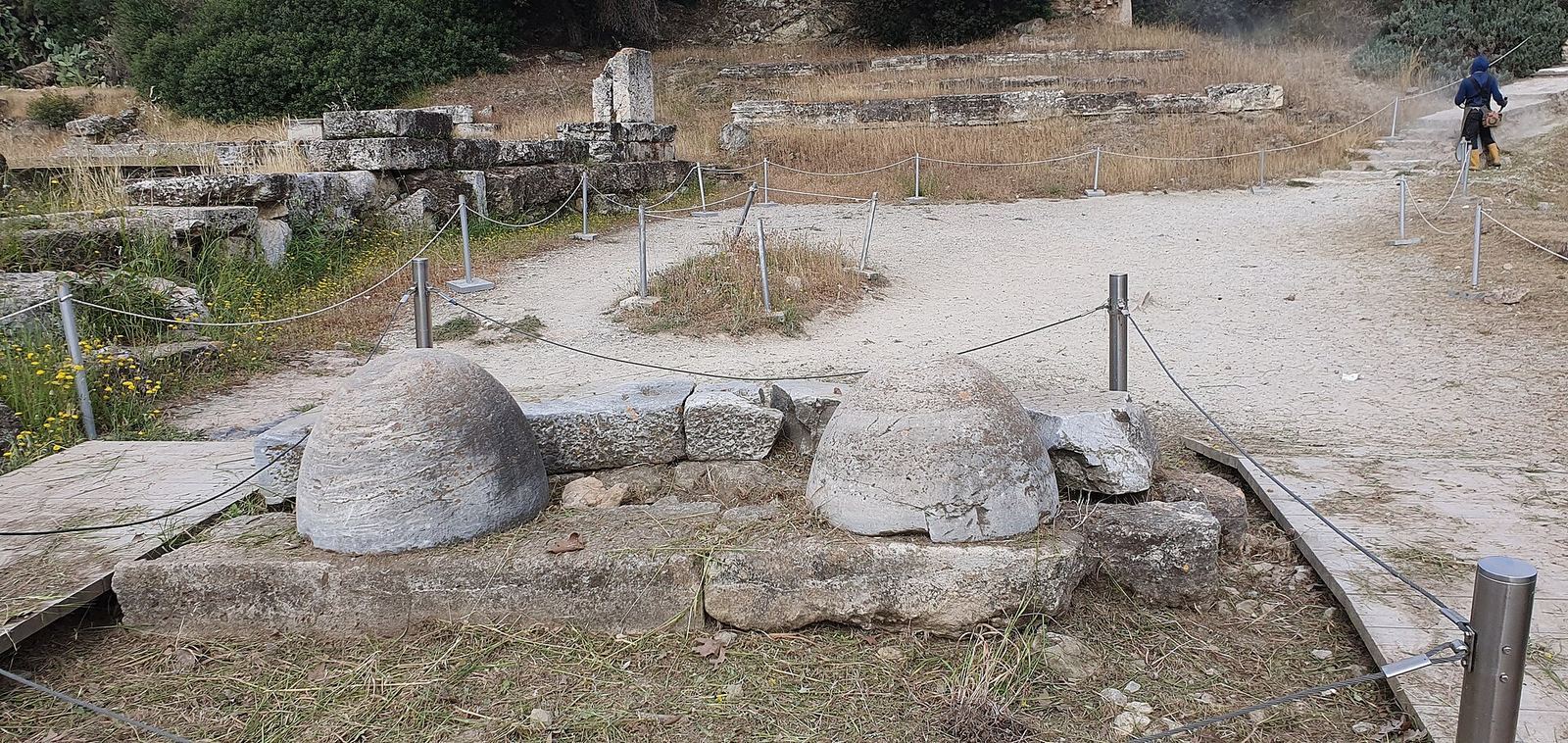
A marble slab inscribed ‘Of Apollo Patroos’ was found near the Varvakeion, about 500 metres north of the Agora. Dated to the late fourth or early third century BC, it may have belonged to the L-shaped temple. It may be distinct from the inscription that could have formed part of the sanctuary’s gilded altar. Four additional marble objects called omphaloi, which had religious associations, were found in the Agora: two near the Metroon’s southwest corner and two farther north. They may have been offerings to Apollo Patroos.