Panlongcheng: A Shang-Period Walled Center in China
Site at a Glance
- Popularity
- High
- Country
- China
- Primary era
- Bronze Age
- Eras represented
- Bronze Age
- Civilizations
- Unclassified
- Site type
- Settlement
- Remains
- City
On this page29 sections
History
Panlongcheng is an archaeological site in China whose settlement developed into a walled center during the Bronze Age, within a sequence dated to about 1600 to 1300 BCE. It is associated with Erligang, an archaeological culture linked to the early Shang, a Bronze Age dynasty of ancient China. At its height, Panlongcheng marked Erligang’s southernmost reach.
Urban formation
The site’s seven archaeological phases are grouped into three stages. In the first, phases 1 and 2, settlement began near the area later enclosed by the town and spread to other parts of the site. High-status buildings and distinctive burial goods appeared during this period, which is associated with Erlitou, an earlier archaeological culture.
Prosperity and decline in the Shang period
Phases 3 to 5 correspond to the early Shang and Panlongcheng’s period of prosperity. A walled center and palace area took shape, while a cemetery containing the largest elite graves became an important burial zone. Residential remains of lower-status inhabitants lay elsewhere in the settlement. Finds from this stage closely resemble material from Zhengzhou’s Erligang-period center in the Central Plains, the region centered on the middle and lower Yellow River basin.
During phases 6 and 7, in the middle Shang period, large buildings and high-status burials shifted from the walled town to another part of the settlement. Bronze grave goods became fewer and less elaborate. The walled center was abandoned, and occupation later ended in the remaining settlement areas as Shang culture withdrew from the middle Yangtze region.
Panlongcheng’s finds define a regional form of Shang material culture known as the Panlongcheng type. Its position and evidence have prompted several possible interpretations of its role. It may have been a regional center of Central Plains influence, a military outpost, a regional state, or a transit and metalworking hub for reaching mineral resources farther south. It may also have been an important city in the Southern Territory named in Shang oracle-bone inscriptions, records carved on animal bones or turtle shells, often for divination. The site’s discovery broadened understanding of how far Shang-period culture extended into the Yangtze basin.
Rediscovery and archaeological investigation
A county gazetteer from the Ming dynasty (1368 to 1644), a local reference work on a county’s geography and history, noted Panlongcheng’s location without identifying its builders or date. A 1932 military map marked its outline under another local name. Residents also unearthed bronze objects during the Second Sino-Japanese War (1937 to 1945), China’s war against Japan that formed part of the Second World War.
In 1954, severe flooding in the Yangtze basin led workers to take earth from Panlongcheng’s walls for embankments. Pottery fragments found during this work brought the remains to official attention as a possible late Neolithic or Shang-period site. In 1963, archaeologists working ahead of water-management construction recovered more than 30 bronze ritual vessels. Their forms resembled objects from the early Shang Erligang phase at Zhengzhou. Major excavations in 1974 to 1976 uncovered palace foundations, examined the walls and moat, and identified Shang-period graves. An archaeological work station followed in 1975, and excavations from 1979 to 1984 found further houses and ash pits.
A large building foundation found in 2006 was excavated in 2008 and 2011. A provincial protection plan issued in 2009 supported further work by archaeological institutions, universities, and the site museum. From 2013, a research program examined a high-status grave and identified a bronze-casting area beyond the known capitals of the Xia and Shang periods. Xia is traditionally recognized as an early Chinese dynasty before Shang, though its dates and historical status are debated. Panlongcheng was designated a National Key Cultural Relic Protection Unit in 1988 and a National Archaeological Site Park in 2017.
Remains
Setting and overall layout
The site occupies low ridges in the foothills of the Dabie Mountains, beside Panlong Lake and south of the Fu River, with Hankou across the river. Its principal remains lie on ridges and their branches. In the Xia and Shang periods, the lake stood nearly five metres below its modern level, and areas now divided by water formed connected land. At its greatest extent, the settlement covered about one square kilometre; its central walled town covered approximately 75,400 square metres. The site includes the town and palace area, residential zones, cemeteries, and craft-production areas. Acidic red soil limits the preservation of organic materials, while village activity since the 1950s has left the landforms largely intact.
The walled town
Walls, corners, and gates
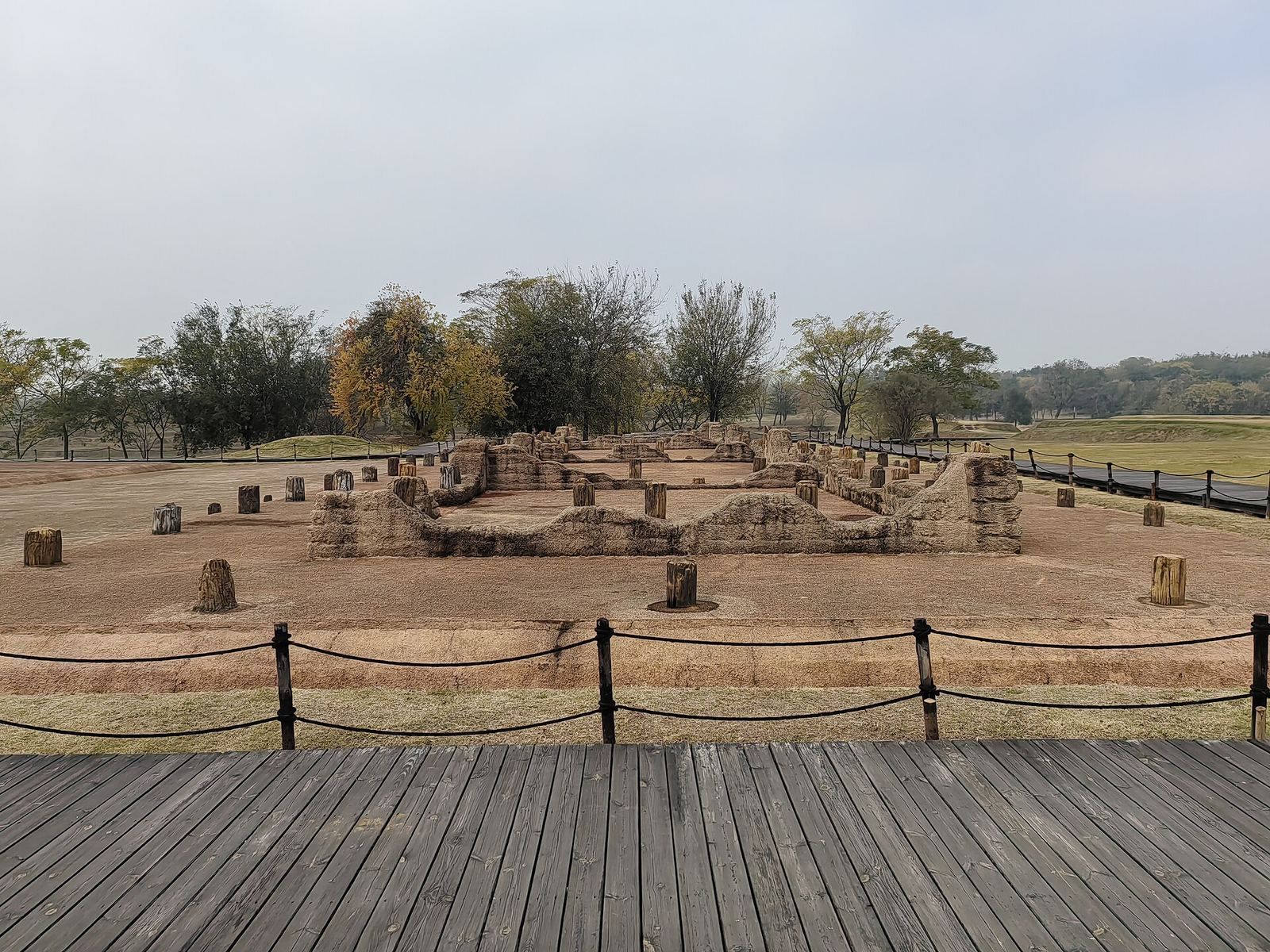
The town stands on raised ground in the site’s southeast, over earlier deposits. Its roughly rectangular plan measures about 290 metres from north to south and 260 metres from east to west, with a perimeter of around 1,100 metres. The ground rises from southwest to northeast. Builders raised its walls from rammed earth, soil compressed in successive layers. Excavated sections contain seven to twelve layers, some marked by tamping, while the sloping outer bank was compacted separately. The outer faces are steep and the inner slopes more gradual. Sections of the west and south walls still rise about two to four metres; the north wall remains at foundation level.
Traces survive at the southeast, southwest, and northwest corners. The northwest corner is nearly square, while the other two are curved. Gates originally stood in all four walls, and openings remain at the middle of the north, south, and west sides. Compacted-earth platforms outside the gates may have formed part of defensive arrangements such as outer gate enclosures.
Moat and drainage
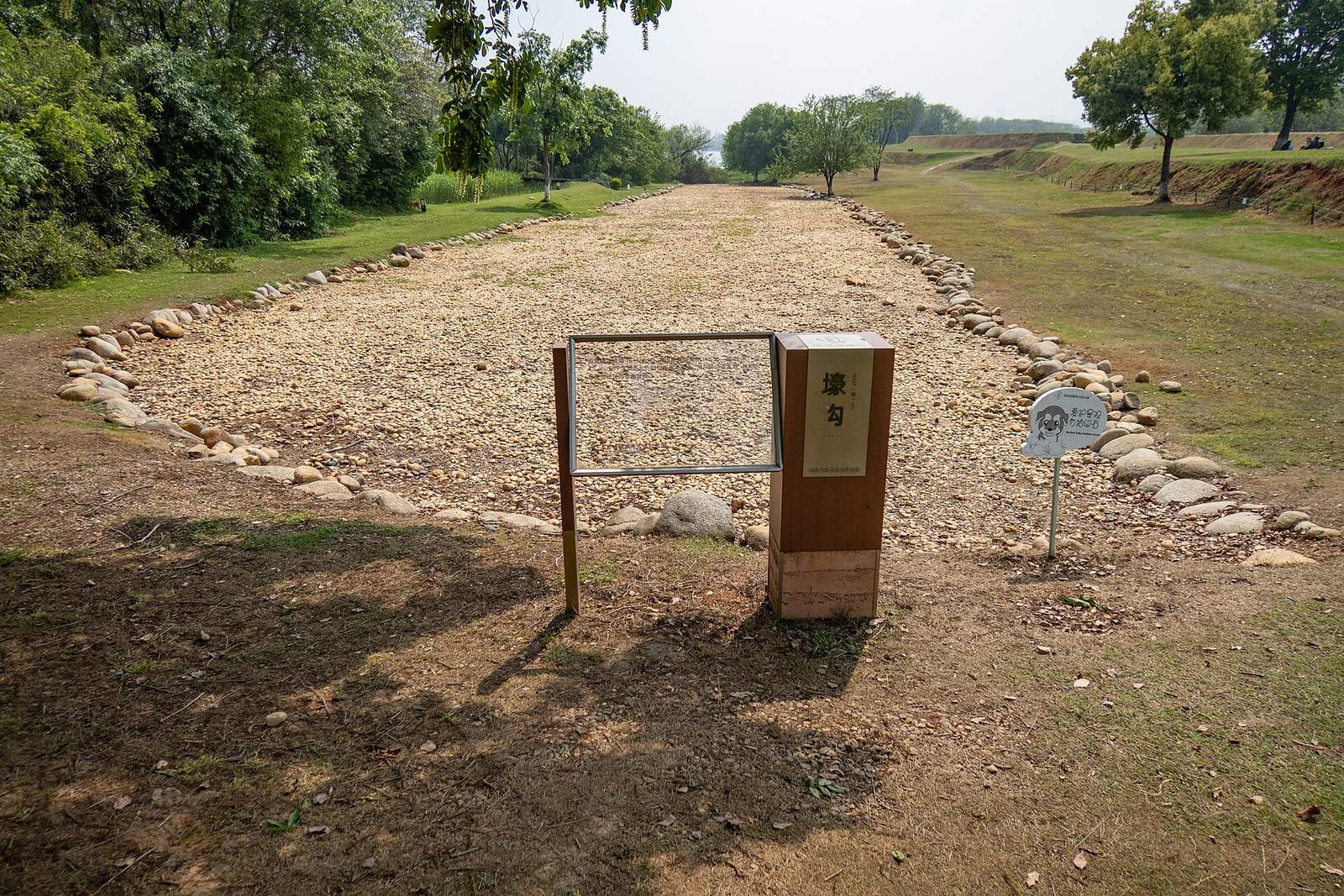
A moat ran about three metres outside the town wall. It measured roughly five metres across and 2.7 to 3 metres deep, following a course of about 1,180 metres. It may have served both defense and drainage. A separate ditch about 15 metres north of the town extended from a nearby ridge toward Panlong Lake and may also have carried water away. Postholes at the bottom of the southern moat may mark supports for a bridge.
Under the middle of the south wall, a stone-lined underground drain survives for about 3.3 metres and is 0.6 metres wide. Its form resembles drains at Zhengzhou and Yanshi.
Palace buildings
Building 1
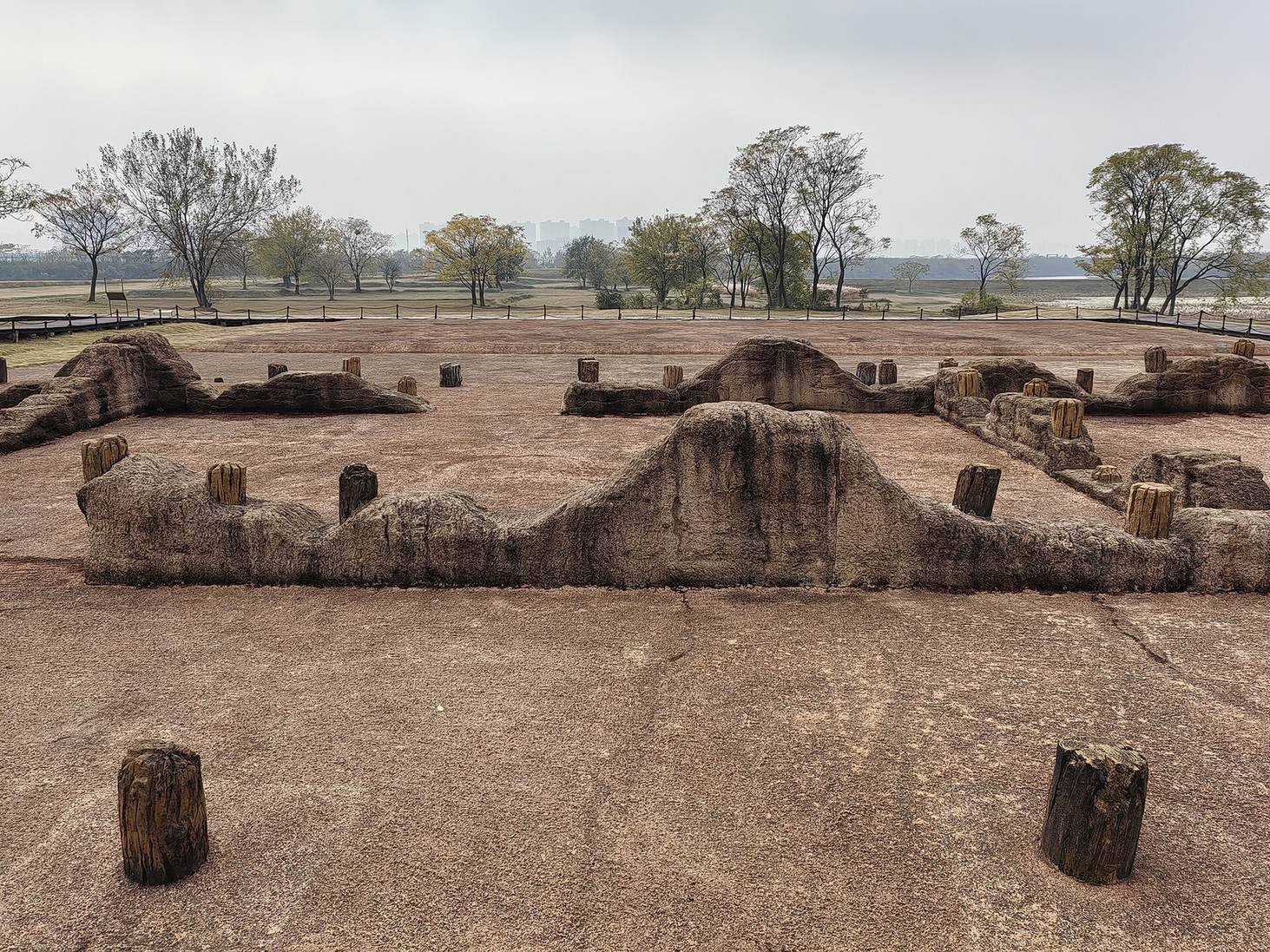
The palace area occupies the town’s northeast, its highest point. Three foundations were investigated there, including two fully exposed buildings from the second stage. They stood on a deliberately raised platform about 100 metres long and 60 metres wide, laid over earlier building foundations and cultural deposits. Both follow the town’s alignment, about 20 degrees west of south. Building 1 stood on a red-earth platform measuring 39.8 by 12.3 metres. Forty-three pits for post bases, set about 0.6 metres from the platform’s edge, may mark a surrounding walkway. The building is estimated to have been 38.2 metres wide and 11 metres deep. Its wall area measured 33.9 metres across and 6 to 6.4 metres deep. Timber-frame walls coated with mud divided it into four rooms. Broken pottery around the posts formed a drainage apron.
Building 2
Building 2 lies south of Building 1. A hard, gray-white surface between them may have served as an activity space. The building’s platform measured 29.95 by 12.7 metres, with traces of drainage paving and pipes nearby. Later graves from the Song dynasty (960 to 1279) and a Qing-period temple (1644 to 1912) damaged its eastern and southeastern sides. Twenty-eight surviving post bases indicate an estimated width of 27.25 metres and a depth of 10.8 metres. The structure has been interpreted as a hall. Building 1 may have been a residential palace; together, the two buildings may represent an early front-court, rear-residence arrangement, separating a formal court from living quarters.
Later large building
A separate foundation on the southern slope of a ridge dates to the site’s third stage. Found in 2006 and excavated in 2008 and 2011, it is estimated to have measured 34 by 12 metres, close to the scale of Building 1. Its orientation matches the palace buildings. The structure had three divisions in depth, while damage to the surrounding deposits prevents its full width and door arrangement from being established.
Cemeteries and burials
Burial patterns and grave forms
More than 40 graves have been found across the settlement, most of them medium or small. At Xiaowangjiazui, the cemetery’s consistent arrangement and burial pattern suggest planned organization. The largest graves, in two high-status cemetery zones, are vertical earth pits of about 10 square metres. They have two-tier earthen ledges, traces of coffins and outer coffins, and a small waist pit beneath the coffin, sometimes holding a sacrificed dog and a jade dagger-axe. Bronze ritual vessels and weapons occur among their grave goods. Medium-sized graves, about two to three square metres, also have ledges and sometimes a waist pit with a sacrificed dog, but contain fewer bronze objects. The smallest, about one square metre, have a coffin and simple pottery offerings.
Tomb 2
Tomb 2, from the second stage, may have held Panlongcheng’s leader. Its opening measures 3.67 by 3.24 metres, its base 3.77 by 3.4 metres, and its depth 1.41 metres. Traces of a red-colored, carved outer coffin measure 2.78 by 2.02 metres and 0.65 metres high. The inner coffin traces measure 2.06 by 1.03 metres, with the deceased’s skull found inside. Three people were buried as sacrifices outside the coffin, two between the inner and outer coffins and one on the outer coffin boards. A dog skeleton lay in the waist pit beneath the coffin. The tomb yielded 77 objects, including 50 bronze pieces and traces of wooden objects. Its bronzes include ritual vessels comparable in style to those from contemporary Central Plains graves.
Residential and craft areas
Pottery kilns
Three kilns from the first and second stages were found in a residential area: one round kiln and two long kilns. The round kiln’s chamber was 1.3 metres wide, with a firebox and ten circular fire openings. Pottery fragments at its base indicate that it was used for everyday pottery. The two long kilns measure 54 by 10 metres and 30 by 5.6 metres. Each had a head, chamber, tail, doors, and walls, with pottery fragments around it. Their form resembles that of later dragon kilns, long kilns built along a slope.
Bronze-casting area
A third-stage bronze-casting area occupied a peripheral zone. Several ash ditches formed a partly enclosed space about 26 metres from east to west and 40 metres from north to south. Finds include ceramic mold fragments, crucibles used for melting metal, malachite, a copper-bearing ore, charcoal, copper slag, and broken bronze objects. Similar ditches occur elsewhere in the settlement.
Bronze objects
Bronze assemblage
More than 350 bronze objects have been excavated, including nearly 200 vessels. Nearly 140 vessels are for wine, alongside cooking cauldrons and food vessels. The collection also includes axes, dagger-axes, spears, adzes, and arrowheads. Vessel shapes and decoration resemble Erligang bronzes. High-status graves contained several sets of drinking vessels, while ordinary graves generally held one or two sets, a difference that may reflect rank.
Notable vessels and weapons
A three-legged ritual cauldron from Tomb 11 in a high-status cemetery measures 85 centimetres high and 55 centimetres across its mouth. Three groups of taotie, a stylized mask-like face motif, decorate its neck. When found, it was the largest known round tripod from the early Shang period. A bronze axe from Tomb 2 measures 41.4 centimetres high and 26.7 centimetres across its blade. It has a round central hole, a square hole near the shoulder, and a kui-dragon, a conventional single-legged dragon motif, below the shoulder. Its height is unusual among early Shang examples.
Pottery
Changing pottery forms
Nearly 100,000 pottery sherds have been recovered. They represent fine clay, sand-tempered, and hard pottery in red, yellow, and black. Later deposits contain more sand-tempered and red wares, while fine clay and black pottery become less common. Early pottery includes tripods, cooking vessels, jars, and steamers resembling finds from Erlitou and lower Erligang contexts. A small-mouthed urn also reflects influence from Neolithic traditions of the middle Yangtze. Middle-period deposits add forms common in Central Plains assemblages, while some earlier forms become much less common. A small group of handled cooking vessels, steamers, and hard-pottery cups may reflect influence from the lower Yangtze. Late pottery resembles the middle-period assemblage but includes more large-mouthed jars and stamped pottery, perhaps reflecting greater local adaptation.
Large-mouthed jars
Large-mouthed jars are especially numerous among late-period sherds and differ from Central Plains Shang pottery. They occur in large, medium, and small sizes, with varying fabrics and manufacturing methods. Some may have served as crucibles for copper smelting, while others may have been used for brewing.
Jade objects
Carved and polished pieces
More than 100 jade objects have been found, including arc-shaped pendants, handle-shaped pieces, and animal forms. Materials include tremolite and serpentine, stone minerals, as well as turquoise. Tremolite may have come from Xinjiang, serpentine from Liaoning, and turquoise from the Shiyan area of Hubei. The pieces are carefully carved and polished, sometimes drilled, and some use styles resembling bronze decoration. A number appear to have been altered for reuse.
Jade dagger-axes
Jade dagger-axes, pole weapons with a crosswise blade, occur in several high-status graves and may indicate the occupants’ standing. The longest found at Panlongcheng came from Tomb 3 in a high-status cemetery. It measures 94 centimetres long and 0.5 centimetres thick, and is made of gray-white serpentine. It is the longest known early Shang jade dagger-axe. Other high-status graves held several examples longer than 50 centimetres.
Turquoise-and-gold ornament
Tomb 17 in a high-status cemetery yielded a turquoise-and-gold ornament in two groups. The southern group measures 16.5 centimetres long and 20 centimetres wide; the northern group is 13 by 6 centimetres. Gold pieces form the eyes and teeth. Decayed black material beneath the turquoise may be the remains of a backing. Reconstruction suggests that the pieces formed a raised dragon ornament once attached to wood or leather.