Hirschberg Palace: Hunting Lodge of the Prince-Electors of Cologne
Site at a Glance
- Popularity
- Medium
- Country
- Germany
- Primary era
- Early Modern
- Eras represented
- Early Modern
- Civilizations
- Electorate of Cologne, Holy Roman Empire
- Site type
- Domestic
- Remains
- Palace
On this page9 sections
History
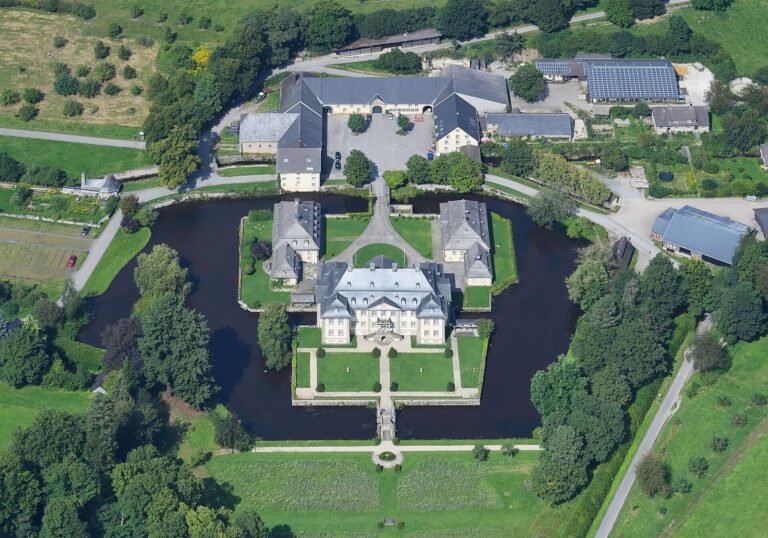
Hirschberg Palace, in Hirschberg, now part of Warstein in North Rhine-Westphalia, Germany, was a Baroque hunting lodge of the Prince-Electors of Cologne, built between 1662 and 1668 on the site of an earlier castle. The Prince-Electors were archbishops who also held electoral rank in the Holy Roman Empire. The palace became a centre of hunting and court life under the Cologne electors.
The medieval castle
In 1340, Count Gottfried IV of Arnsberg received permission from Archbishop Walram of Jülich to grant Hirschberg town rights and build a castle there. The county, along with the castle, passed to the Duchy of Westphalia in 1368. The duchy formed part of the Electorate of Cologne, and a new castle was later built in place of the first fortification.
The castle was completely destroyed during the Thirty Years’ War, a major European conflict fought from 1618 to 1648. Beginning in 1662, Prince-Elector Maximilian Henry of Bavaria commissioned a palace on the site, chiefly to serve as a base for princely hunts. The building was completed in 1668. Its intended design included four wings and four corner towers, but by 1691 it had three wings and two towers. By that year, parts of the deteriorating complex were said to need rebuilding.
The palace under Clemens August
Prince-Elector Clemens August I of Bavaria had the palace modernized during the eighteenth century. Johann Conrad Schlaun’s work concentrated mainly on the interiors. In 1753, Clemens August commissioned a gate to close the open side of the palace courtyard.
The estate reached its height under Clemens August, who held numerous large hunts, especially par force hunts. In this mounted chase, hounds pursued a stag until it could no longer escape. The elector and his guests either joined the hunt or waited at a central point in the forest. Once the hounds had caught the exhausted animal, a horn signal summoned the elector to kill it with a thrust to the heart. The ceremony made hunting a formal display of princely authority. Small chapels and hunting lodges were also built for these outings, and Mass was celebrated in the chapels after the hunt.
Decline and dispersal
After Clemens August’s death, the Cologne electors took less interest in the estate, and large hunts became rare. A burgrave, an official who administered the estate, managed it with the help of forestry officials. Neglect contributed to the buildings’ decline. A fire severely damaged the palace in 1788. When the Duchy of Westphalia passed to Hesse-Darmstadt in 1802, the new administration judged restoration too costly and arranged for the complex to be demolished. The estate was sold for demolition that year, but one wing, including the stables, was retained as a forester’s residence.
The gate initially remained at Hirschberg after the start of Prussian rule in 1816. An art-monument survey in 1824 drew district administrator Franz Anton Thüsing’s attention to it, and he proposed moving it to Arnsberg. The planned demolition of a wing of the former Wedinghausen Abbey, required for fire-safety reasons, determined the gate’s new location. It was dismantled, transported, and rebuilt there during the nineteenth century.
Remains
The palace and estate
Palace structure
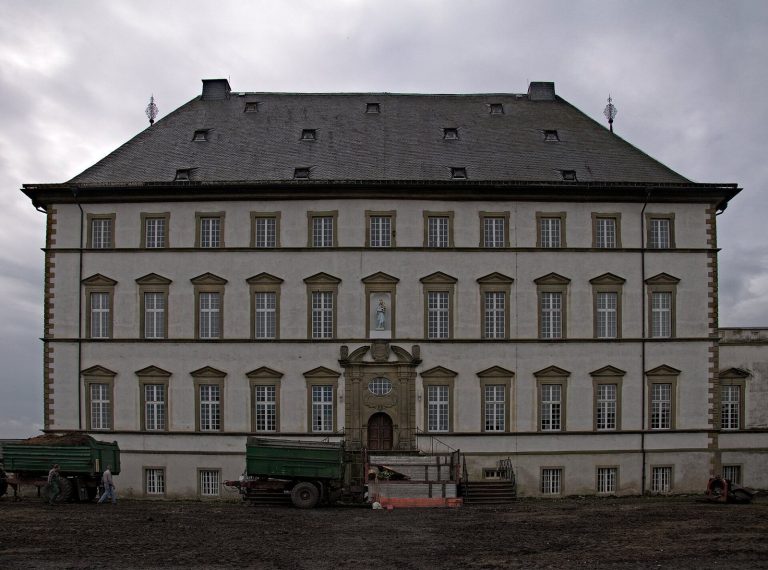
The former palace had a symmetrical, two-storey main block raised on a high base, with two short side wings. Local rubble stone formed its principal building material. Its windows had surrounds, and horizontal projecting bands separated the floors. A slate-covered gabled roof extended over the wings, with chimneys and dormers along the roofline; square corner towers had Baroque domes. A grand entrance portal, reached by steps and framed by pilasters, or shallow column-like projections, displayed the electoral coat of arms above it. An inventory from 1761 lists the elector’s apartment, a dining hall, a billiard room and a chapel, as well as simply furnished upper-floor bedrooms.
Stables and chapel altar
The stables stood south of the palace and formed part of the wing retained after the 1802 demolition. The former stables are among the only surviving parts of the complex. The Hubertus altar from the palace chapel is preserved in the parish church of St. Christoph in Warstein-Hirschberg.
The Hirschberger Tor
Now incorporated into the building complex of the former Wedinghausen Abbey in Arnsberg, the Hirschberger Tor is made of Rüthen sandstone. Its three openings consist of a broad central entrance flanked by two smaller passages. Hunting scenes appear at the top, with further reliefs across the gate. A large electoral coat of arms decorates the right side; on the left, intertwined initials “CA” are surrounded by hunting motifs. Schlaun designed the gate, and sculptor Johann Christoph Manskirch created its sculptural decoration.
On the inner left side, a Latin inscription lists Clemens August’s titles, including archbishop of Cologne and elector, as well as his ecclesiastical offices and territorial titles. A second inscription states that he had the gate built from the ground up and adorned with statues. Its specially emphasized letters, read as Roman numerals and added together, give the year 1753.
A plaque on the exterior commemorates General Beckermann’s failed attack on Arnsberg during the Thirty Years’ War. Its inscription says that Beckermann was driven away on St. Norbert’s night by God’s blessing, amid lightning and rain. Another plaque, added in 1893 for the 250th anniversary of Laurentianum, an academically oriented secondary school, celebrates the school’s flourishing and the work of its teachers and pupils.