Church of the Annunciation of Our Lady of the Newarke: A Lancastrian Collegiate Church in Leicester
Site at a Glance
- Popularity
- High
- Country
- United Kingdom
- Primary era
- Medieval
- Eras represented
- Medieval
- Civilizations
- English
- Site type
- Religious
- Remains
- Church
On this page4 sections
History
The Church of the Annunciation of Our Lady of the Newarke was a collegiate church, served by a college of clergy, founded in 1353 in the southern extension of Leicester Castle’s bailey, or enclosed courtyard, in Leicester, United Kingdom. Henry of Grosmont, the first Duke of Lancaster, established it while enlarging the hospital founded by his father, Henry, 3rd Earl of Lancaster. “Newarke” means “new work,” from the Latin novum opus, and distinguished the church from the older collegiate church of St Mary de Castro. Henry built it to house a fragment of the Crown of Thorns, given to him by John II, king of France. The relic drew pilgrims to the church.
Burials and late medieval history
The church became a burial place for members of the Lancastrian family. Those buried there included Henry, 3rd Earl of Lancaster, and his son Henry of Grosmont; Constance of Castile, the second wife of John of Gaunt and daughter of Peter, king of Castile; and Mary de Bohun, Henry IV’s first wife and the mother of Henry V. Mary died before her husband became king. Mary Hervey, a member of John of Gaunt’s household, died around 1408.
The Frowyk Chronicle and the Ballad of Bosworth Field strongly suggest that Richard III’s naked body was displayed at the church after his death at the Battle of Bosworth Field and before his burial at Greyfriars Priory, a Franciscan religious house.
Destruction
John Leland, a sixteenth-century English antiquary, visited around 1540 and judged the church modest in size but exceptionally beautiful. It was destroyed during the Suppression of the Chantries, part of the English Reformation in which religious foundations established to support prayers for the dead were dissolved.
Remains
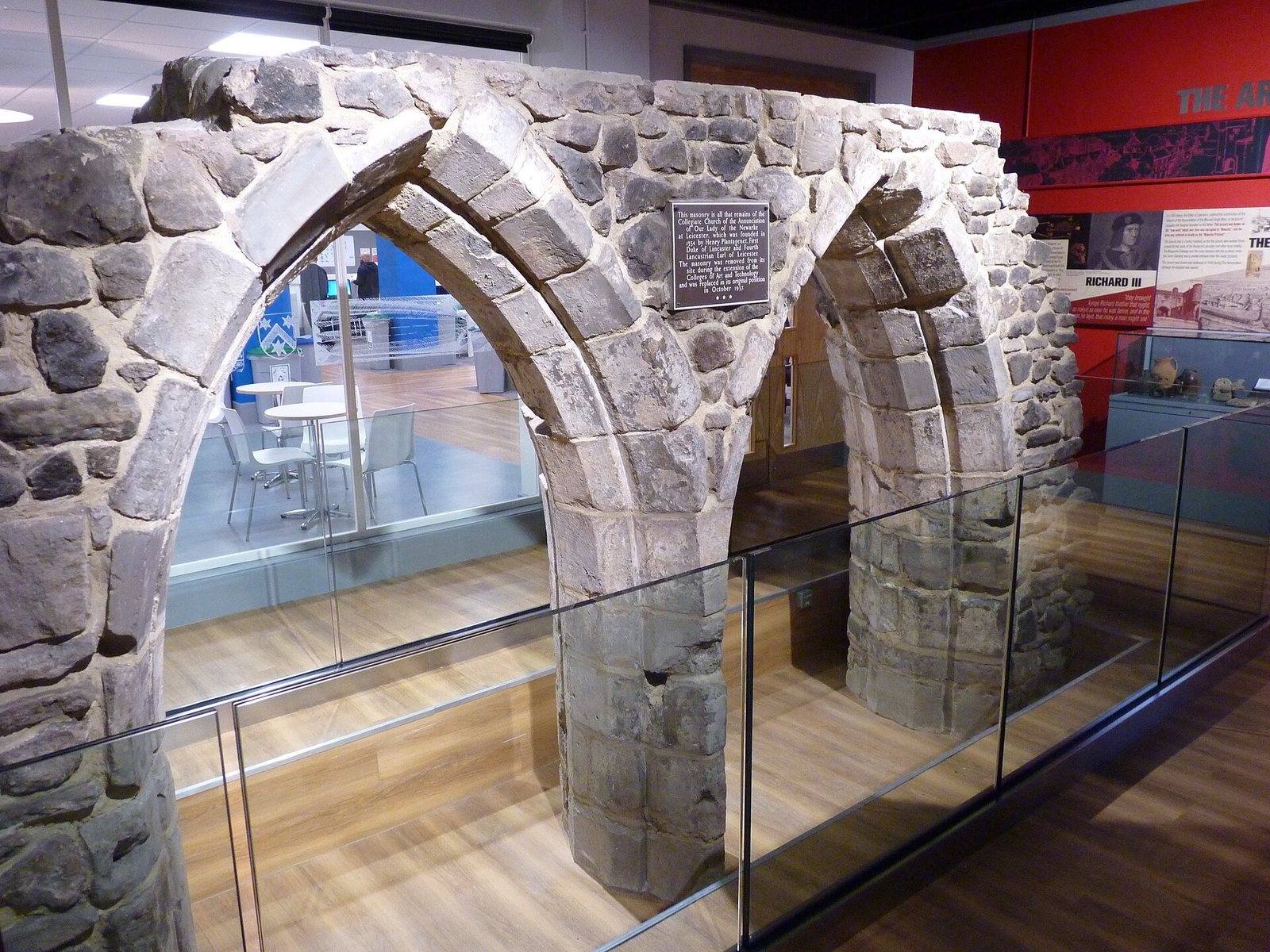
Two arches from the original church survive beneath De Montfort University’s Hawthorn Building. They remain in their original position and can be seen in the university’s heritage centre.
Mary Hervey’s alabaster tomb effigy is now in the chapel of Trinity Hospital, across the road from the church.