Marbach Abbey: An Augustinian Monastery in Haut-Rhin, France
Site at a Glance
- Rating
- 4.2
- Popularity
- Medium
- Country
- France
- Primary era
- Medieval
- Eras represented
- Medieval
- Civilizations
- Holy Roman Empire
- Site type
- Religious
- Remains
- Monastery
On this page11 sections
History
Marbach Abbey was an Augustinian monastery on elevated ground above Obermorschwihr and Vœgtlinshoffen in Haut-Rhin, France. Burckard of Gueberschwihr founded it in 1089, and its Romanesque abbey church was built in the twelfth century. The monastery later became a mother house for religious communities in the Upper Rhine region, Germany, and Switzerland.
Foundation and religious conflict
Burckard, a wealthy ministerial, or dependent noble serving an ecclesiastical lord, gave his fortune to the foundation with support from Manegold of Lautenbach. The counts of Eguisheim also contributed. Burckard obtained public confirmation of the foundation at a provincial tribunal presided over by Count Otho of Habsburg. Gerard, the first count of Vaudémont, and his wife Heilwige gave the community land. In 1092, Count Albert I of Muisal and his wife Ermeneswinde donated an estate near Herrlisheim, along with a share in the right to present a candidate for its parish and part of its church levy.
The house began as a community for both men and women. Its canonesses left in 1124 to found the convent at Schwarzenthann. The monastery lay within the diocese of Basel, although the bishop of Strasbourg held secular authority in the area. Burckard appointed Manegold, formerly prior of Rottenbuch, to lead the community. Manegold introduced Augustinian canons, clergy who lived communally under the Rule of Saint Augustine. Before Marbach’s foundation, he had opposed Emperor Henry IV during the Investiture Controversy, a dispute between the papacy and secular rulers over appointments to church offices. After Manegold’s writings angered Henry, imperial forces plundered the Lautenbach valley and destroyed its monastery. Manegold took refuge nearby and then at Rottenbuch from 1085.
Around 1096, Pope Urban II approved the building of Marbach and authorized Manegold to absolve people formally excluded from church communion for supporting the emperor, if they changed allegiance to the papal side. Knights and other prominent people came to seek this absolution. Manegold also tried to prevent a religious split in Alsace, requiring penitents to reject the rival claimant to the papacy and avoid priests who bought church offices or violated clerical celibacy.
Henry IV’s men captured Manegold at Marbach in 1098. He remained imprisoned until 1103 and died on 24 May that year in mysterious circumstances. On 2 August 1103, Pope Paschal II confirmed Urban II’s letter of protection for the abbey. Its privileges included exemption from church levies on livestock and produce grown by the canons at their own expense, and the right to choose a burial place near the monastery. The community was also to continue its customary church services in penance for bloodshed in the entrance vestibule. Manegold had defended the canons and their property while recognizing the bishop of Basel’s authority over holy oils, altar blessings, and the ordination of priests. Burckard died around 1120, at about ninety years old, and was buried near the abbey church’s choir.
Reform and regional influence
Marbach developed a reform tradition based on the Rule of Saint Augustine as promoted by the monastery of Saint-Ruf in Avignon. Its community practices, called the Consuetudines, reached their definitive form around 1122. In 1117–19, the wider congregation divided into a more lenient branch and a stricter one. Marbach’s customs and church services spread to other houses, and its canons helped establish or reform communities. These included Backnang, Indersdorf, Interlaken, Hördt, Frankenthal, Goldbach, Saint Leonhard in Basel, Schwarzenthann, Saint Arbogast and the Holy Trinity in Strasbourg, and the cathedral church of Lund.
The abbey also fostered historical and artistic work. It produced the Marbach Annals, a thirteenth-century chronicle important to the history of the Staufen, or Hohenstaufen, dynasty of German rulers. Around 1149, Marbach established a workshop for illuminated manuscripts. About 1154, its canon Guta of Schwarzenthann wrote the Codex Guta-Sintram, which the Augustinian canon Sintram of Marbach illustrated.
King Frederick Barbarossa placed Marbach under his protection in 1153, and the abbey maintained close ties with the Staufen royal court. Its congregation dissolved in 1462. Marbach joined the Windesheim Congregation in 1464, a network of religious houses committed to stricter observance, and remained affiliated until 1769.
Growth, property, and financial pressures
Marbach’s land and church-patronage rights provided income but also prompted recurring disputes. Around 1194, Count Ulrich I of Ferrette gave it property at Roggenhusen. In 1220, arbitration settled a dispute with the lords of Hattstatt over the abbey’s rights at Herrlisheim in Marbach’s favor. The same year, the priory was raised to an abbey and its prior received the right to carry a crosier, a pastoral staff representing ecclesiastical authority. Several community members had murdered the provost, the senior clerical officer, in 1214; Abbot Falcon took charge around 1216.
In 1225, the abbot bought property near Koenigshoffen from Ulric of Bollingen for 185 silver marks. He also acquired lands formerly belonging to Meinau Abbey at Allwilre, Soultz, Pulversheim, and Issenheim. The resulting debts led Abbot Hermann to sell those lands in 1242. Conrad Wernher of Hattstatt gave Marbach Langenberg in 1250 in an effort to settle disputes, though the gift later caused further difficulty. In 1224, war had impoverished the community so severely that Berthold of Teck, bishop of Strasbourg, permitted the canons to ask the public for alms.
Later efforts to secure parish income also met resistance. In the late thirteenth century, Abbot Pierre accepted the right to present a candidate for Woffenheim’s parish from Count Thibaut of Ferrette to reduce the abbey’s debts. Werner of Hattstatt had renounced his claim in 1276. The bishop of Basel consented while retaining episcopal rights, and Pope Nicholas IV confirmed the donation in 1292. Werner’s brothers contested it, but an arbitration tribunal decided for Marbach.
Damage, reform, and war
Marbach was pillaged about ten times and suffered fires in 1253, 1290, 1360, 1496, and 1525. The 1253 destruction was severe enough for the bishop of Basel to grant an indulgence, remission of temporal punishment for forgiven sins, to those who contributed to rebuilding. The 1290 fire ruined the convent buildings, while debts delayed their reconstruction. Around 1302, offenders profaned the abbey church, its altars, and its two cemeteries; a bishop acting for the bishop of Basel reconsecrated them in 1348.
Discipline weakened after the time of Manegold and his successor Gerungus, amid poverty and declining observance. The bishops of Basel and Strasbourg sought assistance from other houses in the congregation, and Marbach’s fifteenth-century incorporation into the Windesheim Congregation formed part of these reform efforts. The abbey carried out restoration work in 1496. It rebuilt its chapel of Saint Augustine around 1506, and the chapel was consecrated in 1509.
The abbey cultivated vineyards on clay-limestone soils, with monks from Lucelle Abbey helping during pruning and harvest. Lucelle’s vineyard was marked by boundary stones bearing the letter L and the abbey’s coat of arms. In 1536, Marbach bought the castle called Burgstall for 1,500 florins and repaired and strengthened it. It acquired the convent of Goldbach in 1566, but during the Thirty Years’ War it could not defend the property and ceded it in 1634 to the French marshal Jacques Caumont de la Force. The duke of Lorraine seized Goldbach by deception the following year and held it for about ten years. The Peasants’ War of 1525 and the Thirty Years’ War interrupted Marbach’s rebuilding and modernization and further weakened the abbey.
Suppression and later use
Marbach was suppressed in 1790 and sold at auction on 17 October 1791. The new owner dismantled most of the complex between 1791 and 1806, selling the stone for building material. The church remained intact in 1798 but lost its roof in 1809. Both towers still stood in 1818; the tower toward Gueberschwihr, known as the Abbots’ Tower, had disappeared by 1822, and the other was demolished around 1830.
In 1925, the Catholic organization Avant-garde du Rhin, led by its president Auguste Biecheler, acquired the ruined estate. It developed a holiday center that became a health institution for children considered at risk of tuberculosis. Over several years, thousands of children aged six to fourteen came from across France, cared for by Camillian religious and sisters from the convent of Saint-Marc. As tuberculosis declined after the Second World War, the building was converted in 1968 into an institution for children with difficulties. The former enclosure housed the Auguste-Biecheler institution through the end of 2012.
Publicly funded work from 1986 to 1993 consolidated and restored the surviving narthex, including a partial restoration in 1992. In 1988, the narthex, enclosure wall, gates, and abbey footprint were classified as French historic monuments.
Remains
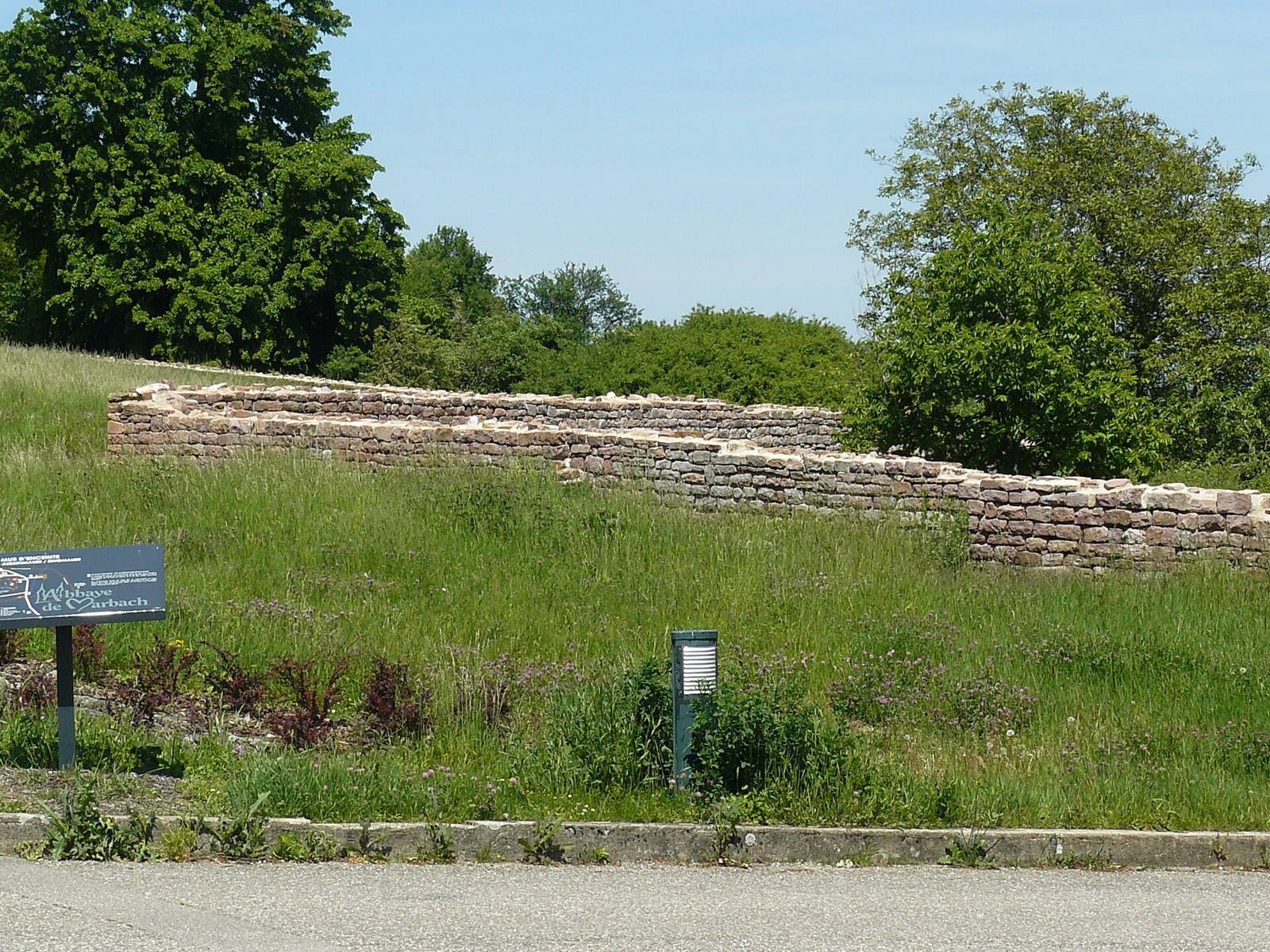
Marbach’s surviving remains occupy elevated ground above Obermorschwihr and Vœgtlinshoffen. The former grounds include the entrance vestibule, sections of the enclosure and gates, a farm, and archaeological traces of the church and monastic precinct.
Church and monastic precinct
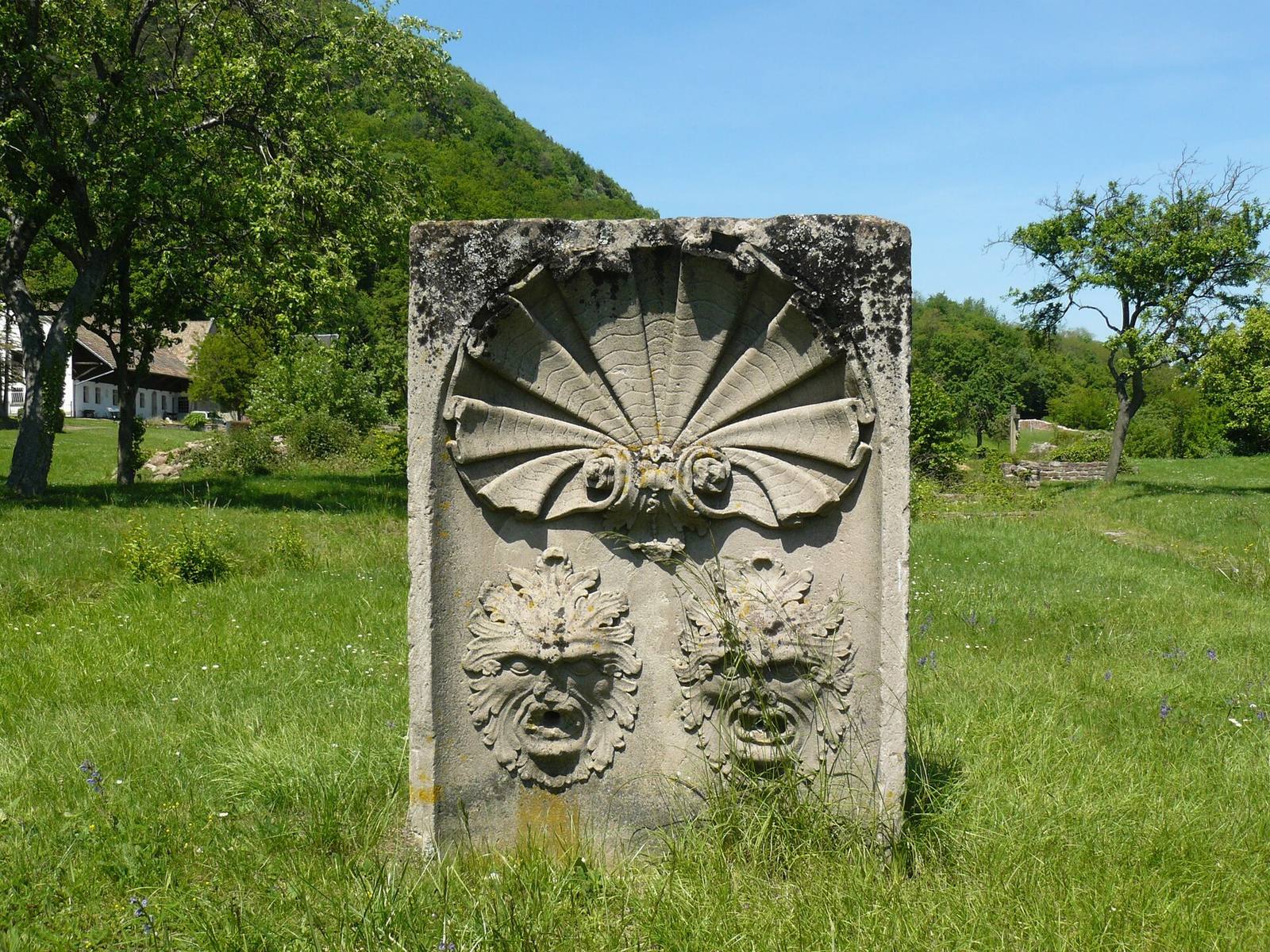
The original foundation was a small square chapel with a single central hall and a rounded sanctuary end. A larger Romanesque church followed in the twelfth century. It measured 65 metres long by 20 metres wide, with two towers beside the choir, the area around the main altar. The church was dedicated to Saint Irenaeus of Lyon, Saint Augustine, and All Saints; it received relics of Saint Irenaeus in 1098. Foundations and fragments of the choir indicate the church’s dimensions and the general outline of the cloister, the covered walk around a monastic courtyard. The former abbey cemetery also survives. A funerary slab came from a sarcophagus that held an abbot’s remains, while fragments of the choir stalls were moved to the Dominican church in Colmar.
Narthex and enclosure
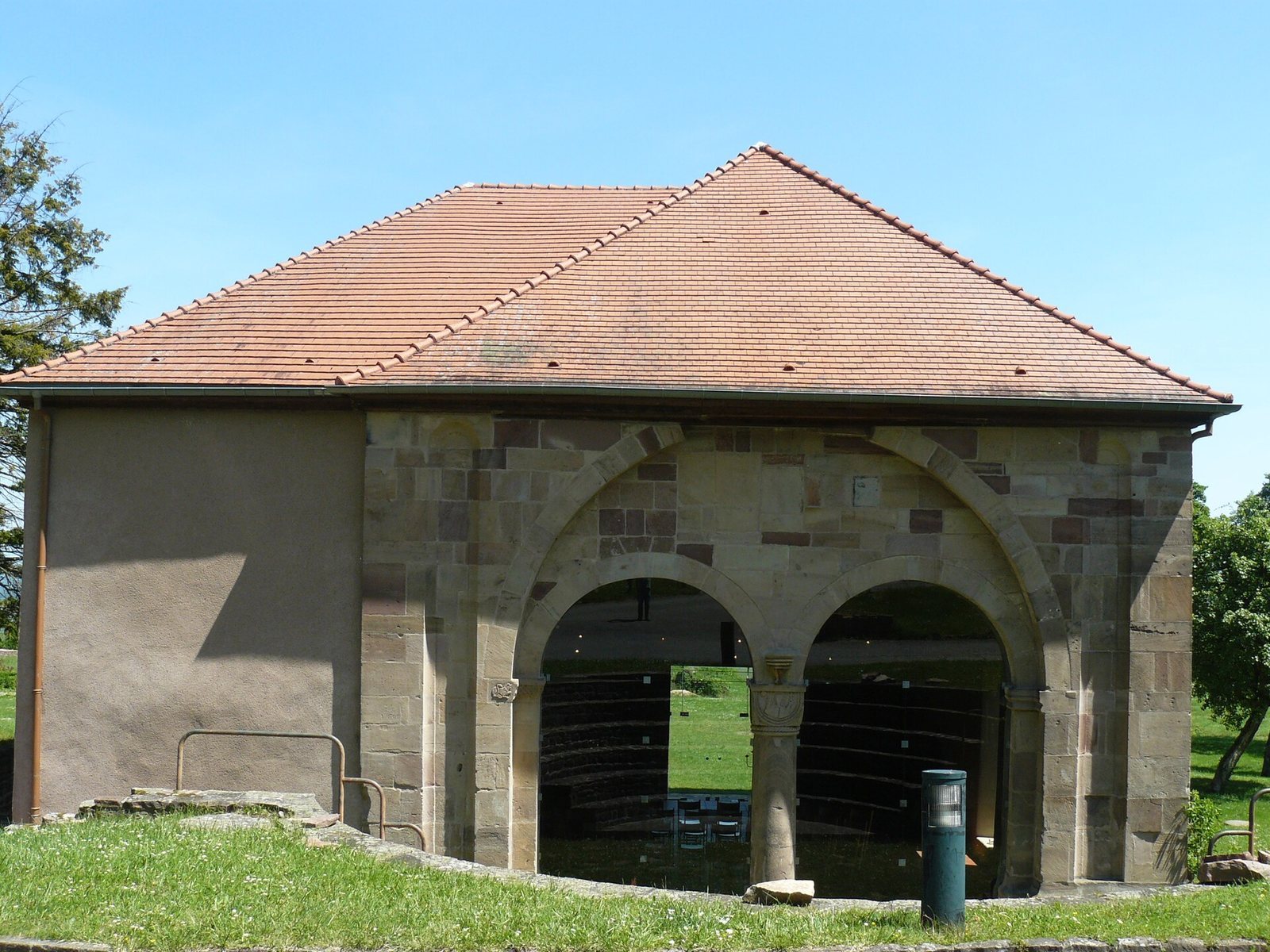
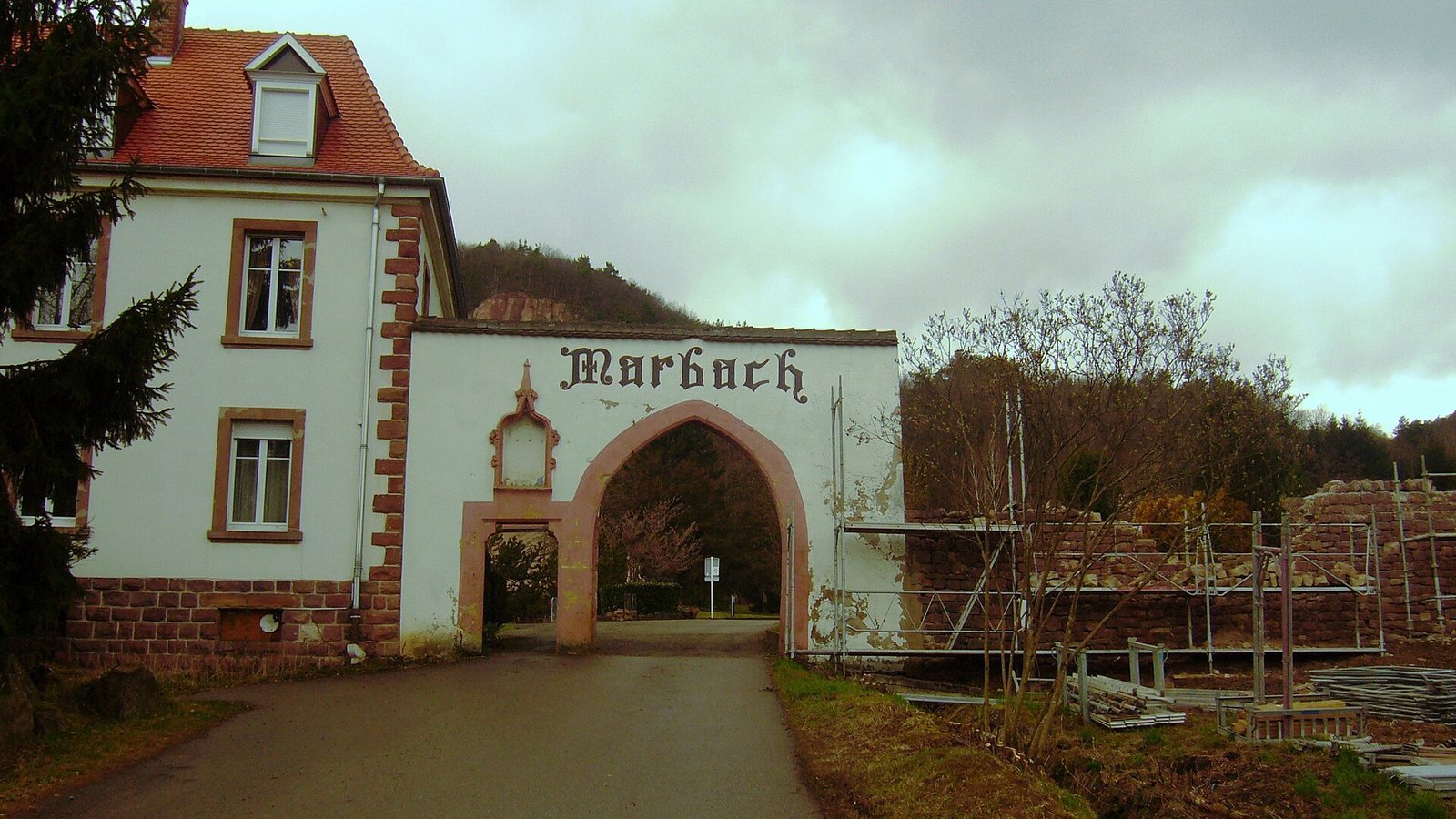
The narthex, an entrance vestibule to the church, was built around 1140. Its three Romanesque arcades, or rows of arches, date to 1152. The open space served catechumens, people preparing for baptism, and sheltered the final stop of the community’s processions. After the church and convent buildings were dismantled, the narthex was used as an inn and later as a quarantine facility. The abbey’s entrance porch dates to 1490. Its enclosure wall, with gates, extends for more than a kilometre and was built over five years, reaching completion in 1496. It is the only surviving enclosure wall of its type in Alsace.
Farm and waterworks
The surviving farm, known as Der Bauernhof, stands within the former abbey grounds. The estate also included fields and orchards, as well as grain and oil mills powered by the Marbach stream. A pond at Buematt regulated the stream’s flow. The farm houses workshops used by youth teams, including for maintenance of the grounds.
Manuscripts and liturgical books
The Codex Guta-Sintram contains material on the Rule of Saint Augustine, a necrology recording community members’ deaths, a homiliary of sermons, advice on hygiene and medicine, and copies of privileges granted to Marbach. It is held at the library of the Grand Seminary in Strasbourg. Another illuminated book from the abbey, an evangelistary containing Gospel readings for church services, is now in the municipal library of Laon.