Pengkalan Kempas Historical Complex: A Tomb and Megalithic Shrine in Malaysia
Site at a Glance
- Popularity
- High
- Country
- Malaysia
- Primary era
- Medieval
- Eras represented
- Medieval
- Civilizations
- Malacca Sultanate
- Site type
- Religious
- Remains
- Tomb
On this page12 sections
History
The Pengkalan Kempas Historical Complex is a historic tomb and stone-monument site in Pengkalan Kempas, Malaysia. Its megaliths, large stones used in human-made monuments, have uncertain ages and purposes, while its Islamic tomb is generally dated to around 1467. The grave is associated with Sheikh Ahmad Majnun, a missionary who preached in the Malacca Sultanate, a Malay Muslim state centered on Malacca. It is considered one of Malaysia’s oldest Islamic graves.
Megaliths and the shrine
The upright stones, or menhirs, are large stones set up as monuments. Their dates and original functions remain unclear. Local tradition places them in the second or third century, while some estimates suggest that certain stones may be at least 1,000 years old. They may have been raised at different times. Across Negeri Sembilan, megaliths have been assigned dates ranging from about 200 years ago to the second century AD. Pengkalan Kempas’s stones are considered likely to be related to examples in the nearby Kuala Pilah and Alor Gajah districts.
The complex occupies a place known as Keramat Sungai Udang, meaning “Prawn River Shrine,” which held cultural importance for nearby communities. People prayed there and swore oaths, practices that continued into the twentieth century. Chinese and Malay communities also celebrated when prayers were answered. A local belief that the stones marked graves was later challenged by excavation.
The tomb and its inscriptions
Inscriptions identify the person associated with the large tomb as an Islamic missionary. They give his name in two forms: Ahmat Majanu in Kawi, an old script used in parts of Southeast Asia, and Ahmad Majnun in Jawi, a Malay script based on Arabic letters. Only the Jawi text uses the title Sheikh. The origins of the names are uncertain. Majanu may be linked to janu, a plant-derived poison, or to a place-name that is no longer known; Majnun may be an Arabic form associated with possession or madness.
The two inscriptions give different dates. The Kawi text uses Shaka year 1385, corresponding to 1463–1464; the Shaka era is a historical calendar system. The Jawi text gives Hijri year 872, corresponding to 1467–1468, and places the inscription during Sultan Mansur Shah’s reign. The Hijri calendar counts years from the Hijra, the migration from Mecca to Medina. The Kawi text concerns Ahmad Majnun’s death, but its meaning is disputed. It has been read as describing treason or an attempted assassination, and also as referring to a plan to rescue princes.
C. Boden Kloss translated the Jawi inscription in 1921. Pieter Vincent van Stein Callenfels’s 1927 transcription of the Kawi text suggested that Ahmad Majnun was executed after trying to assassinate Mansur Shah. Richard James Wilkinson later proposed that a local noble had killed Ahmad Majnun and several tribesmen by mistake. Richard Olaf Winstedt connected Ahmad Majnun to a group of Minangkabau immigrants, a people originating in West Sumatra. That interpretation is considered unlikely because the Kawi text resembles the Minye Tujoh inscription from Aceh, which has no known connection to the Minangkabau.
John Gullick questioned why a monument would honor someone understood to be a traitor. He suggested that rebels might have been allowed to erect one as a gesture of reconciliation, though this did not account for the inscriptions’ differing dates and names. Louis-Charles Damais’s 1968 publication affirmed their dates. In 1980, Johannes Gijsbertus de Casparis proposed that the inscriptions were made at different times, an explanation that could account for both their different dates and name forms. The reason the tomb stands at this particular place is uncertain: it may have been associated with Ahmad Majnun, or the location may already have been sacred.
Archaeological study and heritage
Work at Keramat Sungai Udang began in 1919, when I. H. N. Evans investigated the site. This was the first research devoted specifically to Malaysian megaliths. Excavation found the soil beneath the stones undisturbed, weighing against the belief that they marked graves. Local people told Evans that the shrine had become known only two or three generations earlier. By 1919, natural forest in the area had been replaced by rubber plantations, operated mostly by Chinese and Malay communities.
The complex is registered under Malaysia’s National Heritage Act 2005. Its stones and inscriptions have prompted continuing debate about the age and use of the megaliths, and about the history remembered in the tomb texts.
Remains
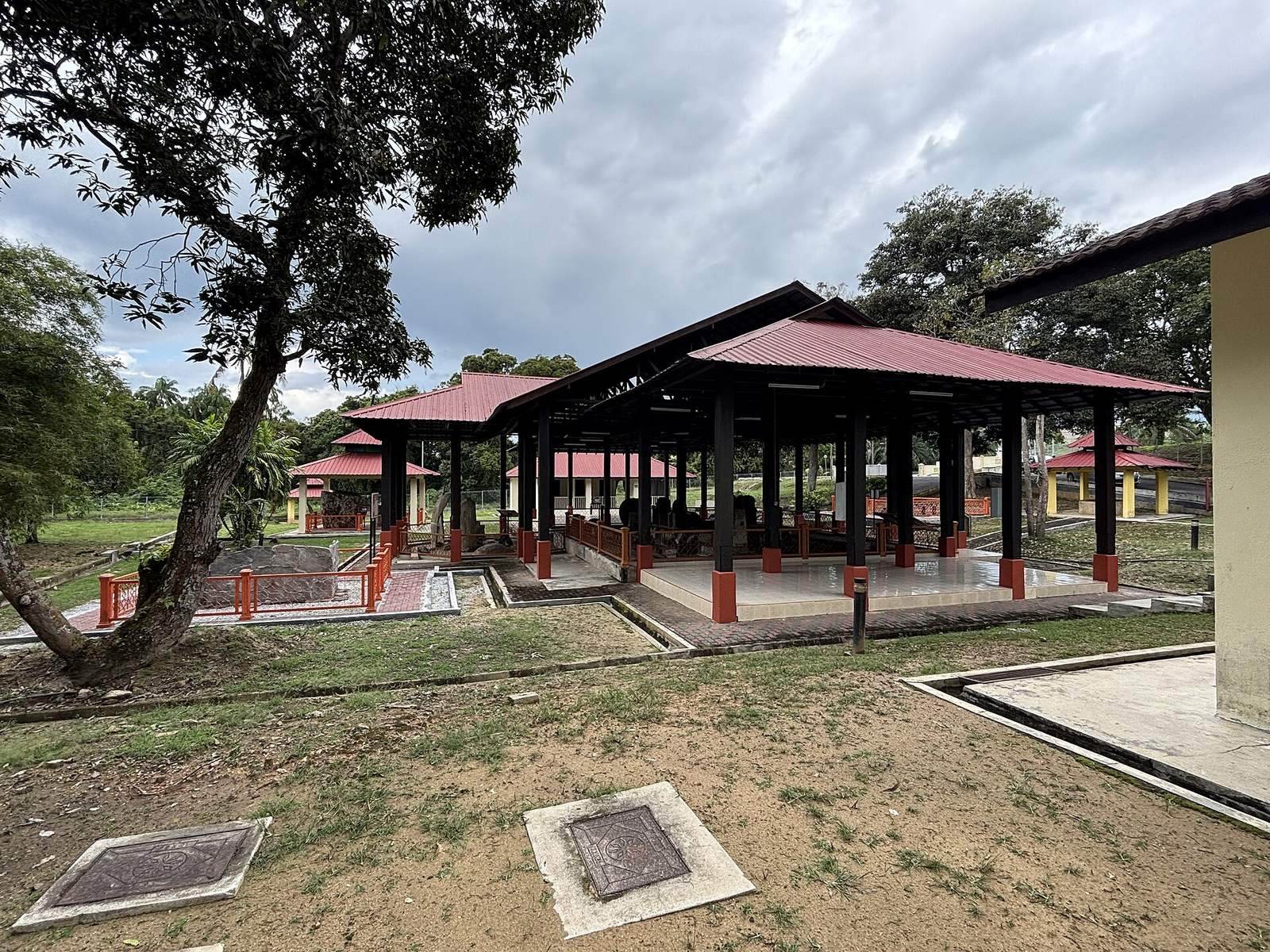
The complex lies in a valley near the Linggi River, on the outskirts of Pengkalan Kempas and about 35 kilometres from Port Dickson. Its central group consists of a large tomb and nearby stones; the wider site also includes a gallery, a surau, or small Muslim prayer space, and stones brought from elsewhere, including donated megaliths.
The tomb and central stones
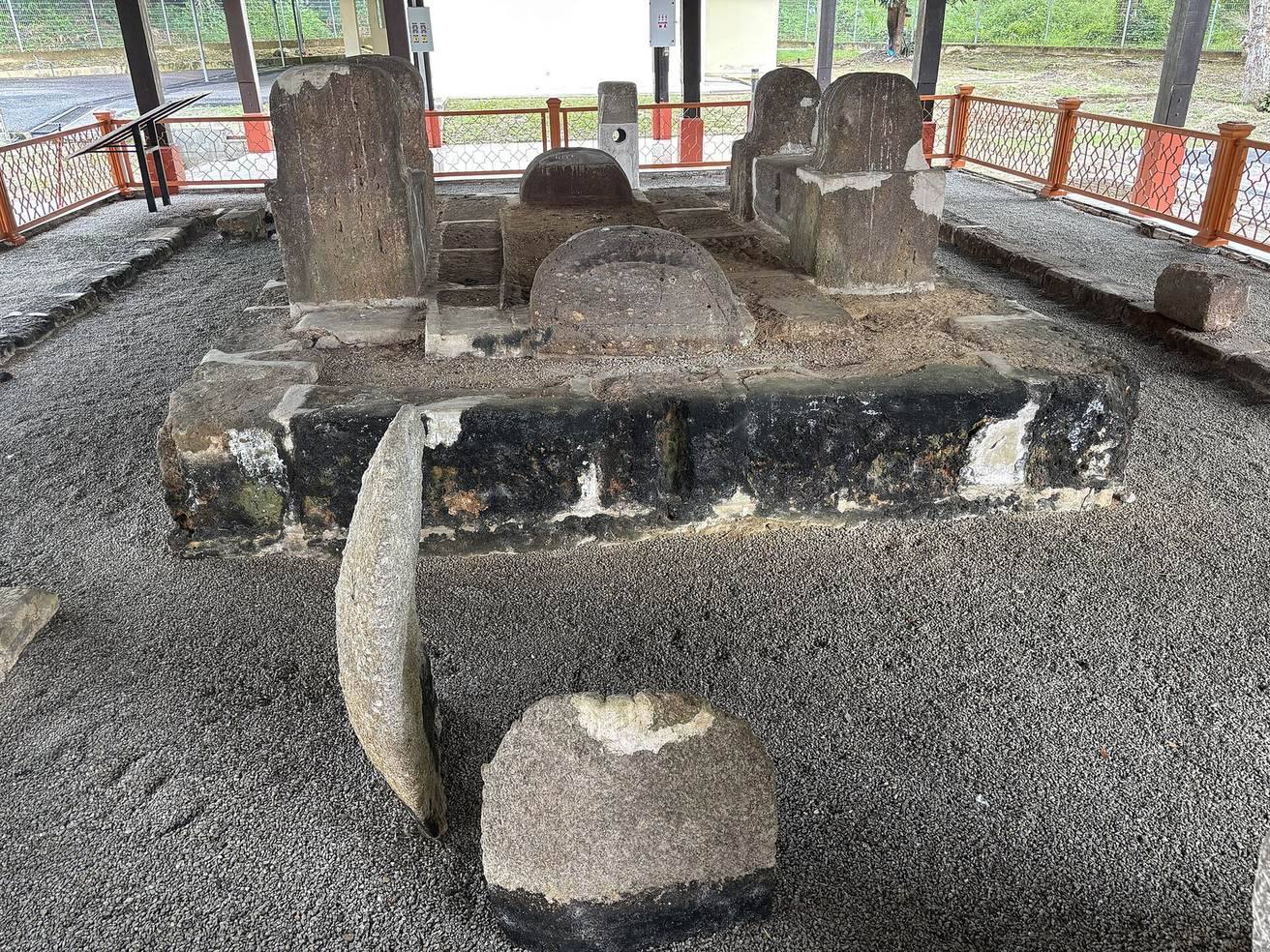
The tomb and inscribed stone
The large tomb stands close to the principal group of three granite menhirs. Its inscribed marker is made of sandstone not found locally. Raised writing appears on all four sides: the east and west faces carry the same Jawi text, while the Kawi text is divided between the north and south faces, with the north portion coming first. The Jawi inscription invokes God’s blessing for the deceased; the Kawi text does not describe the tomb itself.
A hole about the size of an arm passes through the stone below the Kawi text. It may have been cut to carry the marker on a pole, perhaps after the Kawi inscription was made. De Casparis suggested that the stone may first have belonged to a larger structure before being moved and reused for a later burial. In this interpretation, the inscriptions reflect a change in how Ahmad Majnun was remembered, from warrior to respected saint.
The three principal menhirs
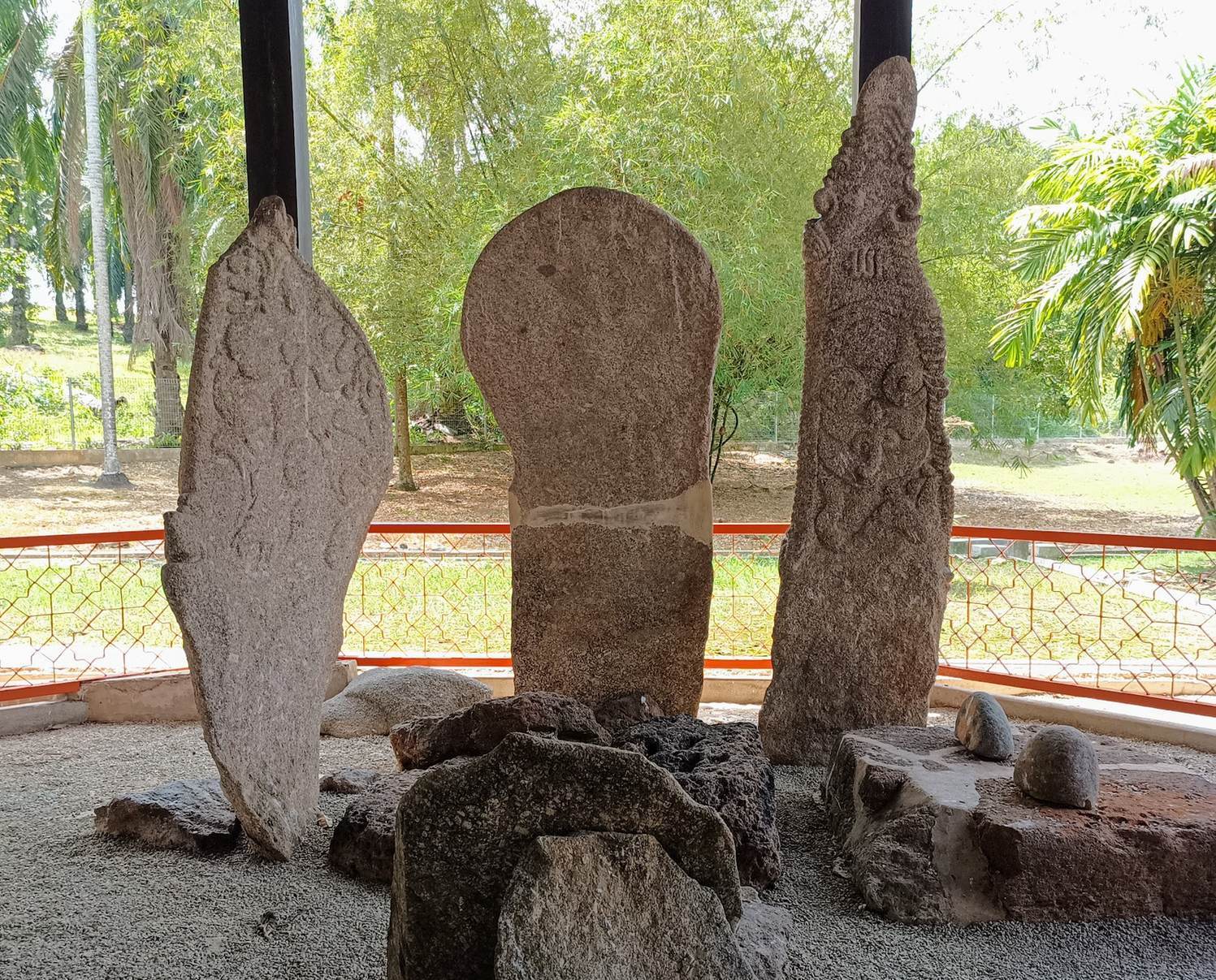
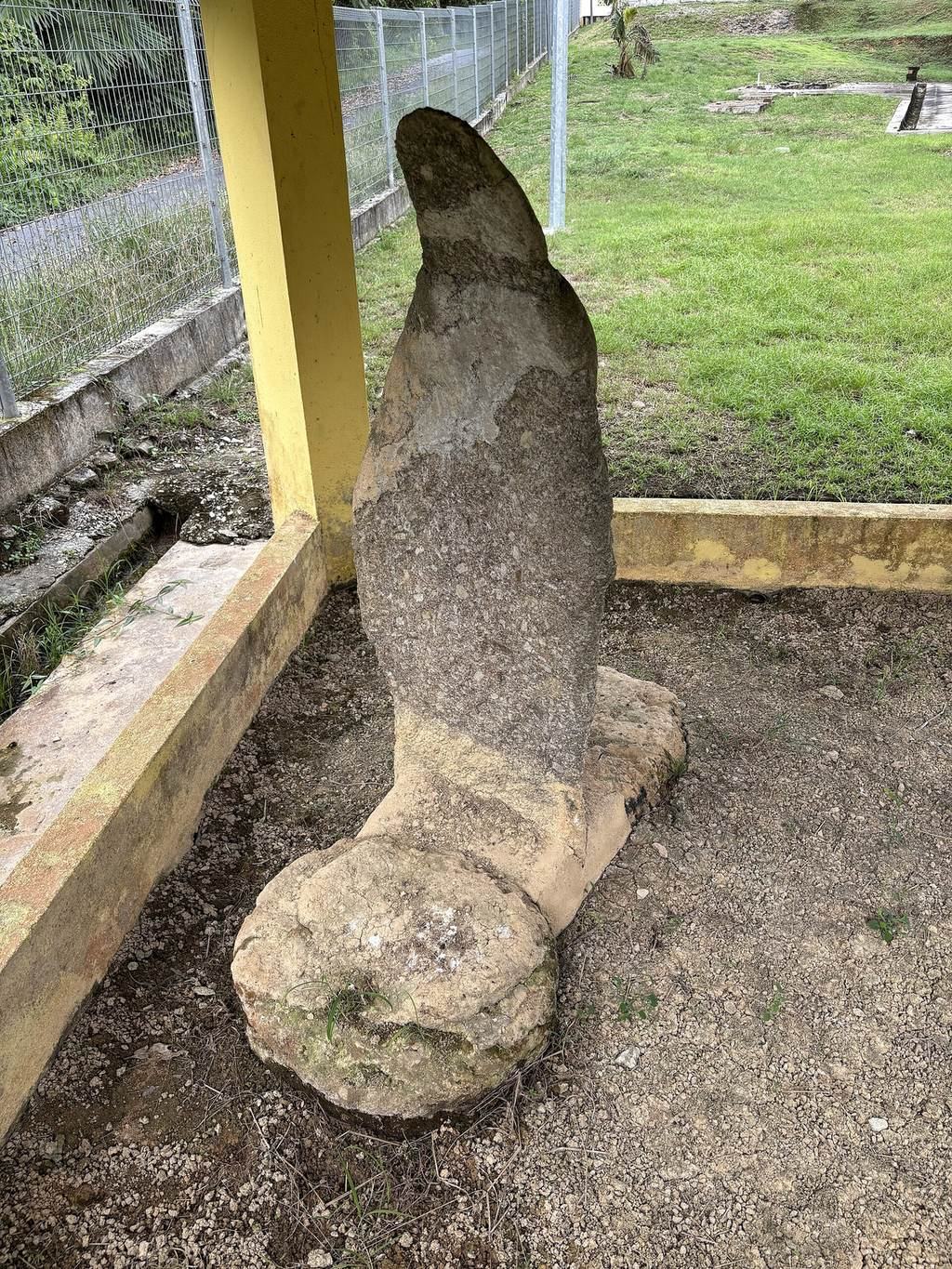
The three granite stones stand close together in a row, with the spoon-shaped stone between those traditionally likened to a rudder and a sword. Local tradition identifies them as the buried saint’s rudder, spoon, and sword; they have also been interpreted as traditional symbols of leadership. The rudder stone bears carvings of plants, the sun, a peacock, and a horse. The spoon stone is undecorated and may once have split in half after a tree fell on it.
The sword stone carries a sun, geometric designs, and the word Allah in raised Jawi lettering. Its carvings may also include a bearded man, compared with figures on a kris, a traditional Southeast Asian dagger, and a naga, a serpent-like figure in South and Southeast Asian traditions. If the word Allah was carved at the same time as the other designs, the stone suggests that animist beliefs, which associate spiritual forces with natural beings or objects, and Hindu artistic elements continued after Islam arrived. The word may, however, have been added later.
The circular shield stone
A separate, large circular stone near the tomb is traditionally identified as a shield. Shallow geometric designs cover one side. Tradition links this stone with the shield among the objects attributed to the buried saint.
Other stones and excavation finds
Scattered stones and a paired feature
Stones of different sizes occur in several parts of the site. At least 15 other large carved stones were probably scattered around the area in 1919, when surveyor W. A. Wallace mapped its condition. A small rock lies opposite the central spoon menhir in a position resembling stone pairs found in the Kuala Pilah and Alor Gajah districts. This pair runs northwest to southeast, unlike the usual north-to-south orientation of comparable pairs.
A separate group away from the tomb includes an isolated large menhir. A Chinese rubber worker damaged it, and Evans later reconstructed it. Some stones may have shifted from their earlier positions during the restoration work.
Excavated material
Finds from the 1919 excavation included granite and laterite stones, ceramics, celadon, glass, stone tools, and coins. At the time, part of the excavated area was swampy and underwater.