Fort du Trou-d’Enfer: A Nineteenth-Century Fort in the Defenses of Paris
Site at a Glance
- Rating
- 4.1
- Popularity
- Medium
- Country
- France
- Primary era
- Modern
- Eras represented
- Modern
- Civilizations
- French
- Site type
- Military
- Remains
- Fort
On this page13 sections
History
Fort du Trou-d’Enfer is a French military fort at Marly-le-Roi, France, constructed from 1878 to 1881 as part of the defenses around Paris. Built by Stractman, a public-works company from Belfort, it belonged to the Séré de Rivières system, a late-nineteenth-century network of French forts and other defenses developed under military engineer Raymond Adolphe Séré de Rivières.
This defensive program followed France’s defeat in the Franco-Prussian War and the partial occupation of the country in 1870. It also responded to the borders imposed in 1871. The fort was planned for a garrison of almost 800 soldiers.
Part of the defenses of Paris
Paris’s defensive network included 18 forts, five detached defensive works called redoubts, and 34 gun batteries, constructed from 1874 to 1881. Fort du Trou-d’Enfer worked with six nearby batteries, at Noisy, Marly, Auberderie, Champ de Mars, Réservoirs, and des Arches, to form the fortified position of Marly. The fort was also called the Réduit du Trou-d’Enfer, or Trou-d’Enfer strongpoint, a defensive core within a larger position. Its name came from the nearby Trou-d’Enfer Farm.
Modernization proposals under programs adopted in 1900 and 1908 included rebuilding with special concrete, but those plans were not carried out.
War and postwar history
German troops occupied the fort during the Second World War. As they withdrew in August 1944, they detonated ammunition at the site, damaging the fort. A fire that year also damaged part of the troop barracks.
In 1962, OAS members Albert Dovecar and Claude Piegts were executed at the fort after being sentenced to death for the assassination of Algiers’s central police commissioner. The OAS was a clandestine French armed organization opposed to Algerian independence. The fort was demilitarized in 1966.
Later use and protection
The fort hosted presidential hunts until they ended there in 1995. It is now owned by the French National Forests Office (ONF), which operates a pheasant hatchery on the site for the grounds of a nearby French presidential retreat.
The wider Trou-d’Enfer site has been a protected natural site since 1938, and two of its heritage features are listed as historic monuments. The association Les Amis du Site du Trou d’Enfer (ASTE) works to preserve and enhance the area.
Remains
The fort
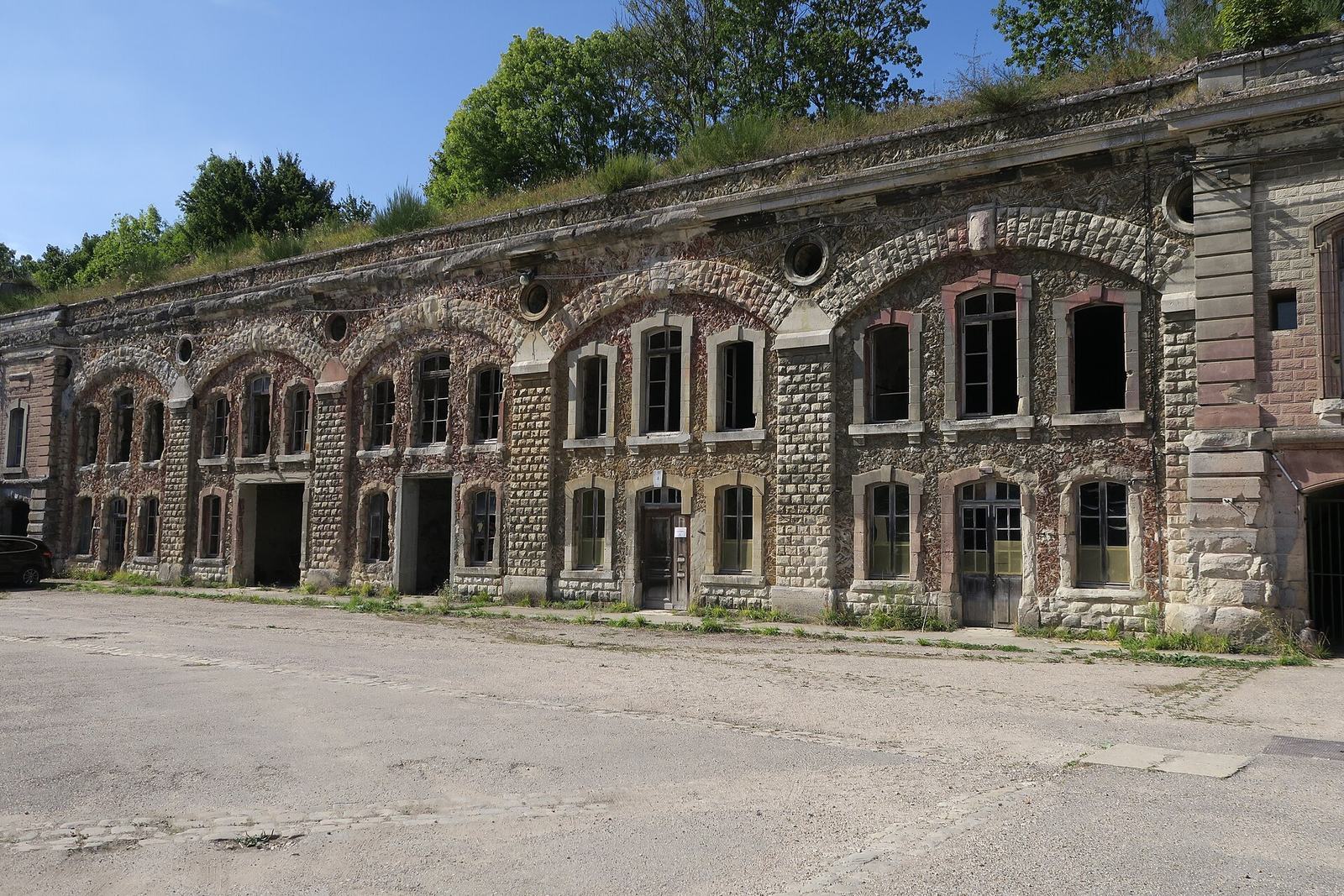
Built of stone and brick, the fort is organized around an entrance reached across a movable bridge, with the troop barracks and courtyards beyond. Defensive positions protected the entrance and ditches, while powder magazines and artillery served the garrison.
Entrance and ditches
The movable bridge retains its wooden deck and some mechanical parts. Protected gun positions set into the main wall covered the entrance and rear ditches. Caponiers, protected structures designed to fire along ditches, provided further defense.
Barracks and magazines
The upper-level troop barracks is divided into ten bays, or structural sections. Its ends give access to separate courtyards and to powder magazines with a combined capacity of 200 tonnes. A small officers’ barracks stood in the courtyard on the right. The troop barracks remains in good condition overall.
Water and artillery
The fort’s well could supply 5,000 litres of water per day. Its armament comprised 40 artillery pieces: 23 guns mounted on the ramparts, seven mortars, and ten guns arranged for fire along the fort’s flanks.
The wider site
The Trou-d’Enfer site covers about 280 hectares within Marly’s former royal hunting grounds. Its features include structures from periods before the fort was built.
Telegraph tower and bridge
A Chappe telegraph tower on the site dates to 1793. The Chappe system sent signals between towers using movable visual arms. A swing bridge elsewhere on the site dates to the seventeenth century.
Farm and aqueduct
An active farm on the site traces its origins to 1675, and the property also includes the Rocquencourt aqueduct.
Poirier fountain
A fountain associated with the Poirier couple has also been placed at the site temporarily for several years.