Hwanhaejangseong: Jeju’s Coastal Defense Wall
Site at a Glance
- Popularity
- High
- Country
- South Korea
- Primary era
- Medieval
- Eras represented
- Medieval, Modern
- Civilizations
- Goryeo
- Site type
- Military
- Remains
- Wall
On this page7 sections
History
Hwanhaejangseong is a coastal fortification on Jeju Island, South Korea, begun in 1270 during the Sambyeolcho Rebellion. The Sambyeolcho were military forces rebelling against Goryeo, the Korean dynasty that ruled from 918 to 1392. Goryeo defenders began the wall, and the Sambyeolcho probably extended it as part of the island’s defenses.
Construction during the rebellion
After the Sambyeolcho captured Jindo, Goryeo sent troops to Jeju to protect its coast. Led by General Go Yeorim, who had previously fought the rebels on Jindo, the defenders first built a wall from Hwabuk east through Jocheon to Hamdeok. The Joseon-era geographical gazetteer Sinjŭng Tongguk yŏji sŭngnam gives a force of 1,000 for the coastal works, a figure that may have included as many as 730 Jeju residents. The Goryeosa, a history of Goryeo, describes groups of about 200 and 70 soldiers.
Goryeo forces arrived around mid-September 1270, but the Sambyeolcho captured Jeju in mid-November, making it unlikely that the government troops completed the whole wall. After landing at Myeongwol and Jocheon and defeating the Goryeo defenders, the rebels probably extended the defenses. They likely began a coastal wall from Myeongwol east to Gonae, then expanded the system to cover six important ports between December 1270 and May 1273. This work accompanied improvements to ports and roads and construction of Hangpadu Fortress. The Sambyeolcho were defeated in 1273.
The wall was intended to hinder landings and give defenders chances to ambush boats approaching shore. A barrier along the coast may also have helped protect settlements on flat ground that was difficult to defend, while reducing salt carried inland by the wind to coastal farms. The system followed a layered approach also used on Ganghwa Island, where coastal walls had been built earlier. Hwanhaejangseong may later have influenced Japan’s Genkō Bōrui, coastal defenses built after the Mongol invasions to guard against further attacks by sea.
Continued use and rebuilding
The wall remained in use during the Joseon period, from 1392 to 1897, and was maintained and possibly extended as a defense against foreign ships, including Japanese pirates. Jeju faced more than 30 pirate incursions between the 13th and 16th centuries. The wall was also called the Great Wall of Tamna, a comparison with China’s Great Wall. The name Hwanhaejangseong first appeared in Tamna Ginyun in 1918 and became common afterward.
In 1845, Jeju’s governor ordered repairs after the British ship HMS Samarang appeared offshore and surveyed waters near Udo for 40 days. Some surviving sections probably include repairs made about five months after the ship left, and new stretches may also have been built on Udo. Repairs may have continued until 1854.
Road building and conservation
Construction of Jeju’s coastal ring road in the 1970s and other coastal roads in the 1990s caused extensive damage to the wall. Restoration began in 2001. The remaining sections received provincial monument status in 1998, after much of the damage had already occurred; the designation was revised in 2021.
Remains
The wall once extended along much of Jeju’s coast, and its full length may have reached 120 kilometres. Another estimate describes a length of 300 li, a traditional East Asian unit whose value varied by place and period. If accurate, that distance would cover about half the island, which was described as 200 li by 120 li.
Construction and form
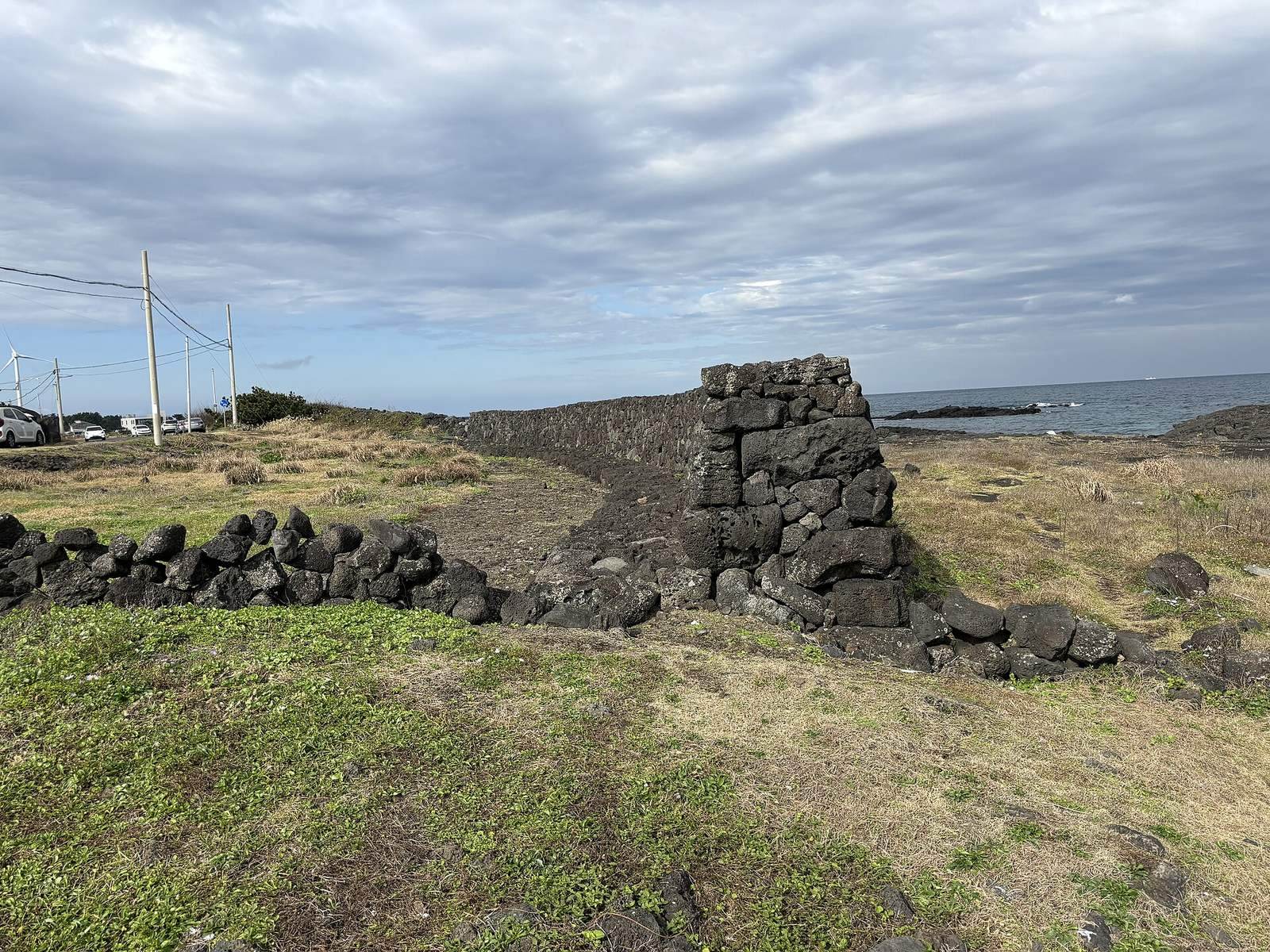
Builders used local basalt and techniques similar to those used for Jeju’s stone boundaries around homes and fields, as well as walls from the Tamna period, when Tamna was a historical polity associated with Jeju. The wall’s profile and slope vary with the terrain and local stone. It averages about two metres wide and three metres high, with some sections reaching four metres in width. Some stretches have multiple layers; in places with two parallel walls, the seaward-facing wall is higher. Openings in some sections allowed defenders to shoot bows or firearms.
Surviving stretches and condition
Wall sections survive in at least 14 areas, though wider estimates put the number of surviving areas at 19 or 28. Ten separate stretches together measure 5,120 metres. The Onpyeong stretch is the longest at 2,120 metres and can be divided into four smaller sections; other remains lie beyond these stretches. The authenticity of part of the Gonneuldong section is disputed, and in some places the fortification is difficult to distinguish from other stone boundary walls. Limited knowledge of the original building methods has complicated repairs. Some reconstruction has been criticized for departing from the earlier design, and one restored section follows a different alignment. Fish farming, stone towers built by visitors, typhoons, and other storms have also damaged the remains.