Colcombe Castle: A Courtenay Family Seat in Devon
Site at a Glance
- Popularity
- Medium
- Country
- United Kingdom
- Primary era
- Medieval
- Eras represented
- Medieval, Early Modern
- Civilizations
- English
- Site type
- Domestic
- Remains
- Manor House
On this page10 sections
History
Colcombe Castle was a residence of the Courtenay family near Colyton in East Devon, England. Their principal seat was Tiverton Castle, but Colcombe became a home for several generations of the Earls of Devon. Its first mansion is attributed to Hugh de Courtenay, 1st Earl of Devon, and dates to the reign of Edward I (1272-1307). In the fifteenth century, the site’s proximity to Shute, the home of William Bonville, 1st Baron Bonville, contributed to a bitter feud that culminated in the Battle of Clyst Heath in 1455.
The Courtenay Manor
At the Norman Conquest, the manor belonged to the Crown. William the Conqueror granted it to Robert de Mount Chardon; Henry II later reclaimed Colcombe and Whitford and granted them to Alan Dunstanville. Alan’s son Walter arranged for the estate to pass to his nephew Thomas Bassett through marriage, with King John’s consent. Thomas’s daughters inherited the property. Joan married Reginald Valletort and later William Courtenay, while Alice married Thomas Sanford and then John Bissett. Alice’s share was eventually bought by Hugh de Courtenay, 1st Earl of Devon, bringing Colyton and Whitford into the earls’ holdings.
Hugh de Courtenay, 2nd Earl of Devon, established a chantry at Colcombe in 1348. A chantry was an endowed religious foundation intended to support prayers or services for the dead. He dedicated it to St John and provided it with lands, including property in Colyton. The foundation’s name lived on in Chantry Bridge and Chantry Meadow; by 1888, the meadow was used as a play area by children from the town.
Thomas de Courtenay, 5th Earl of Devon, used Colcombe while his widowed mother lived at Tiverton Castle as her dower house, a residence set aside for a widow from her husband’s estate. The family’s rivalry with Bonville was intensified by the closeness of his home at Shute to Colcombe. Their territorial conflict reached its climax at Clyst Heath in 1455.
Tudor and Pole Ownership
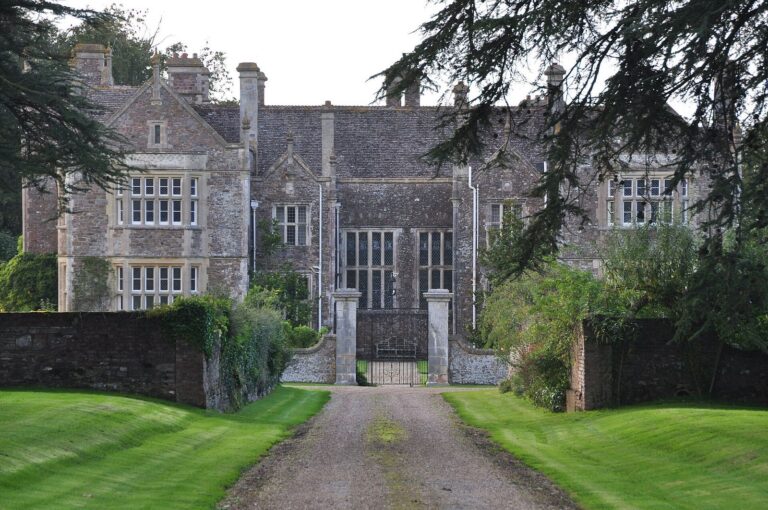
Henry Courtenay, 1st Marquess of Exeter and 2nd Earl of Devon, rebuilt the mansion on a grand scale. Following his attainder, the legal forfeiture of rights and property after conviction for serious offences, and his execution, Colcombe reverted to the Crown. Mary I restored it, along with other lands, to Henry’s son Edward Courtenay, 1st Earl of Devon. After Edward’s death, the manor and house passed to heirs descended from his four great-aunts and were sold. The estate was divided, with one share held by Lord Petre and the other acquired by Sir John Pole and Sir John Drake.
After the Courtenays’ downfall, Walter Erle bought the chantry and its lands from the Crown. In 1543 he received the posts of bailiff and hayward, an officer responsible for fields and livestock, for the manor and hundred of Colyton, as well as the keepership of Colcombe Park and mansion. Catherine Parr granted him a 40-year lease of Colcombe in 1546.
William Pole acquired part of the estate, and his son, the antiquary Sir William Pole, bought the remaining shares from the Courtenay heirs and rebuilt the house. Sir William lived mainly at Shute until 1618. His son John, later the 1st Baronet Pole, occupied an earlier building at Colcombe. In 1618 father and son exchanged homes: Sir William moved to Colcombe and undertook further rebuilding. He died there in 1635.
Civil War and Later Fortunes
During the English Civil War, the conflict between supporters of the Crown and Parliament, Colcombe served in 1644 as the headquarters of Prince Maurice, a Royalist commander. He used it as a base for an attack on Stedcombe, where Sir Walter Erle was sheltering Parliament’s troops. The castle was almost entirely destroyed in the fighting and fire. The blaze also consumed many volumes of Sir William Pole’s history of Devon, including substantial additions made by his son. After the war, part of the property was rebuilt as a farmhouse across a lane.
Colcombe appears to have left the Pole family after the time of the 1st Baronet. Sir John de la Pole, 6th Baronet, later bought it back, possibly from Sir George Yonge, from whom he acquired several large properties in 1790. He intended to build a grand house inspired by Henry Courtenay’s mansion, but died before beginning the work. His will directed his heirs to provide his widow with a substantial house and suitable outbuildings, with at least five acres in Colcombe Park. The plan was probably not carried out; his widow spent her final years at Lindridge House near Plymouth, caring for her sick brother. By the late eighteenth century, Devon historian Polwhele described Colcombe as ruinous.
Remains
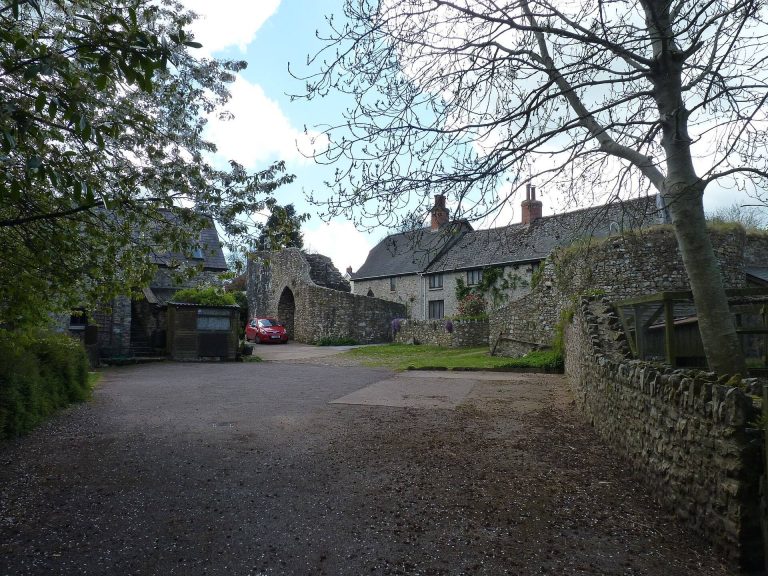
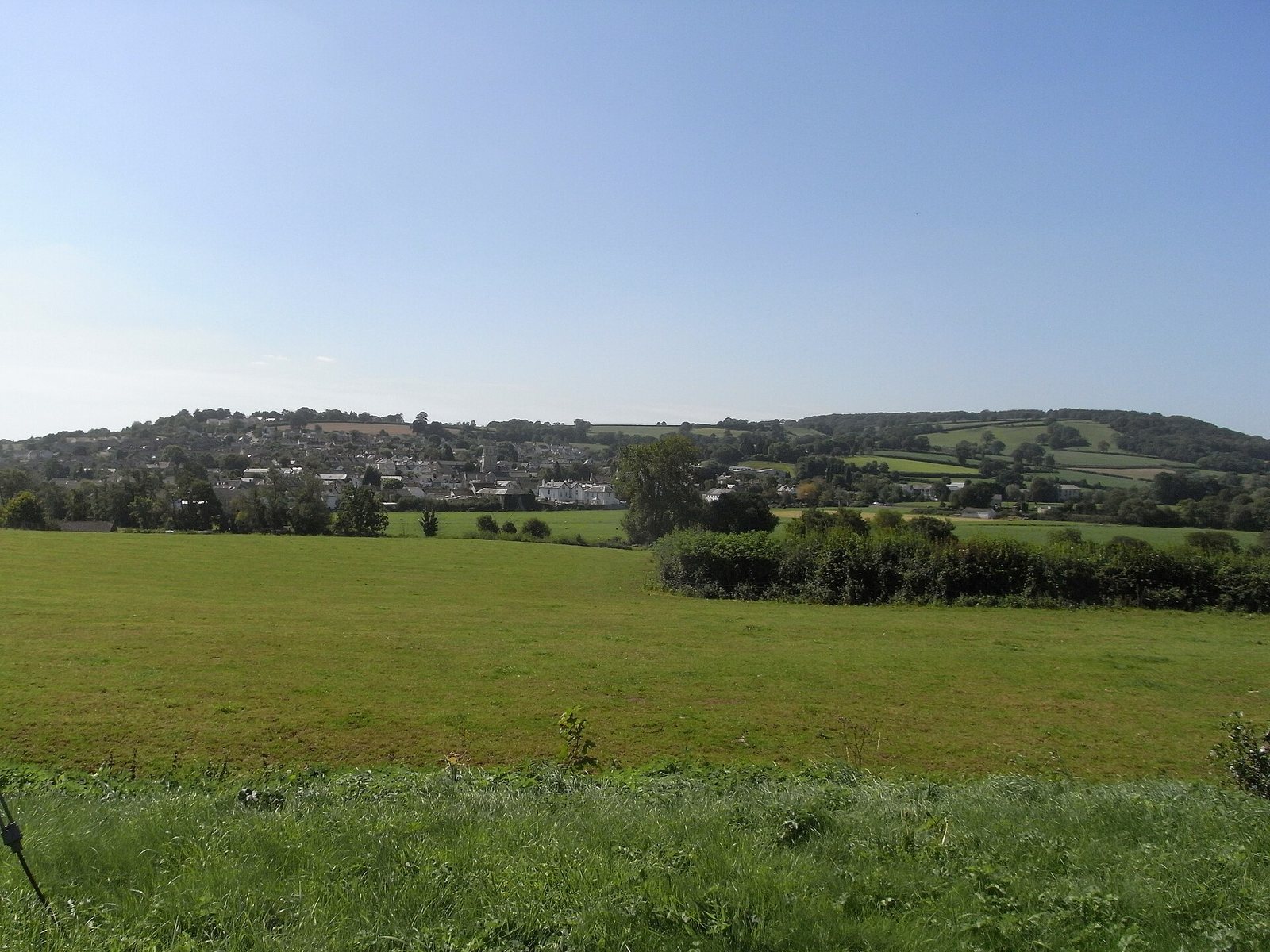
The site lies about half a mile north of Colyton, on a terrace above a shallow valley. Colyton stands on the low hill opposite. A farmhouse and agricultural buildings now occupy the former mansion site. The surviving features and early descriptions offer glimpses of the buildings and landscape, although the name Colcombe Castle does not establish that the house was fortified.
The Mansion Site
Farm and Early Building
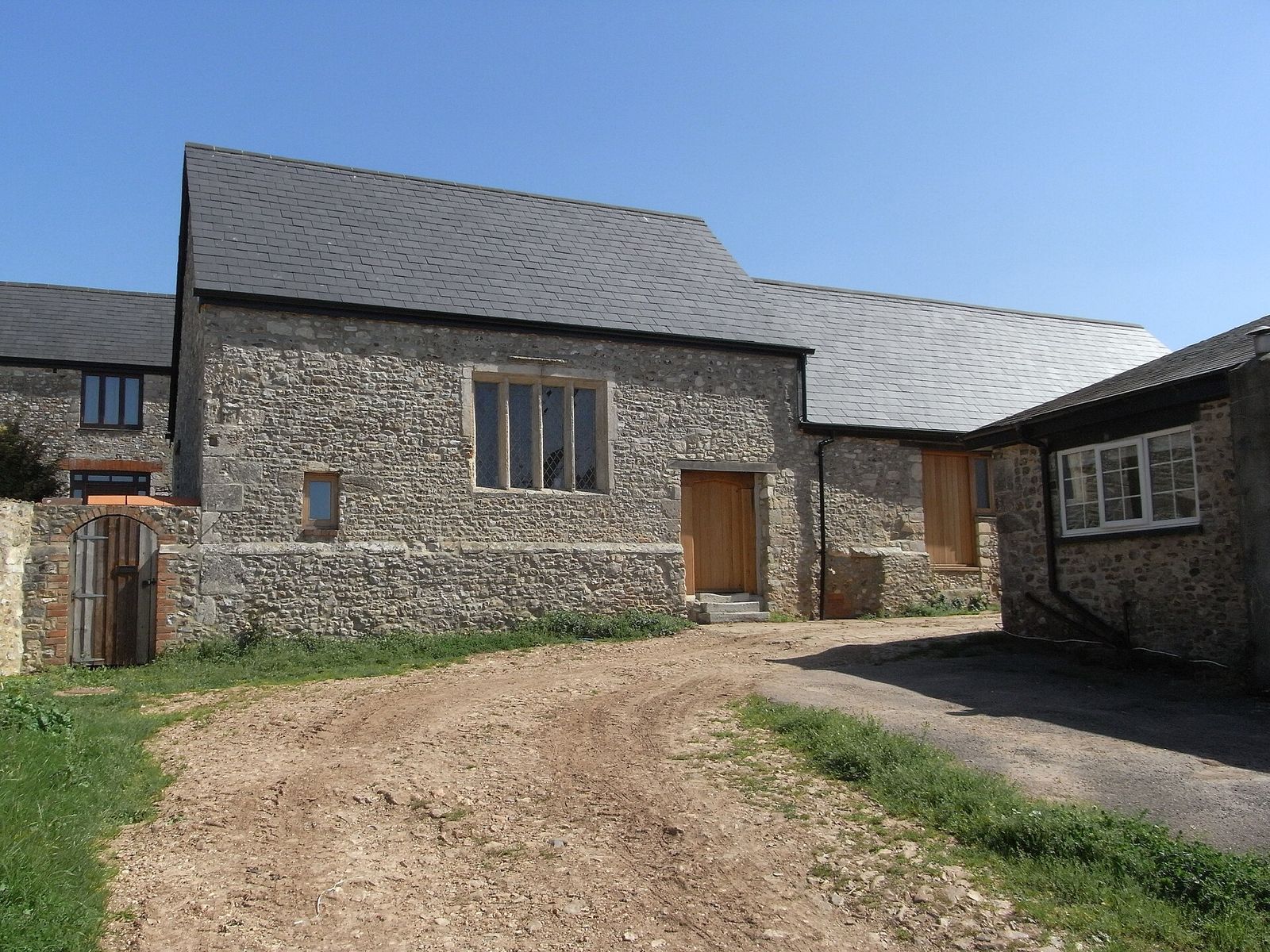
The present farm is known as Colcombe Abbey Farm. One small building, now converted into a house, retains signs of early construction, including a stone window divided by vertical supports. W. G. Hoskins described a large kitchen inside, with a fireplace nearly 20 feet across and a private room above. These features have been associated with the house’s surviving early fabric.
Water Channel and Bridge Window
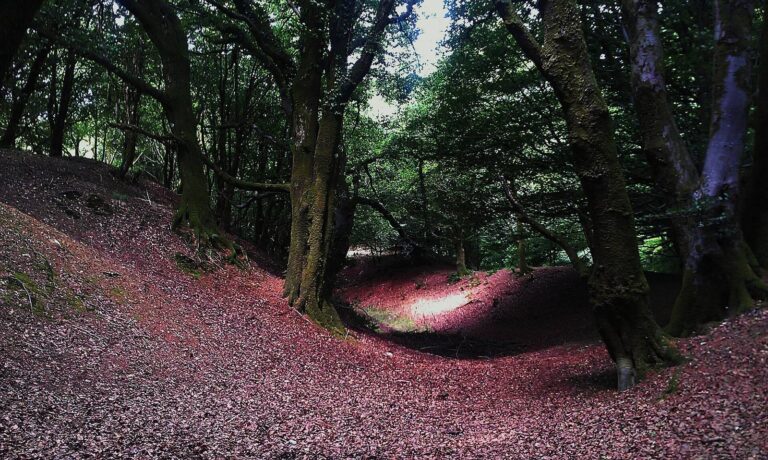
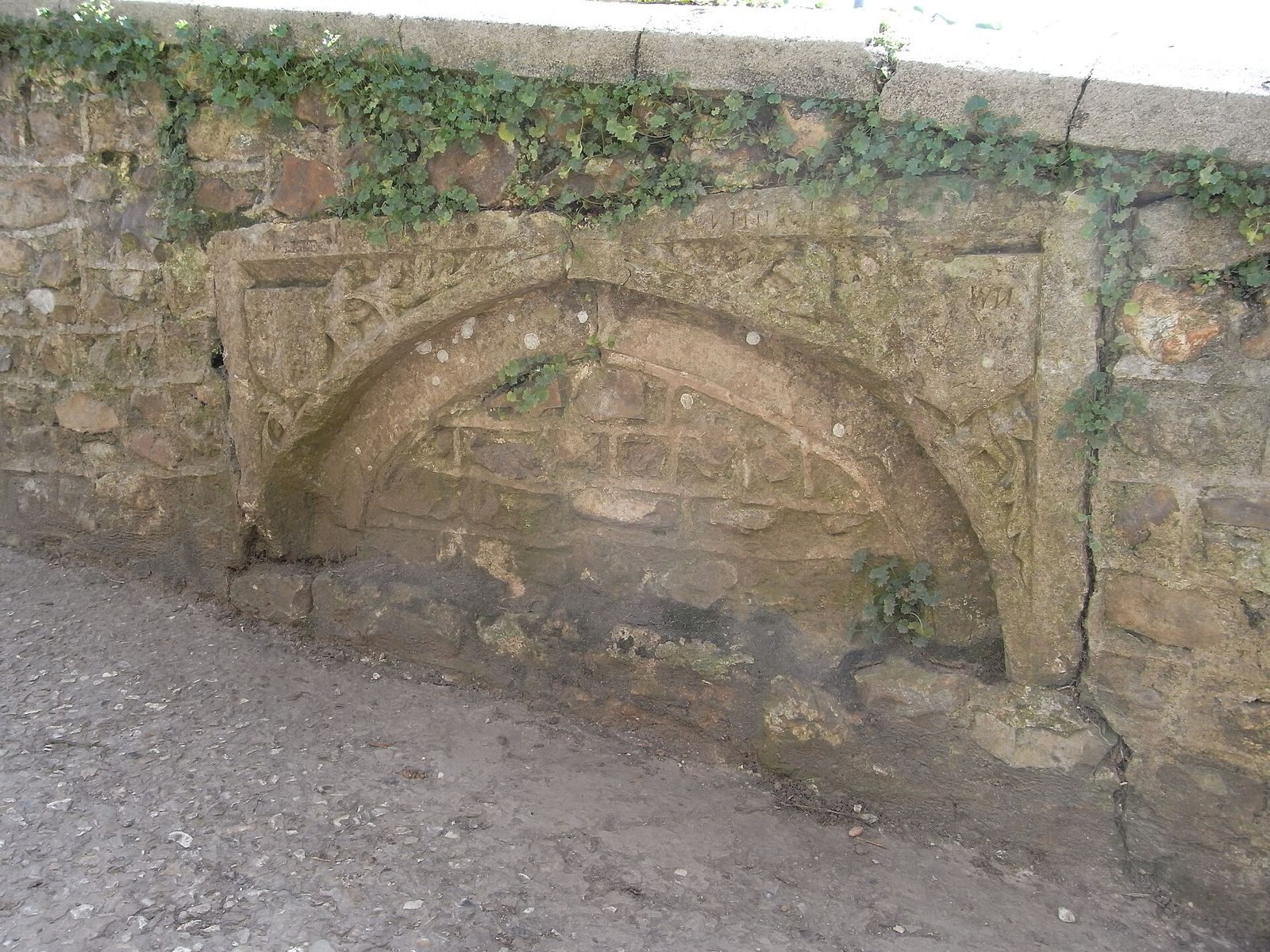
A broad, shallow leat, a man-made channel carrying water, runs beneath the present farmhouse. Nikolaus Pevsner suggested that it might have served as a moat, while another possibility is that it carried water to a mill. Opposite the farmhouse’s front door, the upper arch of an old Tudor-style stone window is built into the bridge’s low parapet. Heraldic shields flank the arch, their carved designs now worn.
Ruins and the West-Side Farmhouse
John Swete described the mansion’s interior as ruined and the ground around it as a farmyard used for manure. Across the lane to the west stood the tenant’s farmhouse, which he thought might have been built using material from the castle. He considered its west-facing side the mansion’s principal front. From there, his view included pasture, the River Coly, the wooded hills of Shute Park to the right and Colyton to the left.
The Effigy at St Andrew’s
A female effigy in Colyton’s parish church of St Andrew is associated with the Courtenay residence at Colcombe. Local tradition identifies it as Margaret Courtenay, a young daughter of William Courtenay, 1st Earl of Devon, and Catherine of York. The story says she died in 1512 after choking on a fishbone. The effigy is about three feet long; its face and head were renewed in 1907, reportedly using the sculptor’s infant daughter as a model. A nineteenth-century brass tablet above it gives the same identification and says Margaret was buried beneath a window in the church’s north transept. Three carved shields show the Courtenay arms, the Courtenay arms alongside England’s royal arms, and the royal arms. Another proposed identification is Lady Margaret Beaufort, wife of Thomas Courtenay, 5th Earl of Devon. This interpretation treats the shield thought to show royal arms as Beaufort arms, which add a border of alternating silver and blue sections to the English royal arms.