Cougnac Caves: Prehistoric Art in Payrignac, France
Site at a Glance
- Popularity
- Medium
- Country
- France
- Primary era
- Stone Age
- Eras represented
- Stone Age
- Civilizations
- Unclassified
- Site type
- Civic
- Remains
- Rock Art
On this page11 sections
History
The Cougnac Caves are two limestone caves at Payrignac, France, one of which preserves prehistoric art from at least two Upper Paleolithic phases. Animal images date to about 25,000 years before present, while dot signs belong to a later phase around 14,000 years before present.
Upper Paleolithic decoration
Charcoal used in some drawings has been dated by radiocarbon analysis, a method that estimates age using radioactive carbon. The animal figures are associated with the Gravettian, while the dot marks belong to the Magdalenian. More precise estimates place the giant-deer image between about 25,100 and 19,500 years before present, and the dots between about 14,200 and 13,800 years before present. The Gravettian, Solutrean, and Magdalenian were successive Upper Paleolithic cultural periods, distinguished in part by their tools and material culture.
Stylistic comparisons with images at Lascaux and Pech Merle have also led to the attribution of the human figures to the Solutrean. The cave art has been interpreted as serving cultural and religious purposes over more than 5,000 years. One interpretation holds that artists regarded the rock as possessing supernatural power and sought to approach it by touching or painting its surfaces.
Rediscovery and protection
In the summer of 1949, Fernand Lagarde, an amateur dowser from Toulouse who was searching for water, found the entrance to the first cave. Prehistorian Jean Mazet was alerted and entered it with the help of local residents. Further exploration led Mazet and accompanying researchers to the decorated cave on 23 November 1952. Its entrance lay in a small hollow in the rock that had previously served as a wine cellar. The decorated cave was classified as a historic monument in 1954.
Remains
The site consists of two limestone caves about 200 metres apart. One is a dry cave with mineral formations; the other contains around fifty examples of prehistoric paintings and engravings.
Cave interiors
The dry cave
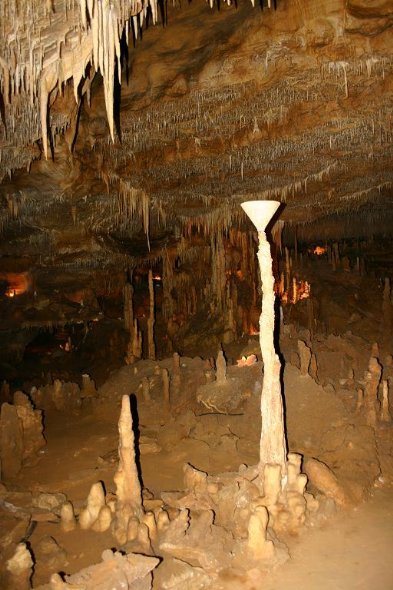
The first cave contains stalactites, mineral formations that hang from the ceiling, and stalagmites, which rise from the floor. It also has numerous other mineral deposits, including particularly fine, tube-shaped formations.
The decorated cave
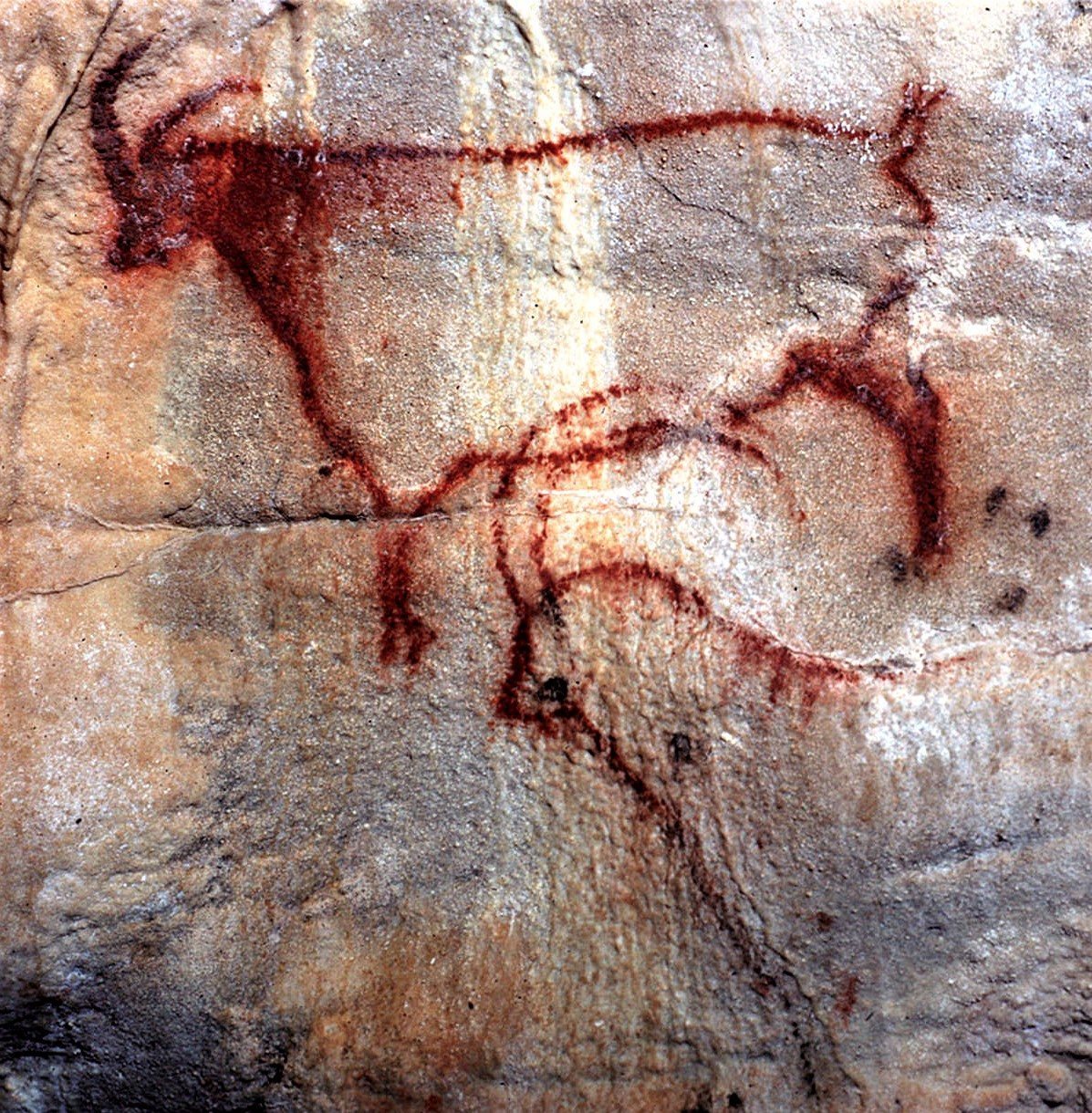
The second cave opens from a small hollow in the rock. Its walls carry around fifty examples of prehistoric art, made as paintings and engravings.
Rock art and other features
Animals and signs
The images include giant deer, ibex (wild mountain goats), mammoths, aurochs (an extinct kind of wild cattle), bison, and a single horse. Schematic human forms appear alongside abstract signs, including dots and lines. Red and brown are the main painting colors, with black used in a smaller number of images. Artists also made systematic use of the natural relief of the cave walls when composing their designs.
Human figures
One black figure, 46 centimetres high, is drawn over two red mammoths. Its head is faintly shown and birdlike; interpretations include a human-bird figure or an auk, a seabird. Seven spear shafts cross its body. A second black figure, 28 centimetres high, has no head or arms and appears to be fleeing. Two spear shafts cross its back and another its thigh; the figure is probably male. A third black human figure is also pierced by spears. Two of the human images have been interpreted as wounded men. Such figures are uncommon among prehistoric cave images in southwestern France.
Stone instruments
Lithophones, stone instruments that produce tones when struck, are also present at the site.