Pau Amarelo Fort: A Portuguese Coastal Artillery Position
Site at a Glance
- Popularity
- Medium
- Country
- Brazil
- Primary era
- Early Modern
- Eras represented
- Early Modern
- Civilizations
- Portuguese
- Site type
- Military
- Remains
- Fort
On this page8 sections
History
Pau Amarelo Fort is a Portuguese colonial coastal fortification on Pau Amarelo beach in Paulista, Pernambuco, Brazil, about 16 kilometres north of Olinda’s historic centre. Construction began in 1729, at an inlet that had already played a part in the Dutch invasion of Brazil.
The Dutch landing and early plans
On 14 February 1630, during the second Dutch invasion of Brazil, Pau Amarelo beach was chosen as the anchorage for a 65-vessel fleet belonging to the Dutch West India Company, a chartered trading company that also organized overseas military expeditions. The fleet was commanded by Admiral Hendrick Corneliszoon Lonck. The following day, 7,280 troops under Colonel Diederick van Waerdenburch landed and marched inland, capturing Olinda and Recife.
A royal charter issued on 15 September 1703 ordered a fort at the Pau Amarelo inlet, with costs assigned to the Pernambuco captaincy, a Portuguese colonial administrative territory. The charter included a plan and instructions from a military engineer, with room for adjustments to suit the ground. A separate proposal placed the fort on the reefs at the inlet bar, where its guns were expected to be more effective. Work began in 1729 under Duarte Sodré, governor and captain-general of Pernambuco, the territory’s senior governor and military authority.
Coastal defense and garrison
In 1745, the garrison consisted of a lieutenant, a constable, five fusiliers, and two artillerymen. As part of efforts to strengthen Pernambuco’s coastal defenses, Governor and Captain-General Luís Diogo Lobo da Silva ordered a ditch and a ravelin, an outwork in front of a fortification, added in 1762. The fort had a garrison in 1801. In 1808, during the Peninsular War and the transfer of the Portuguese royal family to Brazil, a new plan for its reconstruction was drawn up. In 1817, 14 men served there under a lieutenant.
Preservation and later use
A ministerial notice of 4 May 1877 ordered the fort’s works to be preserved. Brazil’s federal heritage agency, IPHAN, listed it as a protected monument on 24 May 1938. IPHAN and the Brazilian Army undertook the first restoration intervention in 1973, after which the municipality administered the fort. A further intervention followed in 1980, and the building then housed a police post. By 2001, low-income families occupied some of its ground-floor rooms.
Remains
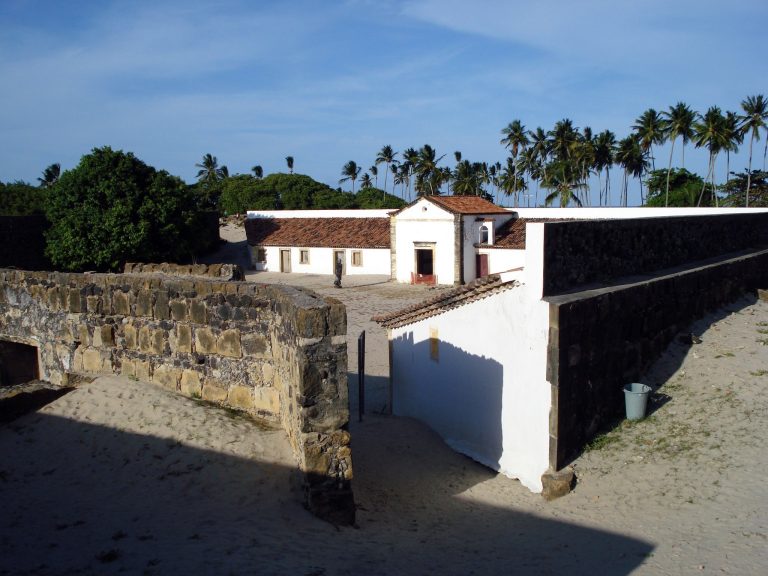
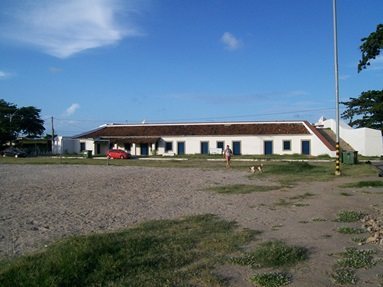
The fort has a rectangular plan, with two sentry boxes at its seaward corners. It has no walls enclosing the perimeter, so it is technically classified as a battery, an emplacement for artillery. Its features include a raised platform for guns, access by ramp, and service rooms beneath the ramp.
Ramp and service rooms
The ramp measures 85 palms long and 18 palms wide, using a traditional span-based unit. Beneath it were the command house, troop barracks, a vaulted powder magazine, a storehouse, a dungeon, and a chapel dedicated to Our Lady of Pleasures, a Catholic title for the Virgin Mary. By 1745, one battery and two half-bastions had been completed; each half-bastion had one face and one flank. A wall supporting the platform for a second battery was also in place, although that platform remained unfinished. Straw-roofed barracks housed the guard, kitchen, powder magazine, and artillery-equipment store. In 1866, the barracks, dungeon, magazine, command quarters, storehouse, and chapel were in good condition.
Artillery platform and surviving fabric
A description from 1866 records a seaward wall and two sentry boxes. The platform was paved with cut stone and had nine raised steps for defenders and six openings through which guns could fire. Eight guns stood there, almost all removed from their mounts. By 1885, only the foundations remained, along with eight guns buried in the sand, ranging from 24-pounders to 9-pounders.
Plans and armament
A watercolor copy of the projected fort plan, dated around 1702, survives in Portugal’s Overseas Historical Archive in Lisbon. The fort had four guns in 1745. Its armament had grown to 12 guns by 1801, with calibers ranging from 40 to 10. In 1817, it held three bronze guns and 24 iron guns of various calibers.