Muhos Church: A 17th-Century Lutheran Church in Finland
Site at a Glance
- Popularity
- Medium
- Country
- Finland
- Primary era
- Early Modern
- Eras represented
- Early Modern, Modern
- Civilizations
- Grand Duchy of Finland, Russian, Swedish
- Site type
- Religious
- Remains
- Church
On this page15 sections
History
Parish origins and construction
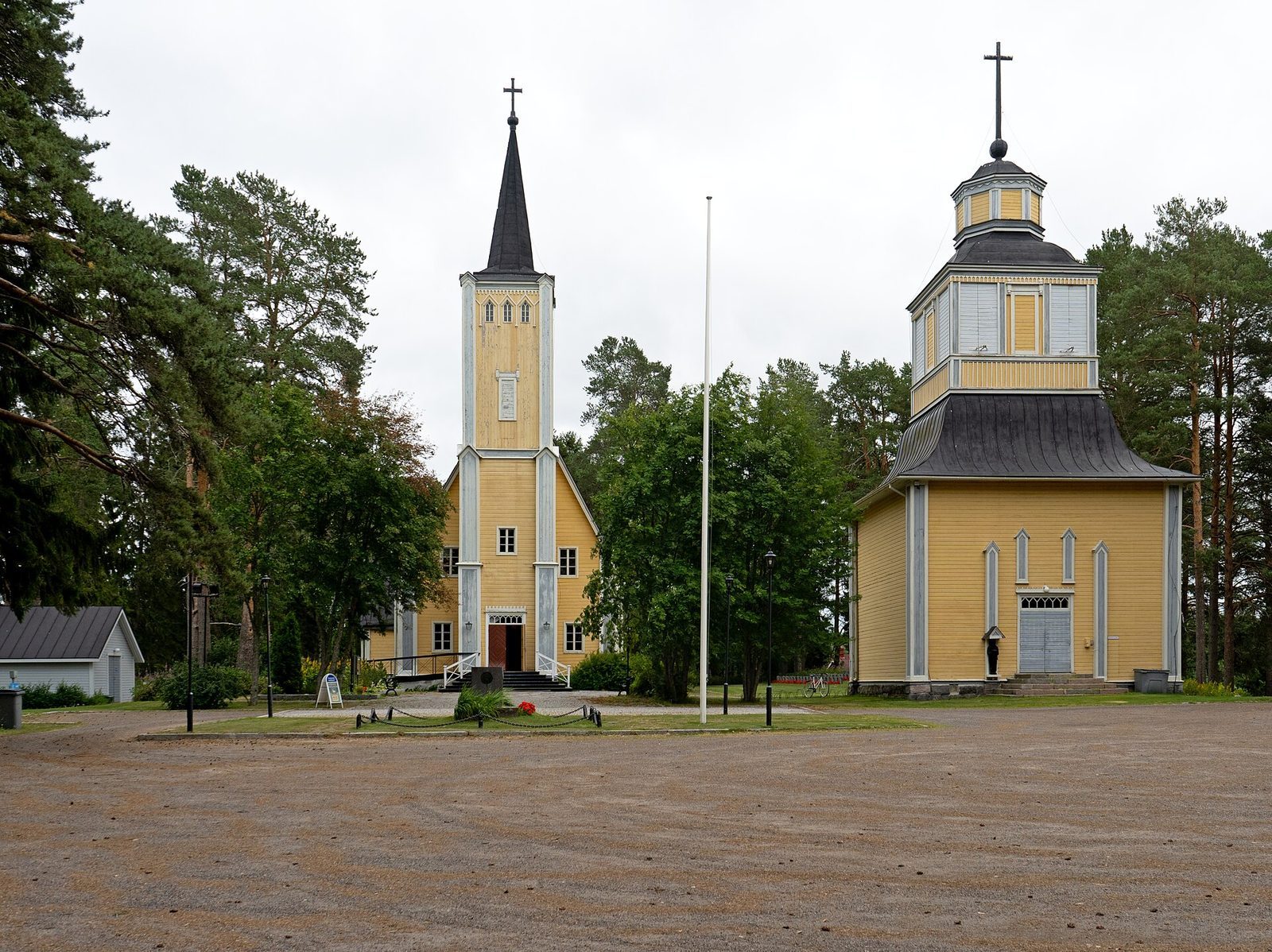
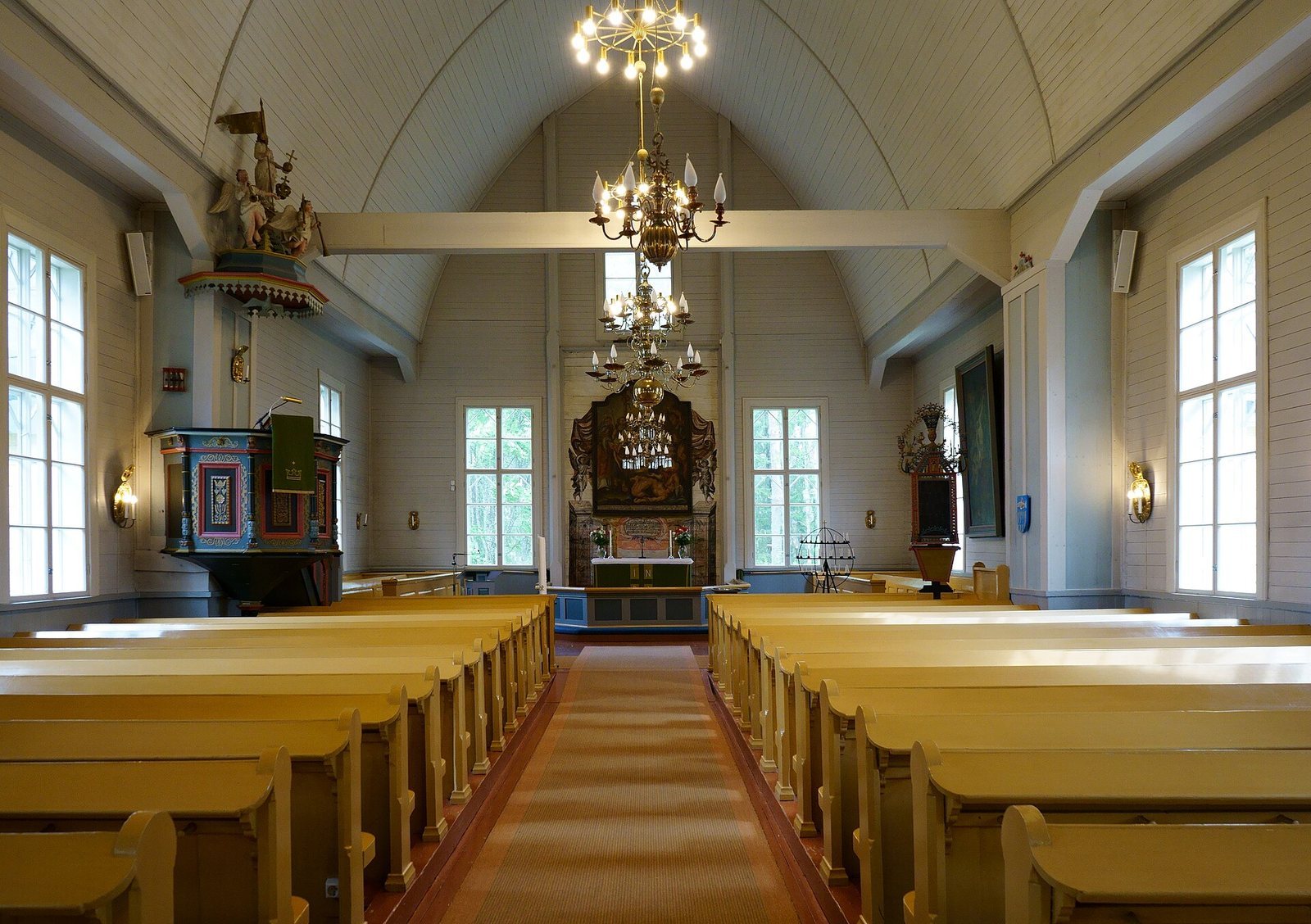
Muhos Church is a wooden Evangelical Lutheran church in Muhos, Finland, built and brought into use in 1634 as the parish’s third church. Tradition places the first church on Church Island and the second on Church Point, both relatively near the present building. The church remains in use throughout the year and has 500 seats. It belongs to the Diocese of Oulu, a regional district of the Evangelical Lutheran Church of Finland.
War damage and renovation
During the Great Wrath, the Russian occupation of Finland from 1714 to 1721 during the Great Northern War, Russian forces devastated the church but did not burn it. Repairs followed the occupation, and the church returned to use. A major renovation took place in 1762 under church builder Matti Honga.
Later changes and protection
Repairs in 1839 resulted in the loss of some of the church’s paintings. In 1872–1873, church builder Mikko Karjalahti led a renovation that introduced Neo-Gothic features, reviving forms associated with medieval Gothic buildings. The exterior walls were covered with boards and painted.
Further work in 1982–1984 renewed the interior and exterior paint, using colors drawn from the nineteenth century. For the church’s 350th anniversary in 1984, it received gifts that included the municipality’s coat of arms, church textiles, and a mission candlestick. A refurbishment of the churchyard in 1998–1999 improved access for people with mobility limitations, following a plan prepared by Jorma Teppo Oy. Muhos Church is recognized as a nationally significant cultural heritage monument and is protected as a church building in Finland’s Built Heritage Register.
Remains
Building and churchyard
Main church
The church stands beside the shore of Muhoslampi, on the Oulu River. Its elongated rectangular wooden structure has external buttresses, supports projecting from the walls, and retains nearly its original form. Tradition identifies its builder as Hannu, known as a tower builder. The church tower acquired its present form during the 1872–1873 renovation.
Bell tower
A separate bell tower was built in 1762. It holds two bells: the larger was cast in Stockholm in 1757, and the smaller in Helsinki in 1885.
Churchyard memorials
Three monuments stand in the churchyard. A memorial in front of the church commemorates those killed in the 1918 war. A memorial stone for people buried in the churchyard was donated by artist V. Tuomainen for the church’s 300th anniversary. Artist Martti Tarvainen made the memorial to fallen heroes, unveiled in 1949. The churchyard also contains graves of those killed in the Winter War and the Continuation War.
Collection figure
In a shelter beside the bell tower stands a 127-centimeter-tall poor-man collection figure, a carved box for charitable donations. Elias Vainio made it in 1934.
Interior decoration and furnishings
Pulpit
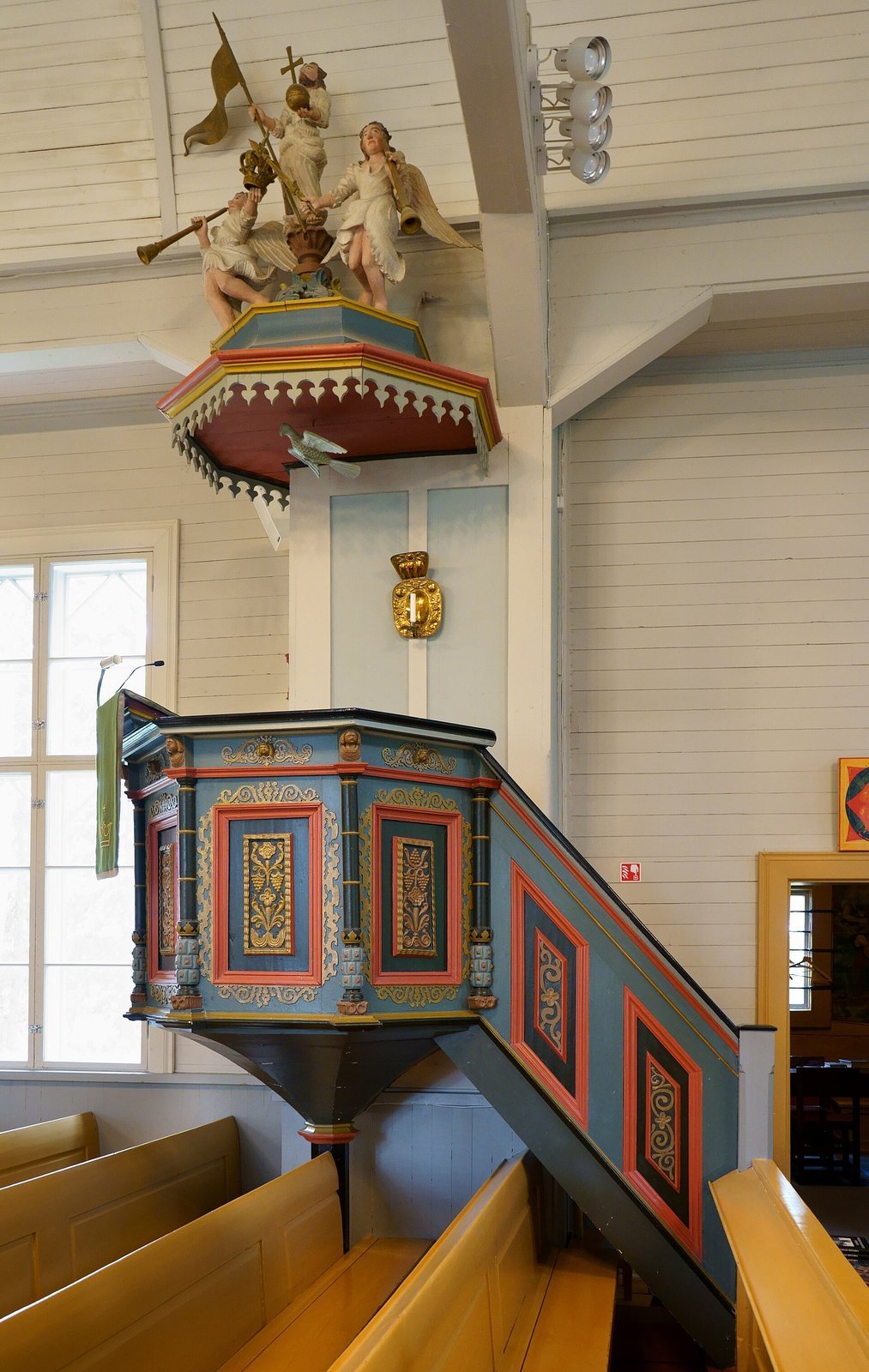
The late-seventeenth-century pulpit was made by carpenter and sculptor Mikael Sigfridson Balt. Tradition says the sculptural group on its canopy was brought from Germany as war booty during the Thirty Years’ War, a major European conflict fought from 1618 to 1648. At its center, the Savior holds a victory banner and a globe, with white-clad angels on either side. A dove hanging from the canopy represents the Holy Spirit in Christian art.
Paintings
Finnish church painter Emanuel Granberg painted scenes on the sacristy walls in 1773–1775. A sacristy is a room where clergy prepare for services and keep vestments and religious objects. Entering from the church hall, the scenes run from left to right: Jesus on the road to Emmaus; Jesus at the home of Martha and Mary; Samuel anointing Saul as king; angel heads surrounding the name Yahweh; Jesus in Gethsemane; Peter denying Jesus; a sinful woman anointing Jesus’ feet; the Prodigal Son as a swineherd; and, above the door, the Good Shepherd. The gallery railing carries portraits of the prophets Ezekiel, Isaiah, Jeremiah, and Daniel. Granberg also painted the altarpiece, Moses and the Bronze Serpent, in oil on canvas in 1778. On the church’s right-hand wall hangs The Deposition from the Cross, painted by Jakob Wallin in 1837.
Hymn board and church furnishings
A rural carpenter made the hymn-number board used to display hymns during services. Around 1828, Abraham Stjernschantz, governor of Oulu Province, donated it. Its carved decoration depicts the Crucifixion and stylized human figures, with a crowned woman at the center evoking the Virgin Mary. The board was regarded as the most splendid in the diocese.
Chandeliers, brass wall lights, and candlesticks are mostly donations from parishioners. The oldest of these objects dates to around the mid-eighteenth century. The tin baptismal basin dates to 1707, while its wooden stand was made in the mid-nineteenth century and has eight carved angel heads.
Organ
The Kangasala Organ Factory built the church’s organ in 1968. It has 23 stops, or selectable sound settings.