Santi Pietro e Paolo: Parish Church of Fratta Polesine
Site at a Glance
- Popularity
- Very Low
- Country
- Italy
- Primary era
- Early Modern
- Eras represented
- Early Modern, Modern
- Civilizations
- Austrian Empire, Habsburg, Venetian
- Site type
- Religious
- Remains
- Church
On this page16 sections
History
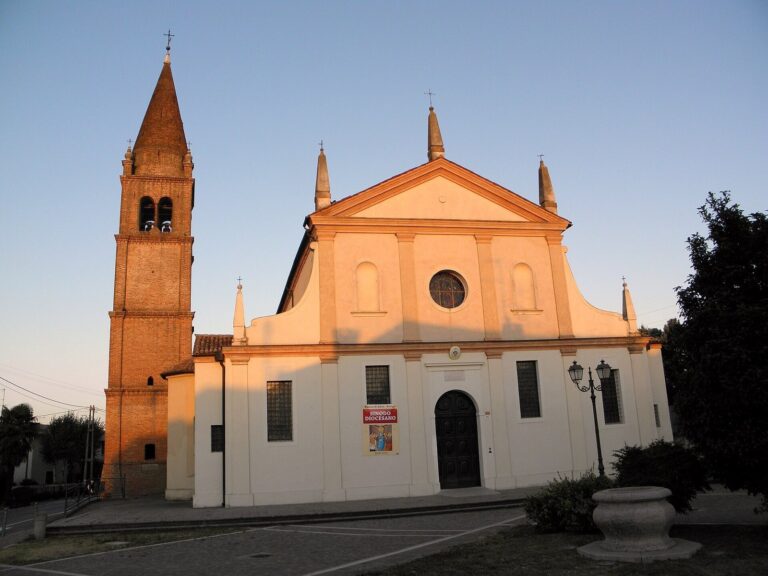
Santi Pietro e Paolo is the Roman Catholic parish church of Fratta Polesine, Italy. Its present building was begun in 1552 to replace an older Church of St Peter and took shape through several later phases.
Medieval and early modern jurisdiction
The earliest known record of a church at Fratta dates to 1123, when it was under the authority of the Abbey of Vangadizza. The abbey was a territorial abbey, whose abbot exercised church jurisdiction over a district. In 1536, the church remained formally subordinate to Vangadizza, but pastoral care was assigned to the parish priest of San Bellino, in the Diocese of Adria.
Rebuilding and completion
The old church had fallen into disrepair and was demolished in 1550. Work on its replacement began two years later, following a design by Zuane Bellettato. By 1682, the building was still only partly complete, although its facade had been finished to a design by Vincenzo Bortoloni.
The transepts, the crosswise arms of the church, were added in the eighteenth century. Bartolomeo Gradenigo consecrated the church in 1759. Gradenigo was a coadjutor archbishop of Udine, an assisting archbishop appointed with the right of succession.
Later changes and present affiliation
Around 1812, the church received furnishings from Venice’s now-destroyed Church of Santa Maria dei Servi. The Stations of the Cross were stolen during the night of 11–12 February 1999. In the postwar period, the Bianchi foundry of Varese recast the church’s four bells.
Santi Pietro e Paolo remains the parish church of Fratta Polesine. It belongs to the Diocese of Adria-Rovigo and the Lendinara-San Bellino vicariate, a grouping of parishes within a diocese.
Remains
The church has a single nave, with shallow chapels opening off its sides, and eighteenth-century transepts. Its interior has an eighteenth-century character, while the facade and the many furnishings reflect different phases of construction and works brought from churches in Venice.
Exterior
Facade
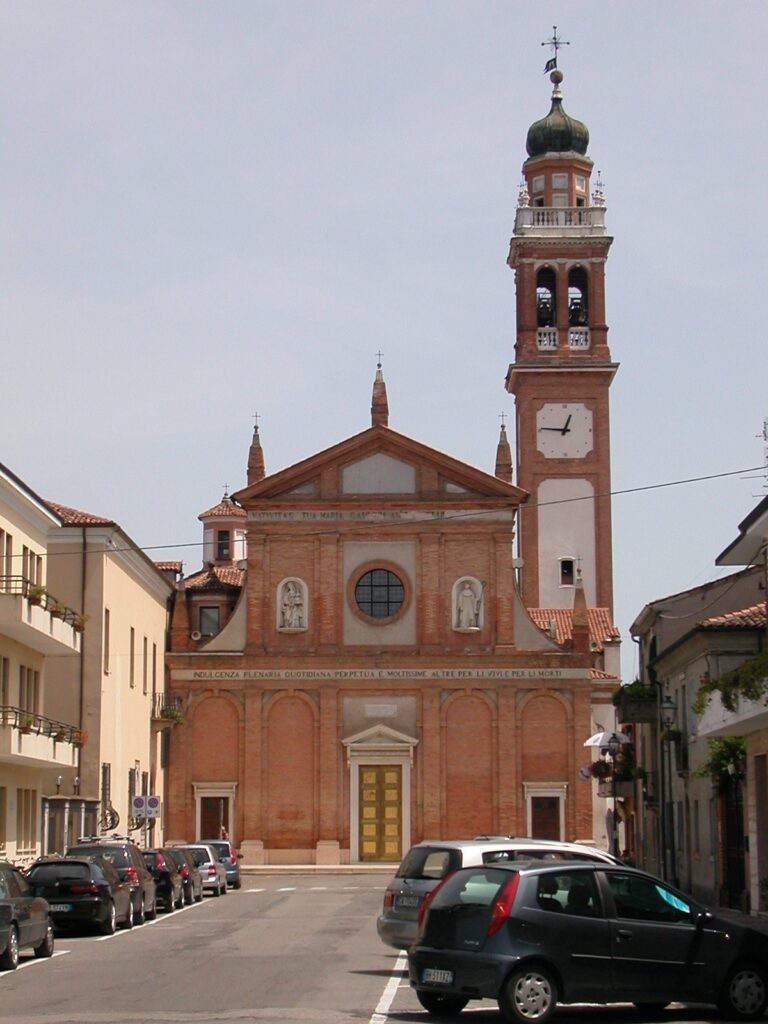
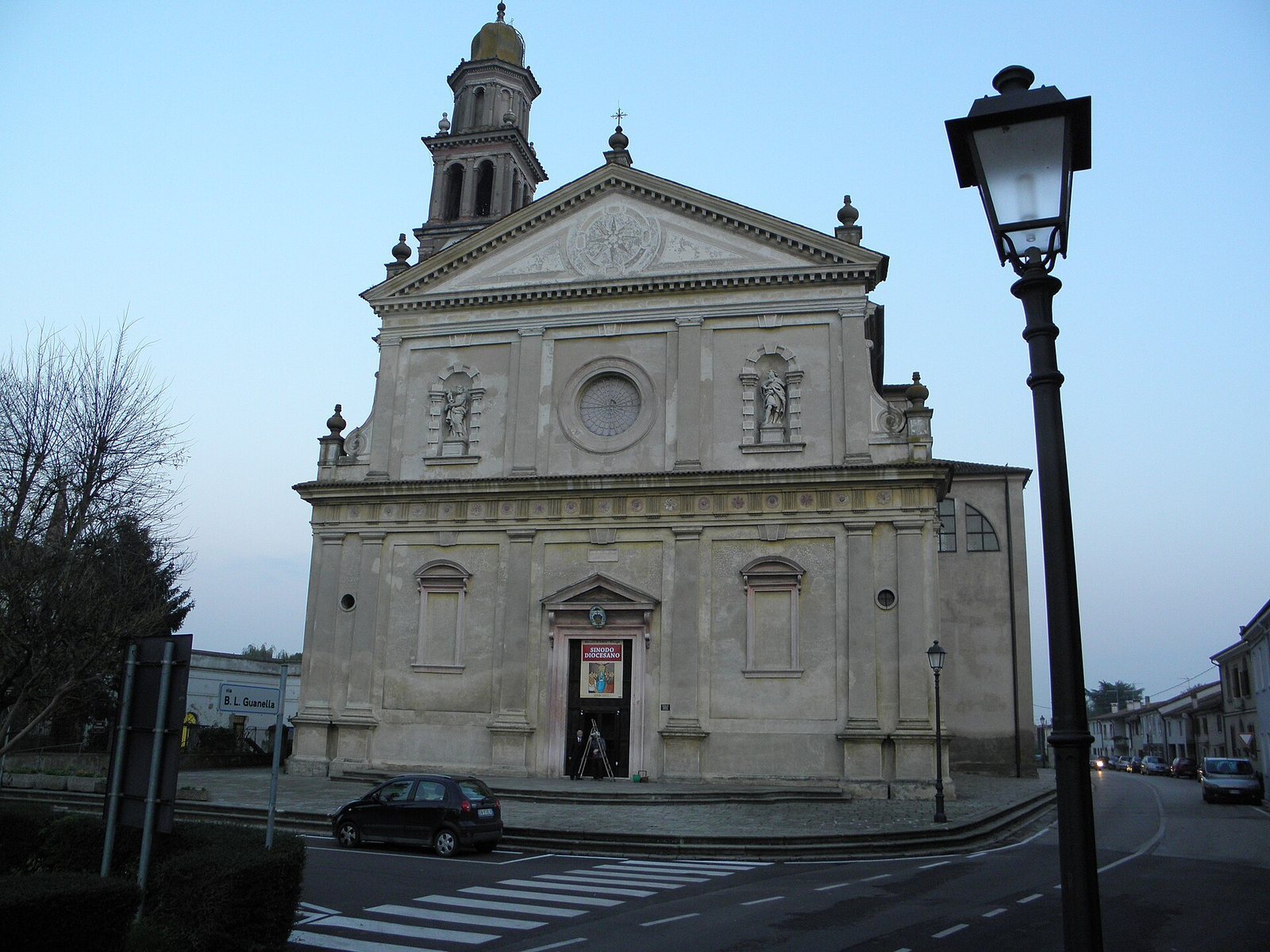
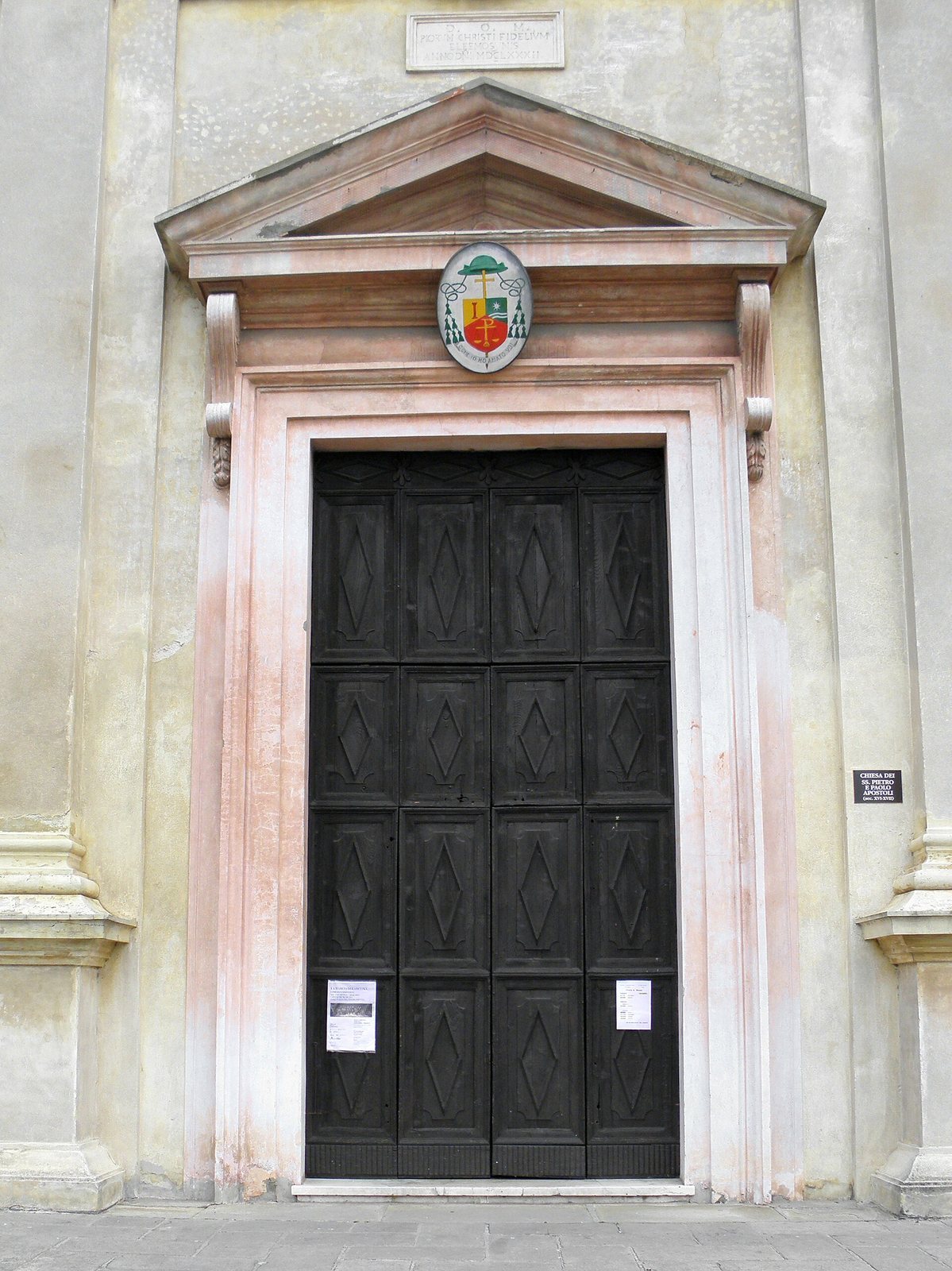
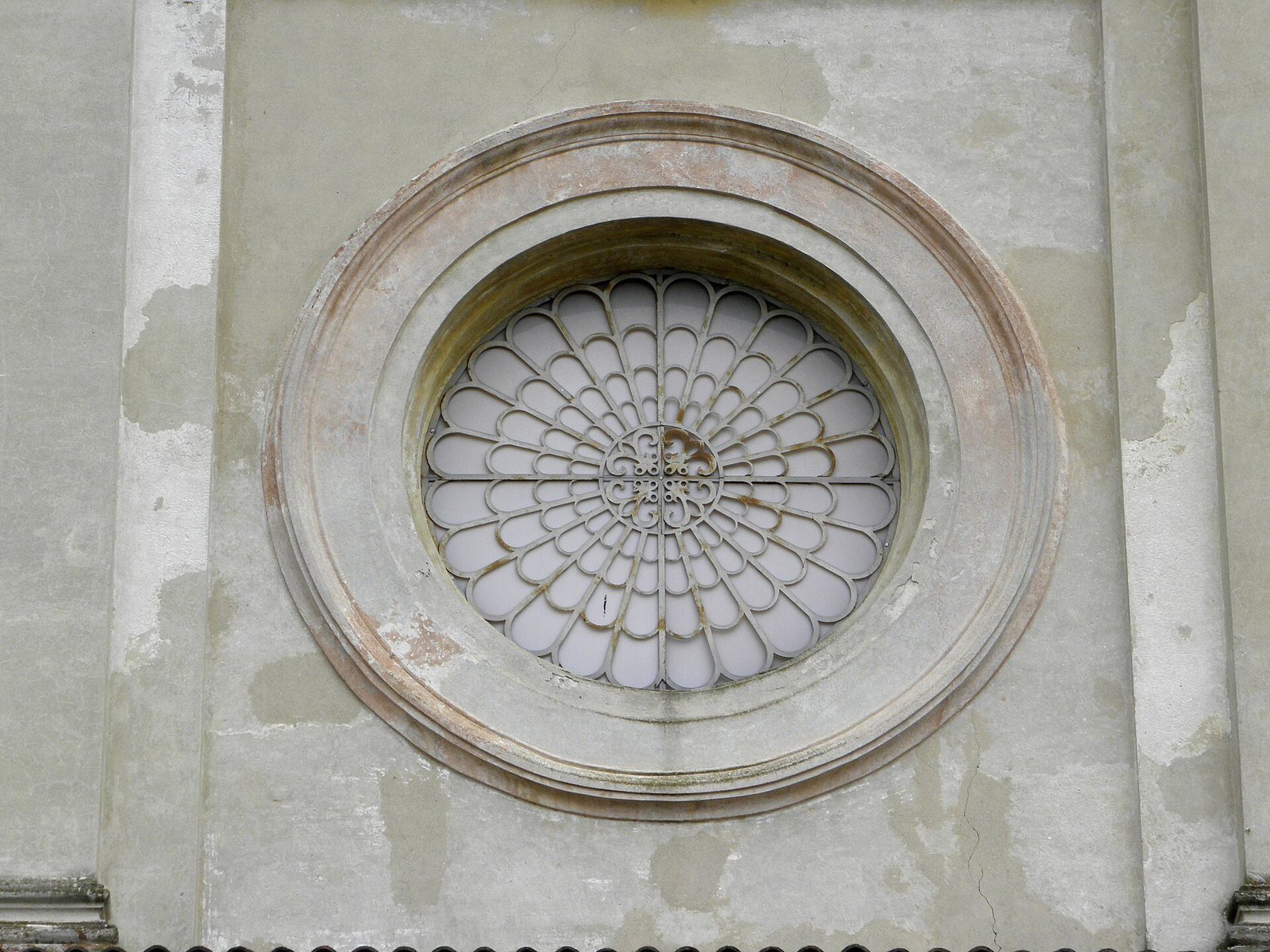
The seventeenth-century facade combines Renaissance features with two levels of classical architecture. The lower level is Doric and the upper Ionic, architectural orders distinguished by their column forms and capitals. A triangular pediment crowns the facade, and an inscription gives the date 1682. Beside the circular window, niches hold statues of Saints Peter and Paul by Giovanni Bonazza.
Bell tower
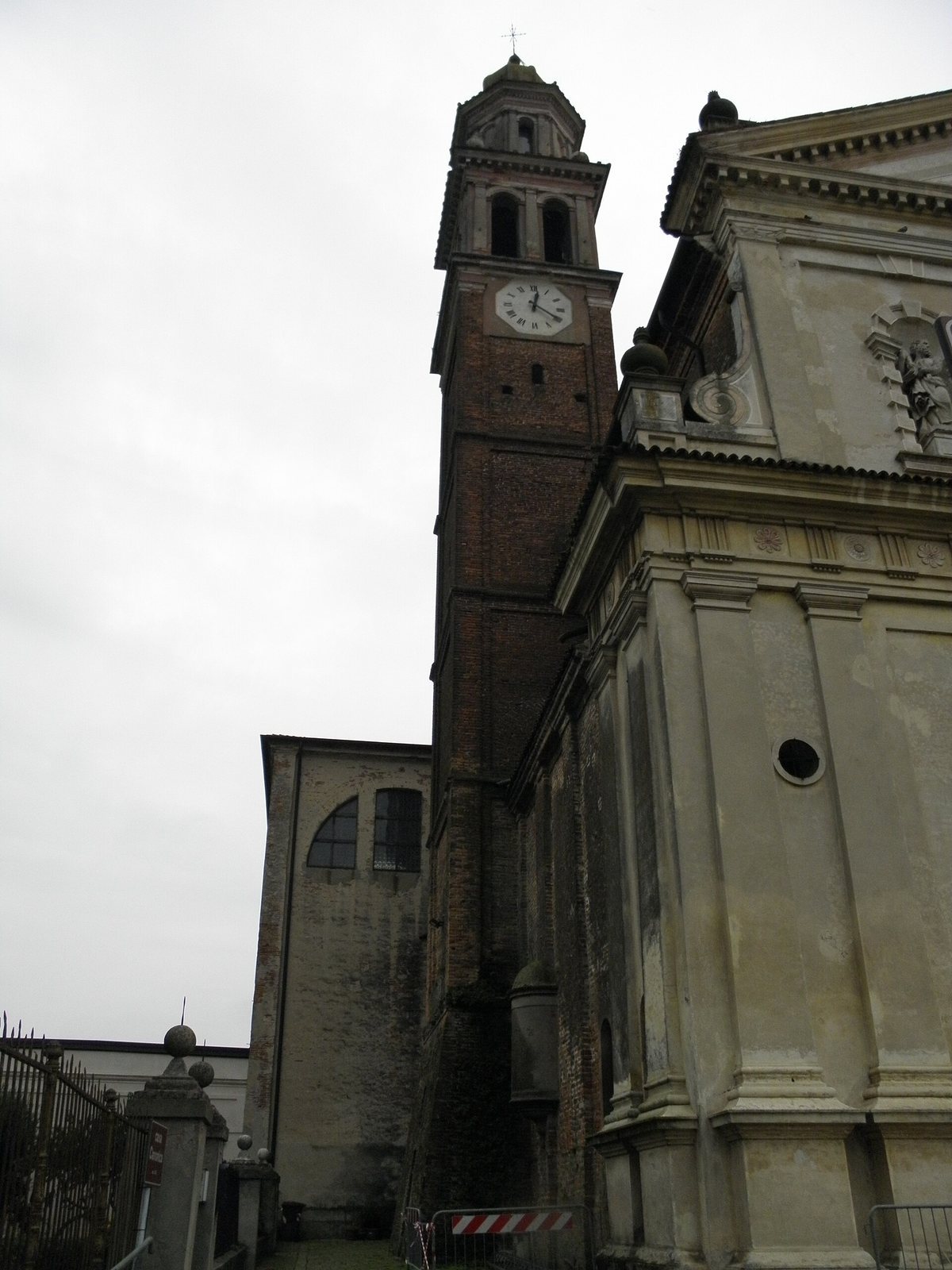
The eighteenth-century bell tower was completed in 1772. It houses four bells, with pitches D3, E3, G-flat3, and G3. The bells were recast in the postwar period.
Interior
Nave and painted decoration
Francesco Zugno painted the ceiling frescoes in a Tiepolesque style, associated with the painter Giambattista Tiepolo. Wall statues of saints date to 1743 and are by Tommaso Bonazza, apart from the statue of St John Bosco. The paintings now used for the Stations of the Cross were made by Gianpiero Callegari, an artist from Fratta.
Altars along the nave
Altars along the nave’s right wall include a seventeenth-century painting of the Forty Holy Martyrs of Mount Ararat by an unidentified artist from Ferrara, and an eighteenth-century image of St Nicholas of Bari by Gian Battista Burato of Verona. The central altar on the left wall holds a Madonna and Child carved in 1682 by the Venetian artist Angelo Pancierati.
Carved furnishings
The pulpit, dated 1859, depicts Jesus among the Doctors. Luigi Voltolini of Lendinara made the gilded carvings of the organ loft, with its columns, capitals, childlike figures called putti, and emblems, as well as the parapet of the altar of the Forty Holy Martyrs.
Entrance vestibule
The wooden vestibule at the main entrance was made by Giovanni Marchiori around 1740–45 for Venice’s Church of Santa Maria dei Servi. Its upper section bears the coat of arms of the Servite Order, a Catholic order also known as the Order of the Servants of Mary, flanked by angels. The work was once attributed to Andrea Brustolon.
Main altar
The main altar dates to 1697. Two large angels were installed beside it in 1704: Pietro Baratta made the angel on the right, and Marino Groppelli the one on the left. Above the altar hangs a canopy dated 1783, topped by a carved work by Sante Baseggio.
Right transept
The right transept contains the altar of St Anthony, made in 1792. Its central marble statue of the saint is by Giuseppe Torretto. Giovanni Marchiori carved the statues of St Alexis Falconieri and St Juliana Falconieri in 1738 for Santa Maria dei Servi in Venice. Two paintings of miracles of St Philip Benizi from that church hang on the transept walls, and Pietro Liberi’s painting of the Ecstasy of St Anthony stands behind the altar.
Left transept
The altar of the Name of Jesus came from the now-vanished Church of Saints Blaise and Cataldus on Giudecca in Venice. Giovanni Maria Morlaiter made its statues of St Benedict and St Scholastica and its central monogram of the Name of Jesus in 1735. Two paintings from the same church, Mattia Bortoloni’s Birth of Jesus and Adoration of the Magi, date to 1734–35. Behind the altar is a sixteenth-century Circumcision, attributed either to Ippolito Scarsella or to Paolo Piazza.