Pegtymel Petroglyphs: Rock Art of the Lower Pegtymel River Valley
Site at a Glance
- Popularity
- Medium
- Country
- Russia
- Primary era
- Medieval
- Eras represented
- Stone Age, Iron Age, Classical, Medieval, Early Modern, Modern
- Civilizations
- Unclassified
- Site type
- Civic
- Remains
- Rock Art
On this page12 sections
History
The Pegtymel Petroglyphs are a rock-art site in the lower Pegtymel River valley of Chukotka, Russia. Usually associated with the Siberian or late Neolithic, regional labels for prehistoric periods, the carvings are broadly dated from the first millennium BCE to the end of the first millennium CE. Their images include reindeer, people, boats, and other animals.
Dating and possible makers
Archaeologist Nikolai Dikov attributed the oldest deer images to about 1000 BCE and placed the latest carvings around 500–1000 CE. Research conducted between 2005 and 2008 also prompted a much later proposed date, in the seventeenth to nineteenth centuries. The people who made the carvings are uncertain; they may have included Paleo-Eskimo groups, an archaeological umbrella term for prehistoric Arctic cultures, possibly including ancestors of today’s Chukchi, an Indigenous people of northeastern Siberia. This proposed connection remains tentative.
In Chukchi, the petroglyphs are called kalenmjon, a word derived from a term meaning to depict or color.
Discovery and archaeological study
A geological team led by Nikolai Samorukov first found petroglyphs in 1965, but the precise location was not recorded and a later effort to return to it failed. In July 1967, an archaeological expedition led by Dikov found a different group of carvings, with more images and a wider range of subjects. A further expedition in 1968 examined the carvings and surveyed a prehistoric settlement in the area. Dikov’s early inventory listed 104 image panels, and his 1971 study described the carvings alongside the expedition excavations.
Protection and continued recording
The site’s boundaries were set in 1968, the year it received state protection. It is also recognized as a federal-level cultural heritage property, a Russian designation for heritage of national importance, and as a natural-historical monument, a protected site valued for natural and historical qualities.
Dikov found further panels in 1986. An expedition in 1999 added 24 panels or carvings to the record; teams in 2002 and 2004 surveyed known locations, and photographs from the latter work revealed 74 additional motifs or panels. In 2005 and 2006, an Italian–Russian project used hardening silicone to capture the carvings’ surface relief. Separate research between 2005 and 2008 recorded about 170 images with subjects unlike those previously known, and proposed the later dating noted above. Experimental emergency conservation took place in 2008. Expeditions in 2021 and 2022 used geographic information systems and 3D modelling to map the cliff and its carved surfaces, recording both damage to known images and previously unrecorded carvings.
Remains
Cliff distribution and carving methods
The site occupies 11 hectares in the Kejnynej mountain area, about 60 kilometres upstream from the Pegtymel River delta and 40–50 kilometres inland from the sea. Its main concentration is at Kaikuul rock, where more than 100 known carvings extend across 12 rocks along roughly 500 metres of the river’s right bank. The site is organized into 12 main areas, with more than 350 image panels and individual motifs. The carved surfaces are sandstone or siltstone that forms the Kaikuul ridge. Images were made by pecking, repeated blows to a stone surface, as well as scraping and grinding. Some have outlined shapes with interiors subsequently pecked, and stone tools bearing pecking marks have been found beneath the carvings.
A cave with carved images was identified during the early investigations. About 10 kilometres downstream from Kaikuul, a prehistoric settlement has a carved panel above it. Another panel lies about five kilometres downstream of the Dvurog tributary’s confluence with the Pegtymel.
Animals, people, and boats
Reindeer and other animals
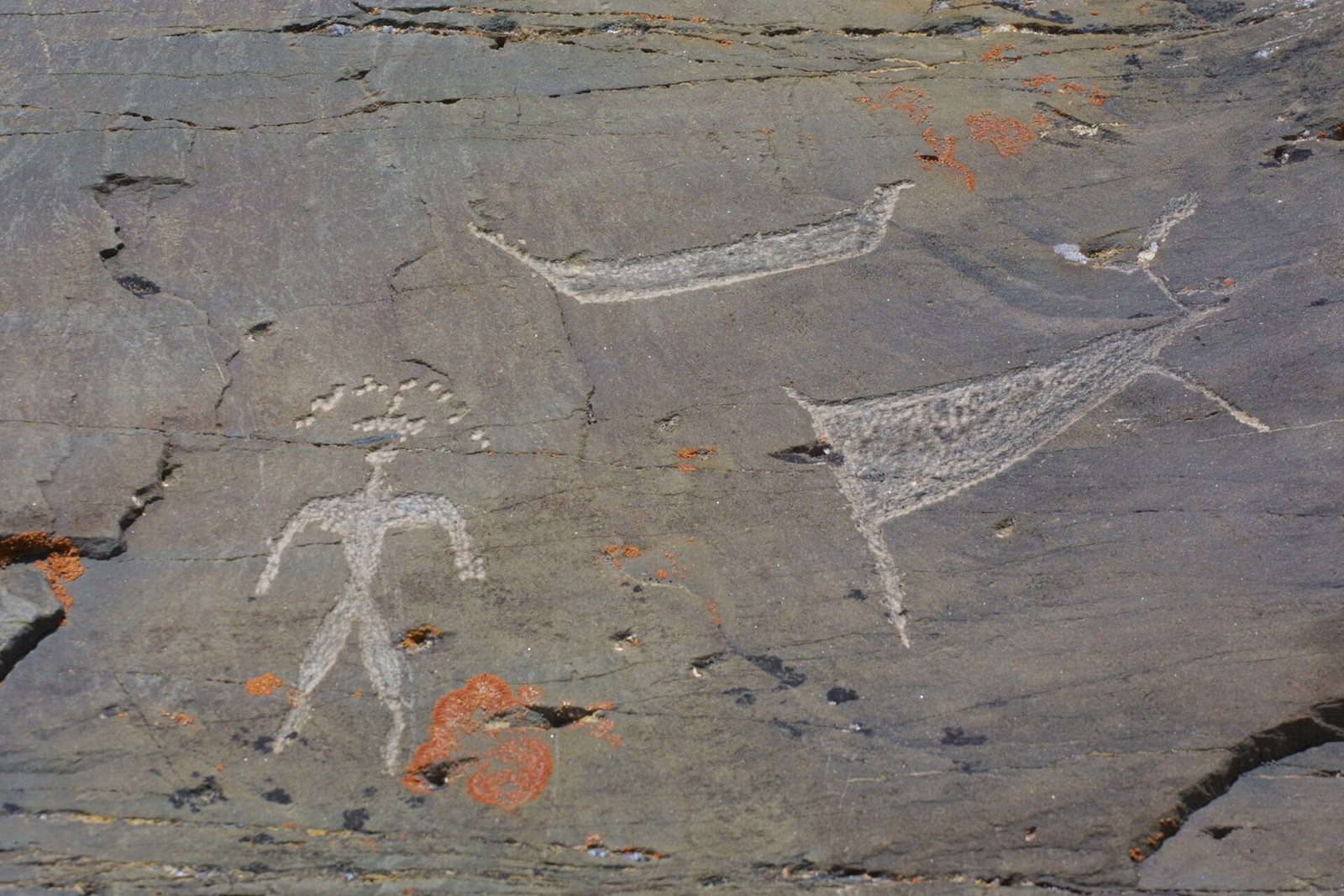
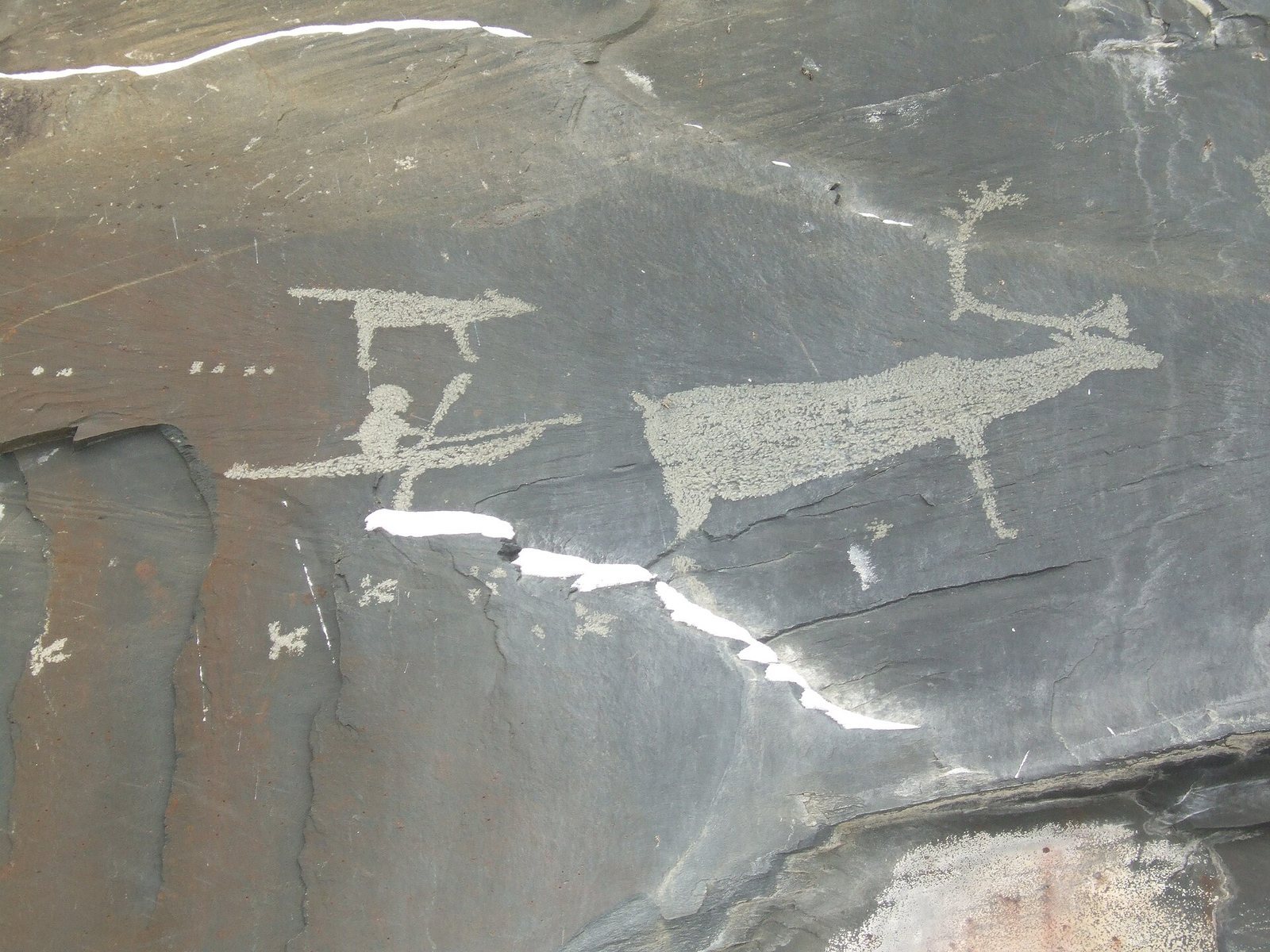
Reindeer are the most numerous subject, with 315 images. Most show the animals in side view, either outlined or fully pecked, and usually with straight legs. Thirty-six lack antlers and have been interpreted as spring reindeer. Several depict feeding animals, and the deer appear both alone and in herds. One is shown galloping and 20 swimming. Other images include nine bears, four identified as polar bears, and 10 marine mammals, among them seals, killer whales, and larger whales. Some whales are shown spouting water as they breathe. Twenty-two bird images mostly depict geese, ducks, swans, and gulls. Dogs and wolves can be hard to tell apart; two such figures appear to act against people rather than assist them.
People and boats
The 265 human figures portray activities including rowing, hunting, skiing, carrying kayaks, spearing whales, and paddling large boats. Hunting dogs assist people in some scenes. A frequent subject is a hunter spearing reindeer from a kayak or canoe, while whale hunting appears in two scenes. Footprint carvings show details of footwear. Two images place a person inside a four-sided enclosure, interpreted as a dwelling.
Seventy-six images show single-person boats, often propelled with double-bladed paddles, though some use single-bladed ones. Larger boats usually carry five to eight people and are depicted with single-bladed paddles, sometimes with a rudder. Shown from the side and with considerable detail, the boats have been divided into ten types; half are also known from ethnographic descriptions. Six images depict double-bladed paddles without people or boats.
Distinctive motifs and preservation
Mushroom-shaped images and tracks
Thirty-four mushroom-shaped motifs form a distinctive part of the carvings. They sometimes appear alone but more often above a person’s head. Interpretations include a reference to the intoxicating effects of mushrooms; other explanations draw on their continued use in the region and their varied significance in local folklore and mythology. Two further images show bear tracks, one with six toes.
Weathering and damage
Weathering, lichen, frost damage to the rock surface, and vandalism have affected some carvings. By 2018, part of the cliff had collapsed toward the river. Carved blocks lay beneath river and landslide deposits and were covered with moss and lichen, while images remaining on the cliff were also subject to vandalism.