Gorgippia: An Ancient Greek City and Bosporan Harbor in Anapa, Russia
Site at a Glance
- Popularity
- Very High
- Country
- Russia
- Primary era
- Classical
- Eras represented
- Classical
- Civilizations
- Ancient Greek, Bosporan Kingdom, Roman
- Site type
- City
On this page15 sections
History
Greek foundation and Bosporan rule
Gorgippia was an ancient Greek city beneath the central part of modern Anapa, Russia, established in the second half of the sixth century BC on a site associated with an earlier center of the Sindoi. Archaeological material from the site also dates to the sixth century BC, while urban construction took shape from the fourth century BC. The Sindoi were an ancient people of the northeastern Black Sea region, and their territory was known as Sindica.
The city’s original name is unknown. Sindik, meaning Sind Harbor, is associated with its early history, but its relationship to the ancient names Sindyka and Sindikos Limen remains uncertain. The later name Gorgippia honored Gorgippus, a member of the Bosporan royal family. Leukon I, king of the Bosporan Kingdom, appointed his brother Gorgippus as royal governor of Sindica. Gorgippia became part of the Bosporan Kingdom, an ancient state centered on the Cimmerian Bosporus and the northern Black Sea, during the fourth century BC. It served as a major harbor and frontier stronghold in the state’s southeast, under royal governors.
Strabo, a Greek geographer of the first century BC, described Gorgippia as the royal capital of the Sindoi, near the sea. The city was also mentioned by Stephanus of Byzantium, a sixth-century AD Greek geographer and compiler. Gorgippia’s economy and culture flourished during the fourth and third centuries BC, with prosperity continuing into the second century BC. Its territory expanded, monumental buildings were erected, and crafts developed, particularly pottery and stone sculpture.
Pontic rule and renewed prosperity
In the late second century BC, Gorgippia came under the Kingdom of Pontus, a separate Hellenistic kingdom on the southern Black Sea. The city freed itself from Pontic rule in 63 BC and minted its own coins during the second and first centuries BC.
Gorgippia prospered again in the first and second centuries AD as a Bosporan center of trade and craft production. Defensive works and monumental buildings were constructed during this period. In AD 110, the royal governor Pharnakion, son of Pof, funded a temple to Aphrodite under the cult title Navarchis. In AD 187, Governor Herodor erected a statue in honor of his father Neokles, who had also served as governor.
Destruction, decline, and excavation
A barbarian invasion and a major fire devastated the city in the late 230s or around AD 240. Gorgippia was subsequently revived, but did not regain its former importance. It experienced renewed life in the fourth century and declined finally in the 370s. During the Middle Ages and the Ottoman period, surviving buildings were dismantled for their stone and other building materials.
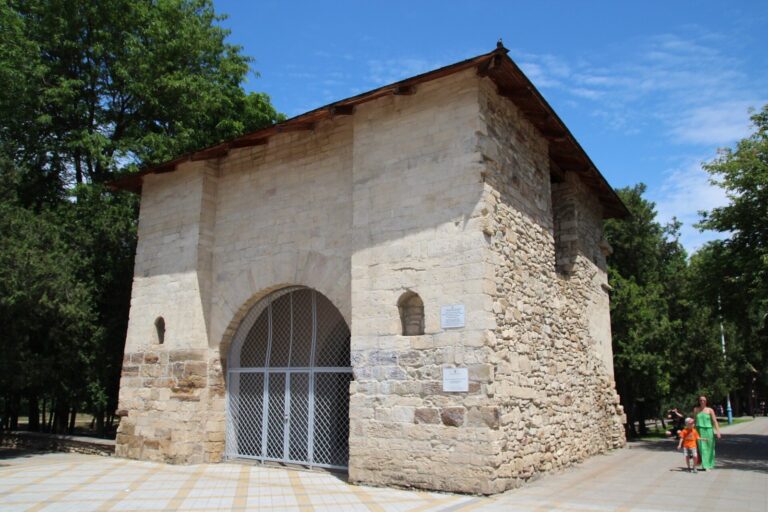
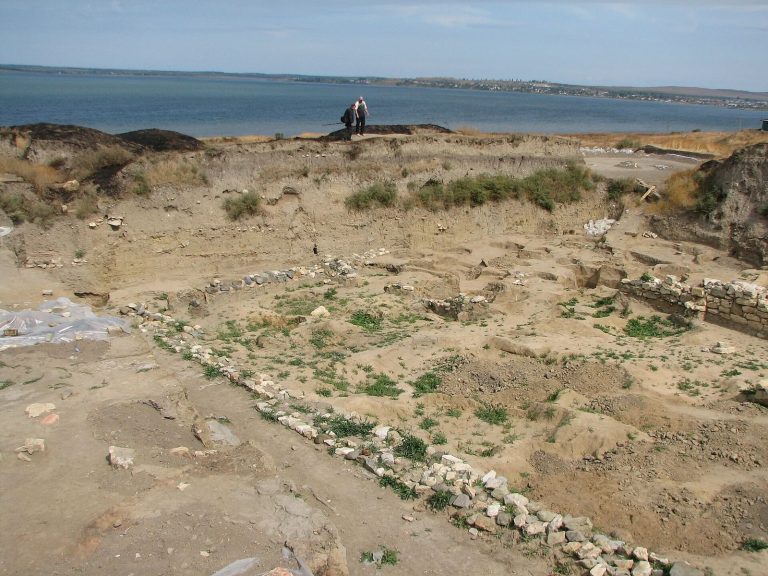
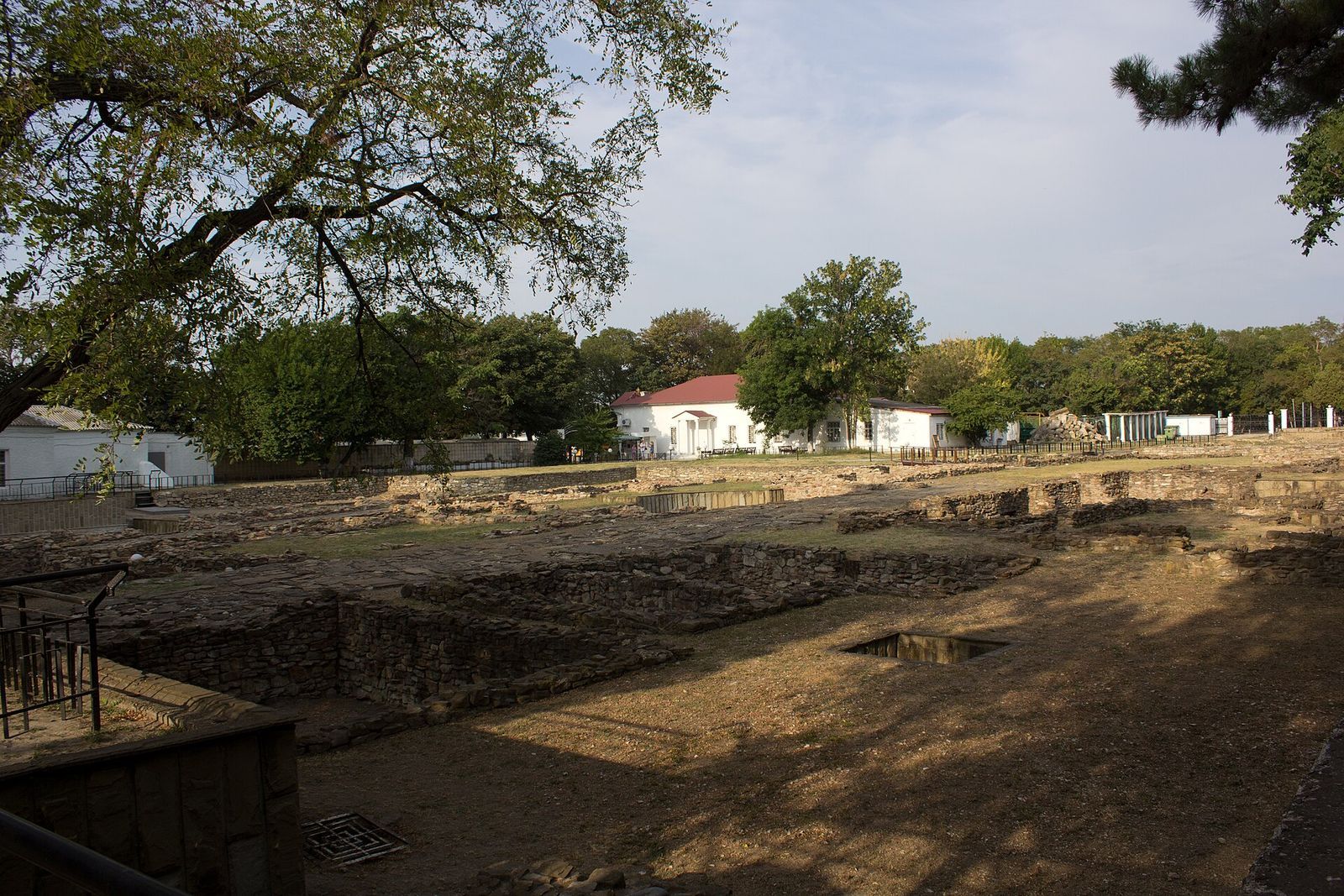
Excavations began in the nineteenth century and included investigations of burial mounds. V. Blavatsky excavated the city in 1949, when its boundaries were also established. Systematic work began in 1960 under I. Kruglikova and continued under E. M. Alekseeva from the 1970s through 1999, exposing city quarters and examining the cemetery. An open-air museum-reserve was later established at the site. Gorgippia is recognized in Russia as a cultural heritage site of federal significance.
Remains
City plan and streets
The ancient city adjoined the sea and extended beneath the central part of modern Anapa. At its height, it covered an estimated 35–40 hectares; about 40 hectares are now known or investigated, though the full extent remains uncertain beneath modern development. The city stretched roughly 800 metres west of the museum area and was about 500 metres wide. Its plan took shape in the fourth century BC, and some remains of an earlier, fifth-century BC cemetery later became enclosed within the growing urban area. Stone buildings were altered and rebuilt over time, often using blocks and slabs from earlier structures.
The main street, dating to the fourth and third centuries BC, ran east to west from the eastern gates toward the city center and reached up to 8 metres in width. It had a clay surface laid over bedrock, scattered with small stones, broken paving slabs, and amphora fragments. A later street, 4–4.5 metres wide, led toward the sea. Other streets, up to 5 metres wide, ran inland from the seaward side and crossed these routes at right angles. The Hellenistic city also had a water-supply system, and defensive walls were built during its first- and second-century AD period of prosperity.
Houses and household spaces
Houses stood on stone foundations and generally had one or two storeys, basements, and sometimes inner courtyards. Most contained two to four adjoining rooms of different sizes. The smallest room was often at the edge of a house and used for household work. Basements reached depths of 1.5 metres, and some were used as living spaces.
Some basement rooms were cut into bedrock. Their roughly dressed stone walls were laid with clay mortar, and their floors were clay; uneven places were filled with building debris that included broken pottery. One house retains part of a floor paved with stones set in lime mortar. Walls elsewhere were built of stone or brick, and roofs were covered with locally made tiles.
Workshops and production
Remains of pottery workshops lie in the northeastern part of the city. Wine presses and substantial ceramic and metalworking production also formed part of Gorgippia’s craft economy. The open-air archaeological area includes workshops, wineries, and vats used for salting fish.
Public and sacred buildings
The agora
Excavations in the agora, a public gathering and civic space, exposed remains of public buildings, sculpture fragments, and Doric columns, which belong to a classical Greek architectural style. Foundations and walls of houses and paved streets can also be seen in the excavated quarters.
Sanctuaries and temples
The sanctuary of Demeter, a goddess associated with fertility and agriculture, is represented by temple fragments, numerous depictions of the goddess, and vessels used in worship. Other religious buildings included temples to Aphrodite, associated with love and beauty, and Poseidon, associated with the sea and seafaring. A marble cult building was dedicated to Dionysus, a god associated with wine and revelry. The city also had a temple in the Ionic style of classical Greek architecture, dedicated to a deity described as just, and a marble temple in the Corinthian style.
Statues and inscriptions
Statues of Bosporan kings and governors stood in the city. Finds include fragments of two large marble statues and a marble statue of Governor Neokles, dated to the second half of the second century AD. A marble stele, or upright inscribed slab, lists 226 men who won athletic contests at celebrations honoring Hermes, a god associated with such competitions.
The necropolis
A rich cemetery lay east of the city and included decorated tombs. Among its burials were tombs with painted interiors and richly furnished graves.
The Tomb of Hercules
This second- to third-century AD tomb was decorated with multicolored frescoes showing the Twelve Labors of Hercules, the hero famed for completing these legendary tasks. It contained three sarcophagi, which had been looted in antiquity. In 1978, the tomb was dismantled into blocks for restoration. Some of its frescoes and other exhibits are displayed at the Anapa Archaeological Museum.
The undisturbed tomb
A separate, undisturbed tomb contained two sarcophagi made of shell limestone, with a rock-cut grave nearby. Its grave goods included vessels, bronze objects decorated with colored enamel insets, a horse harness covered in gold, bronze lamps, a large two-handled amphora, silver cups and spoons, and glass jugs. The first sarcophagus held the burials of two elite women and gold ornaments, including trefoil shapes, face plates, and appliqués.
The second sarcophagus belonged to an elite warrior. It held gold face plates and a wreath, a short iron sword or dagger in a wooden sheath with gold fittings and relief decoration, and garnet and turquoise inlay. Remains of two other iron swords were also found. Other solid-gold objects included two rings, a clothing clasp, a bracelet, a buckle, a rigid neck ring, and various fittings. The most valuable finds from this tomb were transferred to the Felitsyn Krasnodar State Historical-Archaeological Museum-Reserve.
Other finds from the city’s cemetery include inscribed marble slabs and sarcophagi. Some objects and frescoes are displayed at the Anapa Archaeological Museum, while other tomb finds are held by the Felitsyn Krasnodar State Historical-Archaeological Museum-Reserve.