Transfiguration Cathedral (Tambov): The Seat of the Tambov Eparchy
Site at a Glance
- Popularity
- Medium
- Country
- Russia
- Primary era
- Early Modern
- Eras represented
- Early Modern, Modern
- Civilizations
- Russian
- Site type
- Religious
- Remains
- Cathedral
On this page11 sections
History
The Transfiguration Cathedral is an Orthodox church in Tambov, Russia, begun in 1694 and completed in 1783. It became the seat of the Tambov eparchy, an Orthodox diocese established in 1682, and was Tambov’s first stone church. It is also the oldest Orthodox church in Tambov Oblast. Its late Baroque design incorporates European Rococo forms, a style that developed from Baroque, and elements of classicism based on classical forms.
From wooden church to stone cathedral
A wooden church dedicated to the Feast of the Transfiguration was built in Tambov in 1636, the year the town was founded. The stone cathedral later replaced it on the same site. The eparchy was created in 1682 as part of efforts to promote Christianity in the sparsely populated steppe lands then known as the Wild Field. Its first bishops sought a larger stone church to take the place of the wooden one.
Bishop Pitirim, who urged the project, was a seventeenth-century bishop later venerated as a saint and regarded as Tambov’s patron. Work began in 1694, but Pitirim died before the cathedral was finished and was buried there. Local merchant Matvey Borodin financed the work that brought construction to completion in 1783.
Diocesan use and nineteenth-century changes
Before the Revolution, the cathedral served as a burial place for the eparchy’s bishops. Its visitors included pilgrims and, in the early twentieth century, Emperor Nicholas II, the last emperor of the Russian Empire; Grand Duchess Elizabeth Feodorovna; and John of Kronstadt, an Orthodox priest and saint. Nicholas II visited on December 20, 1914.
In 1809, Bishop Theophil (Raev) of Tambov called for the deteriorating wooden belltower to be replaced with a stone structure. The new tower was built during the 1810s.
Closure and return to worship
The cathedral closed for worship in 1929 and became home to the Tambov Regional Museum. Its belltower was dismantled in 1931–1932. The ensemble received state protection as a local monument in 1974 and is now designated a cultural heritage site of federal significance.
In August 1991, the regional council resolved to return the former cathedral to worshippers. A cross was raised on the main dome on August 4, 1993, and the altar in the lower church was consecrated on August 6. Pitirim’s relics and other sacred objects returned on August 8. The cathedral was restored to the Tambov eparchy in 1993, with the transfer completed during Patriarch Alexy II’s first visit to Tambov. Its religious community was registered the following year.
On August 9 and 10, 2002, Alexy II held an all-night vigil, celebrated the liturgy on Pitirim’s feast day, and led a religious procession.
Remains
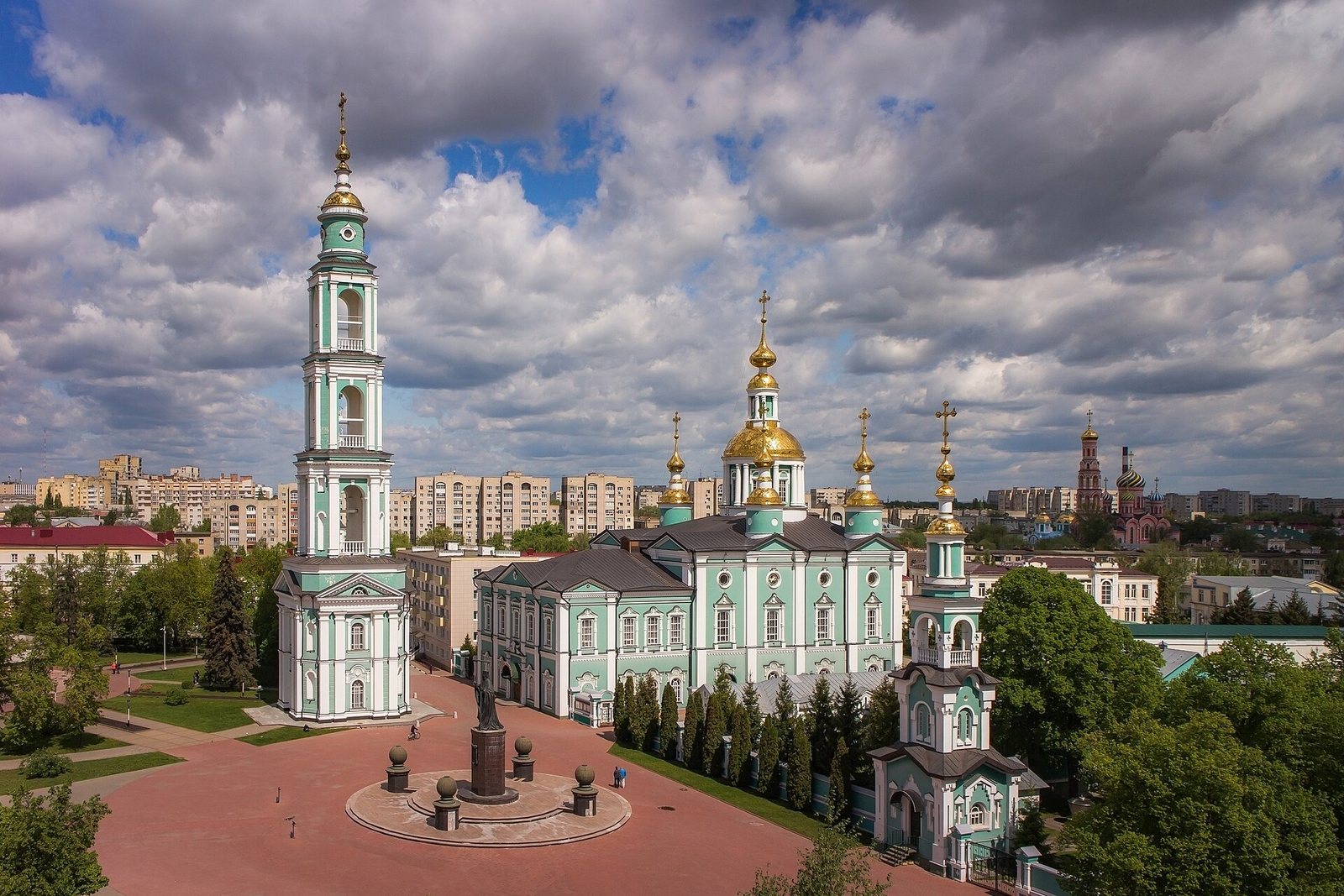
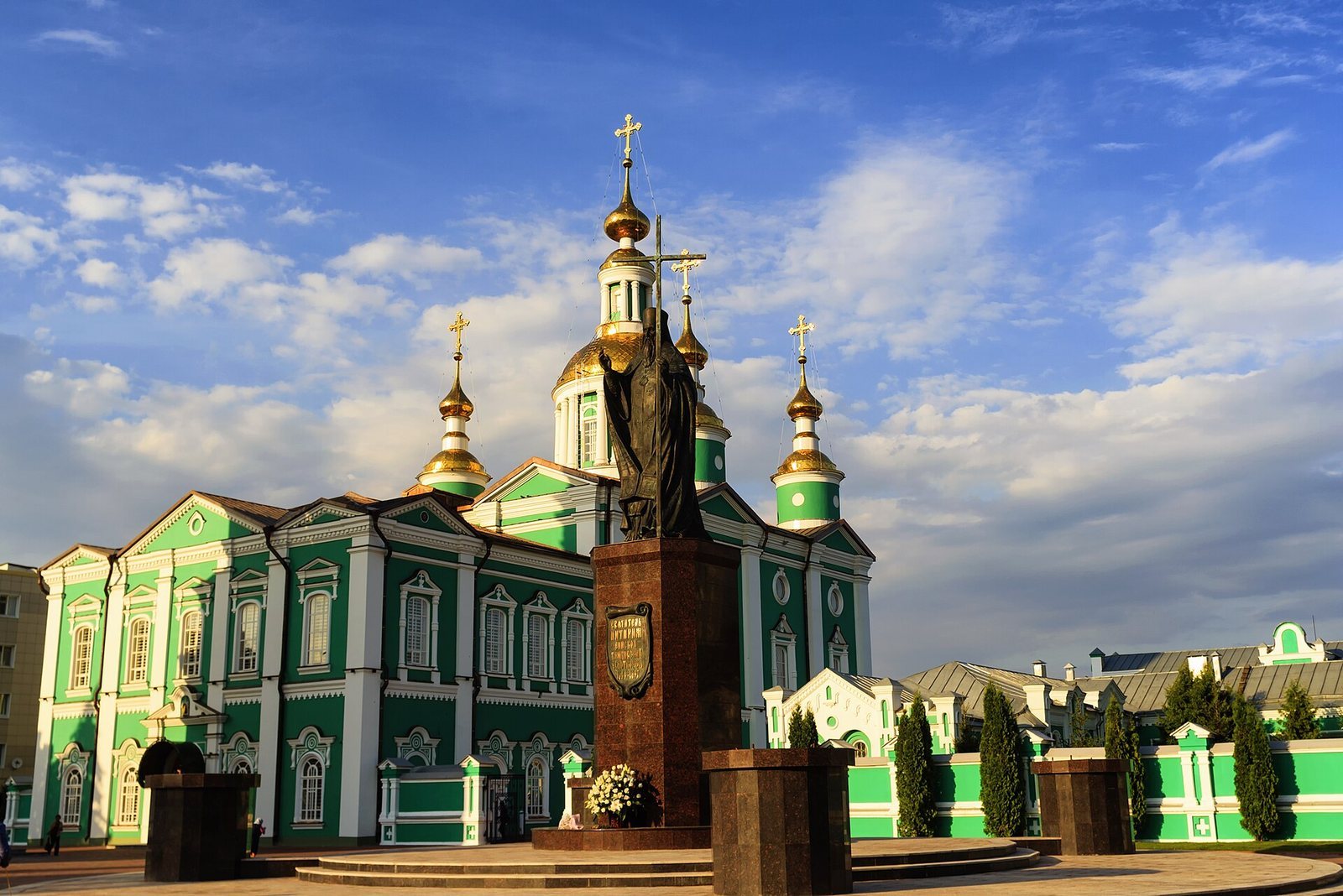
The ensemble brings together a brick, five-domed cathedral and a separate stone belltower. The cathedral has a four-sided plan, with one central dome and four smaller domes.
The cathedral and its furnishings
Cathedral building
The cathedral’s design was modeled on the Assumption Cathedral in Ryazan. Interior painting continued until 1803, and a lower church forms part of the building.
Sacred objects
Pilgrims came to venerate Pitirim’s relics and icons painted by him. Objects associated with the cathedral also include Pitirim’s vestment, a ceremonial garment presented by Tsar Alexei Mikhailovich. In 2002, Alexy II gave the cathedral a lectern icon of the Transfiguration, intended for display on a reading stand. On August 31, 2014, Patriarch Kirill presented a copy of an icon of the Mother of God known as the “Queen of All.” At the presentation, he recounted that an acquaintance had recovered after praying before the icon while suffering from fourth-degree cancer, and urged people with cancer to pray to the Virgin Mary in faith and seek healing.
Belltower and commemorative sculpture
Belltower
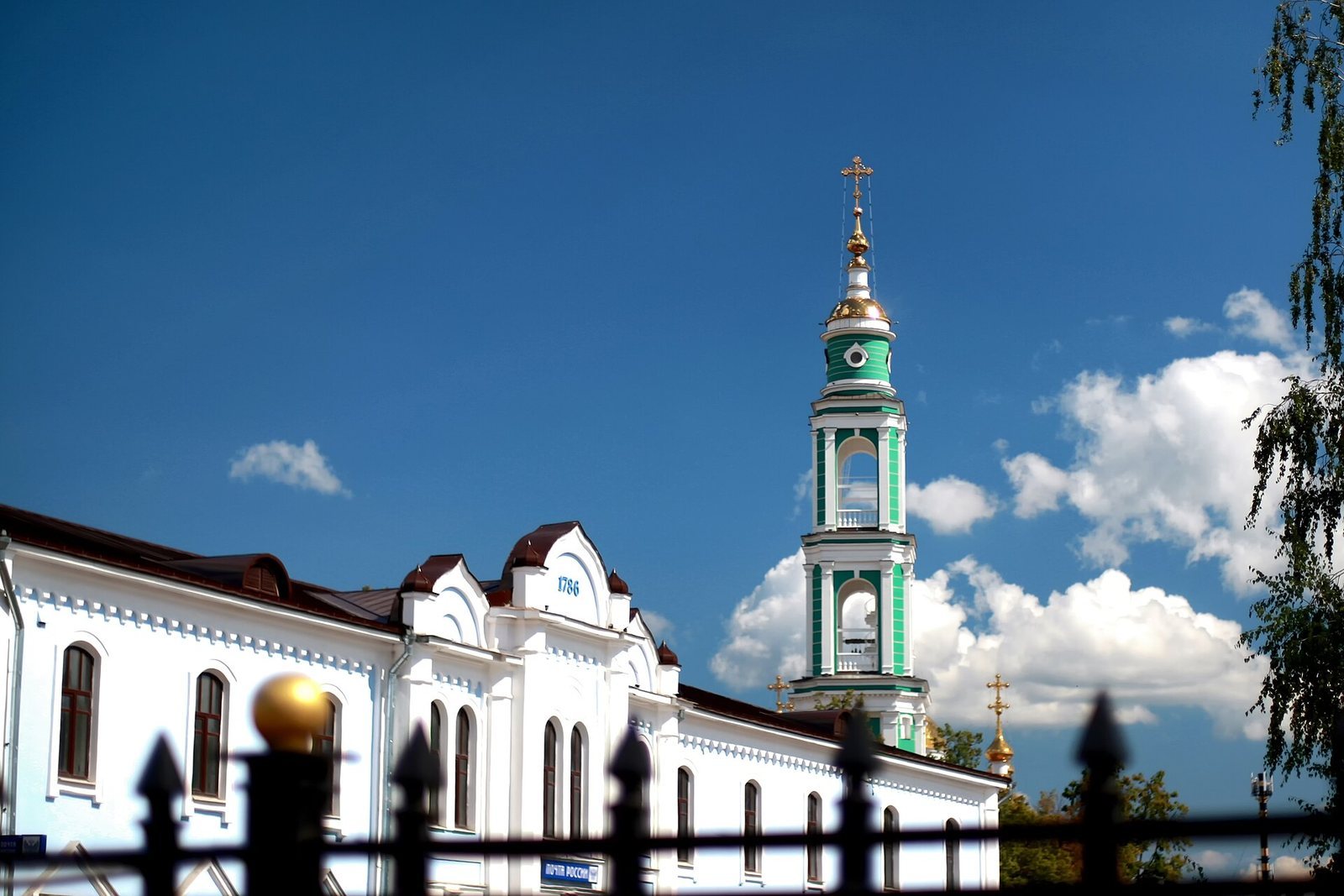
The original free-standing stone belltower stood ten sazhen, a traditional Russian unit of length, from the cathedral. At 42.5 metres high, it was the tallest building in the Tambov Governorate. The Neoclassical tower had three tiers, a tent roof, and a lantern. A four-tier version was reconstructed in 2011 using old photographs and measurements.
Statue of Pitirim
A statue of Pitirim stands beside the cathedral. Sculpted by Moscow artist Aleksandr Rukavishnikov, it was unveiled in 2014.