Spaso-Sumorin Monastery: A Russian Orthodox Monastic Complex in Totma
Site at a Glance
- Popularity
- Medium
- Country
- Russia
- Primary era
- Modern
- Eras represented
- Early Modern, Modern
- Civilizations
- Russian
- Site type
- Religious
- Remains
- Monastery
On this page12 sections
History
Foundation and early development
Spaso-Sumorin Monastery is a Russian Orthodox monastic complex in Totma, Russia, founded in 1554 by the monk Theodosius Sumorin. It served a community of monks within the Diocese of Veliky Ustyug, a church district overseen by a bishop. The monastery was also known as Transfiguration-Sumorin Monastery. Its name referred to its principal Church of the Savior and its founder. Theodosius secured a charter from Tsar Ivan IV, known as Ivan the Terrible, and the blessing of Macarius, the senior bishop in Moscow. With help from Totma residents, he established a wooden church dedicated to the Transfiguration of the Lord, with a steep roof rising to a point and a communal dining hall.
Theodosius died in 1568. A second wooden church, dedicated to the Presentation of the Virgin Mary in the Temple, a Christian feast commemorating Mary’s presentation at the Temple, was built soon afterward. In 1685–1689, the wooden churches were dismantled and replaced by a stone cathedral with a side chapel dedicated to the Presentation. This building campaign marked the start of a period of monumental church construction in Totma.
Relics and monastic life
Theodosius’s relics, bodily remains venerated as sacred in Orthodox practice, were discovered in 1796. A church honoring the Vologda wonderworkers, saints associated with the region and credited with miracles, was established in 1844. The monastery also took on wider responsibilities. The Trinity Hermitage, a small religious retreat founded on Dedov Island in the Sukhona River in 1676, became affiliated with it in 1832. Ivan Kuskov, founder of Fort Ross, a Russian settlement in California, was buried at the monastery in 1823.
By 1909, the monastery provided a hospice for pilgrims, an almshouse for ten people, and a school named for Theodosius. His local feast was observed on 30 September, while processions took place on 30 August, 2 and 5 September, and 28 January. The monastery closed in 1919, and its buildings were put to varied uses, including as a technical school, a military unit, museum departments, and other institutions.
Closure and renewed religious use
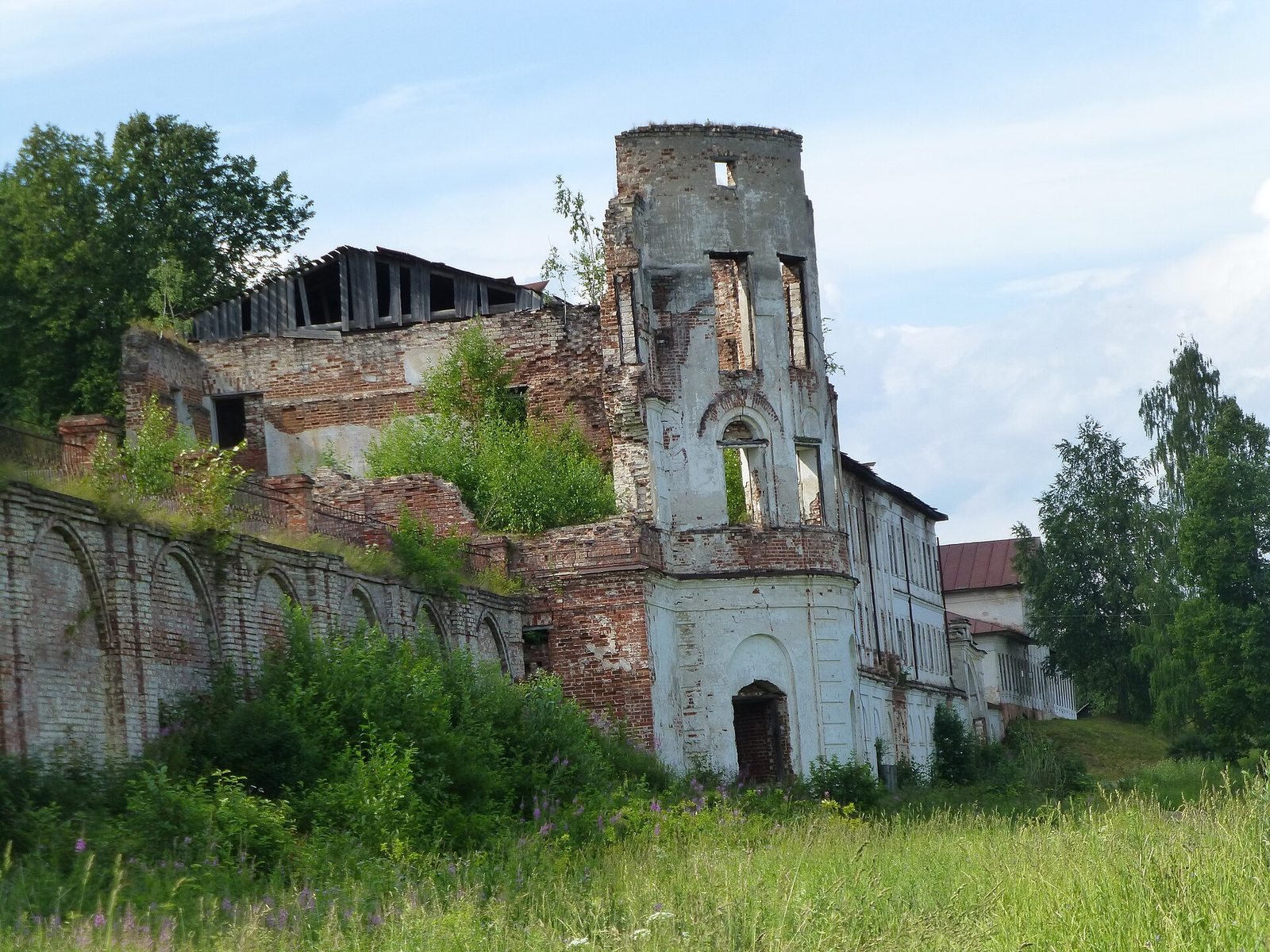
The monastery ensemble received federal cultural-heritage status in 1995. Between 2008 and 2010, growth was cleared from the walls and trees considered at risk of falling were removed. A regional heritage program supported restoration work from 2009 to 2011, with volunteers taking part.
In July 2014, Metropolitan Ignatius of Vologda blessed the monastery’s opening as a bishop’s metochion, a religious establishment under a bishop’s authority, and appointed priest-monk Theodosius Pisarev as its superior. In late 2015, the Ascension and Transfiguration Cathedrals and the north wing of the monks’ residence were transferred to the metochion for 490 years. On 15 September 2016, a solemn procession returned Theodosius’s relics to the monastery. The monastery is active and undergoing restoration.
Remains
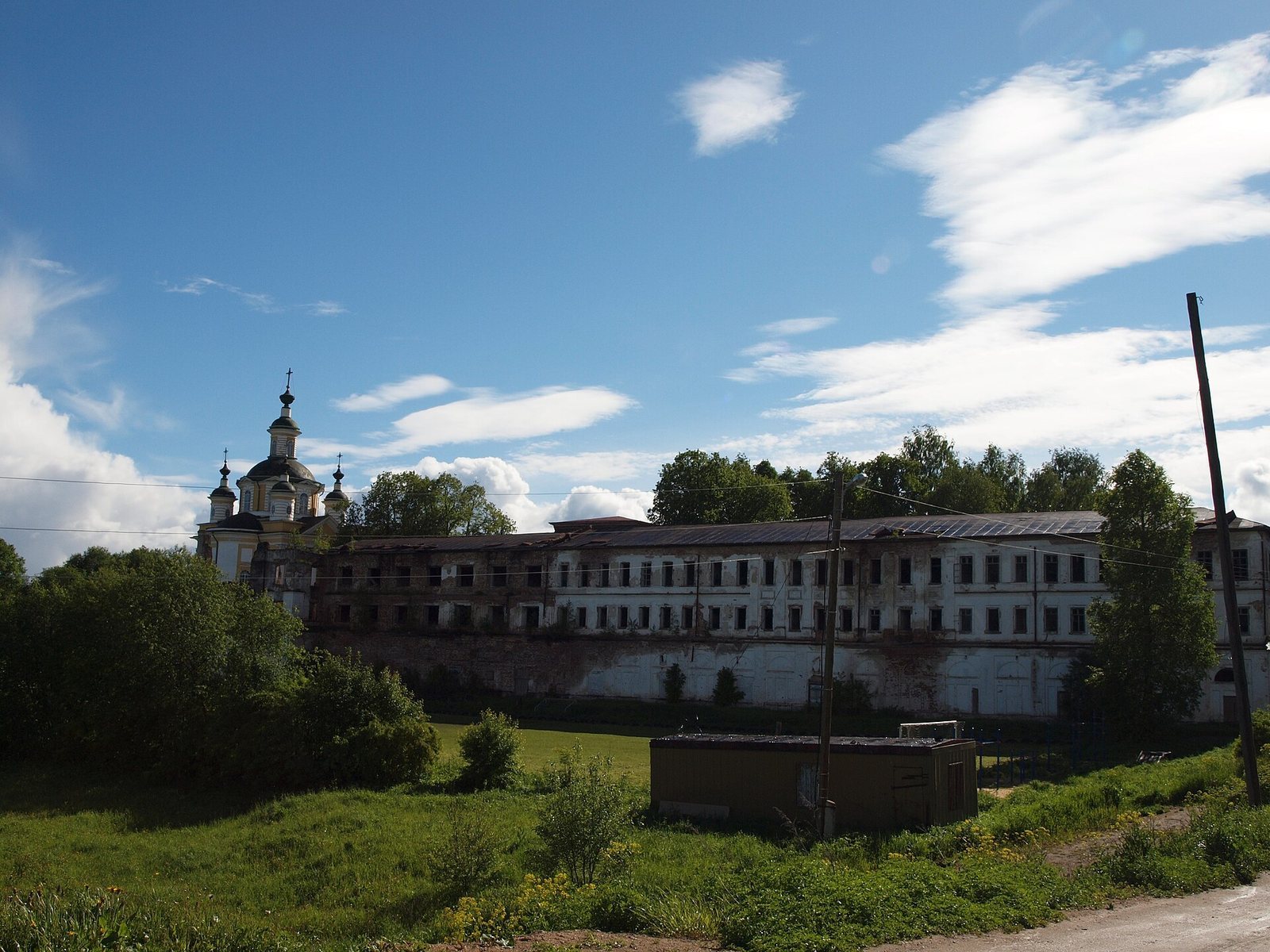
The monastery stands on the bank of the Pesya Denga River in Totma. Its ensemble includes the Transfiguration and Ascension Cathedrals, other churches, a bell tower, and part of the monks’ residential building. The cathedrals reflect different phases of construction and draw on Classical forms associated with ancient Greek and Roman architecture.
Cathedrals
Transfiguration Cathedral
Rebuilt in 1801, the Transfiguration Cathedral took the form of a heated church in the Classical style, with an upper structure crowned by a dome and a smaller dome above it. A major reconstruction from 1876 into the 1880s gave the building greater height, five domes, a new altar area, and elaborate facade decoration drawing on seventeenth-century architecture. Its design has been associated with Konstantin Thon, a prominent nineteenth-century Russian architect.
Ascension Cathedral
The Ascension church was first built of wood shortly after 1690. Its stone replacement, erected in 1757–1764, began to sink and deteriorate because the ground beneath it was weak. A new cathedral was built in 1796–1801 and reached its later form by 1825. In the Late Classical style, it has an extensive dining-hall wing on the west, with side chapels and a columned entrance porch. The interior retains Classical-style plaster decoration on its walls. Paintings made in the 1860s by academic painter Platon Tyurin cover the walls and dome, though they are badly damaged. Vasily Kazakov, son of the architect Matvei Kazakov, has been identified as the cathedral’s designer.
Other churches and monastic buildings
Churches and bell tower
The monastery complex also included a church associated with the communal dining hall, a Church of St John Chrysostom on the bell tower’s second tier, and a Church of the Dormition, commemorating the Virgin Mary’s death in Eastern Christianity. The bell tower was described as about 35 sazhen high, using an old Russian unit of length.
Church of All Vologda Wonderworkers
This church stands over the place where Theodosius’s relics were discovered. Its position connects the building with the veneration of the monastery’s founder.
Residential wing and sacred objects
The north wing of the monks’ residential building remains part of the ensemble. The Ascension Cathedral housed Theodosius’s relics in a precious reliquary, a container for sacred remains, along with an iron cap, ascetic chains, prayer beads, and the Sumorin icon of the Mother of God, a sacred image of the Virgin Mary used in Orthodox devotion.