Church of the Nativity of Christ in Kargopol: An Orthodox Cathedral
Site at a Glance
- Popularity
- Medium
- Country
- Russia
- Primary era
- Early Modern
- Eras represented
- Medieval, Early Modern
- Civilizations
- Russian
- Site type
- Religious
- Remains
- Cathedral
On this page12 sections
History
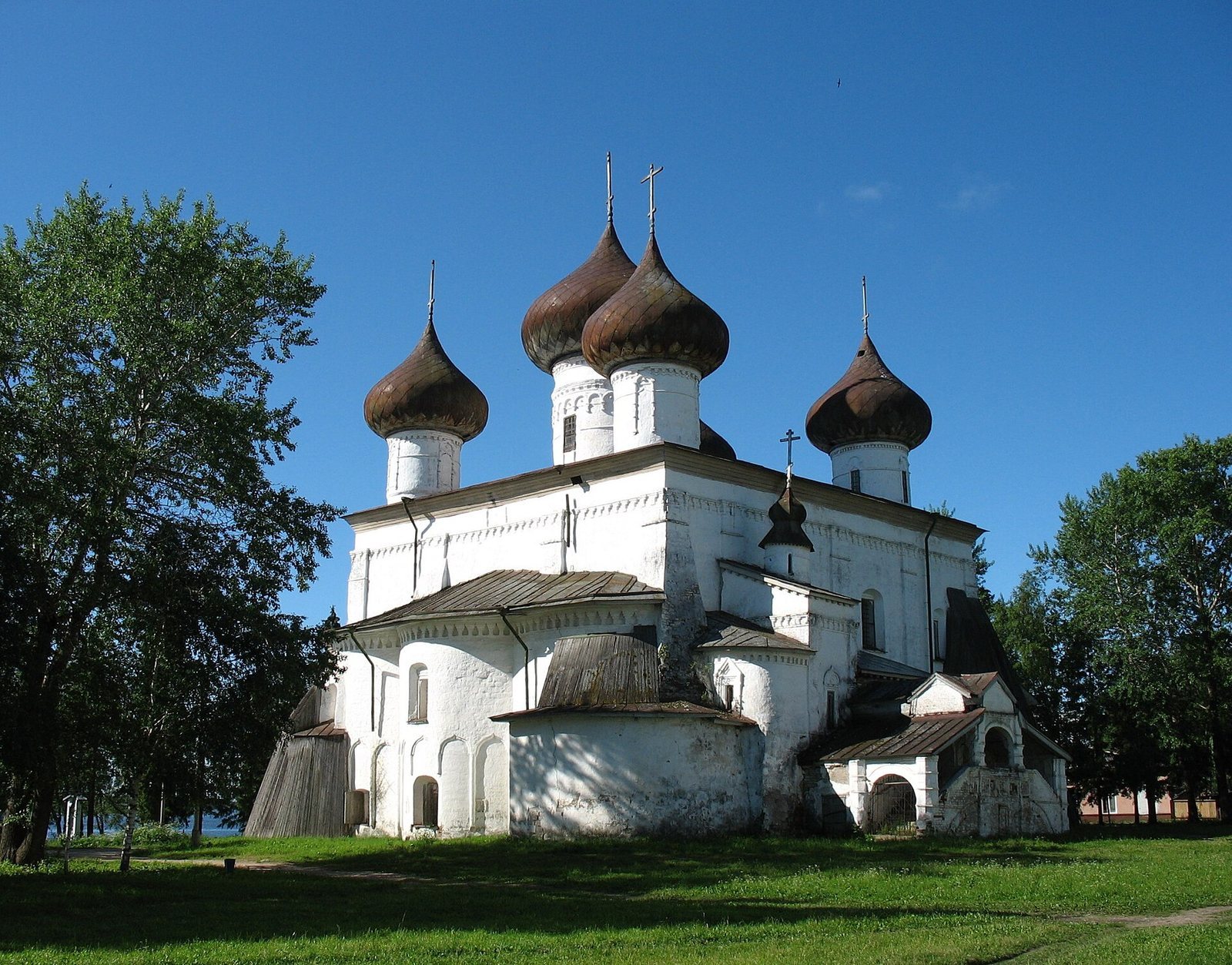
The Church of the Nativity of Christ is an Orthodox cathedral in Kargopol, Russia. Built between 1552 and 1562, probably by craftsmen from Novgorod, it was the town’s first stone building and its principal Orthodox church. Its scale and decoration were intended to express Kargopol’s wealth, and its design followed churches in the Moscow Kremlin.
Construction and expansion
In 1652, a chapel dedicated to Saints Philip and Alexis was added on the cathedral’s north side. Its construction may have been connected with a brief stay there by the relics of Metropolitan Philip, a sixteenth-century Russian Orthodox leader later venerated as a saint. The relics were being taken from Solovetsky Monastery to Moscow on the order of Patriarch Nikon, a seventeenth-century head of the Russian Orthodox Church.
A chapel dedicated to the Merciful Savior was later added on the south side, together with a gallery and covered porch to the west. These additions received rich decoration in the style of the seventeenth century.
Fire and later use
The miraculous Kazan Icon of the Mother of God was kept in the cathedral from 1714 until the late 1920s. A fire in 1765 cracked the walls. Some wall paintings survived the fire, but they suffered damage during the five years the building remained unrepaired and exposed to the weather.
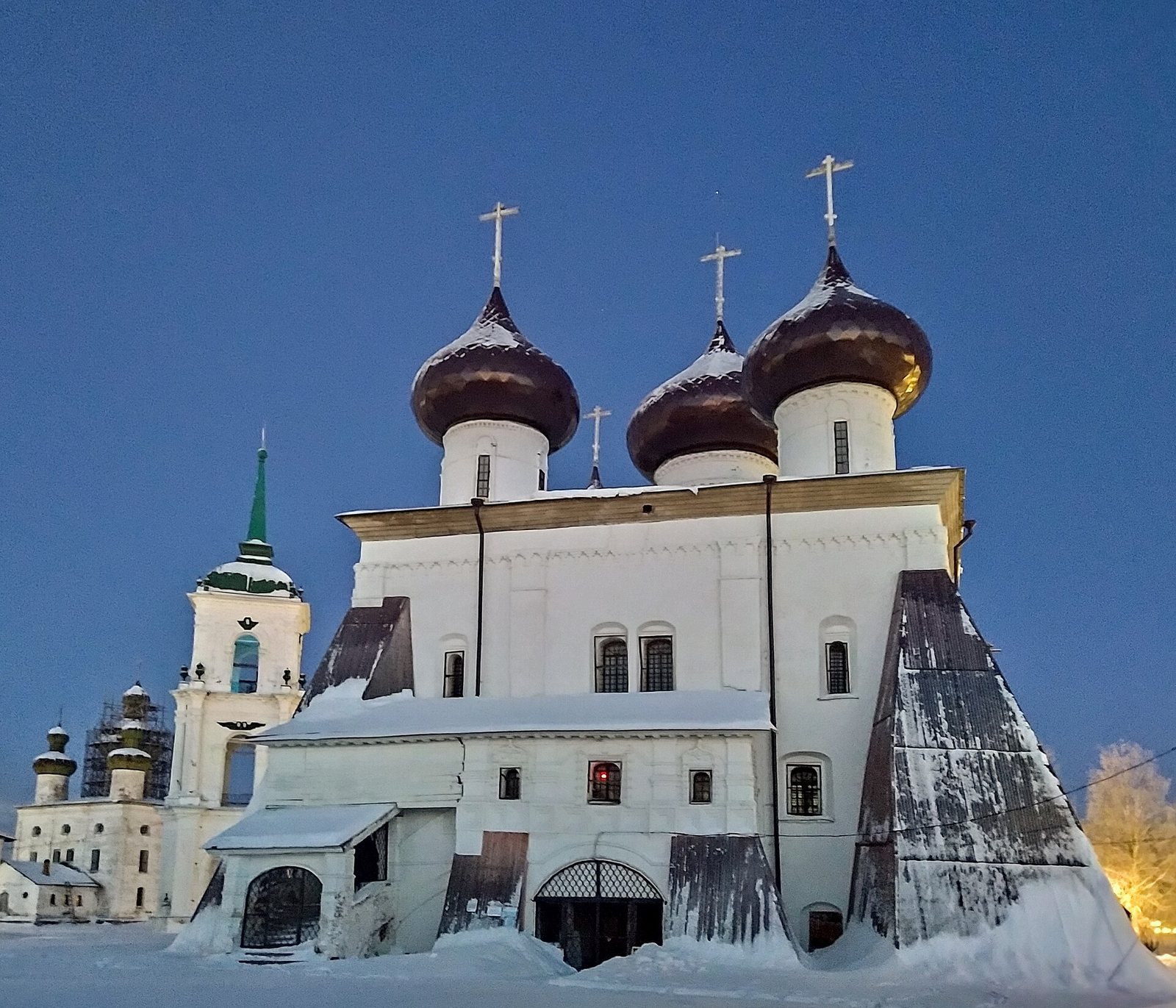
A three-tier bell tower was built in 1778 in honor of Catherine II, empress of Russia from 1762 to 1796. In 1936, the cathedral ceased to function as a church and passed to the Kargopol Historical, Architectural and Art Museum-Reserve. It is now used as a museum and has federal-level cultural heritage protection in Russia.
Remains
Cathedral complex
Main church
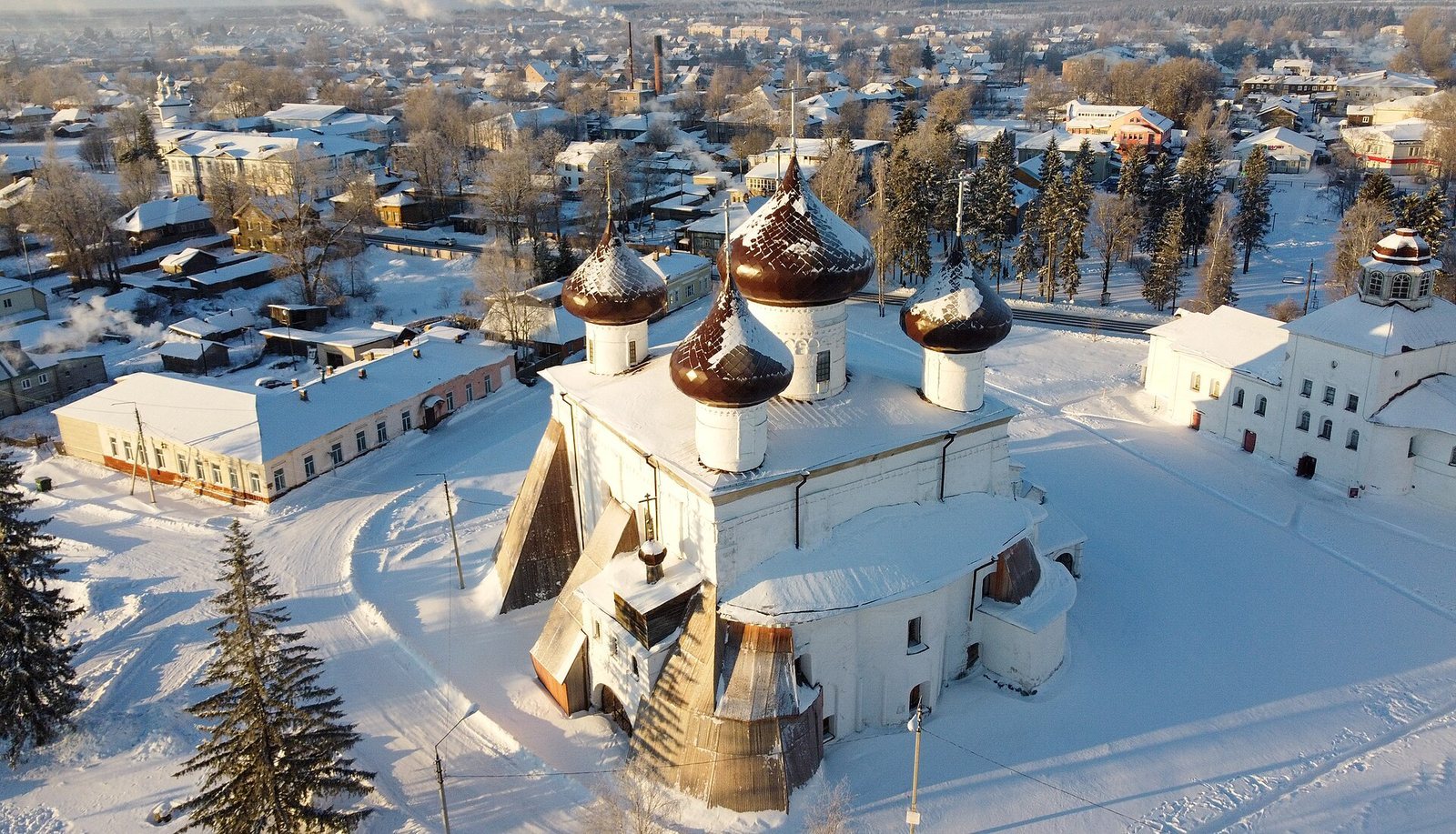
The cathedral combines white stone and brick. Its original plan was a simple rectangle with two levels and a raised lower storey. The square main worship space is supported by six internal pillars and has three apses, projecting ends associated with the sanctuary. Five domes, one central and four at the corners, rest on circular brick drums, the structures that support them, and are topped with crosses. Semicircular and rectangular windows have decorative frames, shallow half-columns divide the facades, and substantial supports reinforce the corners of the main space.
The original roof may have been made of boards with broad eaves. The upper level was an unheated summer church, probably reached by wooden stairs and porches on three sides. Over time, the building settled nearly a metre into the ground.
Chapels and western gallery
The north and south chapels remain attached to their respective sides of the church. A gallery and covered porch extend from the west, with carved white stone among their decorative features.
Bell tower
A three-tier bell tower forms part of the cathedral complex.
Interior and surviving decoration
The first level holds painted ceiling panels from churches and chapels across the Kargopol district. On the second level is a carved, five-tier screen of icons separating the sanctuary from the worship space, dating to the second half of the eighteenth century. A fragment of medieval fresco is visible on the west side. The walls are now painted white, and the icons remaining in the church were installed after 1765.
An iron beam shaped like a hand projects from the central stone drum. A chain attached to it once supported the central chandelier.
Icons associated with the cathedral
The Placing of the Robe of the Virgin
This mid-sixteenth-century icon, now in the Russian Museum in Saint Petersburg, is a northern provincial work of the Novgorod school, a regional tradition of Russian icon painting. Measuring 46 by 38 centimetres, it was painted on a panel prepared with cloth and a ground layer. The Virgin points toward the Church of Blachernae, where the image shows a reliquary containing her robe. A blessing hand of God the Father appears above, while a seven-figure devotional group centers on Christ and includes the Virgin, John the Baptist, the apostles Peter and Paul, and the archangels Michael and Gabriel.
The Nativity of Christ
This icon, also held by the Russian Museum in Saint Petersburg, dates to the second half of the sixteenth century. It measures 180 by 155 centimetres and was painted on a pine panel prepared with cloth and a ground layer. Its northern painting style presents Gospel episodes as a continuous sequence rather than arranging them around a single center. The painter’s approach is direct and folkloric, and the artist may have been among the finest working in Kargopol at the time.
A circular section at the top represents heaven. The scenes include Mary riding a white horse toward Bethlehem with Joseph and a youth; the birth, with Mary reclining beside the infant in a manger; and mounted Magi in the upper corners. Elsewhere, an angel announces the birth to sleeping shepherds, two women wash the infant, shepherds praise him with music, and three Magi bring gifts. At the left, Joseph sits speaking with an old man.