Alexandra Redoubt: A British Supply-Line Fortification in the Waikato War
Site at a Glance
- Rating
- 4.3
- Popularity
- Medium
- Country
- New Zealand
- Primary era
- Modern
- Eras represented
- Modern
- Civilizations
- British
- Site type
- Military
- Remains
- Fort
On this page8 sections
History
Construction during the Waikato War
Alexandra Redoubt is an earthwork fortification near Tuakau, New Zealand, built by British forces in July 1863 during the Waikato War, a campaign within the New Zealand Wars that lasted from July 1863 to April 1864. Before the invasion, Tuakau was a settlement of Ngāti Pou, a Māori kinship group, in the Lower Waikato Valley, north of the river.
On 12 July 1863, the day the British invasion of the Waikato began, Lieutenant Colonel Alfred Wyatt set out from Drury with 300 soldiers of the 65th Regiment of Foot, a British infantry regiment. They reached Tuakau the following day, removed its Māori residents, and built the redoubt. It was named for Alexandra of Denmark, who married the future King Edward VII in 1863.
The fortification protected the side of General Duncan Cameron’s invasion route and guarded a supply line along the Waikato River. Steamers brought food and munitions from Onehunga to Port Waikato, where the supplies were transferred to canoes and taken upriver to Queen’s Redoubt at Pōkeno, Cameron’s base.
The Camerontown attack
After the redoubt was completed, 150 soldiers of the 65th Regiment were stationed there under Captain Richard Swift. On 7 September 1863, about 100 Kīngitanga warriors, supporters of the Māori King Movement, attacked Camerontown, a depot several kilometres downstream. Ngāti Whauroa fighters allied with the British guarded the depot but offered only limited resistance. Camerontown was destroyed, and five British officials who had arrived ahead of a supply convoy were killed. One was the resident magistrate for the Lower Waikato.
Swift led 50 men from the redoubt in pursuit. The party was ambushed, and Swift and several others died. Colour Sergeant Edward McKenna led the surviving British soldiers back to the redoubt. McKenna and Lance Corporal John Ryan later received the Victoria Cross, a British award for bravery.
Abandonment and memorial
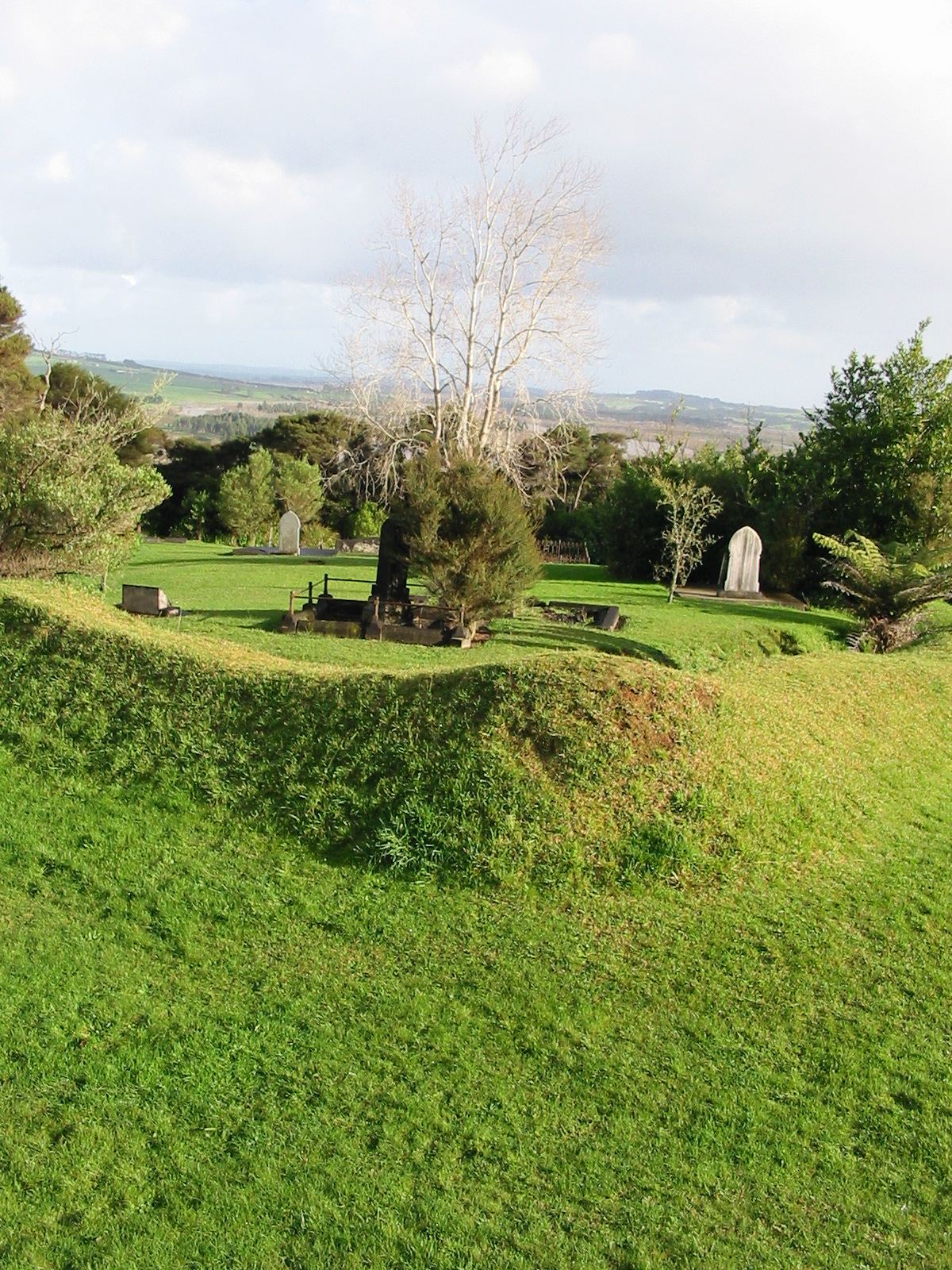
As British forces advanced farther south and the supply route became less vulnerable, the 65th Regiment left the redoubt. A locally organized militia then held it until it was abandoned in October 1864. The adjoining area served as a cemetery. In December 1916, a memorial was unveiled there, and Alexandra Redoubt is now a historic reserve.
Remains
Fortification and commemorative features
Redoubt
The grass-covered earthwork stands on a hill about 100 metres high, roughly one kilometre south of modern Tuakau, overlooking the Waikato River. Its rectangular plan measures about 50 by 20 metres, and the site covers approximately one-third of a hectare. Bastions, projecting defensive works, occupy two corners and were intended to provide coverage on all sides. A stone path runs along the parapet, the protective raised bank of the fortification. The redoubt is in excellent condition.
Cemetery and memorial
The cemetery lies beside the redoubt. Its memorial commemorates British Army and local militia personnel killed at Camerontown and elsewhere in the Franklin District.