Anapa Fortress: Ottoman and Russian Coastal Fortifications
Site at a Glance
- Rating
- 4.9
- Popularity
- Low
- Country
- Russia
- Primary era
- Unclassified
- Eras represented
- Unclassified
- Civilizations
- Unclassified
- Site type
- Military
- Remains
- Fort
On this page10 sections
History
Anapa Fortress was a complex of Ottoman and later Russian fortifications in Anapa, Russia, on the Black Sea coast. It formed part of the Black Sea Coastal Line and changed hands repeatedly during Russian-Ottoman conflicts.
Genoese and Ottoman Rule
In the 14th century, Genoese inhabitants of the maritime republic of Genoa established a fortified trading post on the site of Gorgippia, an ancient city on the northeastern Black Sea coast. Ottoman forces captured the post in 1475 under Sultan Mehmed II. By 1481, a small fortress had been built with the assistance of French engineers.
In 1641, the Ottoman traveler and writer Evliya Çelebi reported that the fortress had no garrison and had been repeatedly plundered by Don Cossacks, communities associated with the Don region. He described it as the residence of the governor of the Taman sanjak, an Ottoman administrative district within Kefe province, named for Kaffa in Crimea. Çelebi put the local population at no more than 300, saying residents paid a tithe only when compelled and were prone to revolt. He connected the name Kevergan, meaning “Diamond Ore,” with pearl-shell gathering along the shore, where he said Russians came each year to collect shells.
Ottoman Expansion in the Eighteenth Century
After the Ottoman Empire lost Crimea and the Right-Bank Kuban, its government sought to reinforce its territories north of the Caucasus. With the approval of local landowner Magomet-Girey Zanov, Ferakh Ali Pasha, a high-ranking Ottoman official and former commandant of Sudzhuk-Kale, oversaw a fortified town and a trading compound for merchants from Constantinople. Five hundred refugee families from Taman assisted in the work. Arrivals from nearby regions and Trebizond, a historic port on the southern Black Sea coast, added to the town’s population.
Russian-Ottoman Struggles
On 21 June 1791, Russian forces led by Lieutenant General Ivan Gudovich captured the fortress by assault. Gudovich ordered its fortifications demolished, its wells filled, and the town’s buildings burned. The Treaty of Jassy, a peace agreement that set terms between Russia and the Ottoman Empire, returned the town to Ottoman control on 29 December 1791. The Ottomans restored the fortress in 1797–1798.
On 29 April 1807, a Russian Black Sea squadron under Vice-Admiral S. A. Pustoshkin and a landing force led by Major General I. P. Govorov stormed the fortress. Over the next six days, Russian forces blew up the fortifications, removed the guns and ammunition, and threw other property into the wells. After they withdrew, Turks and Circassians, peoples indigenous to the northwestern Caucasus, began restoring the stronghold.
On 4 June 1809, a squadron under Captain-Lieutenant Stulli began bombarding the fortress. Before land forces arrived, a landing party commanded by Captain-Lieutenant Perkhunov went ashore, and the fortress surrendered with little resistance. A Russian garrison remained for the next three years. The two-battalion Anapa Garrison Regiment was formed on 19 October 1810, and Anapa was classified as a second-class fortress on 4 June 1811. Under the Treaty of Bucharest, a Russo-Ottoman peace agreement, the town was returned to the Ottomans on 16 May 1812. Before departing, the Russian garrison demolished the principal fortifications and removed the best weapons.
Russian Rule and Demolition
In June 1828, a Black Sea squadron under Vice-Admiral A. S. Greig and a landing force under General-Admiral A. S. Menshikov captured Anapa. The Treaty of Adrianople, another Russo-Ottoman peace agreement setting territorial terms, assigned the town to Russia on 2 September 1829. The fortress was first classed as second-class and later as third-class. Anapa received city rights in 1846. In 1854, its fortifications were finally destroyed because they could not be defended against the Anglo-French fleet, and the garrison withdrew.
Remains
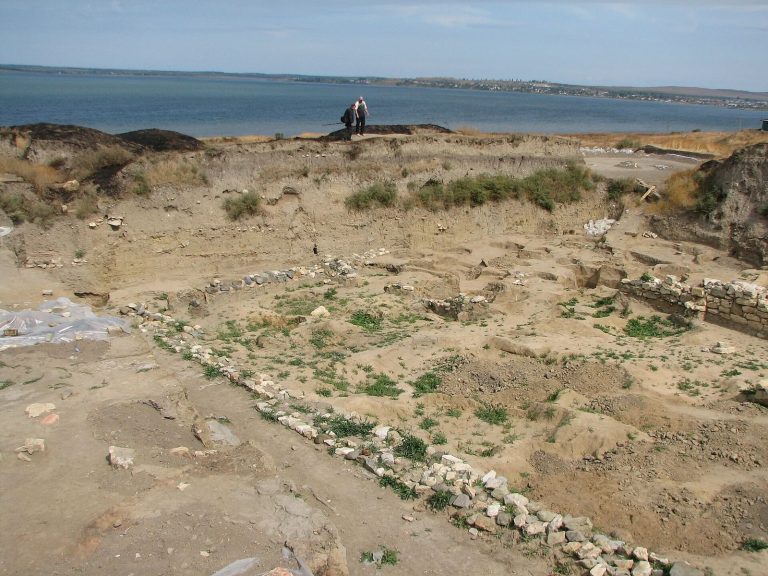
The fortress’s described layout ranged from an enclosed castle and surrounding dwellings to a stronghold on a cape above a harbor. The town also included religious, administrative, and commercial buildings.
Defensive Works
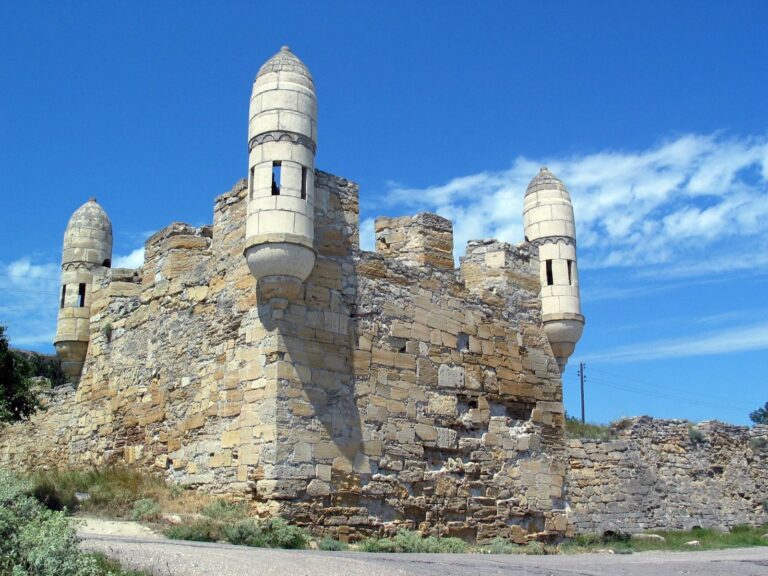
The Genoese trading post consisted of a castle encircled by dwellings and enclosed by a strong wall. The later Ottoman fortress was armed with 12 cannons.
Harbor and Urban Fabric
Harbor
Evliya Çelebi placed the fortress at the tip of a cape, atop a clay cliff. He described it as strong and well built, apparently completed only recently and in good condition. He also praised its large harbor, claiming it could shelter 1,000 vessels tied together and was protected from winds in every direction. In his description, it had no equal on the Black Sea.
Town Buildings
By 1784, the town had three mosques, three bathhouses, administrative buildings, and a library. More than 500 shops and coffeehouses served the town.