Vellore Fort: A Vijayanagara Stronghold in Tamil Nadu
Site at a Glance
- Rating
- 4.3
- Popularity
- Very High
- Country
- India
- Primary era
- Early Modern
- External website
- Open
- Eras represented
- Early Modern, Modern
- Civilizations
- British, Maratha, Vijayanagara
- Site type
- Military
- Remains
- Fort
On this page20 sections
History
Foundation and Vijayanagara rule
Vellore Fort is a fortification in central Vellore, Tamil Nadu, India, built in 1566 by Nayaka chiefs Chinna Bommi Reddy and Thimma Reddy Nayak. The chiefs served the Vijayanagara Empire, a major South Indian power. Nayakas were regional military leaders or governors in the empire.
After Vijayanagara’s defeat at the Battle of Talikota, Chandragiri became the empire’s fourth capital and Vellore gained strategic importance. The Aravidu dynasty, Vijayanagara’s last ruling dynasty, later made the fort an imperial capital, and its rulers lived there during the seventeenth century. In 1614, a coup within the royal family killed Emperor Sriranga II and his family. His son Rama Deva Raya escaped with the aid of supporters. The crisis led to the 1616 Battle of Toppur, fought between rival factions contesting the Raya title, the royal title used by Vijayanagara rulers. The Nayakas of Tanjore, Gingee, and Madurai backed opposing sides.
Bijapur, Maratha, Mughal, and Arcot rule
The Bijapur Sultanate, a Muslim-ruled state in the Deccan, briefly took the fort in the 1640s during the reign of Sriranga III, a different ruler from Sriranga II. The Nayakas of Tanjore helped Vijayanagara regain it. Bijapur captured Vellore again amid conflicts between regional powers in the mid-seventeenth century. This defeat ended the direct line of Vijayanagara emperors.
After a siege lasting fourteen months, the Marathas captured the fort in 1678. Shivaji, founder of the Maratha kingdom, sent a representative who reinforced its defenses. In 1707, the year Mughal emperor Aurangzeb died, a Delhi force led by Daud Khan, a Mughal commander, seized it from the Marathas. The Mughal Empire was a major South Asian empire. In 1710, Saadatullah Khan, the newly established Nawab of Arcot, declared independence. The Nawab ruled the Carnatic, a historic region in southeastern India. In 1733, his successor Dost Ali transferred the fort to one of his sons-in-law.
British garrison and the Vellore Mutiny
The British took possession of Vellore during the Carnatic Wars, eighteenth-century conflicts involving Indian states, Britain, and France. They used it as a major garrison until Indian independence in 1947. In 1780, during the Second Anglo-Mysore War, Hyder Ali besieged the fort. This war formed part of a series of conflicts between the Kingdom of Mysore and the British East India Company and its allies. The Company was a British trading enterprise that had acquired military and territorial power in India. The British garrison resisted for more than two years, until the siege was lifted.
After the Third Anglo-Mysore War in 1792, two of Tipu Sultan’s sons were held at the fort as hostages. Following the fall of Srirangapatnam and Tipu’s death in 1799, other members of his family, including his wife and mother, were detained there as well. On 10 July 1806, Indian soldiers in the British-led Madras Army, known as sepoys, rebelled at Vellore. Regulations requiring them to replace their turbans with new round hats, remove beards, caste marks, and jewelry, and wear hats with cowhide badges were seen as interference with religious beliefs.
Before sunrise, sepoys attacked the European barracks. By late morning, about 15 officers and 100 British soldiers had been killed, and their houses ransacked. Some rebels urged Tipu’s sons to lead them. Cavalry and horse artillery sent from Arcot arrived within nine hours, and the revolt was suppressed by noon. More than 800 mutineers were scattered; about 350 were killed and a similar number wounded. The inquiry that followed resulted in Tipu’s family being transferred to Calcutta and held in isolation. Governor Lord William Bentinck and Madras Army commander Sir John Cradock were recalled. The revolt was the first major military rebellion faced by the British in India, though the 1857 rebellion later overshadowed it.
Captivity and later religious history
Sri Vikrama Rajasinha, the last king of the Kingdom of Kandy in Sri Lanka, was held at the fort with his family for 17 years. The fort also housed royal captives from Mysore.
The temple within the fort served for a long period as an arsenal and remained without a deity until it was sanctified again with an image of Shiva. Muslim prayer is not permitted in the fort’s mosque, a restriction that has prompted protests. In the late 1980s, local Muslim leaders said they did not seek to worship there while supporting the temple’s reopening. The Archaeological Survey of India maintains and conserves the fort.
Remains
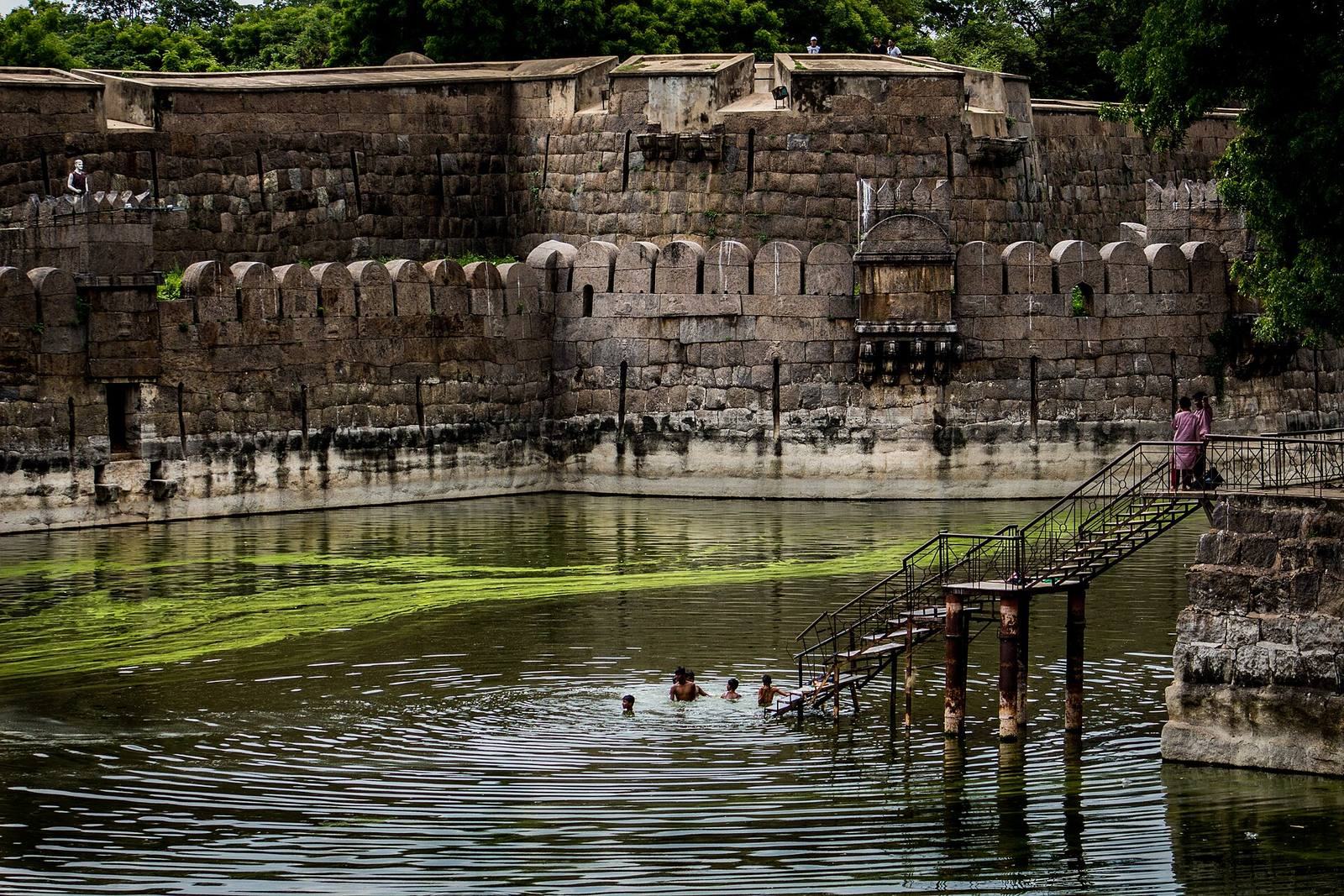
Set within a broken mountain range at an elevation of about 220 m, the fort has a roughly square plan, with sides measuring about 360 m and an area of approximately 13 hectares. Its granite was quarried in the Arcot and Chittoor districts.
Defensive layout
Walls and bastions
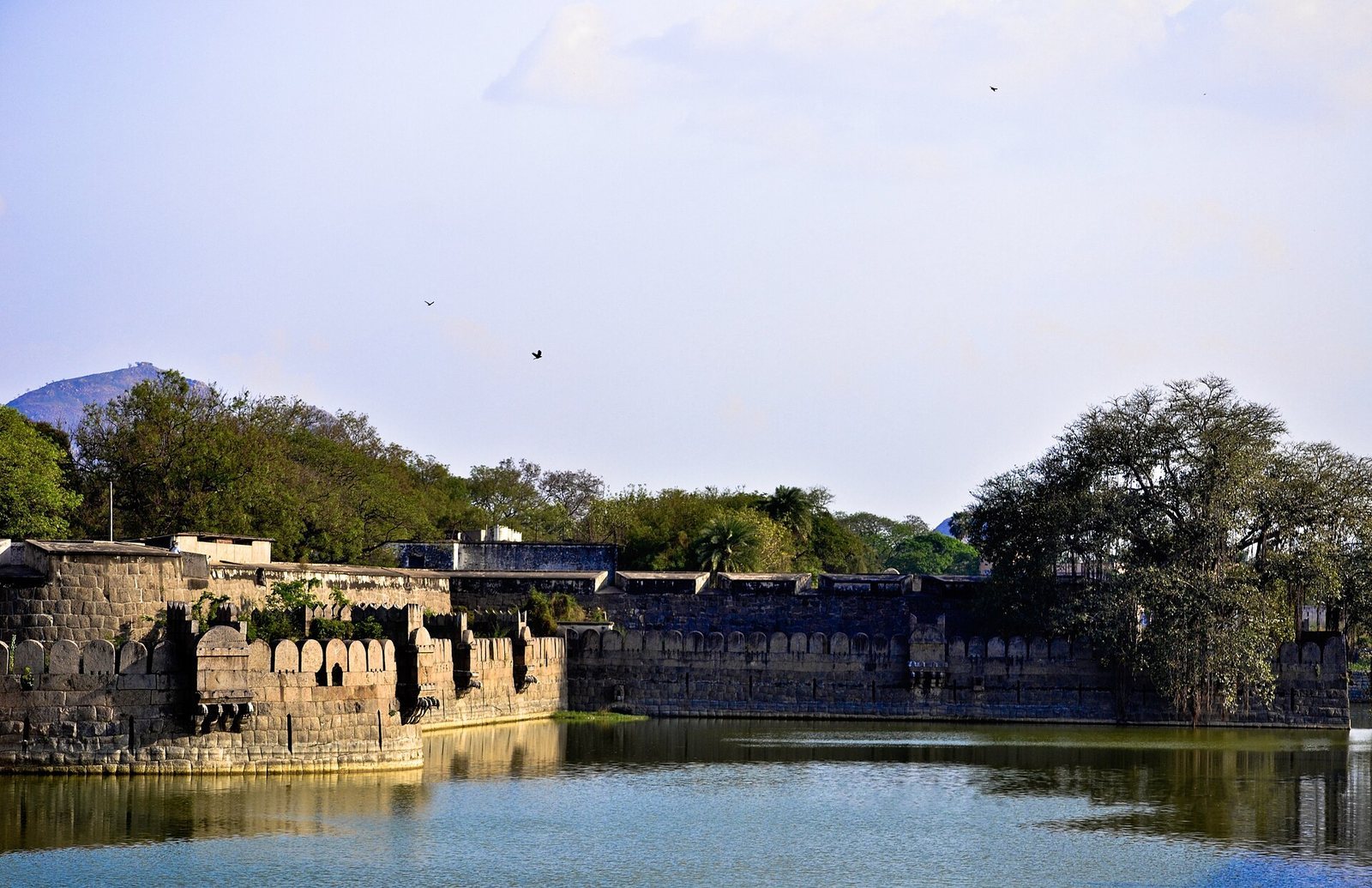
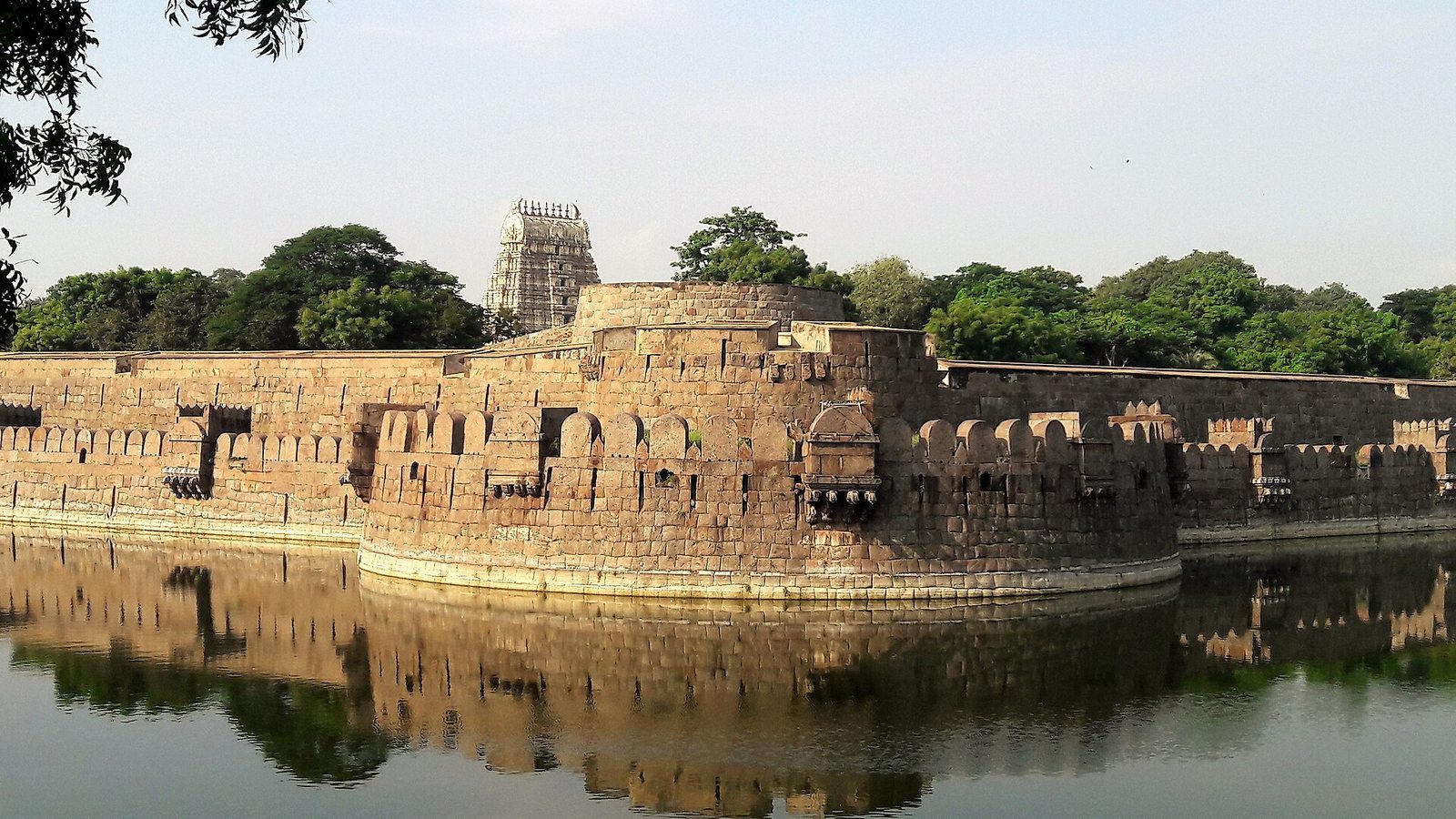
Massive double walls, broad raised ramparts, and irregularly projecting bastions, defensive structures that jut out from a fortification, form the main defensive works. The double walls were wide enough for two carts to pass side by side.
Moat and proposed passage
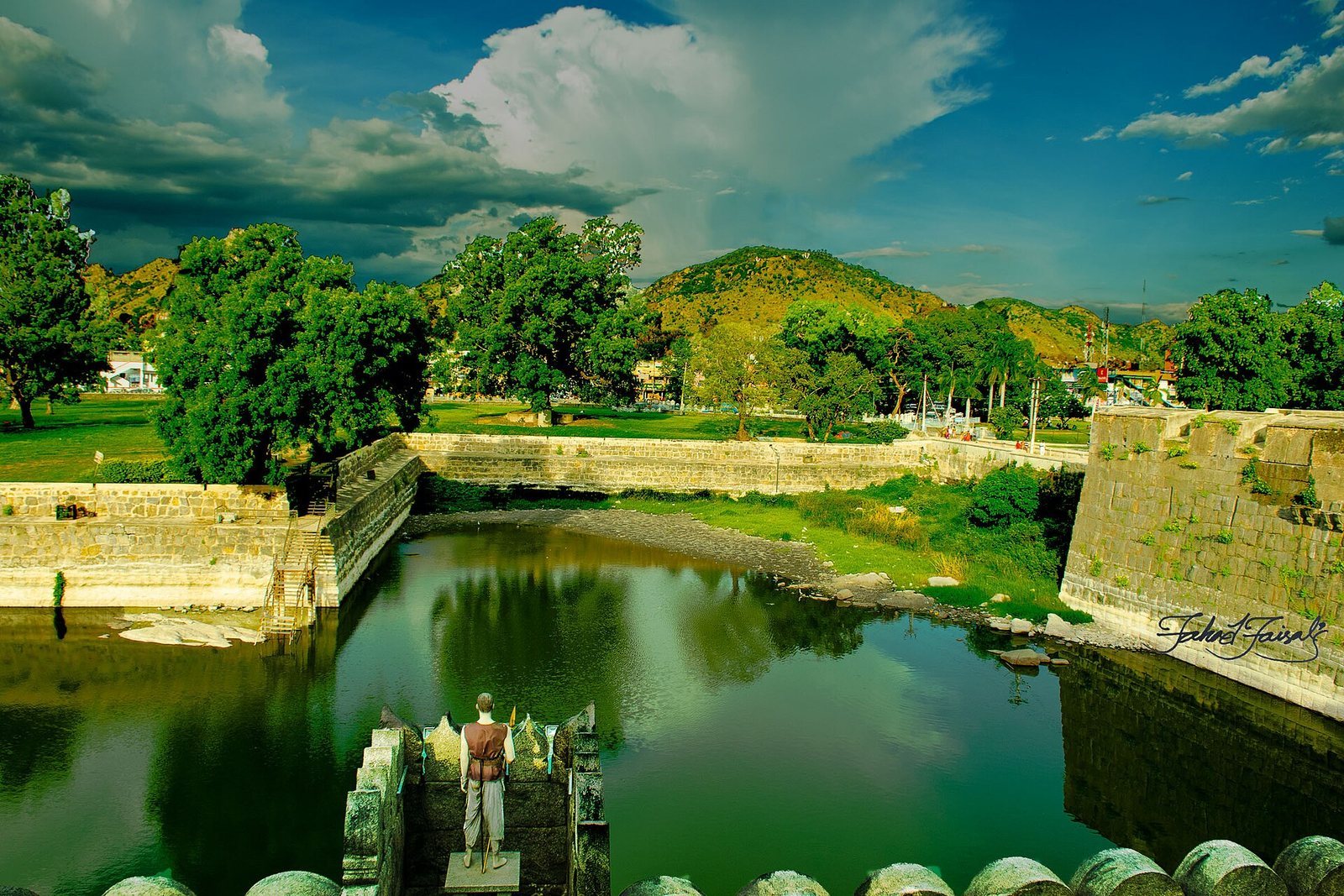
A deep, water-filled moat surrounds the fort. It was reputed to have held 10,000 crocodiles. A passage is traditionally said to have linked the fort with Virinjipuram, about 12 km away, perhaps as an escape route for the king and royal family. Its existence remains unconfirmed.
Religious buildings and church
Jalakanteswarar Temple
Jalakanteswarar Temple, also known as Jalagandeeswarar Temple, is dedicated to Shiva, a major Hindu deity. The deity was originally called Jwarakandeeswarar. Carvings decorate the temple, including a celebrated sculpture in the porch to the left of the entrance.
Mosque
A mosque within the fort was built during the period of the last Nawab of Arcot.
St. John’s Church
The Government of Madras built St. John’s Church in 1846 for officers and men at the East India Company’s military station. Although commonly known by that name, the church was never officially consecrated or formally given it. It is the oldest standing church in the Vellore Diocese, a church district under a bishop.
Prison and royal burial places
Royal prison
A royal prison is located within the fort.
Muthu Mandapam and royal graves
Muthu Mandapam is a memorial built around the tombstone of Sri Vikrama Rajasinha. His grave and the graves of the last Vijayanagara Raya kings are also within the fort.
Tombs east of the fort
About a kilometre east of the fort are the tombs of Bakshi Begum, Hyder Ali’s widow, Padshah Begum, Tipu Sultan’s wife, and Tipu’s sons. Bakshi Begum died in 1806, and the sons died in 1834.
Public and museum buildings
Public offices
Buildings within the fort serve as public offices. They include Tamil Nadu’s oldest police training centre.
Government Museum
A Government Museum is associated with the site. Its collections cover anthropology, botany, geology, numismatics, the study of coins and currency, prehistory, and zoology. A gallery presents monuments from the former North Arcot district.