Palazzo di San Crispino: A Historic Palace in Ferrara
Site at a Glance
- Popularity
- Low
- Country
- Italy
- Primary era
- Medieval
- Eras represented
- Medieval, Early Modern, Modern
- Civilizations
- Papal States
- Site type
- Civic
- Remains
- School
On this page9 sections
History
Palazzo di San Crispino is a fifteenth-century palace in Ferrara, Italy, later used for university-affiliated schools and as a shoemakers’ oratory. Its present architectural character reflects a major neoclassical renovation in the nineteenth century.
Origins and public schools
The building’s construction is dated to the fifteenth century. A separate local tradition credits Charlemagne, the Frankish ruler crowned emperor in 800, with dedicating the site to shoemakers in 808 as a reward for a craftsman’s service.
Until 1561, the palace housed public schools of belles lettres, or literary and humanistic studies, affiliated with the Studium of Ferrara, the city’s university institution. A fire later damaged part of the building. The shoemakers’ guild then had it converted into an oratory, a place for prayer and worship. From 1567, the public school operated instead at Palazzo Paradiso.
Oratory and changing uses
The oratory was dedicated to Saints Crispinus and Crispinianus, Christian patrons of shoemakers, and the building retained their name. Christian tradition describes them as missionaries from Rome who worked as shoemakers and were executed under Emperor Maximian after refusing to renounce their faith. Believers were said to have protected their bodies until the persecutions ended; the saints were then buried in neighboring tombs at Soissons, where a basilica was built over the graves.
After Ferrara’s ghetto was established in 1627, Jews were required to attend compulsory sermons in the building. In 1675, Francesco Ferrari painted a fresco above the loggia showing Charlemagne enthroned beside mounted paladins, legendary knights associated with his court.
Renovation and later use
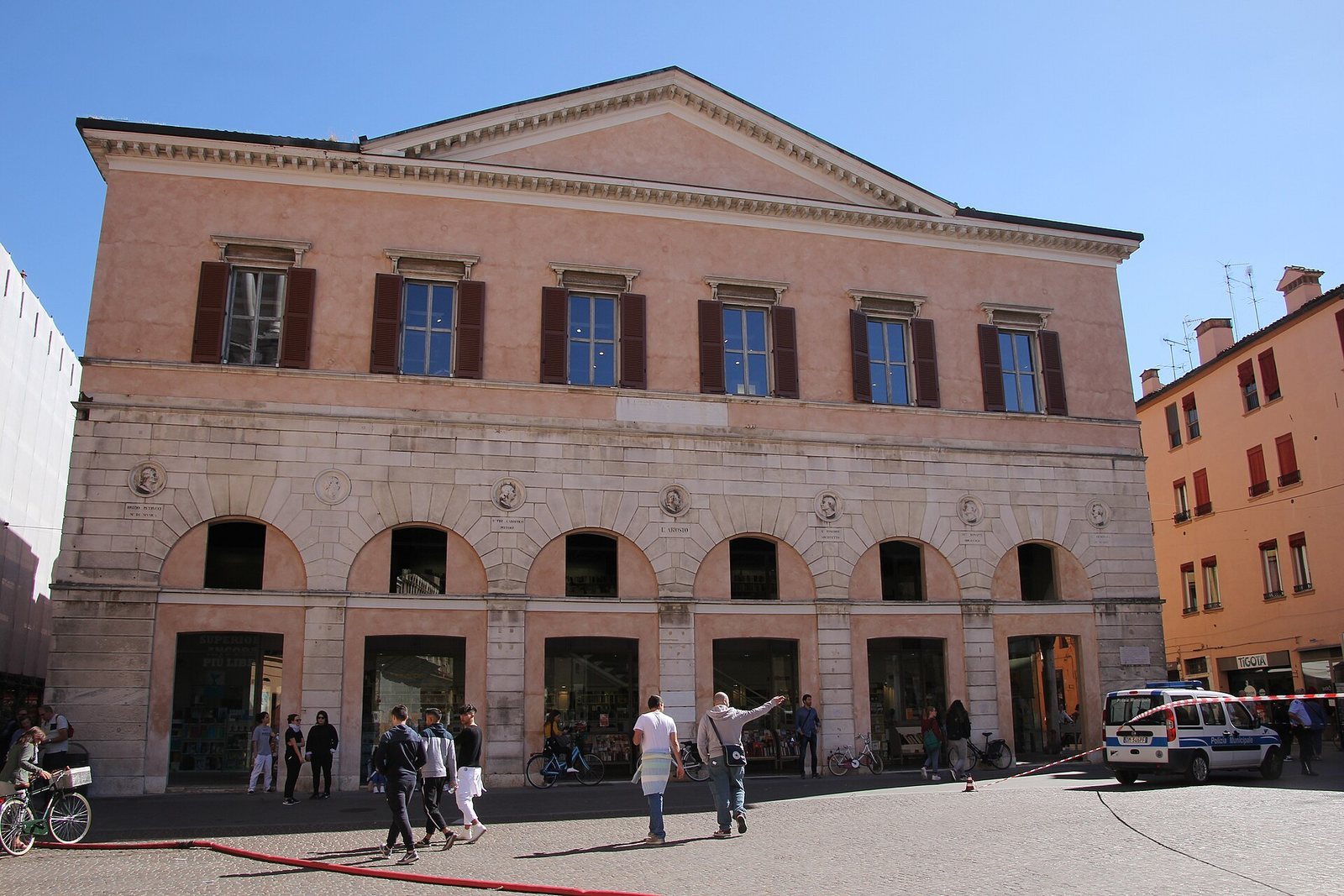
In the nineteenth century, architect Giovanni Tosi substantially renovated the palace and transformed its historic loggia. Restoration of the old portico began in the mid-1970s, paused amid ownership disputes, and later resumed after legal issues were addressed. Since the late twentieth century, the palace has housed a bookshop.
Remains
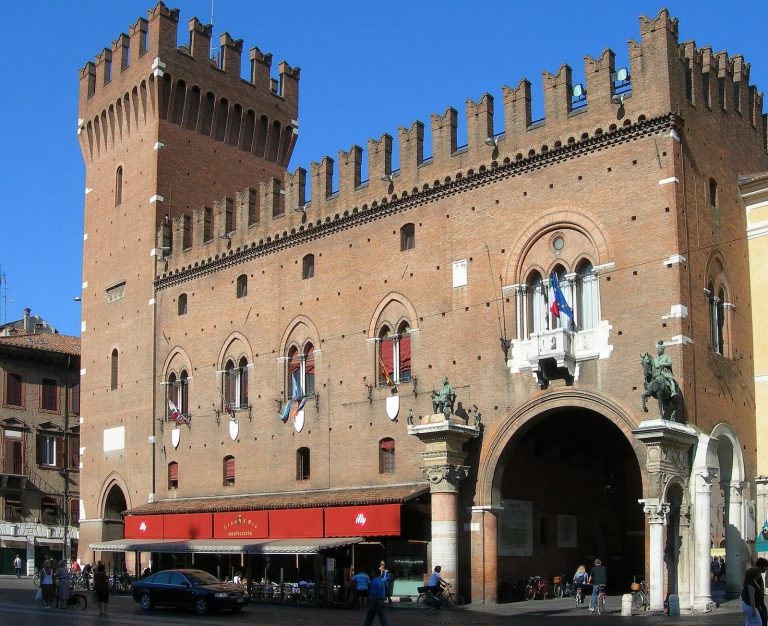
The palace stands on Piazza Trento e Trieste, at the corner of Via Mazzini and Via Contrari. Its surviving features include a street-front loggia, the rear wall, an interior hall vault, and decorated facade.
Architectural and decorative features
Loggia and rear wall
The loggia, a covered space open along one or more sides, has a neoclassical appearance shaped by Tosi’s renovation, and shops were fitted inside it. A wooden ceiling from the sixteenth century survives there. The rear wall preserves remains of medieval shops.
Hall vault
Around 1750, Giuseppe Facchinetti and Francesco Pellegrini painted the Glory of Saints Crispinus and Crispinianus on the hall’s vault. Pictorial and decorative elements from the work were recovered during restoration.
Facade medallions
Tosi designed large medallions representing civic virtues, working with sculptor Gaetano Davia to select notable figures from Ferrara. Renaissance poet Ludovico Ariosto occupied the central position. The side medallions represented Brizio Petrucci, sculptor Alfonso Lombardi, painter Benvenuto Tisi da Garofalo, architect Antonio Foschini, engineer Teodoro Bonati, and art historian Leopoldo Cicognara.