Senatskaya Tower: A Defensive Tower of the Moscow Kremlin
Site at a Glance
- Popularity
- High
- Country
- Russia
- Primary era
- Early Modern
- Eras represented
- Medieval, Early Modern, Modern
- Civilizations
- Russian
- Site type
- Military
- Remains
- Tower
On this page12 sections
History
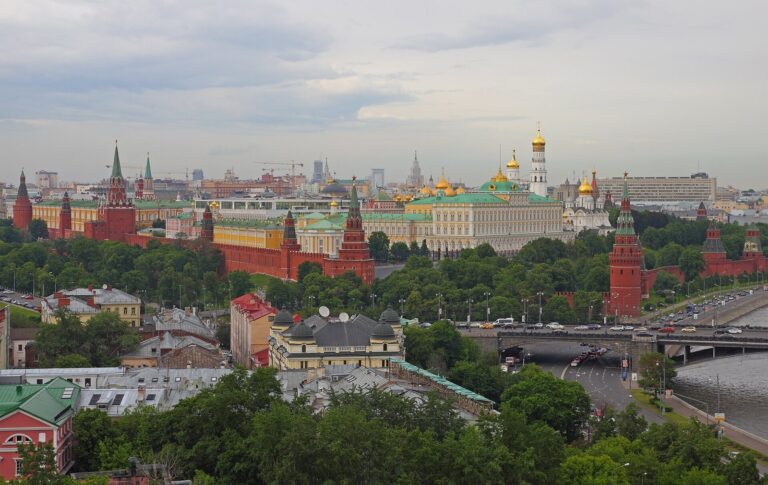
Senatskaya Tower is a fortress tower in the eastern wall of the Moscow Kremlin, facing Red Square in Moscow, Russia. Built in 1491 on the orders of Ivan III and directed by the Italian architect Pietro Antonio Solari, it formed part of the Kremlin’s late fifteenth-century fortifications. The broader rebuilding began in the 1480s, when Ivan III ordered the old white-stone defenses replaced with brick. Work continued under his successor Vasily III into the sixteenth century, as the centralized Muscovite state grew in power.
Construction, defense, and naming
The tower guarded the Kremlin on its Red Square side. In 1508, Vasily III commissioned the architect Aleviz Fryazin to dig a defensive moat linking the Moskva and Neglinnaya rivers. The ditch beneath the tower was also the site of executions of prominent people. Nearby Kremlin grounds contained the court of the Trubetskoy princes, the court of the sovereign’s spiritual confessors, churches, and offices serving the palace administration.
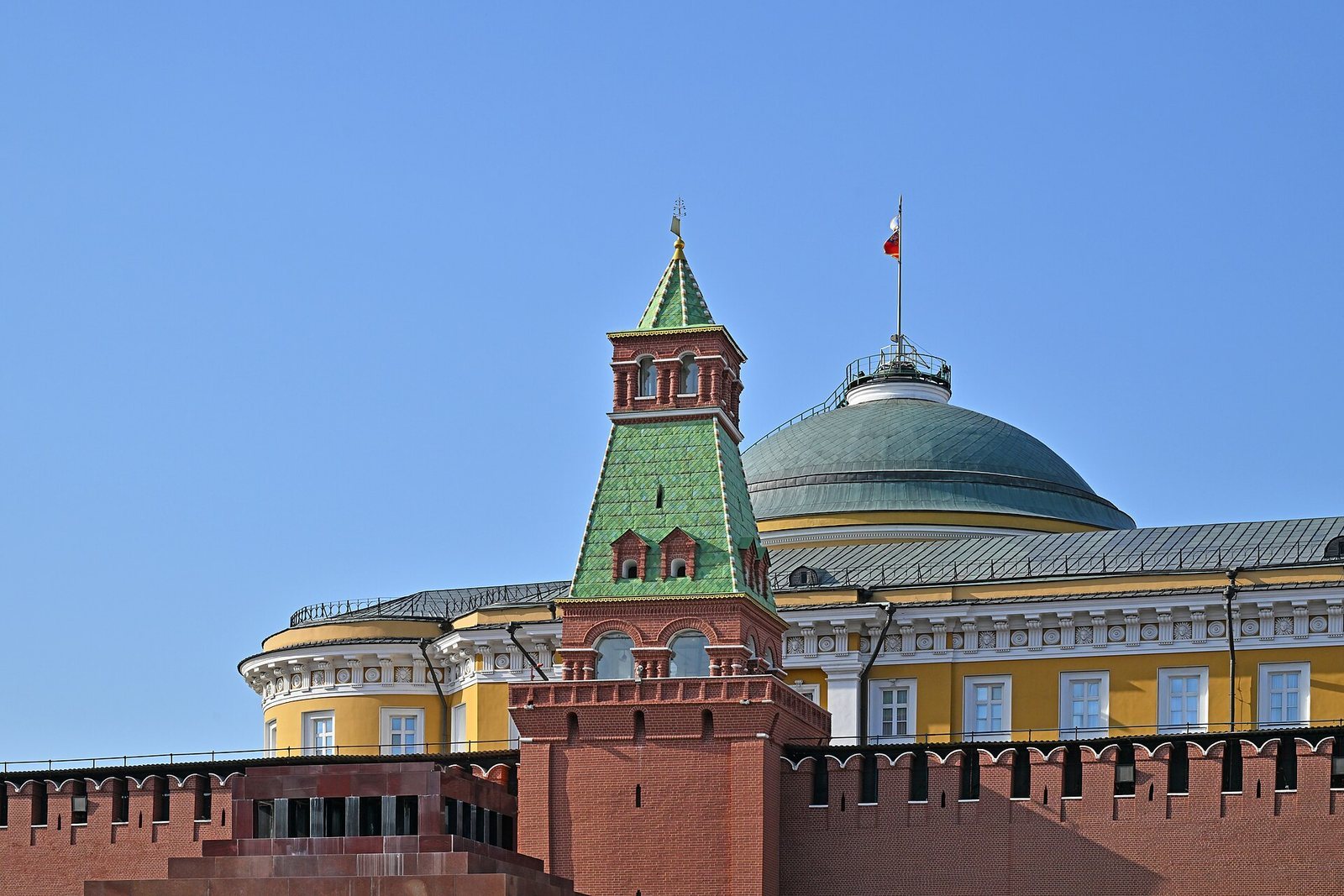
The tower went without a settled name for centuries. An inventory from 1668 called it the Blind Tower, and it was also known as the Nameless Tower. Its present name arose in the 1780s, after the Senate Palace was built opposite it. The Senate was a major governing and judicial institution of the Russian Empire, and the palace served as its Kremlin seat.
From fortress to ceremonial landmark
The tower was rebuilt in 1680, by which time the Kremlin’s towers no longer served as active defenses. Its exterior was repaired and altered repeatedly afterward. Whitewash was renewed in 1781, 1783, 1805, and 1823, while the spire was painted green in 1821. Fire had damaged the facing, and a crack in the lower facade, visible in drawings from the late eighteenth and early nineteenth centuries, was repaired.
As French troops withdrew from Moscow in 1812, they mined Kremlin towers and walls, but the Senatskaya Tower escaped damage in the city’s fire that year. Alexander I approved a general plan for Moscow’s reconstruction in 1817, prepared and carried out by a commission led by architect Osip Bove. After Red Square was restored, a monument to Minin and Pozharsky was erected opposite the tower in 1818. These leaders were associated with the resistance that helped bring the early seventeenth-century Time of Troubles to an end. The monument was later moved nearer St Basil’s Cathedral.
The tower’s central position in the eastern wall made it a focal point for imperial coronation decorations. At Alexander III’s coronation, it displayed a large state coat of arms and a star bearing the emperor’s monogram, both illuminated. A survey and restoration project was prepared in 1860–61; in 1882 the base was repaired and brickwork adjusted. Further restoration followed in 1896 in connection with Nicholas II’s coronation. In 1915, architect Alexey Shchusev criticized a completed roof restoration. He and restorer Pyotr Pokryshkin examined the Kremlin tower roofs and recommended tile coverings.
Revolution and Soviet-era changes
After Bolshevik forces took the Kremlin in October 1917, a burial and memorial ground developed along the wall beside the tower. Urns containing the ashes of prominent Soviet figures were placed in the wall on both sides. Mikhail Kalinin, Felix Dzerzhinsky, Mikhail Frunze, and Andrei Zhdanov were buried at the tower’s foot. A restoration campaign involving architects Ilya Bondarenko and Ivan Rylsky took place in 1918–20, and a comprehensive assessment of the Red Square-facing walls and towers followed in 1923.
The Soviet period also brought the construction of Lenin’s Mausoleum in Red Square and a passage through the tower for members of the Communist Party’s Central Committee, its governing body. Proposals to alter the tower included sculptor Sergey Merkurov’s idea of shortening it to support a statue of Lenin, and architect Arkady Mordvinov’s suggestion of placing a statue of Stalin on it.
Conservation and heritage status
Further restoration took place in 1973 and 2016. The later work strengthened the brickwork, renewed waterproofing, repaired the white-stone decoration and reinforced the Kremlin’s swallowtail-shaped battlements; workers also checked the old foundations. Senatskaya Tower is a federal-level Russian cultural heritage property. As part of the Moscow Kremlin ensemble, it is included on the UNESCO World Heritage List.
Remains
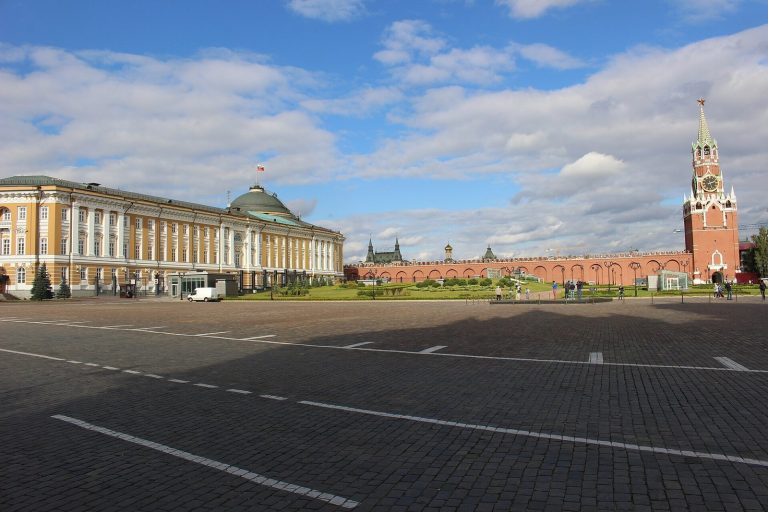
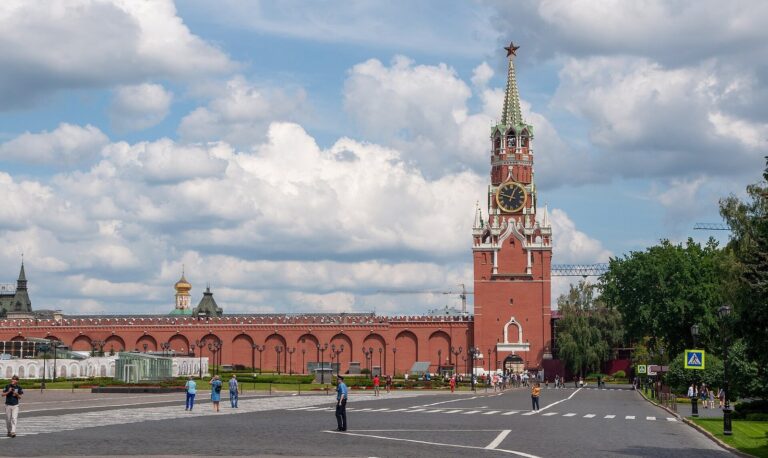
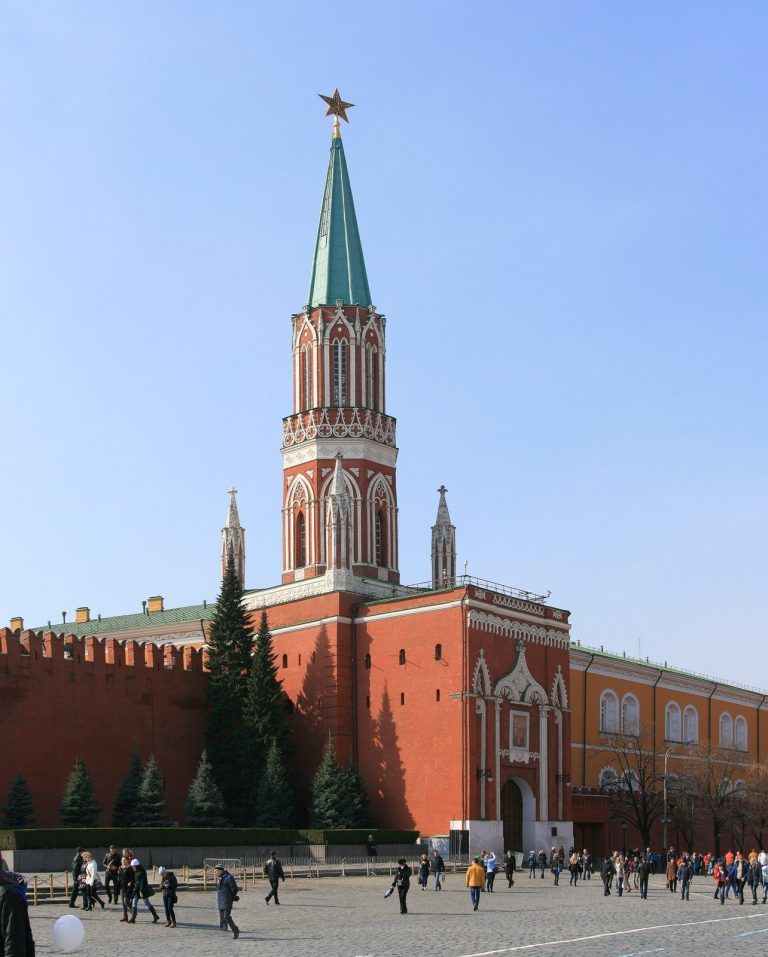
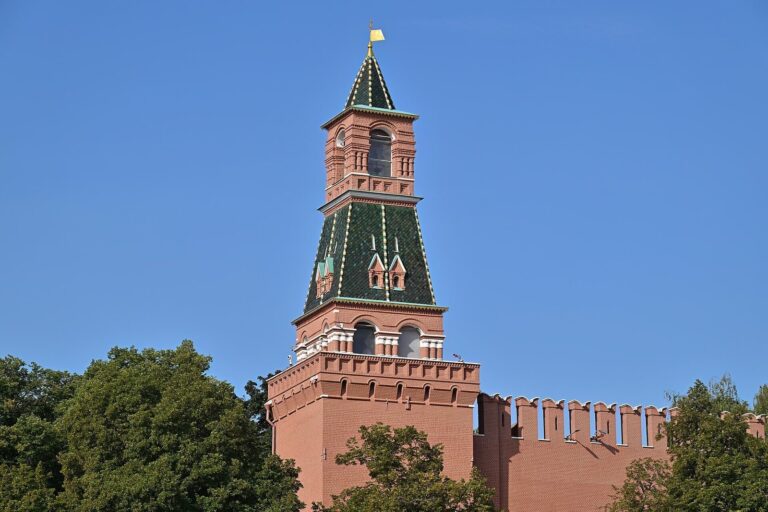
Senatskaya Tower stands between the Spasskaya and Nikolskaya towers in the center of the Kremlin’s eastern wall. Its square base rises 34 metres, and its walls are four metres thick. It has no gate. Inside, three levels contain square rooms with vaulted ceilings.
Tower structure and defensive features
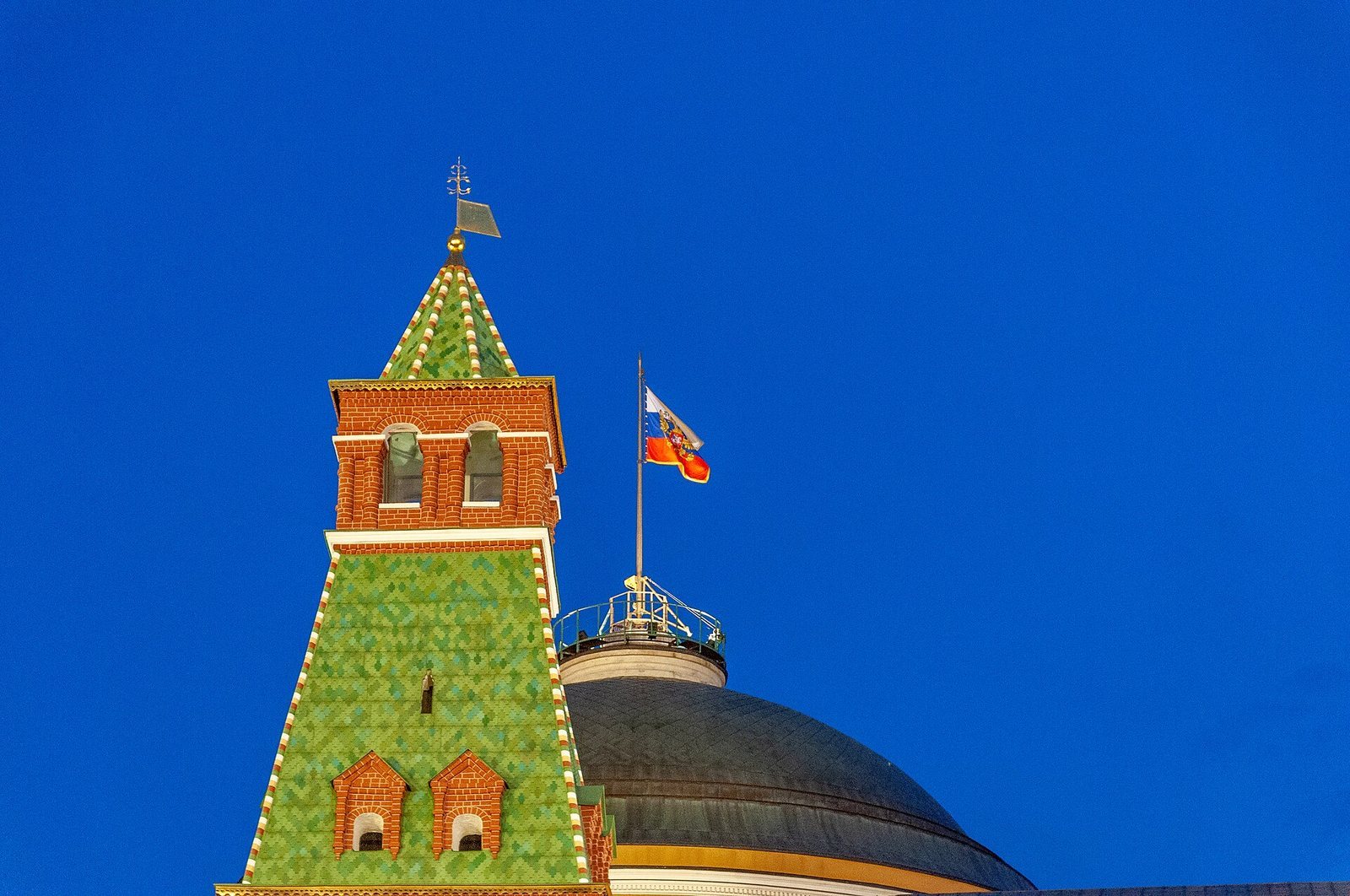
In the fifteenth and sixteenth centuries, three levels of narrow openings allowed defenders to fire toward the front of the tower. A fighting platform with battlements and guns stood above them, sheltered by a low wooden roof and topped with a weather vane. The 1680 rebuilding gave the lower section a low protective wall with projecting openings through which defenders could attack below. Above it rose a four-sided tent roof and a smaller upper roof with a gilded weather vane. The defensive openings were blocked from inside, and the battlements were replaced by a brick parapet with recessed rectangular panels. The tower’s tent roof now has a copper covering.
Moat and foundations
The moat dug in 1508 reached a depth of 30 metres beside the tower and extended from the Moskva River to the Neglinnaya River. Small battlemented walls followed its edges. The moat and the buttresses beside the Kremlin wall at the tower’s base were dismantled in 1824.
Memorials and the Mausoleum
Memorial relief
A memorial relief installed on the tower on 7 November 1918 honored those killed in the October 1917 fighting and buried by the Kremlin walls. Measuring seven by eight arshins, a traditional Russian unit of about 71 centimetres, it showed a winged figure representing Victory with a red banner and palm branch. Weapons and a mourning ribbon lay at the figure’s feet. Behind its shoulder, the rising sun’s rays carried the words “October 1917 Revolution.” The relief was removed in 1948 and transferred to the Russian Museum.
Worker statue
For the fifth anniversary of the October Revolution, sculptor Friedrich Lecht created a statue of a worker holding out his cap as if greeting demonstrators. It stood beside the tower until March 1924, when it was removed during construction of Lenin’s Mausoleum.
Lenin’s Mausoleum and passage
The first wooden version of Lenin’s Mausoleum, a memorial and burial structure for Bolshevik leader Vladimir Lenin, stood on the tower’s axis in Red Square. It was 12 metres high, about one-third the tower’s height. During construction of a later version in 1929, a subterranean space more than six metres deep was found beneath the tower. In 1948, a passage was made through the tower for members of the Communist Party’s Central Committee.