Kinloch Castle: An Edwardian Country House on Rùm
Site at a Glance
- Popularity
- Very High
- Country
- United Kingdom
- Primary era
- Modern
- Eras represented
- Modern
- Civilizations
- British
- Site type
- Domestic
- Remains
- Castle
On this page15 sections
History
Kinloch Castle is an Edwardian country house at Kinloch on the island of Rùm, Scotland, United Kingdom. Commissioned by George Bullough as a private residence, it was completed in 1900 with a Tudor-inspired exterior and castle-like battlements. Its story reflects Rùm’s shift from sheep farming to elite hunting, as well as the wealth and landholding power behind the island’s sporting estate.
Sheep farming and estate change
In the early nineteenth century, Rùm belonged to Alexander Maclean of Coll. During the Napoleonic Wars, conflicts between Napoleon’s France and European coalitions from 1803 to 1815, island kelp was processed into soda ash used in explosives. When the market price collapsed, Maclean leased Rùm to his relative Lachlan Maclean for sheep farming. The Highland Clearances, the removal of rural communities as estates were reorganized, reshaped the island. By 1828 its former residents had been cleared; the population had been 443 in 1795. Tenants from Skye and Muck were brought in to work the sheep farm.
Lachlan built Kinloch House before giving up the lease in the late 1830s. In 1845 Hugh Maclean of Coll sold the island to James Gascoyne-Cecil, 2nd Marquess of Salisbury. Salisbury reorganized the sheep farm, built cottages linked by roads to a pier at Kinloch, and brought red deer and other game back to the island. The estate passed to his son, Viscount Cranborne, and then, after Cranborne’s death in 1865, to his brother Robert, later 3rd Marquess of Salisbury and prime minister. Robert sold Rùm to Farquhar Campbell of Aros in 1870. As sheep farming became less profitable, hunting increasingly defined the estate.
The Bulloughs and the castle
John Bullough took the island’s shooting lease in 1879 and purchased Rùm in 1888, intending to establish a hunting reserve. He introduced deer and game birds and planted trees. When he died in 1891, his son George inherited the island. George commissioned Kinloch Castle as a luxurious private home. Construction began in 1897, employing 300 men from Eigg and Lancashire, and the house was finished in 1900. The project cost £250,000, and further changes followed George’s marriage in 1903.
George and his friends used the castle during the annual shooting season. During the Second Boer War, fought between the British Empire and Boer republics in southern Africa from 1899 to 1902, he lent his yacht, Rhouma, to carry wounded soldiers to the castle as a hospital ship. He received a knighthood in 1901 for this service.
Decline, conservation, and interpretation
Use of the castle diminished after the First World War, and the estate fell into neglect. Rùm’s population fell from 100 in 1900 to 28 in 1951. After Sir George’s death in 1939, trustees managed the island and castle. They sold the estate in 1957 but kept the family mausoleum; George’s widow, Monica, was buried there beside him in 1967.
The Nature Conservancy bought Rùm and designated it a National Nature Reserve, a protected area for nature conservation, in keeping with Lady Bullough’s wishes. The island and castle passed to Scottish Natural Heritage in 1992; the agency is now called NatureScot. The Kinloch Castle Friends’ Association formed in 1996 to help safeguard the building. A restoration scheme pursued after the castle appeared in the BBC competition Restoration in 2003 did not proceed, but repairs were made in 2010 and 2011. The rear section’s use as a hostel ended in 2015, and NatureScot manages the castle with support from the association.
The castle was listed as a Category A building in 1971, Scotland’s highest listing category for buildings of special architectural or historic interest. Its grounds entered the Inventory of Gardens and Designed Landscapes in Scotland, the national record of notable designed landscapes, in 2003. A 2002 assessment emphasized the surviving evidence of wealthy sporting life and interpreted the castle as a monument to Highland landowner power and newly acquired wealth. It judged the plan unusual but functional, and the design and construction technically conventional. Nature writer Jim Crumley offered a sharply different judgment, condemning the building as a monument to wealth, ego, and greed.
Remains
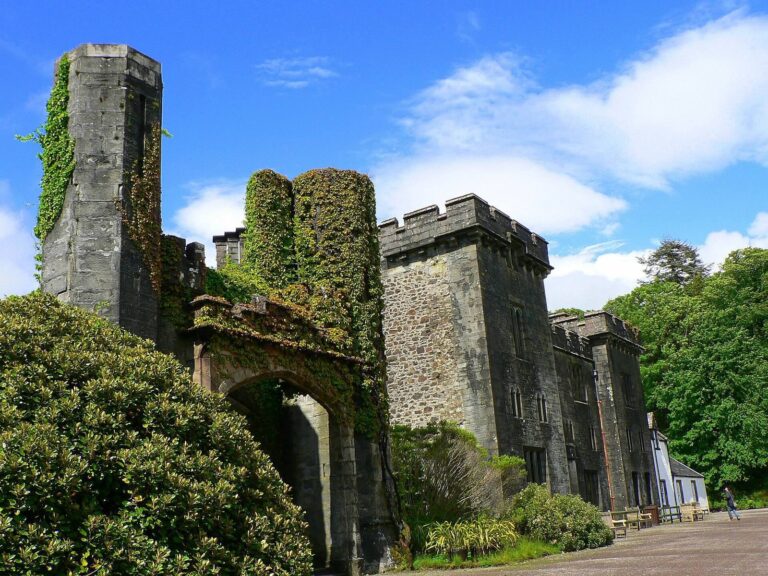
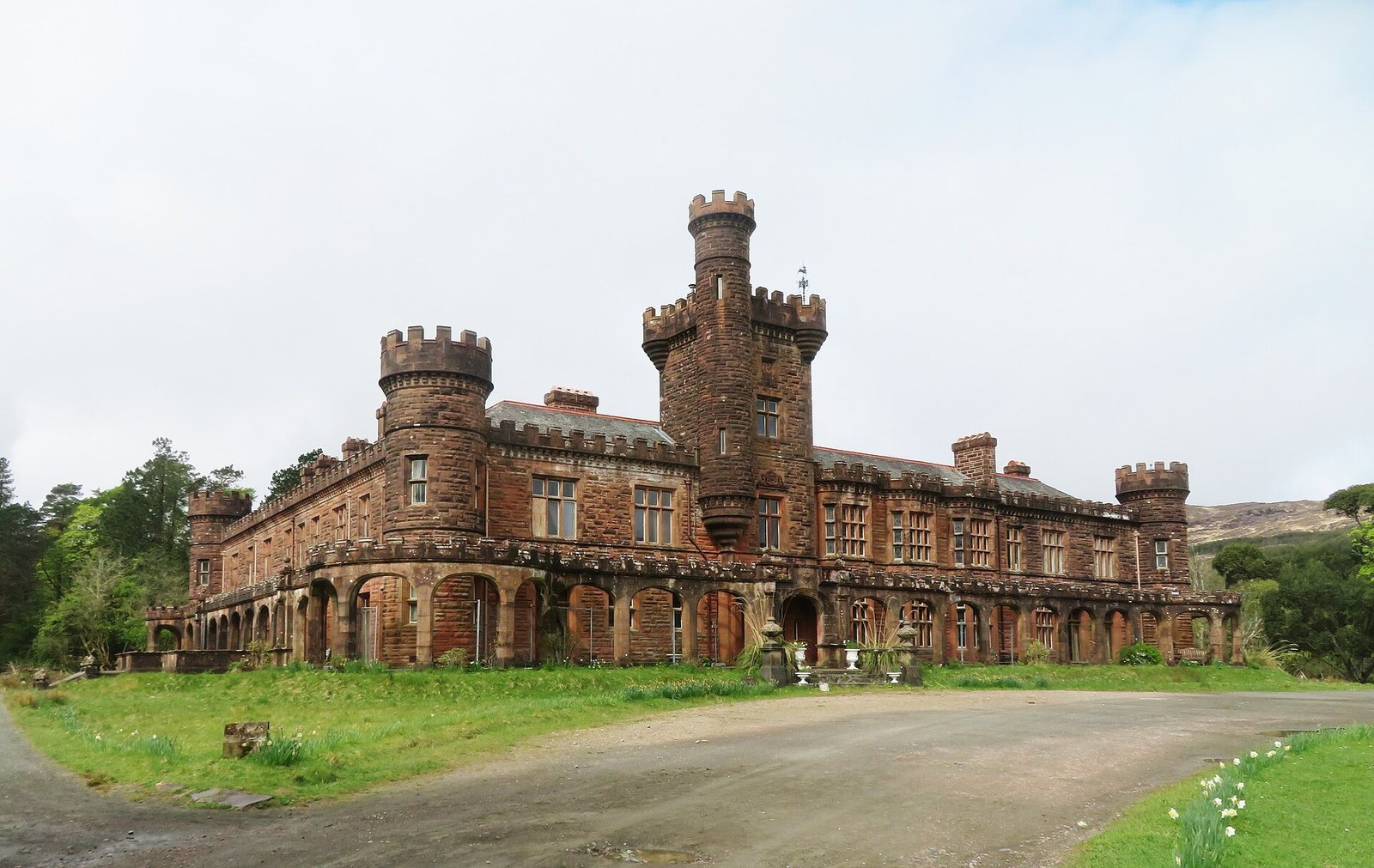
The castle stands within its estate at Kinloch. Its red sandstone exterior, built with stone from Annan in Dumfries and Galloway, combines the form of an Edwardian country house with Tudor-inspired details and castle-like battlements. The surviving estate features include gardens, earlier houses, cottages, a shooting lodge, and the Bullough family’s temple mausoleum.
The castle and its interior
Main house
The main house was designed as a private residence, with a Tudor-inspired exterior marked by battlements. Its walls are made of red sandstone brought from Annan. The castle had its own electricity supply as well as plumbing, heating, and telephone systems.
Interior features
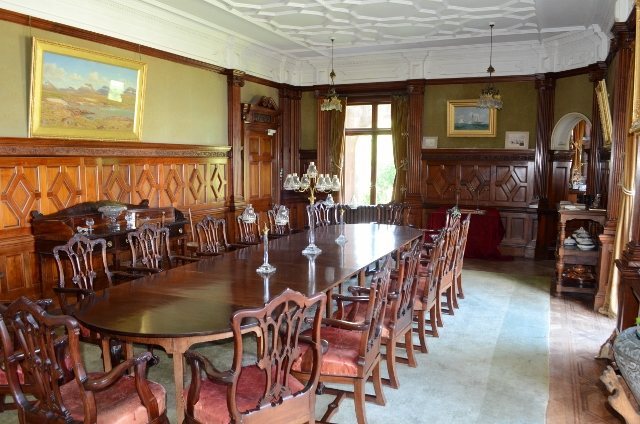
A German-made orchestrion, a mechanical instrument that plays music automatically, was installed to provide music in the hall and is also described as being beneath the stairs. The castle is associated with a variety of gifts from the Emperor of Japan.
Hostel section
A rear part of the building, separate from its museum rooms, served as a hostel until 2015. It contained bunk rooms and a small number of Oak Rooms furnished with four-poster beds.
Gardens and estate structures
Gardens
By 1912, formal and informal gardens had been established on topsoil brought from Ayrshire. Their features included a water garden, a Japanese garden, a bowling green, and a golf course. A walled garden contained glasshouses and briefly housed alligators.
Kinloch House
The earlier Kinloch House, built by Lachlan Maclean, stood northeast of the present castle.
Cottages and pier roads
Cottages on the estate were connected by roads to the pier at Kinloch.
Tigh Ban shooting lodge
The shooting lodge at Tigh Ban was built around 1870.
Family mausoleum
George Bullough first built a mausoleum for his father with ceramic-tile decoration, then demolished it and replaced it with the surviving Doric temple. Its design uses forms derived from the ancient Greek Doric order.