Temple of Hera at Olympia: An Early Greek Sanctuary
Site at a Glance
- Popularity
- Very High
- Country
- Greece
- Primary era
- Iron Age
- Eras represented
- Iron Age, Classical
- Civilizations
- Ancient Greek, Roman
- Site type
- Religious
- Remains
- Temple
On this page14 sections
History
The Temple of Hera at Olympia is an ancient Greek sanctuary in Greece, built around 600–580 BC in the early Doric style, one of the principal architectural orders of ancient Greece. Dedicated to Hera, a major goddess and the wife and sister of Zeus, it is the oldest temple at Olympia with a surrounding colonnade.
Foundation and dedication
An Elean tradition recorded by Pausanias credits the temple to people from Skillous, a city in Triphylia. They supposedly built it eight years after Oxylus became king of Elis, a sequence that implies a date around 1096 BC, many centuries earlier than the archaeological dating.
Reconstructions of the building’s early development differ. One proposal places a small Doric temple, with a main enclosed room and an entrance porch, around 650 BC; a rear room and colonnade were added around 600 BC. Another reconstruction sees the temple as a unified design built around 600 BC.
The temple was dedicated to Hera, Olympia’s principal patron goddess. One interpretation proposes that a nearby city first established the sanctuary for her alone. Zeus may have joined the worship later, perhaps after control of Olympia passed from Triphylia to Elis after 580 BC, or in the fifth century BC, when a separate Temple of Zeus was built. The Temple of Hera then served both gods until Zeus had his own temple.
Ritual and later use
Pausanias describes a ceremony held every four years in which sixteen women wove a peplos, a long garment worn by women in ancient Greece, for Hera and organized the Heraea. The festival included footraces for unmarried girls, who competed in age groups from youngest to oldest.
During the Archaic period, an early phase of Greek history before the Classical period, the temple held culturally important objects and offerings. In Roman times it served in effect as a museum. It was closed during the late Roman Empire’s persecution of pagans.
Destruction and later history
An earthquake destroyed the temple in the early fourth century AD, and it was not rebuilt. The first excavations at the site took place in 1877–78.
Since 1936, the Altar of Hera has been used to light the Olympic flame, with a parabolic mirror concentrating sunlight. In the present-day ceremony, a high priestess, a senior female ritual officiant, leads the rite, and the flame is lit at the altar beside the temple ruins.
Remains
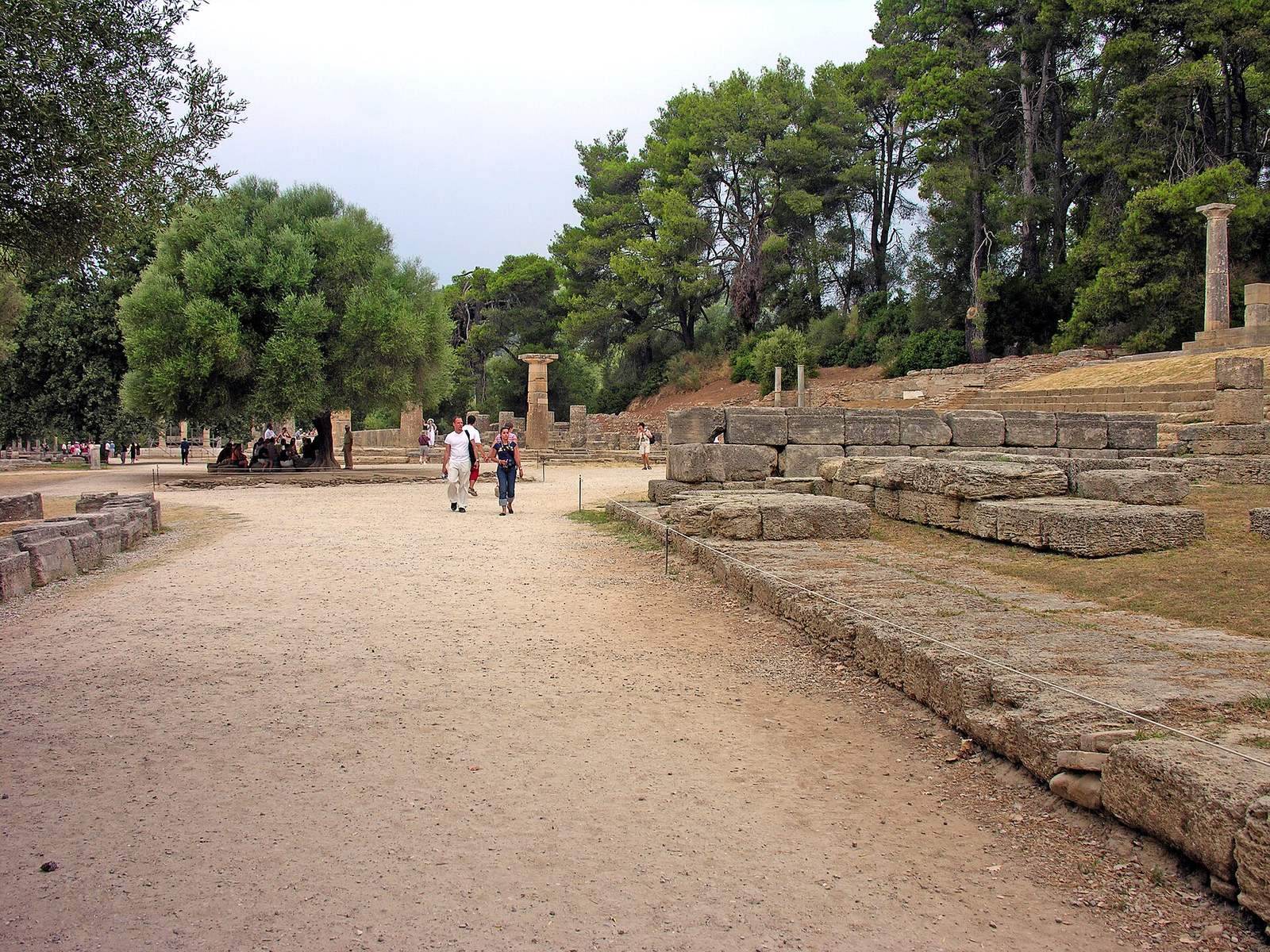
The temple stood in the northwestern part of Olympia’s sacred precinct, the Altis, on the southern slopes of Kronios Hill. Its east–west building plan placed the Altar of Hera to the east. A single colonnade surrounded the temple, with six columns at each short end and sixteen along each long side.
Temple architecture
Plan and columns
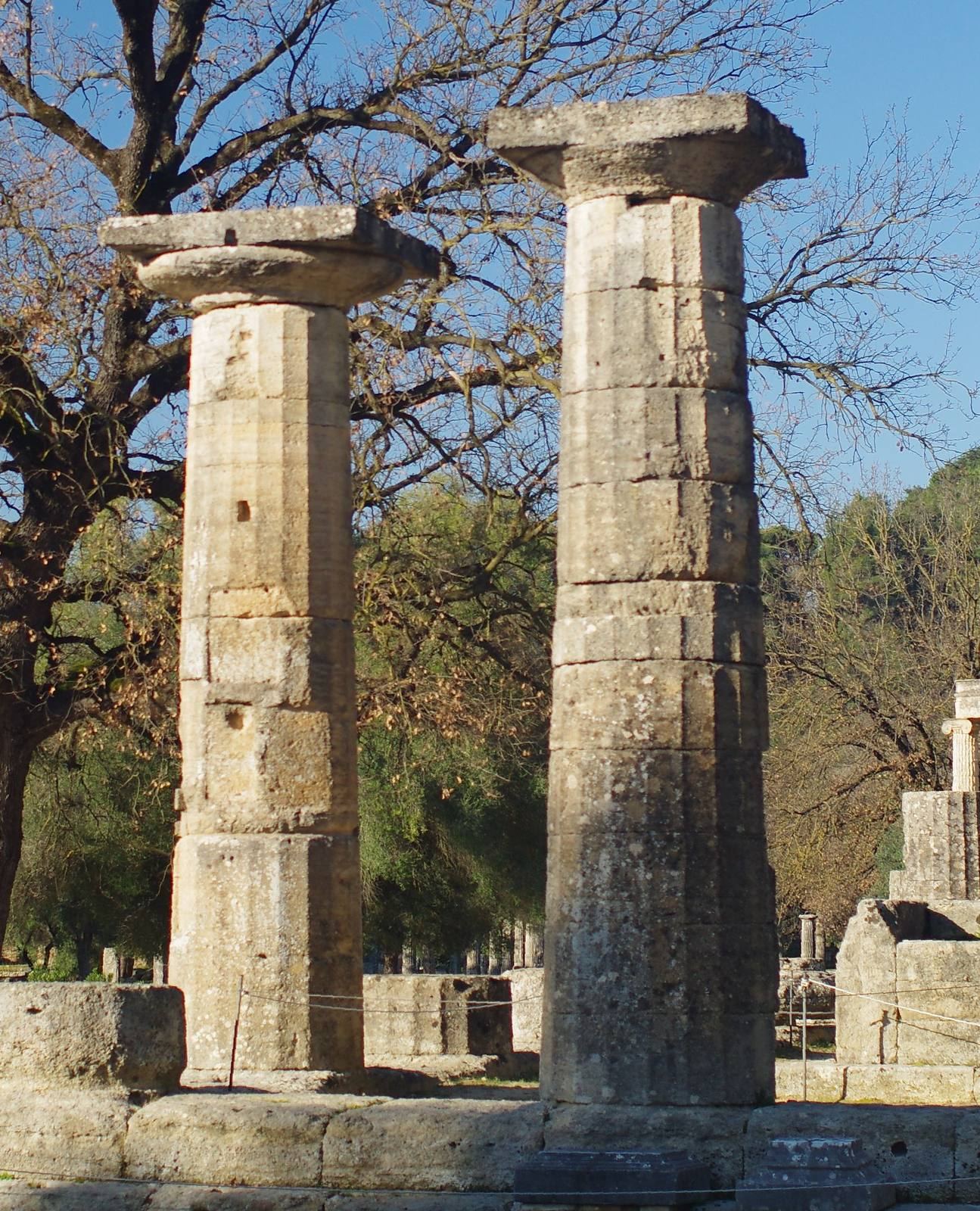
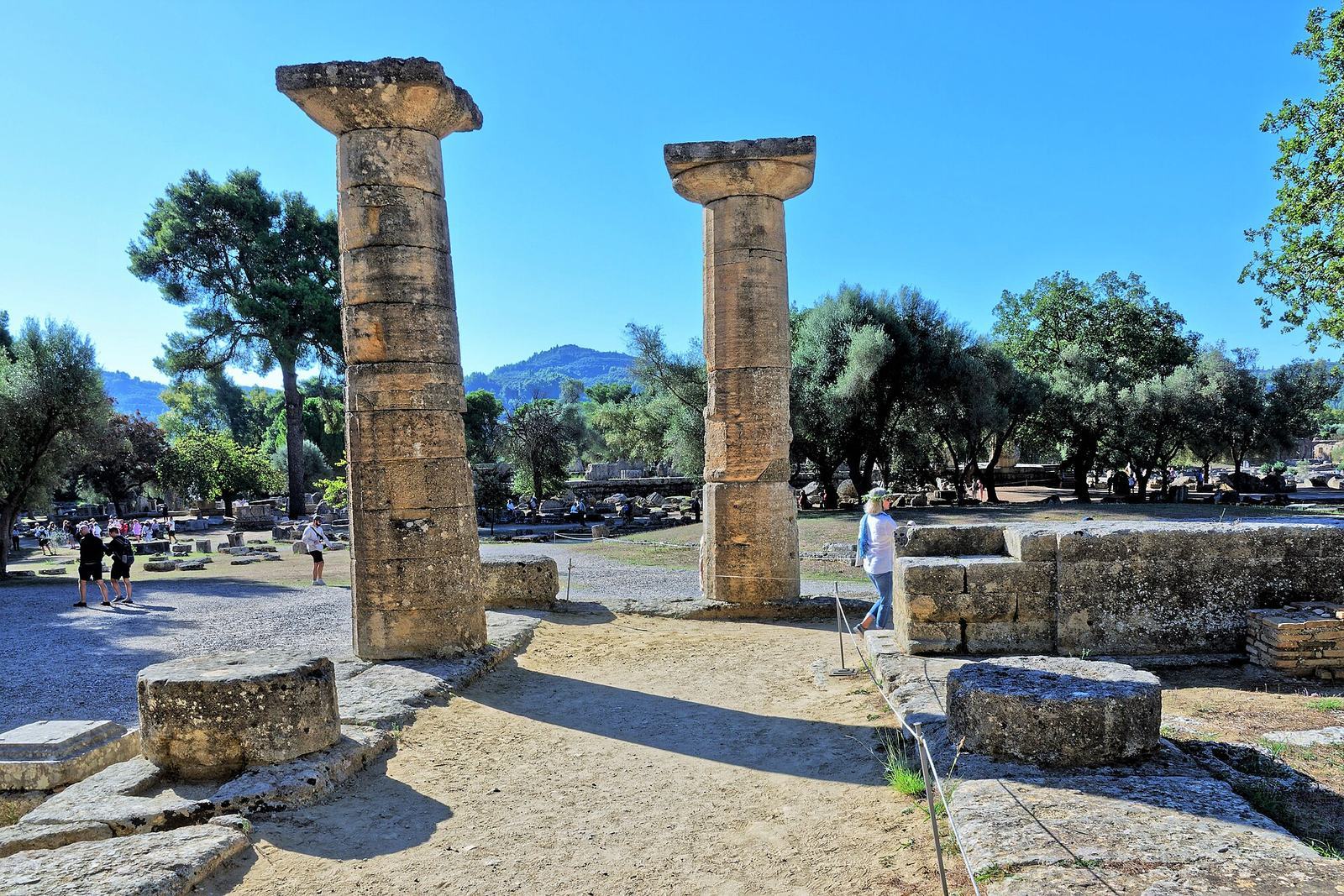
At the level of the platform supporting the columns, the temple measured about 50 by 19 metres (approximately 164 by 62 feet). Its plan was longer and narrower than forms common in the preceding architectural period, although elongated layouts were characteristic of early Doric buildings. Stone columns were installed over an extended period, from the mid-sixth century BC into the Christian era. Pausanias noted in AD 173 that one of the two columns in the rear room was still oak. The columns vary in their details: their capitals differ, their shafts vary in diameter by nearly 0.30 metres, and one has a different number of vertical grooves. One interpretation proposes that stone columns gradually replaced wooden ones, though archaeological evidence does not support that reconstruction. Another suggests that different workshops erected stone columns at the same time, perhaps for separate city-states or private donors. The horizontal structure above the columns is thought to have been wooden.
Walls and roofing
The walls had stone bases and upper sections made of mudbrick. Limestone, unfired bricks and terracotta tiles were also used. Holes in the projections at the wall ends indicate that wooden facing protected them from the weather. The roof was Laconian, a regional form of ancient Greek roofing.
Pediment decoration and surviving fabric
The pediments were decorated with disk-shaped ornaments, each about 2.5 metres in diameter and made from a single piece. One is displayed at the Archaeological Museum of Olympia. The museum also displays fragments of terracotta decoration from the horizontal structure above the columns and a central terracotta pediment ornament.
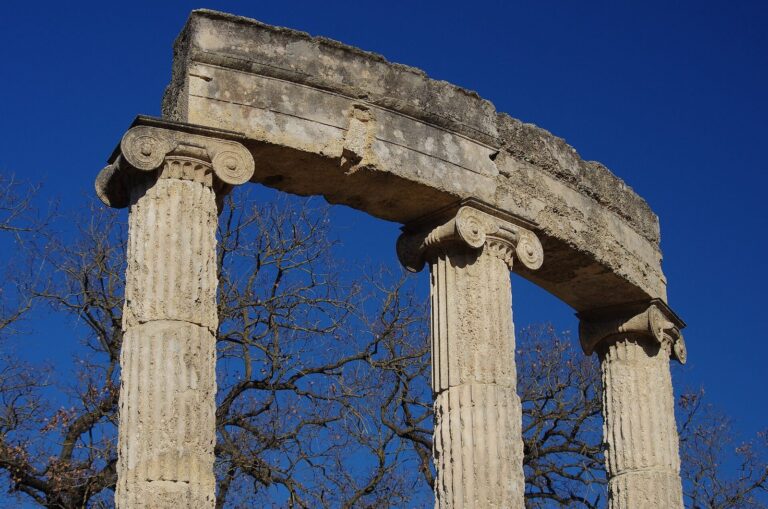
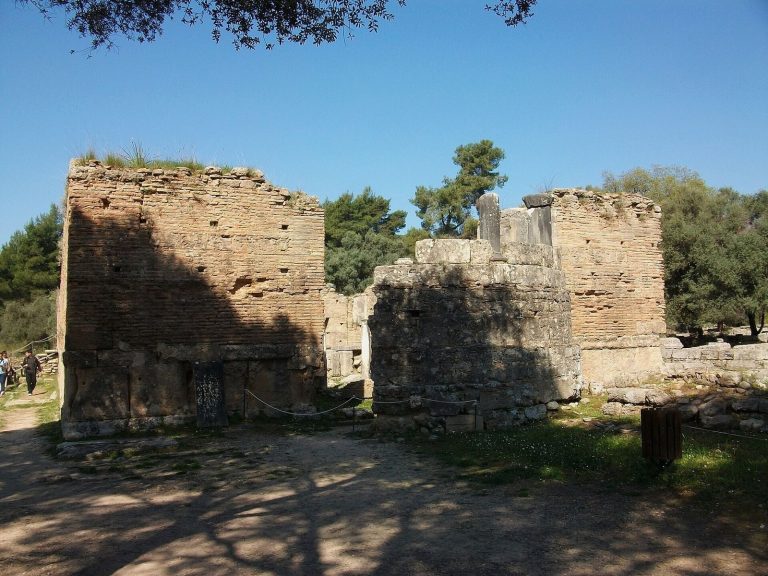
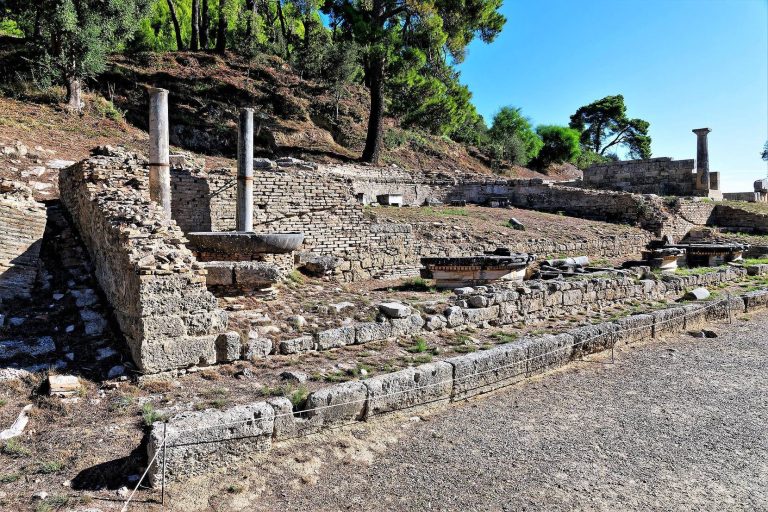
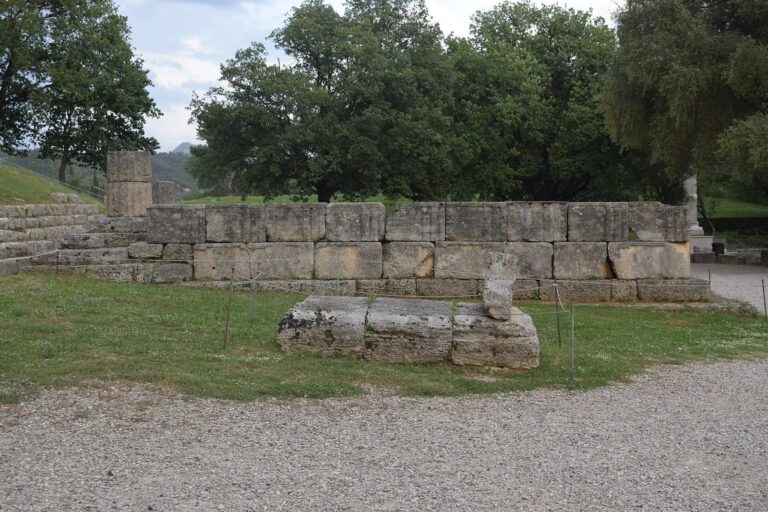
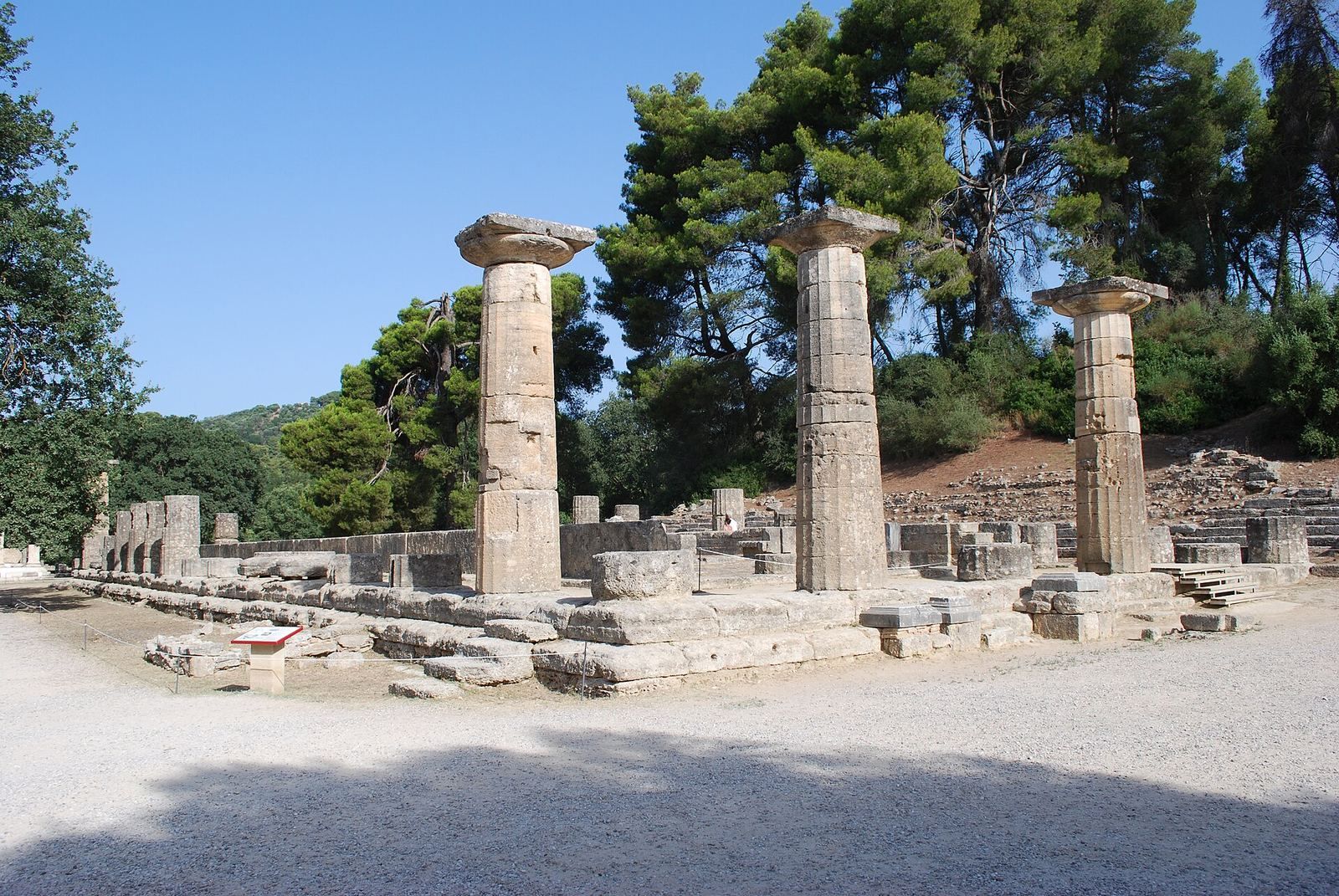
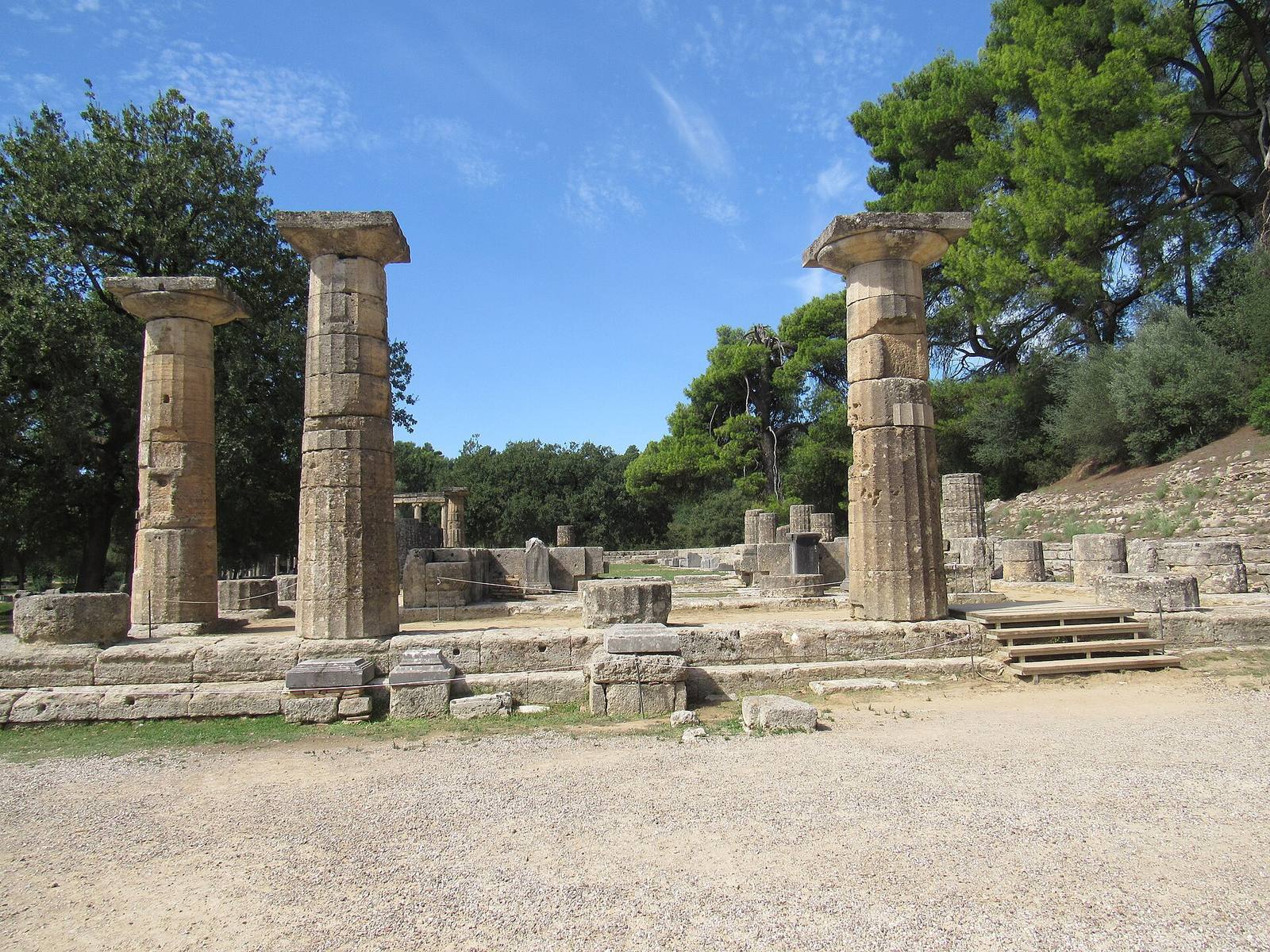
Foundations, large upright stone slabs from the main room, and the lower sections of columns survive at the site. Four columns have been re-erected.
Sculptures and furnishings
Cult images
Pausanias describes a statue of Hera seated on a throne and a standing, bearded Zeus wearing a helmet. He characterized their workmanship as simple. He also mentions seated statues of the Hours, goddesses associated with the seasons and the ordered life, attributed to Smilis, a sculptor associated with Aegina. A nearby statue of Themis, who personified divine law and order and was the mother of the Hours, was attributed to the Spartan sculptor Dorykleidas. The temple also held gold-and-ebony statues of the Hours attributed to Emilos. An Archaic-period stone head displayed at the Archaeological Museum of Olympia may have belonged to the temple’s statue of Hera.
Statues and other offerings
A statue associated with the temple showed Hermes, a god of messages and travel, carrying the infant Dionysus, god of wine and festivity. It is generally identified as the Hermes of Praxiteles and regarded as one of the best-preserved examples of Greek sculpture. The temple’s rear room held other statues of deities and offerings dedicated to them. Pausanias also describes an ivory-covered couch said to have belonged to Hippodameia and a bronze disk of Iphitus of Elis commemorating the sacred truce traditionally associated with the founding of the Olympic Games.
The victors’ table
The ivory-and-gold table made by the Greek sculptor Colotes displayed the olive wreaths awarded to Olympic victors. Its carved figures included Hera, Zeus, Rhea, a Titan associated with the generation of the gods, Hermes, Apollo and Artemis, associated respectively with prophecy and music, and with hunting. Other figures on that side were Asclepius, god of healing, and his daughter Aceso, who personified recovery, as well as Ares, god of war, and Agon, the personification of contest. The opposite side showed Pluto, another name for Hades, ruler of the underworld, with Dionysus, Persephone, queen of the underworld, and nymphs, female nature spirits.
The chest of Cypselus
A cedar chest associated with Cypselus, a ruler of Corinth, carried mythological figures made or inlaid in ivory and gold, as well as figures carved in the cedar itself. Corinthian inscriptions identified some of the figures, and some inscriptions ran in alternating directions. A tradition linked the chest’s name with a story that Cypselus had been hidden inside it as a child. Writing in the first century AD, Dio Chrysostom said that the chest had been found in the temple’s rear room.