Whale Bone Alley: A Late Punuk-Culture Archaeological Complex
Site at a Glance
- Popularity
- High
- Country
- Russia
- Primary era
- Medieval
- Eras represented
- Bronze Age, Medieval, Early Modern
- Civilizations
- Unclassified
- Site type
- Religious
- Remains
- Sanctuary
On this page8 sections
History
Regional hunting and early activity
Whale Bone Alley is a fourteenth- to sixteenth-century archaeological complex on Yttygran Island in Russia’s Chukotka Autonomous Okrug, south of the Chukchi Peninsula. It belongs to the late phase of the Punuk culture, an archaeological designation associated with ancient Eskimo communities around the Bering Strait. Whale hunting in the Chukchi Peninsula region dates back at least to the second millennium BCE. Whales provided materials for daily needs and ritual, and Yttygran lay near migration routes and became an important hunting place.
Hunting groups used the island seasonally, probably into the twentieth century, living in camps as they followed whales and walruses. Yttygran also lay near a historical boundary between territories associated with Asian Eskimo communities, a broad term for Indigenous Arctic peoples that includes Yupik, and the Chukchi, an Indigenous people of northeastern Siberia. Deposits from the bottoms of some pits have a separate, probable date of 1700–1400 BCE.
The Punuk-period complex and its interpretations
The identity of the alley’s builders is uncertain. Local memories gathered during Soviet investigations referred to another population, the masigmit, rather than identifying the people sharing those memories as the builders. Anthropological and geographical research links the name to Yupik communities around Mechigmen Lagoon and Bay. Yupik are Indigenous people of northeastern Siberia and adjacent Arctic regions. A leading hypothesis associates the complex with Yupik groups living north of Yttygran and with the Masik tradition, a regional cultural designation linked to Yupik communities around Mechigmen Bay.
The site is considered a likely sacred place for villages on Chukotka’s eastern coast. Early Soviet researchers suggested that initiation ceremonies, perhaps including displays of physical strength, might have taken place there. Yupik residents proposed instead that people used the location to butcher whales and store meat. The island’s Yupik name, Sikliuk, derives from Siklyugak, meaning “meat storage.” Another interpretation is that the complex served as a whale-hunting base and exchange place, selected in part for its position near a migration route. Fairs were held there in the seventeenth century during Cossack exploration of the region; Cossacks were frontier military communities involved in Russian expansion across Siberia.
Researchers have interpreted the complex’s scale and organization as evidence of cooperation among communities, complex social structures, and shared religious beliefs, perhaps within a broader political organization. They have also seen it as evidence that cultural development in the region did not follow a simple linear course. One interpretation places its builders culturally closer to the Aleut, also called Unangan, Indigenous people of the Aleutian Islands and nearby areas, than to other Eskimo peoples. Whale Bone Alley and Ouelen have been proposed as parts of a shared cultural and ritual complex. In this view, Punuk and Beringian cultures, associated with the region around the Bering Strait, shared traits while retaining local differences, and Yupik and other Eskimo populations may have mixed and influenced one another around Mechigmen Bay.
Investigation and protection
A Soviet anthropological expedition led by Mikhail Chlenov discovered the site in 1976. Further archaeological, ethnographic, and linguistic expeditions investigated it in 1977, 1979, and 1981 to examine its origins and purpose. The 1981 team also surveyed the Mechigmen Bay region and visited former Yupik camps, including Masik and Nykhsirak.
In August and September 1990, a Soviet-French expedition led by French Arctic specialist Jean Malaurie studied the site and Chukotka, with particular attention to archaeological and philosophical questions about its possible ritual role. Malaurie later recounted the expedition and his reflections in L’Allée des baleines. A Russian Institute for Cultural and Natural Heritage expedition visited the site in 2006. Russia granted Whale Bone Alley federal-level cultural heritage protection in 2011.
Remains
The coastal complex
The remains occupy a coastal strip beside Senyavin Strait, a passage in the Bering Sea off Chukotka, with a hill farther inland. The complex extends for roughly half a kilometre and consists of two connected zones arranged according to geometric principles. A stone or pebble path runs north–south for about one-third of the site’s length, linking the middle of the alley to the second zone.
The bone alley
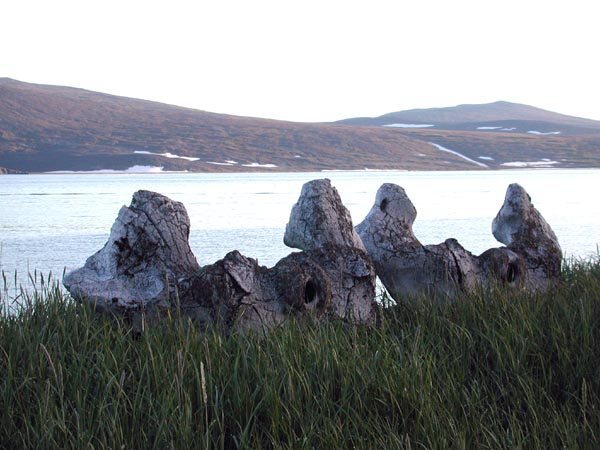
The alley is about 70 centimetres wide and runs roughly north–south between two parallel rows of whale bones. Its skull groups are set at regular intervals: 15 groups lie about 10 metres apart. Those at either end are oriented perpendicular to the beach, while the central groups lie parallel to it. The skulls are partly buried and supported by stones, with large pits near some bone arrangements.
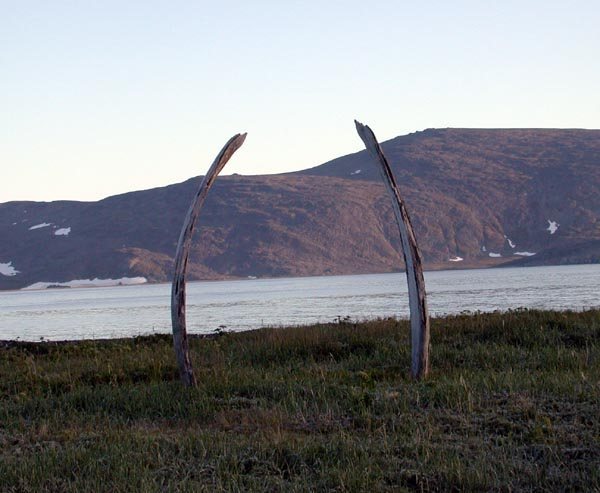
The site contains 34 whale jawbones, of which 13 remain in their original positions. Their arrangement is less regular than that of the skull groups. They may originally have been placed in opposing pairs to form arches, although climate and erosion could have shifted them. The whale remains, including ribs, are from bowhead whales.
The Sanctuary
The second zone, known as the Sanctuary, lies about 50 metres from the alley, to its south and west toward the hill. It occupies a slope of loose rock and is centered on a large circle edged with boulders. More than a hundred pits, each one to two metres deep, cover the area; some contained whale meat and fat. Arrangements of whale bones and rocks are also present and probably had a ritual function.