Björklinge Church: A Medieval Church in Sweden
Site at a Glance
- Popularity
- Medium
- Country
- Sweden
- Primary era
- Early Modern
- Eras represented
- Medieval, Early Modern, Modern
- Civilizations
- Swedish
- Site type
- Religious
- Remains
- Church
On this page16 sections
History
Björklinge Church is a medieval stone church in Björklinge, Sweden, consecrated in the fourteenth century and probably built in the early part of that century. It belongs to Björklinge parish in Uppsala Diocese and the Church of Sweden, within the Western Uppland Deanery, an administrative district within a diocese.
Medieval foundation and expansion
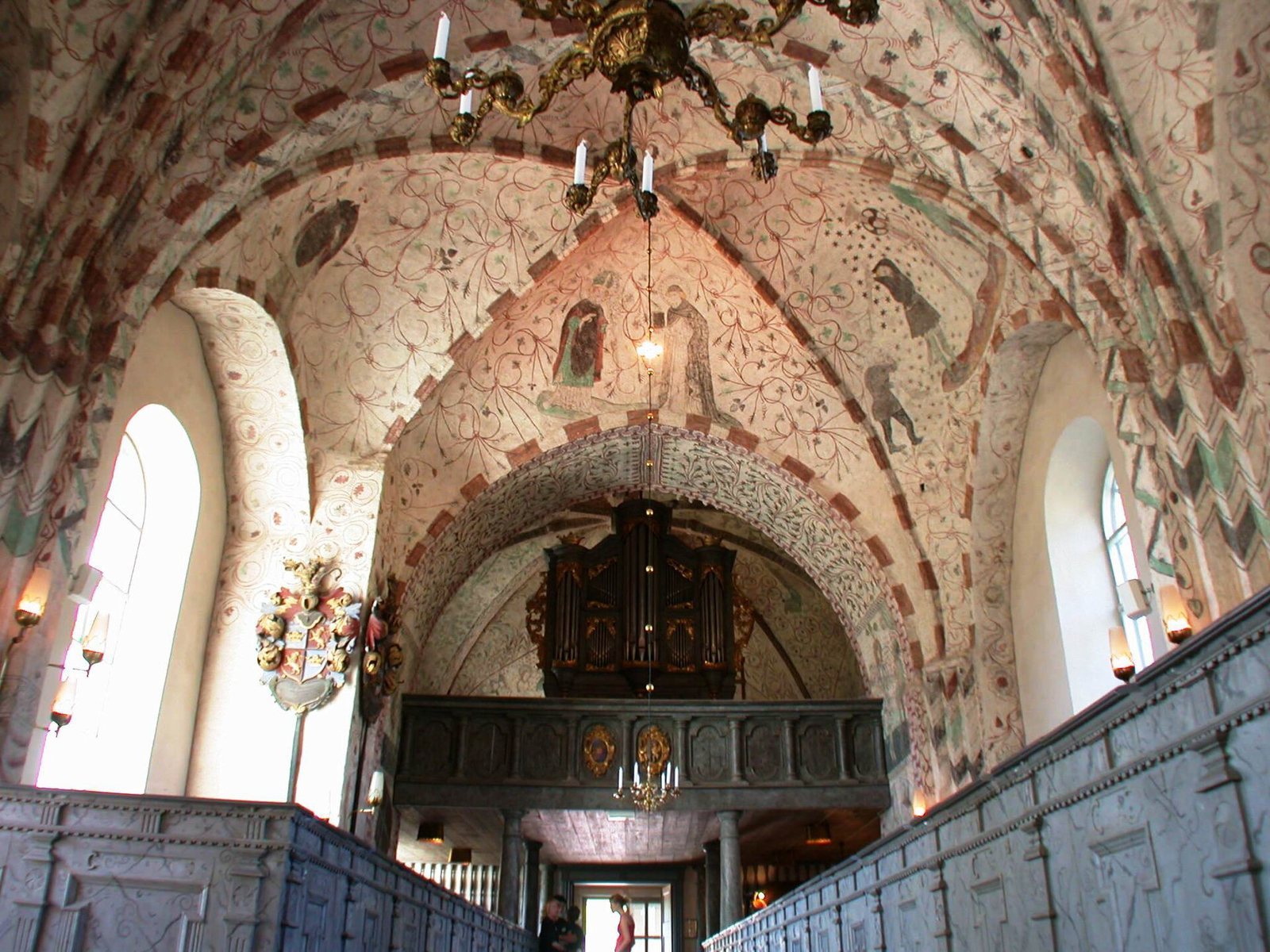
The church’s medieval building was altered during the fifteenth century. Wooden ceiling vaults were replaced with brick vaults in the first half of the century, and the interior was painted around the middle of it. Around 1470, the church was extended westward, adding a later medieval phase to the original structure.
Rebuilding in the seventeenth century
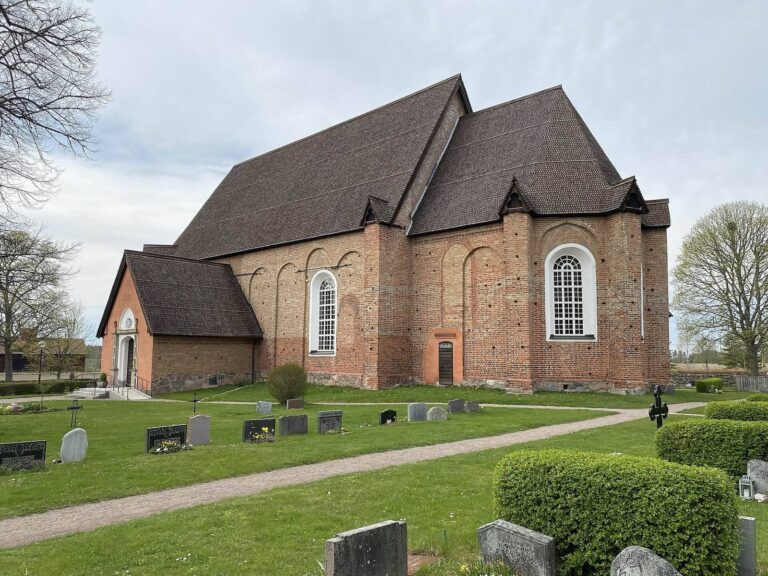
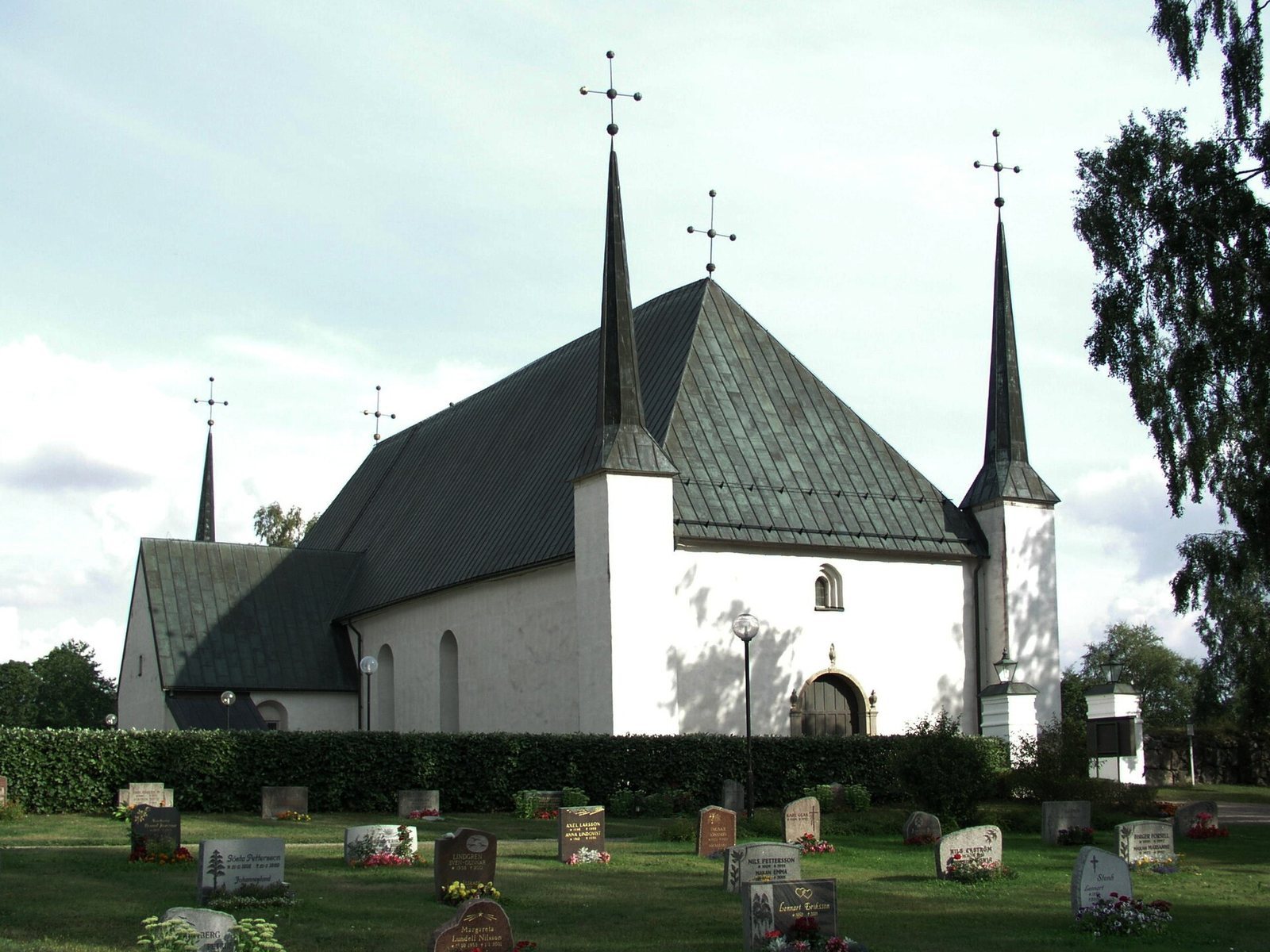
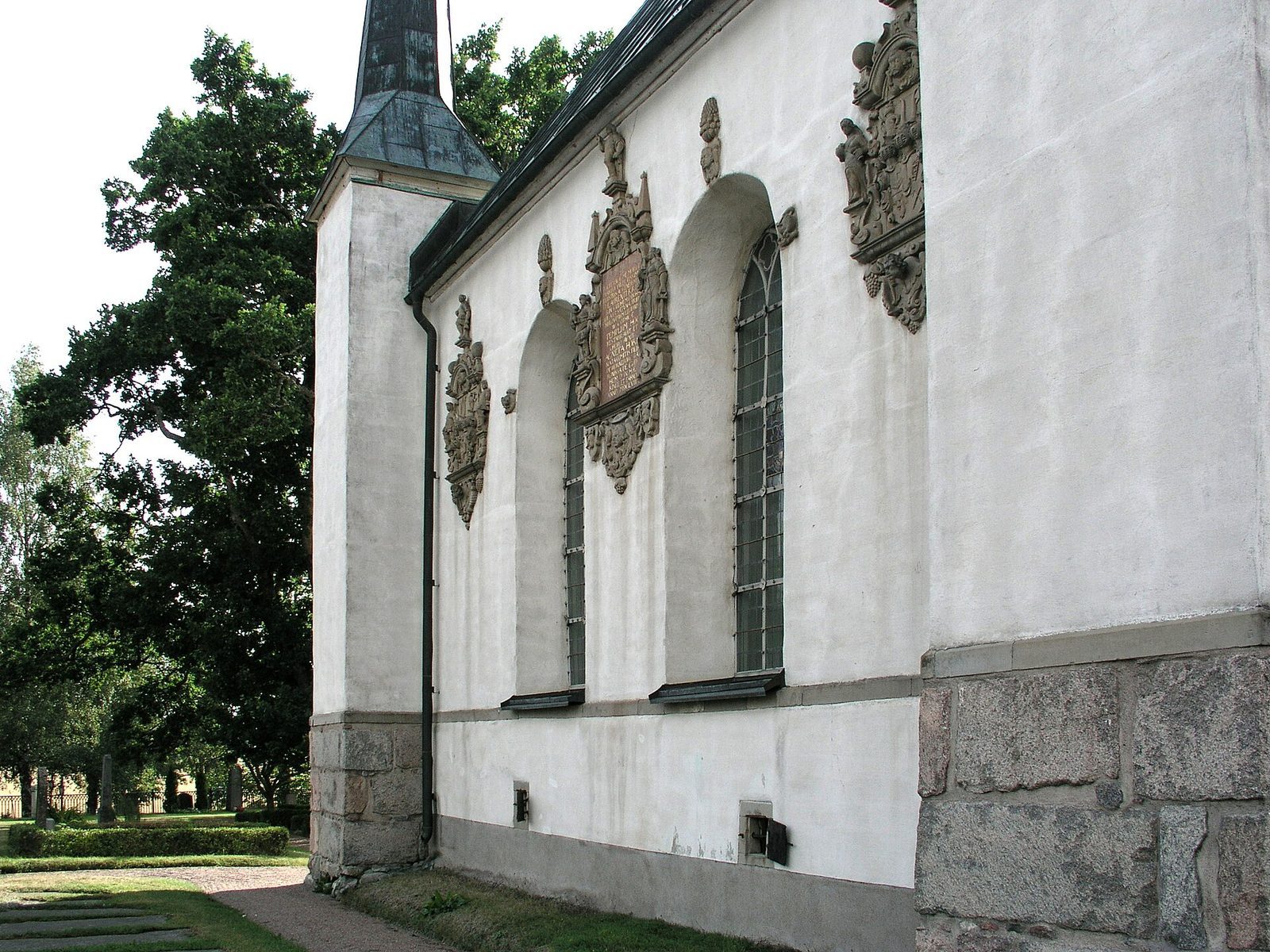
In 1657, Agneta Horn of Sätuna, a Swedish noblewoman, commissioned master mason Andreas Fischer, also recorded as Fipher, to remodel the church. The work removed the old straight-ended chancel and lengthened the building eastward, with a burial vault beneath the new chancel. The south porch was replaced, windows were altered, and the former south and west entrances were blocked in favor of new doorways with sandstone surrounds. Four corner towers were built, and the exterior was rendered white. Fischer carved the Horn and Kruus family arms on the east gable. A seventeenth-century image shows a brick-pattern design painted over the exterior render. These changes established the church’s late-seventeenth-century form. Though it combines styles, its general character reflects Sweden’s Great Power era, when the country was a major European power.
Stained glass was installed in eleven windows in 1658. In 1673, Gustav Kruus commissioned a pulpit from carver Nicklas Schultz, who also made a chancel screen, a partition between the chancel and the rest of the church. Painter Anders Lorenz decorated both. Kruus gave them to the church as a Christmas gift and in memory of Horn, who had died the year before. Two pyramids in the chancel and a gallery also belong to this period. The Närlinge burial vault was added in 1688. After Gustaf Kruus’s funeral in 1692, the church acquired epitaphs commemorating noble people buried there.
Changes from the eighteenth to nineteenth centuries
Decorative work continued into the eighteenth century. In 1714, the medieval altarpiece was replaced by a separate altar retable. Organ builder Olof Hedlund of Stockholm received a commission from Baron Otto Fleming in 1739, and the church’s first pipe organ was completed the following year. Its original specification also survives in a manuscript by Abraham Abrahamsson Hülphers.
The Hedlund organ was repaired several times. In 1779, Nicolaus Söderström divided its trumpet stop into bass and treble sections. Pehr Olof Gullbergson’s 1851 repair replaced the Qvinta 3-foot stop with a Fugara 8-foot stop and added an attached pedal. A later repair replaced the Spitsflöt 4-foot stop with a Vox candida 8-foot stop. Johan Edberg worked on the instrument in 1881 and may have replaced the Mixtur IV chor with a Flöjt 4-foot stop. E. H. Erikson repaired it in 1918.
In 1847, the 1673 pulpit was discarded and replaced with a simpler one. The Sandbro and Närlinge burial vaults were last opened for examination in 1859 and have since remained closed as graves.
Restoration and later changes
A renovation led by Martin Olsson in 1917–18 uncovered medieval wall paintings and introduced a new interior color scheme. An exterior renovation in 1956–58 added copper sheeting to the roof. In 1960, artist and nun Syster Marianne provided paintings for the six windows whose earlier stained glass had been lost.
In 1931, Åkerman & Lund built a tubular-pneumatic organ behind the Hedlund instrument. This type of organ uses air pressure to connect keys with pipes. As the newer instrument became increasingly unreliable, a choir organ was used from 1963. The Hedlund organ was restored in 2001–02, the 1931 instrument was removed, and the historic organ returned to use on 10 November 2002. The mechanical choir organ built in 1963 was later sold and moved to Borgenkyrkan in Tierp. The church’s present choir organ dates from 1999.
Around 1990, underground rooms were created on the north side, reached from the sacristy. They included a meeting room and a textile chamber, while a small gathering area was made in the chancel by the sacristy entrance. Work completed in 1992 added steel-and-glass inner doors and a sound system, and medieval paintings in the oldest part of the church were uncovered again.
Remains
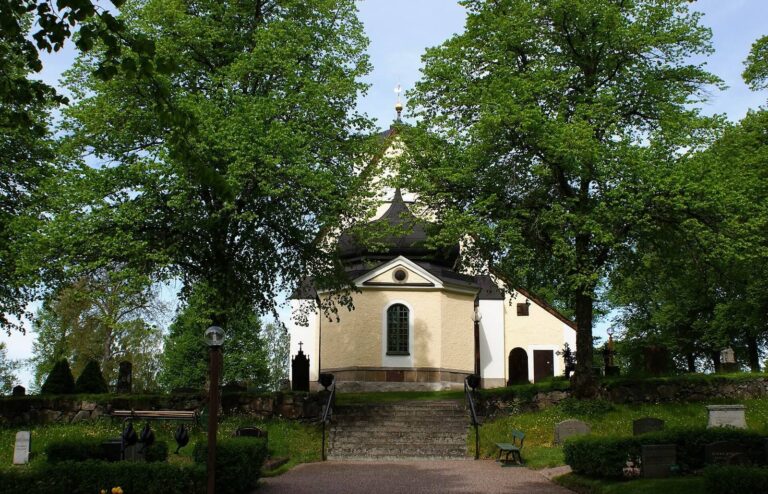
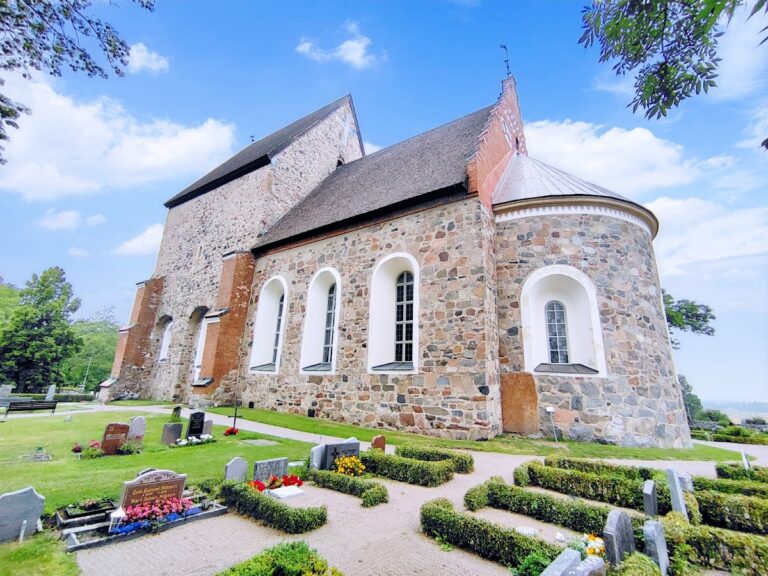
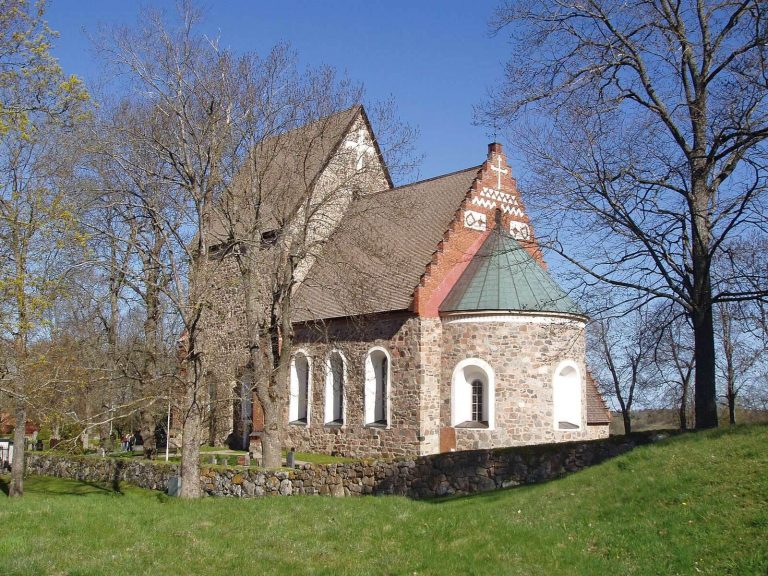
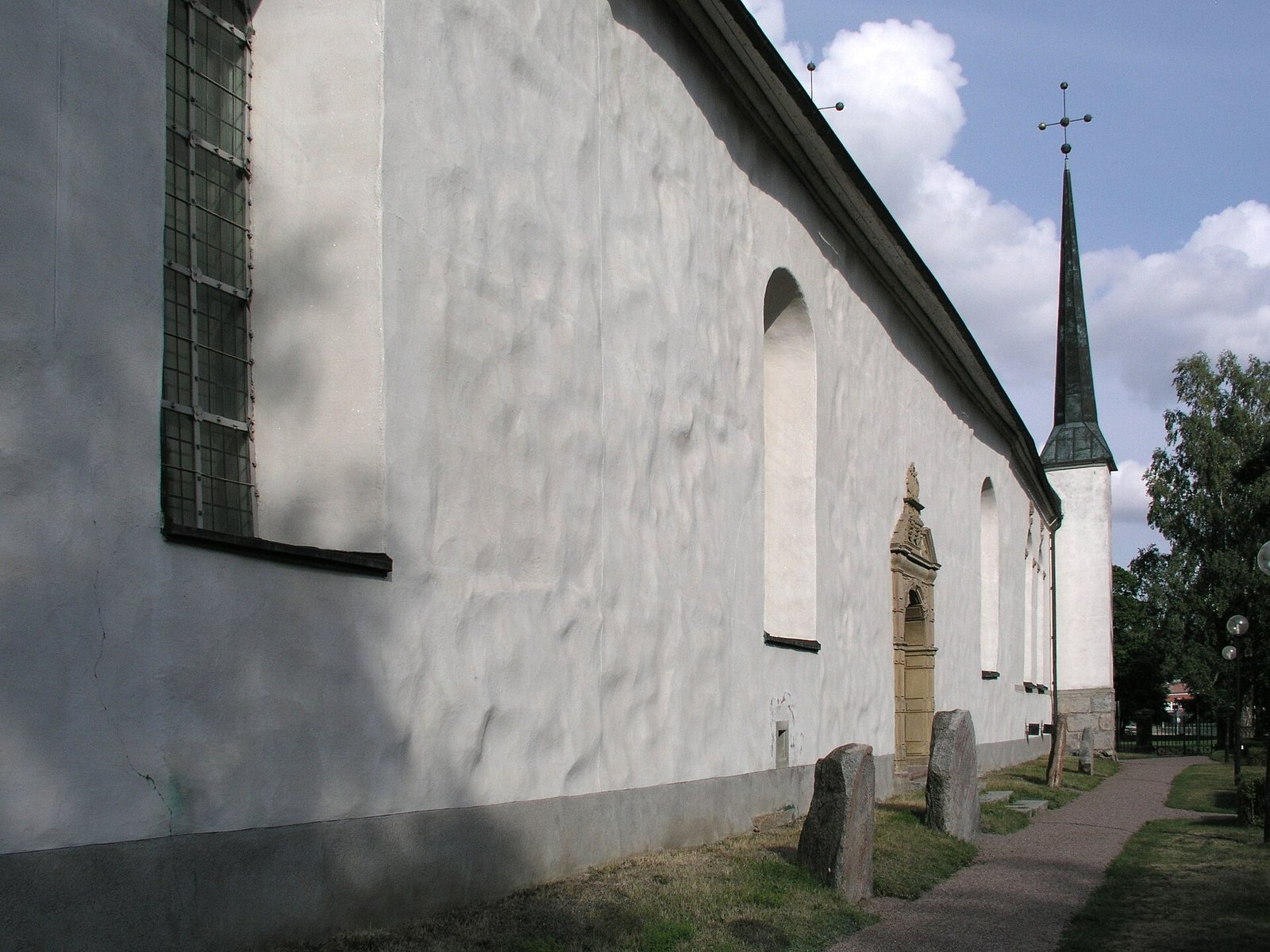
The church stands on a south-facing slope about 20 kilometres north of Uppsala. Its plan has a rectangular nave, a straight-ended chancel as wide as the nave, and a sacristy attached on the north. The main entrance is midway along the nave’s south wall. Rendered walls rise beneath a copper-clad hipped gable roof, with a small spired tower at each corner. A separate bell tower, built in 1927, stands across Gävlevägen. A marble memorial plaque occupies the centre of the east gable, between limestone coats of arms of the Kruus and Horn families. Four runestones stand outside along the south wall: U 1045 and U 1046 are to the left of the entrance, and U 1047 and U 1048 to the right.
Interior and furnishings
Vaults and wall paintings
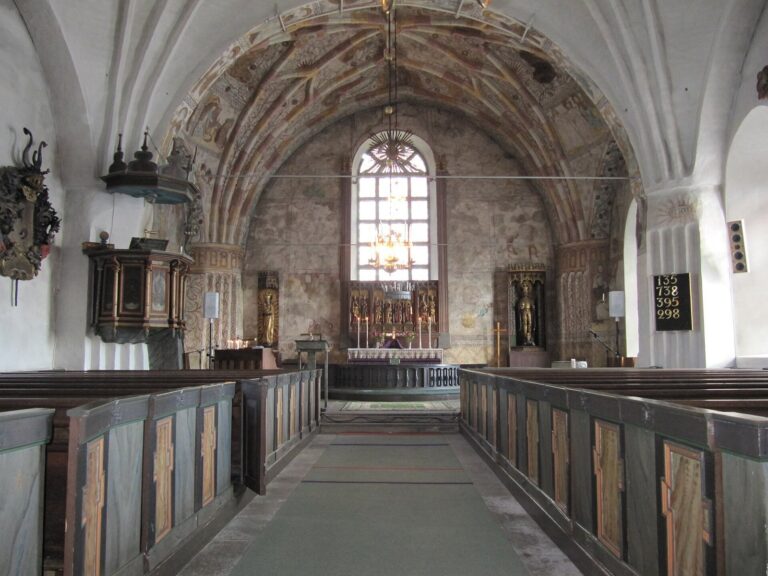
The church’s brick star vaults have ribs arranged in star-like patterns. Paintings in the front part are attributed to the Ärentuna school of mural painters and date to around 1450. In the western part, the vault from around 1470 carries work attributed to the Tierp school. Its ornament is more exuberant than that of the earlier paintings associated with the Mälar school. These names refer to regional groups of medieval painters rather than to individual artists.
Windows and altar furnishings
Five of the eleven stained-glass windows installed in 1658 survive. Paintings by Syster Marianne occupy the six windows where the earlier glass was lost. Four chancel windows depict services from the traditional daily cycle of Christian prayer: Matins and Lauds on the south side, and Vespers and Compline on the north, with Vespers nearest the altar. A sandstone baptismal font probably dates to the early fifteenth century. The oak altarpiece, probably made in the last quarter of the fifteenth century in Lars Germundsson’s workshop in Enköping, includes sculptures in oak and other hardwoods and now stands above the sacristy entrance. The altar retable is a separate work.
Screen, pulpit and gallery
Parts of the chancel screen survive and now serve as a screen in the chancel pew. Two pyramids stand in the chancel, and a gallery belongs to the same furnishing phase as the screen. The present pulpit was made in 1847 by manufacturer Dahlman of Västerås. It is simpler than its predecessor and cost 333 riksdaler and 16 skilling banco, historical Swedish units of currency. The earlier pulpit remained extant in the 1880s, but its later whereabouts are unknown.
Burial places and memorials
Vaults and tombs
Three major burial vaults are associated with the church: the Sätuna vault beneath the chancel, the Sandbro vault and the Närlinge vault. A large tomb of Öland marble stands on the north side of the main chancel, just east of the pulpit. It commemorates State Councillor and Count Otto Fleming (1696–1778) and his wife Catharina Charlotta Gyllengrip (1700–1784). Andreas Campanius and his wife lie beneath a stone slab in the sacristy. Born Andreas Michaelis, Campanius was the son of a bell-ringer from Rimbo and later served as rural dean and as a member of parliament in Björklinge.
Heraldic memorials and churchyard
Numerous funerary heraldic memorials are mounted on the church walls. Used in noble funerals, these included a principal banner bearing the deceased’s arms and an inscription, sometimes accompanied by ancestral arms representing family lines. Two main funeral banners and ancestral arms for Carl Casper and Lars Wrede are displayed on the south wall. Bror Hjorth, his wife and his parents are buried in the churchyard. Southeast of the churchyard, between the church and county road 600, stands Hjorth’s bronze statue of the fiddler Gås-Anders (1815–1896), inaugurated on Ascension Day in 1944. The churchyard’s ash burial garden includes five megaliths and a central stone.
Organs
Hedlund organ
The Hedlund instrument is an eight-stop positive, a compact type of pipe organ. Its sounding facade contains the full Principal 8-foot rank. Organ stops control groups of pipes; manuals are hand-operated keyboards, and the pedal is operated by the feet. The lower 30 keys are brown, while the 21 upper keys are black with white coverings. The instrument retains its original wind chest, the chamber that supplies air to the pipes, and the trumpet stop divided into bass and treble sections. Its pitch is a¹ = 455 Hz, and its tuning follows Neidhardt’s historical system from 1729.
Choir organ
The present Allen digital choir organ has three manuals, a pedal and 56 stops. It can be played in the chancel, and its sound is heard both there and in the gallery.