Village Church Dittersbach: A Baroque Evangelical Lutheran Church
Site at a Glance
- Popularity
- Very Low
- Country
- Germany
- Primary era
- Early Modern
- Eras represented
- Early Modern, Modern
- Civilizations
- Electorate of Saxony, Holy Roman Empire, Kingdom of Saxony
- Site type
- Religious
- Remains
- Church
On this page14 sections
History
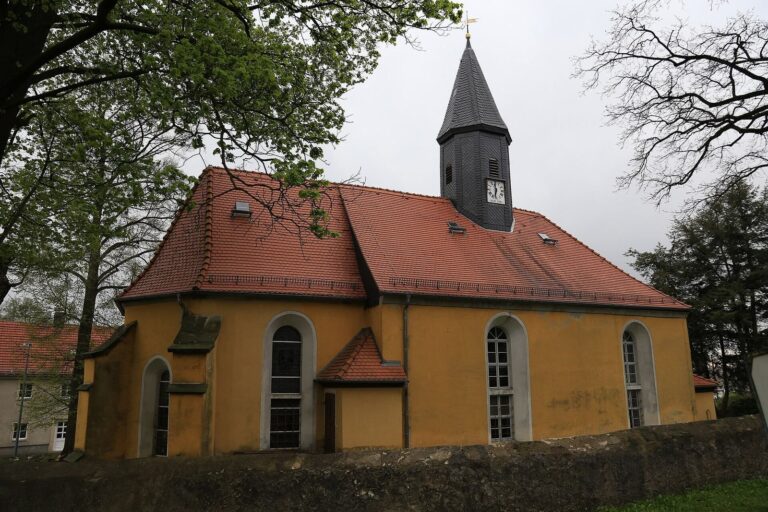
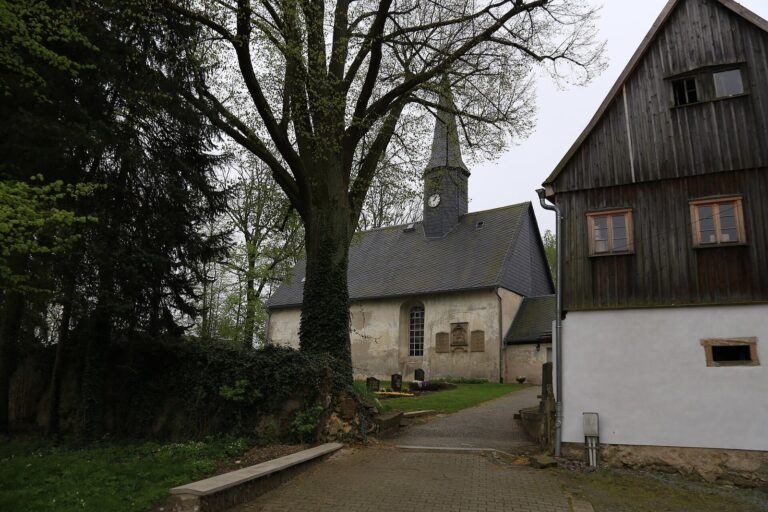
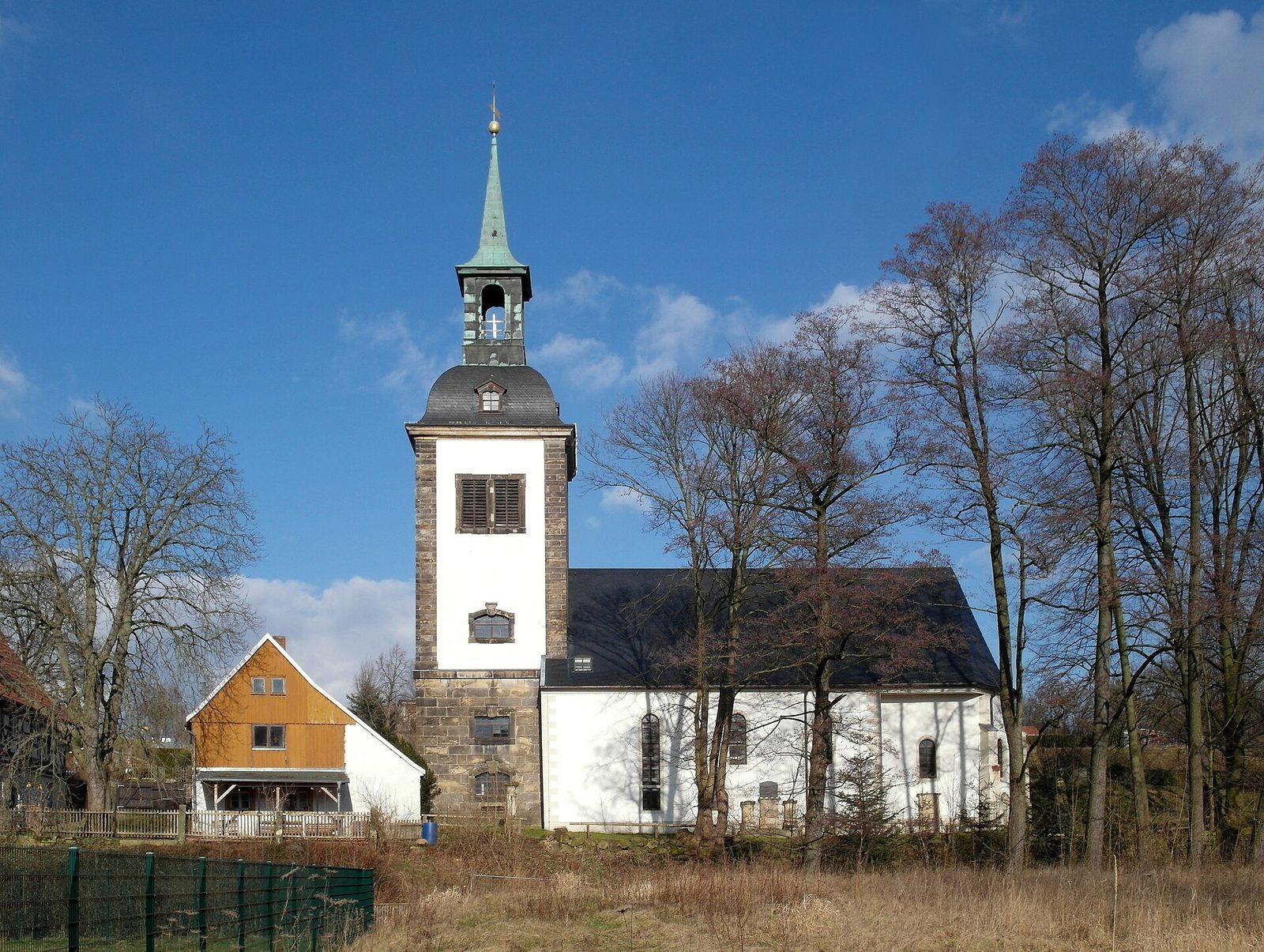
Village Church Dittersbach is an Evangelical Lutheran church in Dittersbach, Germany, rebuilt after a fire in 1662 and shaped as a Baroque hall church. It belongs to the Dittersbach congregation in the Dittersbach-Eschdorf parish, within the Pirna church district of the Evangelical Lutheran State Church of Saxony.
Rebuilding and early additions
The church was rebuilt following the 1662 fire. Work on its tower began when the foundation stone was laid on 15 May 1721. The tower was completed in 1722, and the nave was extended into it. The bells had an earlier history: Andreas Herold cast a small and a medium bell in 1660, while Johann Gottfried Weinhold made a large bell in Dresden in 1742.
Gottfried Silbermann built the church organ in 1726. The large bell cracked in 1845, ending its use in the peal.
Nineteenth-century changes
The church interior was refinished in 1849. In November 1856, the existing peal was taken down and melted for new bells by Friedrich Gruhl at Kleinwelka. The new peal began its journey from Kleinwelka on 21 December and rang on Christmas Eve. In 1893, organ builder Eduard Berger lowered the organ’s pitch by moving its pipes.
Twentieth-century renewals
In 1917, the small bell was melted down for wartime use. The Hermann Eule firm changed the organ in 1926, replacing the Tertia, a mutation stop, with an Aeoline, a soft, string-toned stop. In 1952, the firm restored the earlier specification. A replacement small bell, made by the Schilling foundry in Apolda, was installed in 1968.
Further interior renewals took place in 1953, 1974, 1978, 1980, and 1986, followed by a major interior renovation in 1992. In 1993, the organ’s pipework was returned to its earlier position and the instrument was restored to Chorton, a historical church-pitch standard. An exterior renovation followed in 2006.
Remains
Architecture and fittings
Building and layout
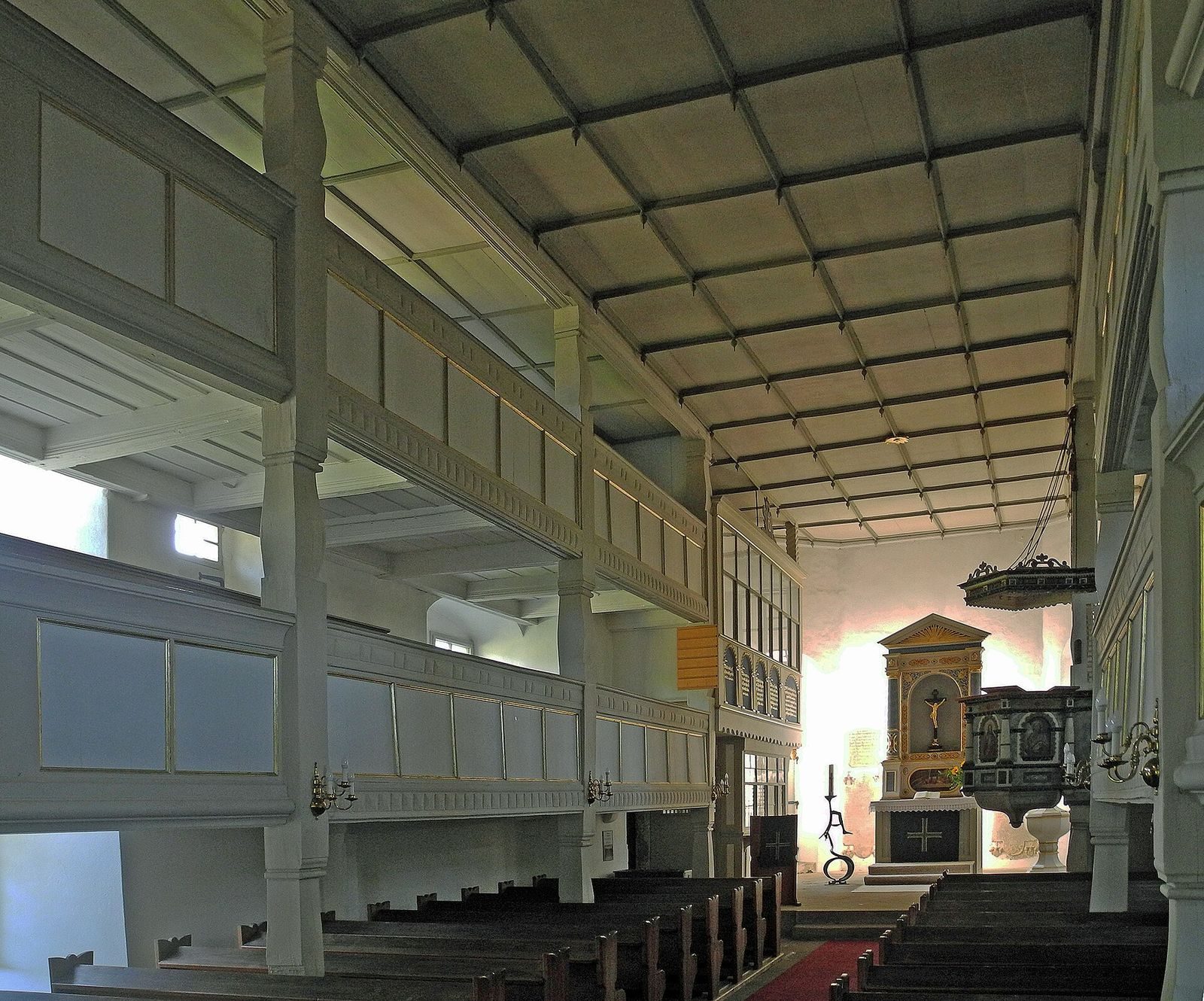
The church is built of plastered rubble stone, with segmental-arched windows. At the altar end, the choir is supported by buttresses and finishes in a three-eighths polygonal end, formed by three sides of an octagon. Inside, a flat ceiling spans the space. Two-tier galleries run along the north and south sides, while a single-tier gallery occupies the west side.
Wooden furnishings
The wooden furnishings include a simple Classicist altar dating to 1843 and a baptismal font from 1859. The pulpit, made in the mid-17th century, has painted figures of Peter, Christ, and Paul on its basket.
Memorials and paintings
Von Kiesewetter memorials
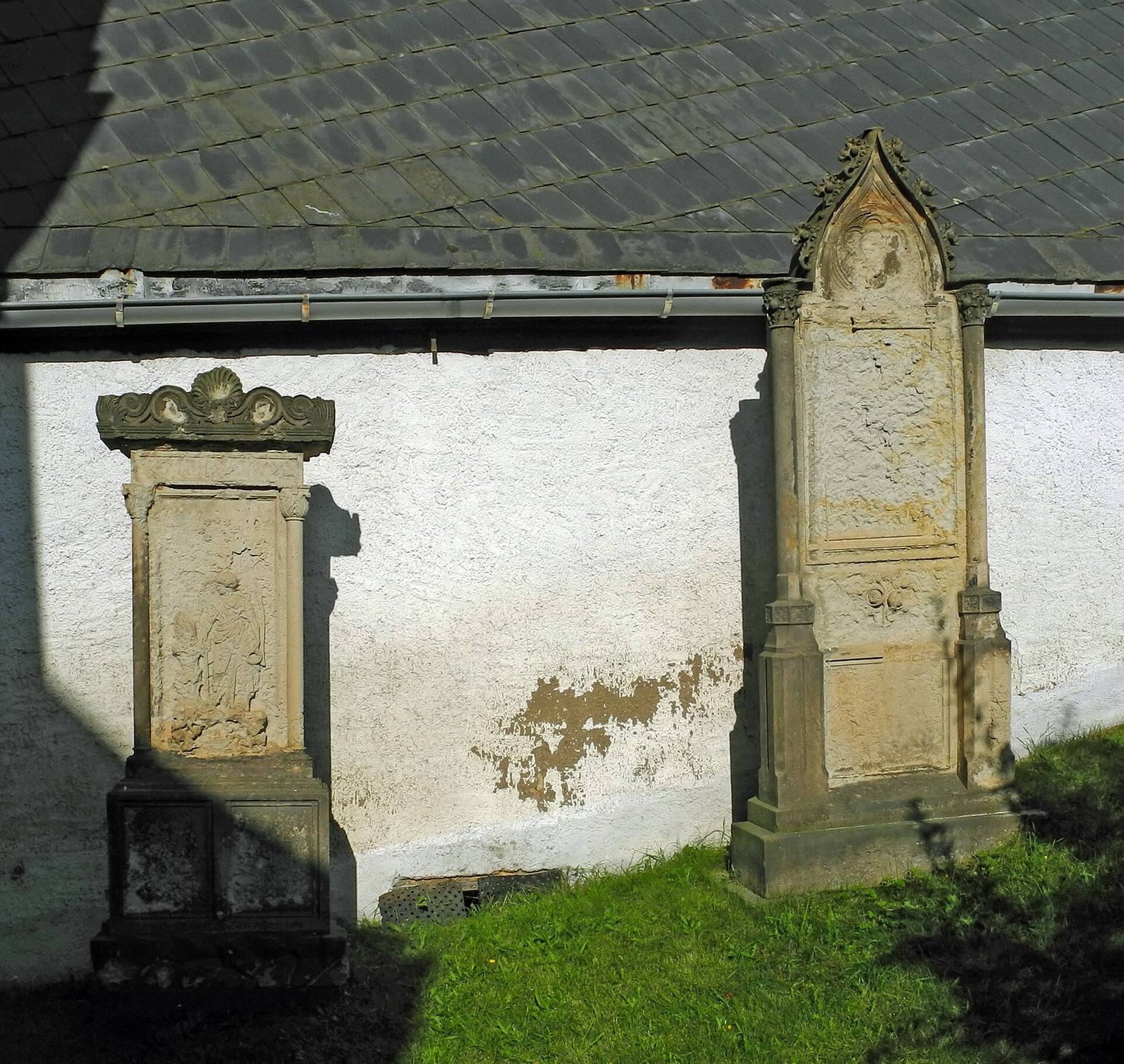
A figural tombstone for Christian von Kiesewetter, who died in 1643, stands in the patron’s box on the north side. Behind the altar are memorials to Otto von Kiesewetter, who died in 1647, and Christoph von Kiesewetter, who died in 1742. Two carved coats of arms of the von Kiesewetter family, dated 1662, are also preserved there.
Paintings in the tower
The tower contains a painting of Susanne Maria von Kiesewetter, who died in 1647, and a portrait of a pastor, both from the mid-17th century. An 18th-century painting depicts Noli me tangere, the scene in which the risen Jesus speaks to Mary Magdalene.
Organ and bells
Organ
The well-preserved organ has an unpainted, balanced façade and 14 stops, each selecting a set of pipes. It is played from one manual keyboard and a pedal operated by the feet. Its current pitch is a1 = 467 Hz; it is tuned in equal temperament, with a wind pressure of 74 mm water column.
Bells
The present peal consists of three bronze bells. They hang in a steel frame, with cast-steel yokes supporting them.