The Metroon: A Temple of the Mother of the Gods at Olympia
Site at a Glance
- Popularity
- Low
- Country
- Greece
- Primary era
- Classical
- Eras represented
- Classical
- Civilizations
- Ancient Greek
- Site type
- Religious
- Remains
- Temple
On this page8 sections
History
Origins and cult
The Metroon was the smallest temple in the Altis, Olympia’s sacred precinct in Greece, and was built in the Doric style of ancient Greek architecture. Pausanias, a second-century CE Greek travel writer, described it as a sanctuary of the Mother of the Gods. That title may have referred to Rhea, the mother of the Greek gods, to Cybele, a mother goddess whose cult originated in Anatolia, or to both. Worship at the site may reach back to prehistoric times, but the temple’s construction date is uncertain.
The earliest Zanes, statues of Zeus funded by athletes caught cheating, were erected in 388 BCE. Their bases stood between the temple and the stadium entrance, prompting the possibility that the temple was already there. The reverse sequence is also plausible: the temple may have been positioned in relation to statues already in place. A date in the late fifth century BCE has been considered possible. The spread of Cybele’s worship through Greece in the fifth century accompanied a revival of the cult of Demeter, goddess of grain and agriculture. Demeter may also have been worshipped at Olympia, and that renewed interest may have helped lead to the construction of the modest-sized temple.
Roman imperial use
During the Roman imperial period, the temple was rededicated to Augustus, Rome’s first emperor, and used for the imperial cult, religious honors directed toward emperors. Its earlier cult statue may have been replaced by images of Roman rulers. Pausanias later noted that statues of emperors stood inside instead of an image of the Mother of the Gods.
An ancient earthquake badly damaged the building, which was subsequently repaired. An inscription on a block from the temple’s upper structure calls Augustus Sebastos, meaning the Revered, without treating him as a deified emperor. The inscription may place the repairs between 27 BCE and 14 CE.
Dismantling and archaeological recovery
In the third century CE, much of the temple was taken apart for stone used in a defensive wall. The wall was considered necessary because of the Herulian incursion, although the Heruli apparently did not reach Olympia. Temple blocks were built into the wall’s northern and eastern sides; archaeologists later recovered them and returned them to their original positions.
Pausanias’s description guided nineteenth-century archaeologists to the remains, which they found in May 1878. Excavations later that century identified fragments of statues associated with Roman rulers. A colossal figure was identified as Augustus, while six others were interpreted as Claudius and Agrippina the Younger, Titus and his daughter Julia Titi, and Domitian and his wife Domitia Longina. Georg Treu considered the figures to have been arranged in chronological order. Erika Schmidt instead viewed them as a unified group from the Flavian dynasty, founded by Vespasian and continued by his sons Titus and Domitian, including Vespasian and his wife and daughter, Domitilla the Elder and Domitilla the Younger.
Remains
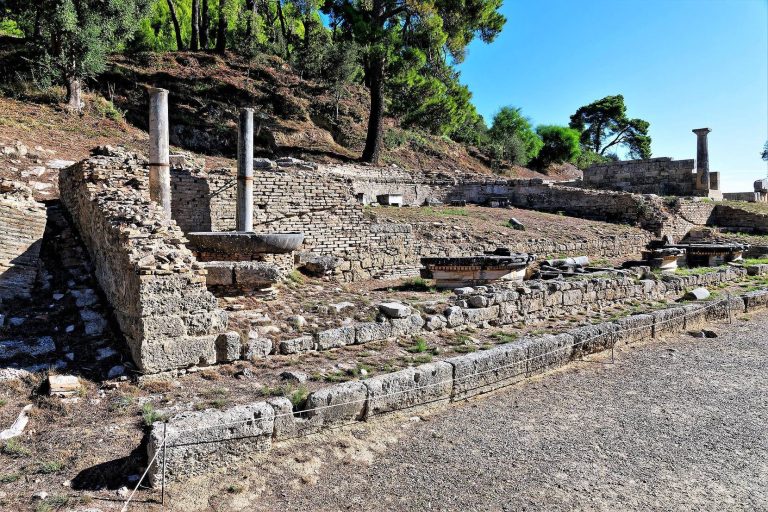
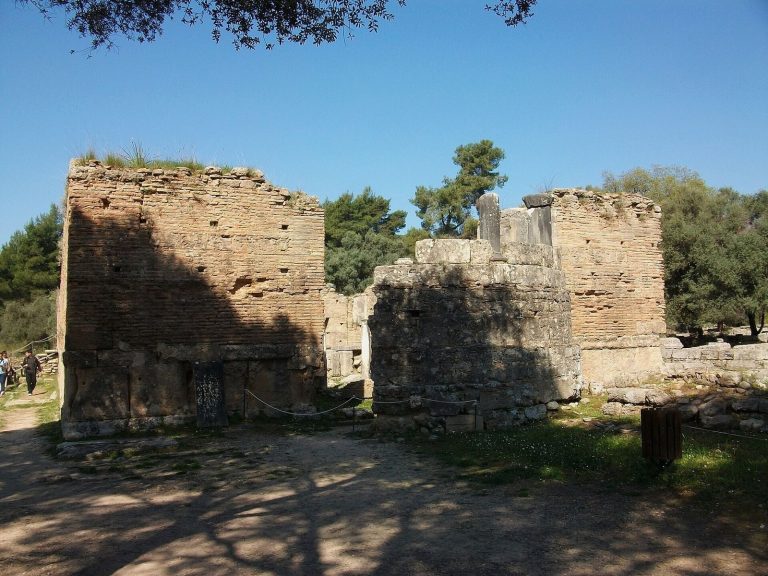
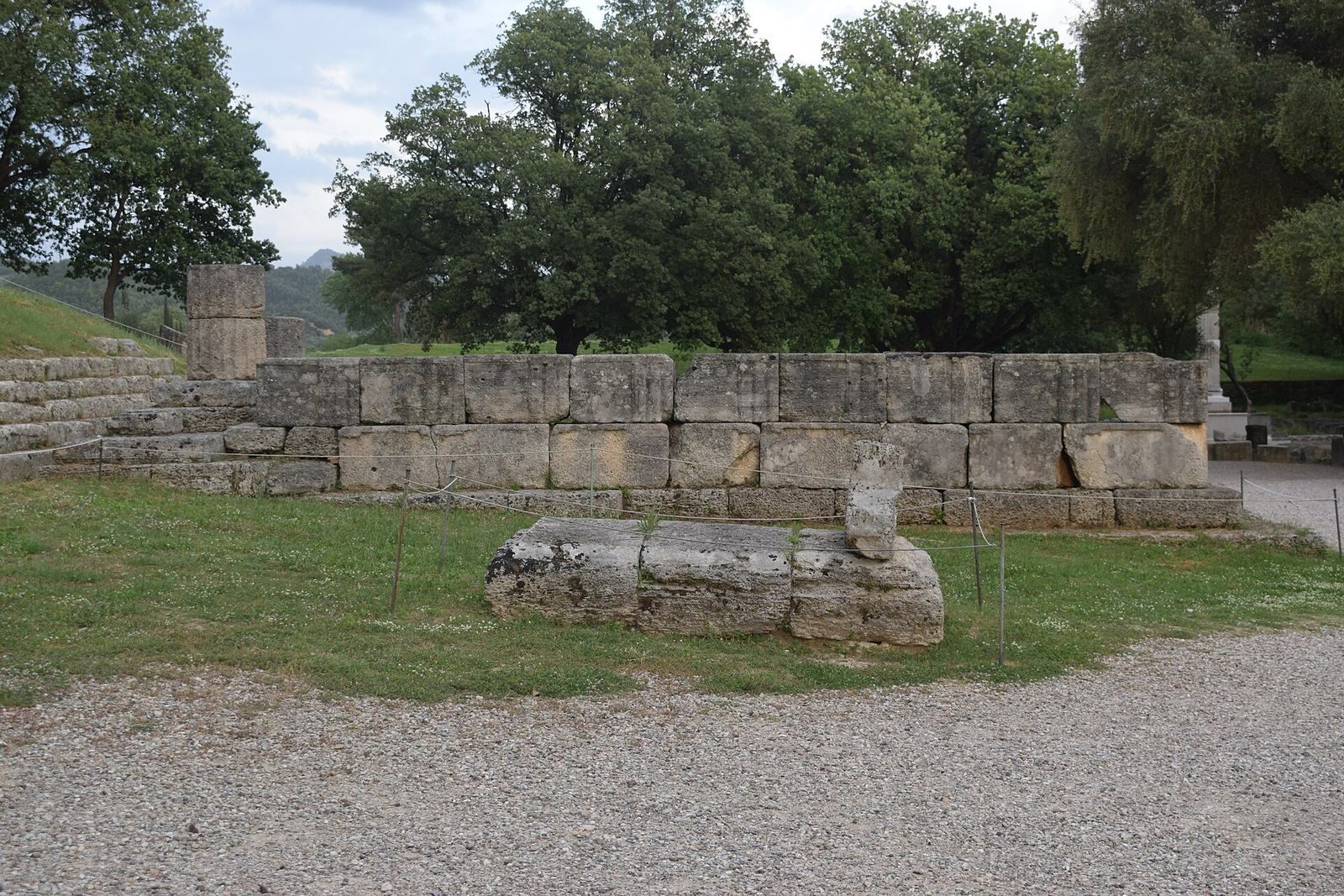
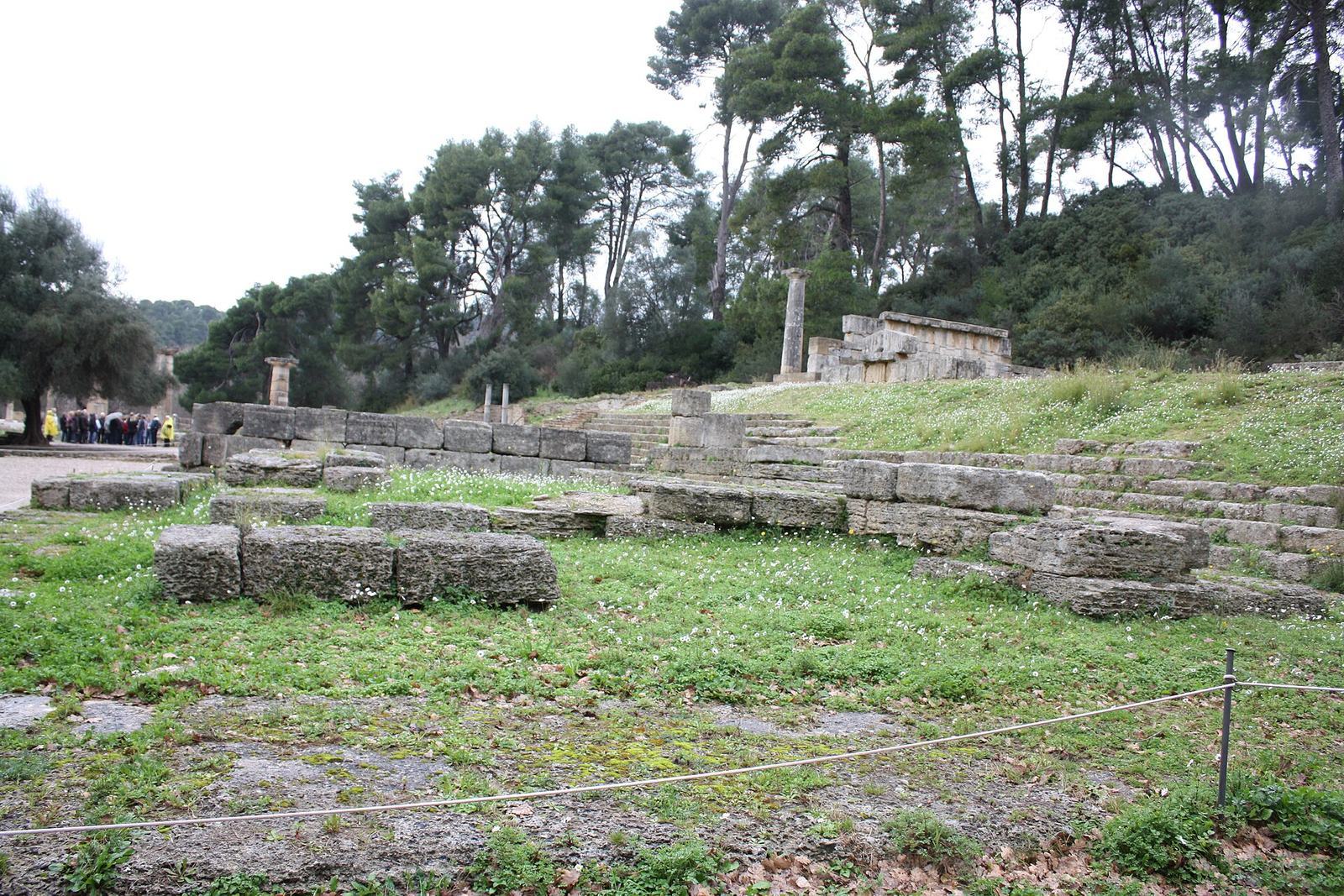
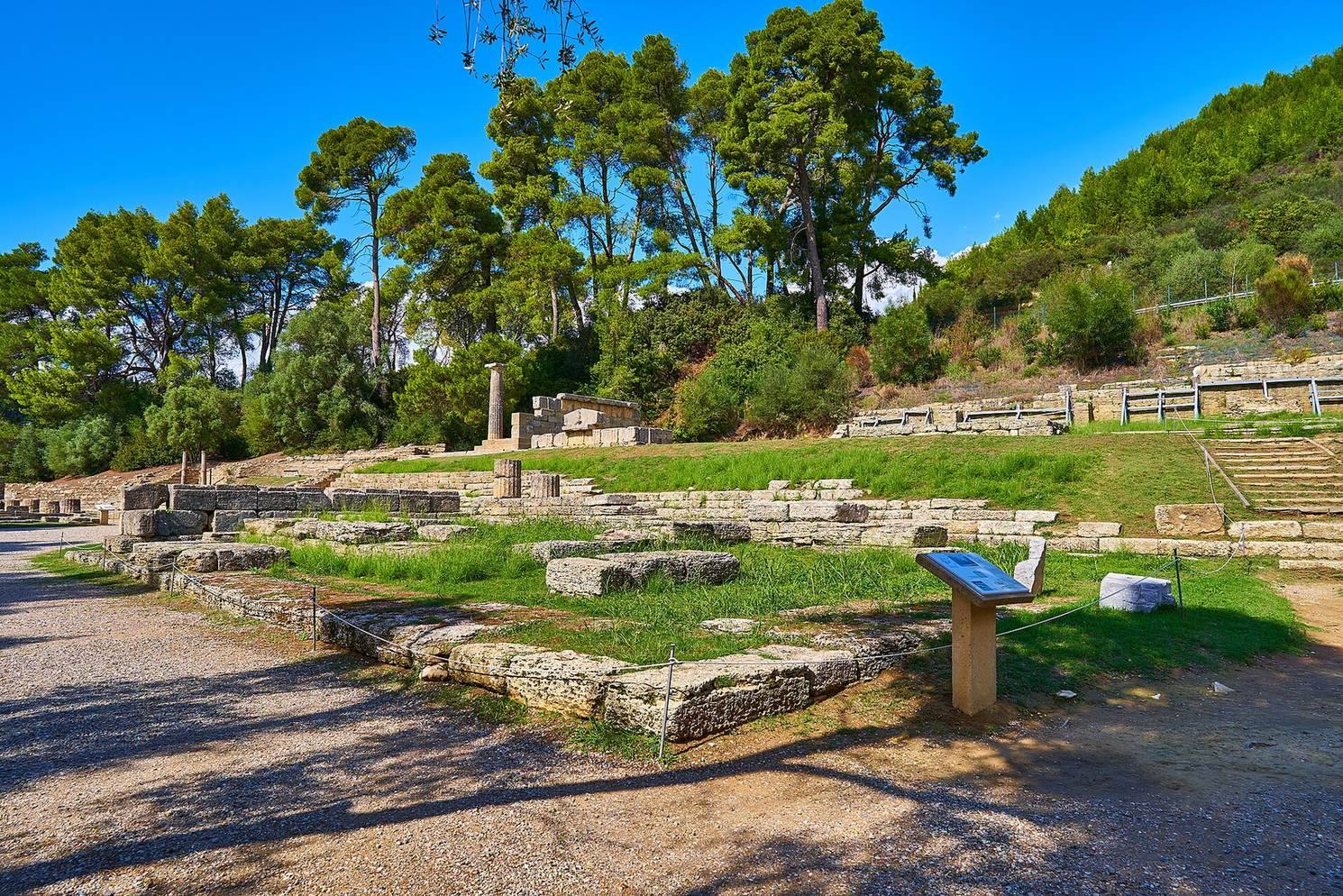
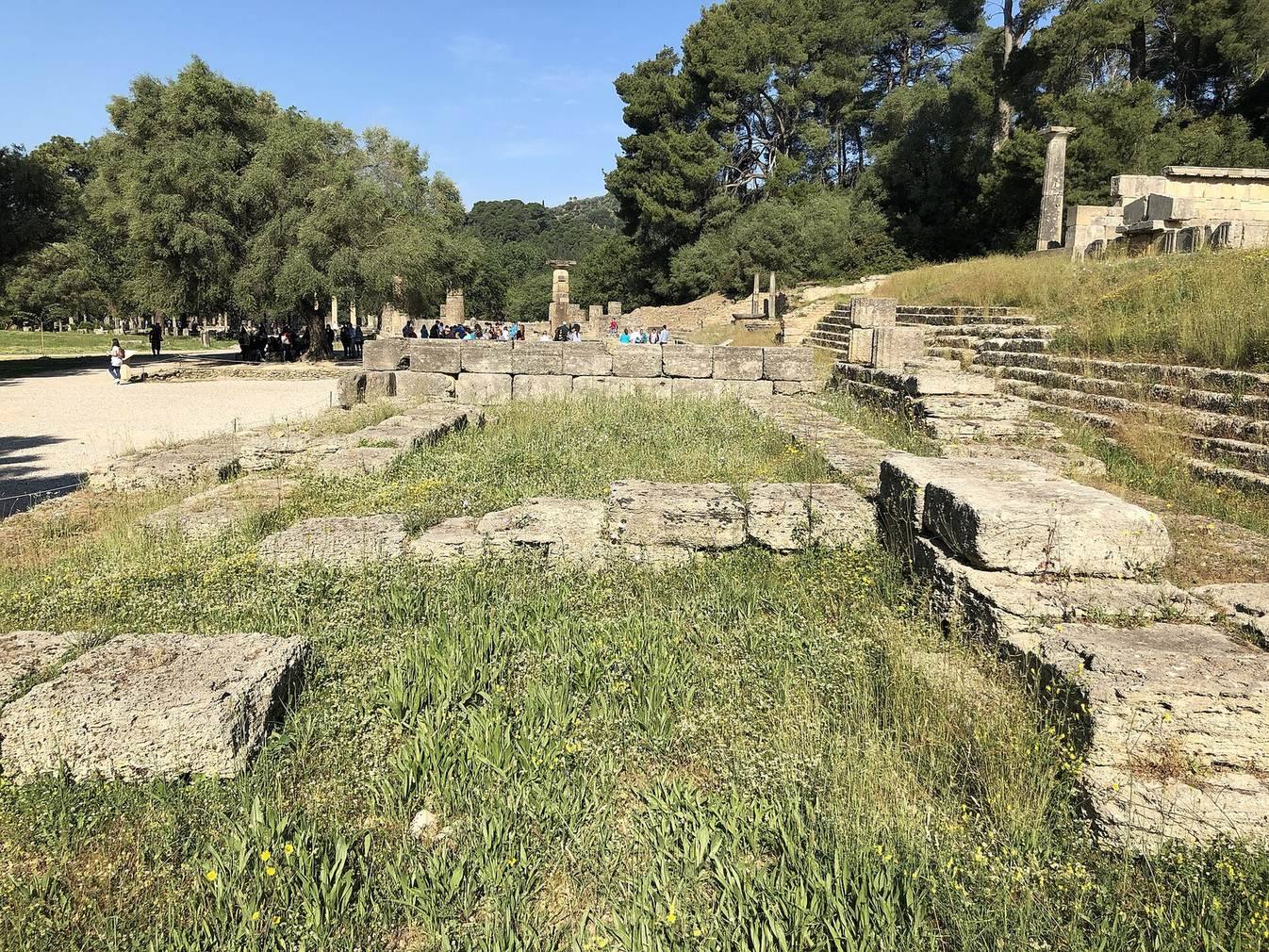
The temple stood north of the sanctuary of Zeus, south of the terrace of the treasuries, and east of the Temple of Hera. Its surviving foundations, column platform, and upper stonework preserve parts of a compact Doric building.
Plan and construction
The temple had six columns at each short end and eleven along each long side. Its column-supporting platform measured 10.62 by 20.67 metres. Within it were an entrance porch, an inner chamber arranged in three aisles and a rear porch. The inner chamber measured 6.30 metres long by 5.15 metres wide. The columns were estimated to have stood 4.63 metres high, with a usual distance of 2.01 metres between them. Built from shell limestone, they measured 0.85 metres across at the base and 0.65 metres at the top, and were covered with white plaster.
Surviving stonework and orientation
Parts of the foundations and column platform remain, including a section at the northwest corner, alongside fragments of the horizontal structure once carried by the columns. A projecting cornice block from a corner indicates that the triangular upper end of the temple was about 1.20 metres high. The entrance and altar were on the west side rather than the customary east. The altar was probably dedicated to Rhea. One explanation is that the temple was fitted around an existing altar; another proposes that an altar farther north could not be accommodated on the terraced ground, so the temple was built just to its south.
Sculpture
A statue found at the site represents a ruler as Zeus, holding a thunderbolt and sceptre. A reclining youth, 90 centimetres high and carved from Parian marble, was found during excavations at the Prytaneion, a civic building associated with public functions and a communal hearth. The figure is interpreted as Dionysus, a god associated with wine and ritual, and may have belonged to the Metroon’s triangular upper section before being reused at the Prytaneion. The statues associated with the temple are displayed at the Archaeological Museum of Olympia.