Basilica Therma: A Roman Imperial Public Bath in Türkiye
Site at a Glance
- Popularity
- Medium
- Country
- Turkey
- Primary era
- Classical
- Eras represented
- Classical
- Civilizations
- Roman
- Site type
- Sanitation
- Remains
- Baths
On this page12 sections
History
Roman foundation and ancient identity
Basilica Therma is a Roman imperial public bath in Sarıkaya, Yozgat Province, Türkiye, built in the second century AD in the Roman province of Cappadocia. It is an example of Roman bath architecture in Anatolia, set directly above a thermal spring at about 1,170 metres above sea level, in the lowest part of a large valley. A route ran via Kayseri to Kamuliana, Euaissa, and Sibora, while Tavium, Sebastopolis, and Rumdiğin lay nearby.
The bath’s ancient identity remains uncertain. It may be the place called Aquae Saravenae, although this identification has also been proposed for a site near Kırşehir. The second-century geographer Ptolemy included the name Sarouena in his atlas. A thirteenth-century copy of the Peutinger Map, a medieval version of a Roman road map, gives the name Aquas Aravenas in corrupted Latin; the map’s original is thought to date from the fourth or fifth century.
Christian period
By the fourth century, as Christianity spread and paganism was prohibited in Anatolia, a church had been added north of the bath. The settlement became a bishopric that lasted until 451, and the bath gained a Christian ritual role alongside its use for bathing. Sixth- and seventh-century Byzantine episcopal lists refer to the place as Basilikai Thermai, meaning royal baths.
In autumn 979, the East Roman general Bardas Phokas defeated the rebel military leader Bardas Skleros near Basilica Therma. A large church, now known as Uçayak Church, was later built to commemorate the victory at the place where the battle began, about 100 kilometres west of the bath.
Medieval and Ottoman rule
In 1067, the East Romans, or Byzantines, lost the Battle of Kayseri and control of Cappadocia to the Seljuks after ruling the region for about seven centuries. Authority later passed to the Danishmendids, the Sultanate of Rum, a Seljuk state in Anatolia, and the Ottoman Empire. The bath remained in use during the Byzantine, Seljuk, and Ottoman periods.
An Ottoman record from 1905 considered directing revenue from the Ilısu thermal spring to pay teachers at a primary school in Boğazlıyan whose salaries could not otherwise be met. The proposal indicates that the bath was still active and drawing visitors in the early twentieth century.
Rediscovery and conservation
French traveller Chantre described the remains in 1893–1894. Dr. Von der Osten referred to them during archaeological work at Alişar from 1927 to 1932, and Richard C. Haines carried out the first excavations at Basilica Therma in 1932. The Yozgat Museum Directorate began excavation and cleaning in 2010, with further excavation in 2014.
The bath was registered as immovable cultural property in 1987, and the area received protected-site status in 2013. In 2018, Basilica Therma was added to Türkiye’s UNESCO World Heritage Tentative List, which identifies places a country may consider nominating for World Heritage status. Aerial-drone records have also been compared with earlier terrestrial laser scans in a study of the capabilities and limits of digital recording methods.
Remains
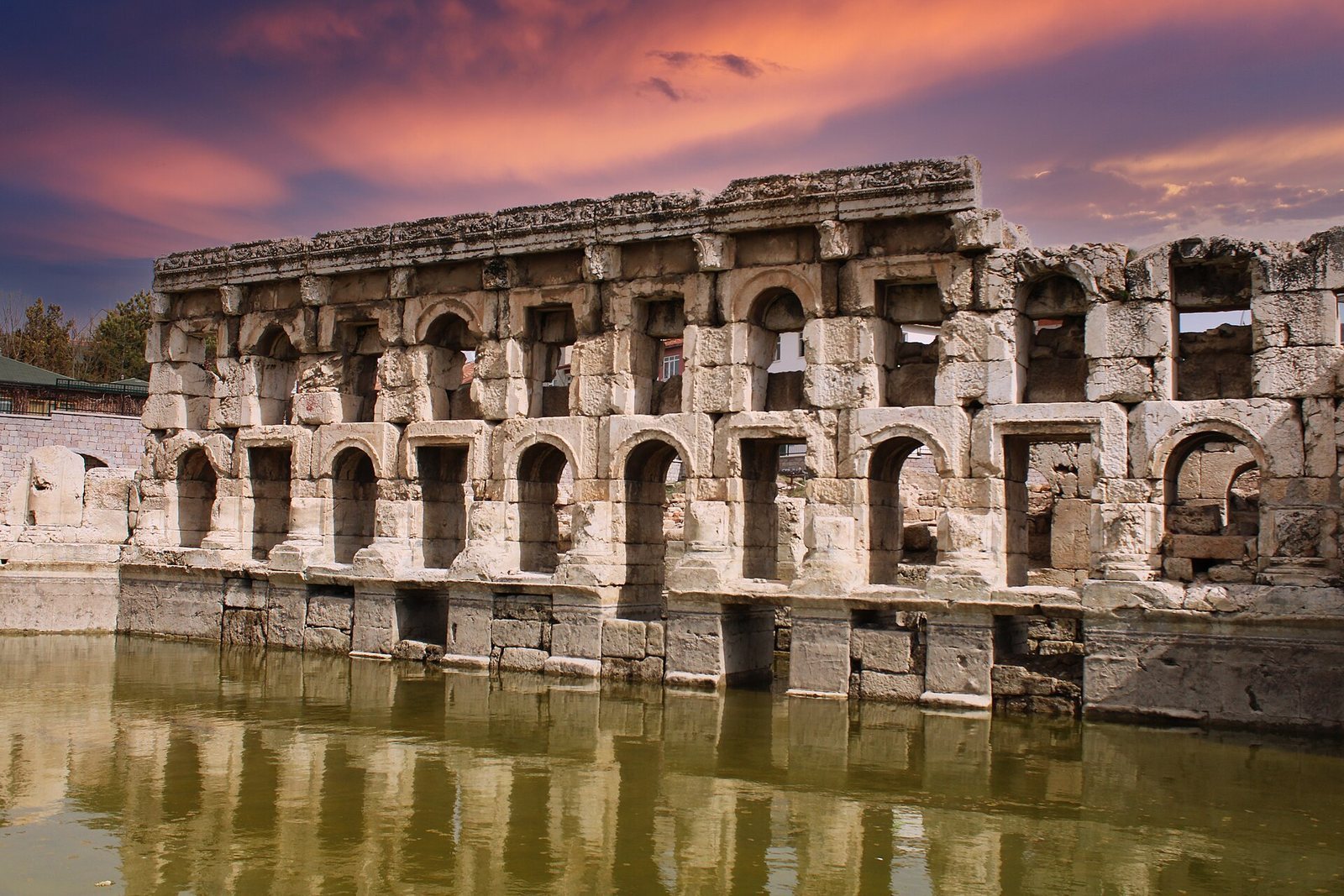
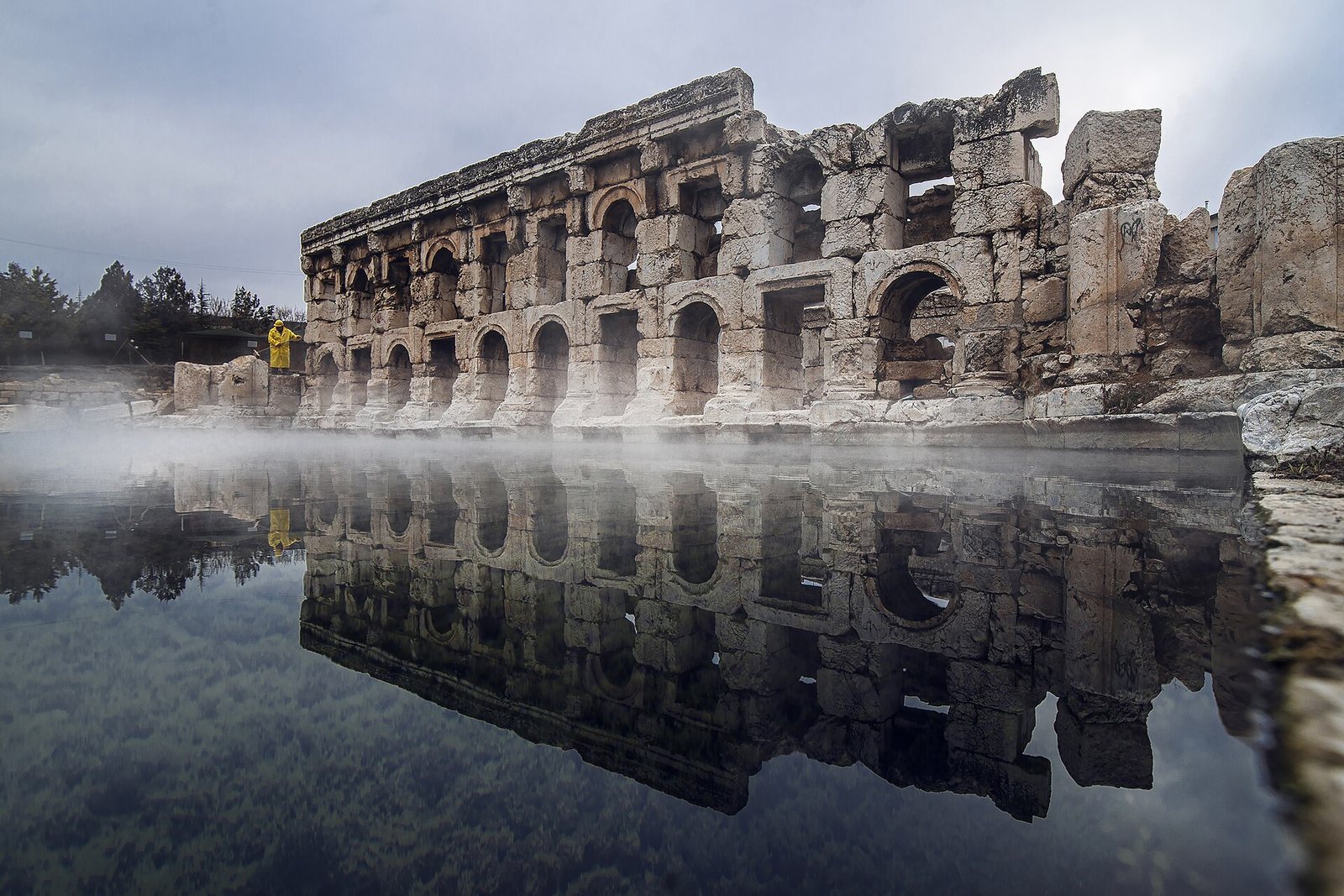
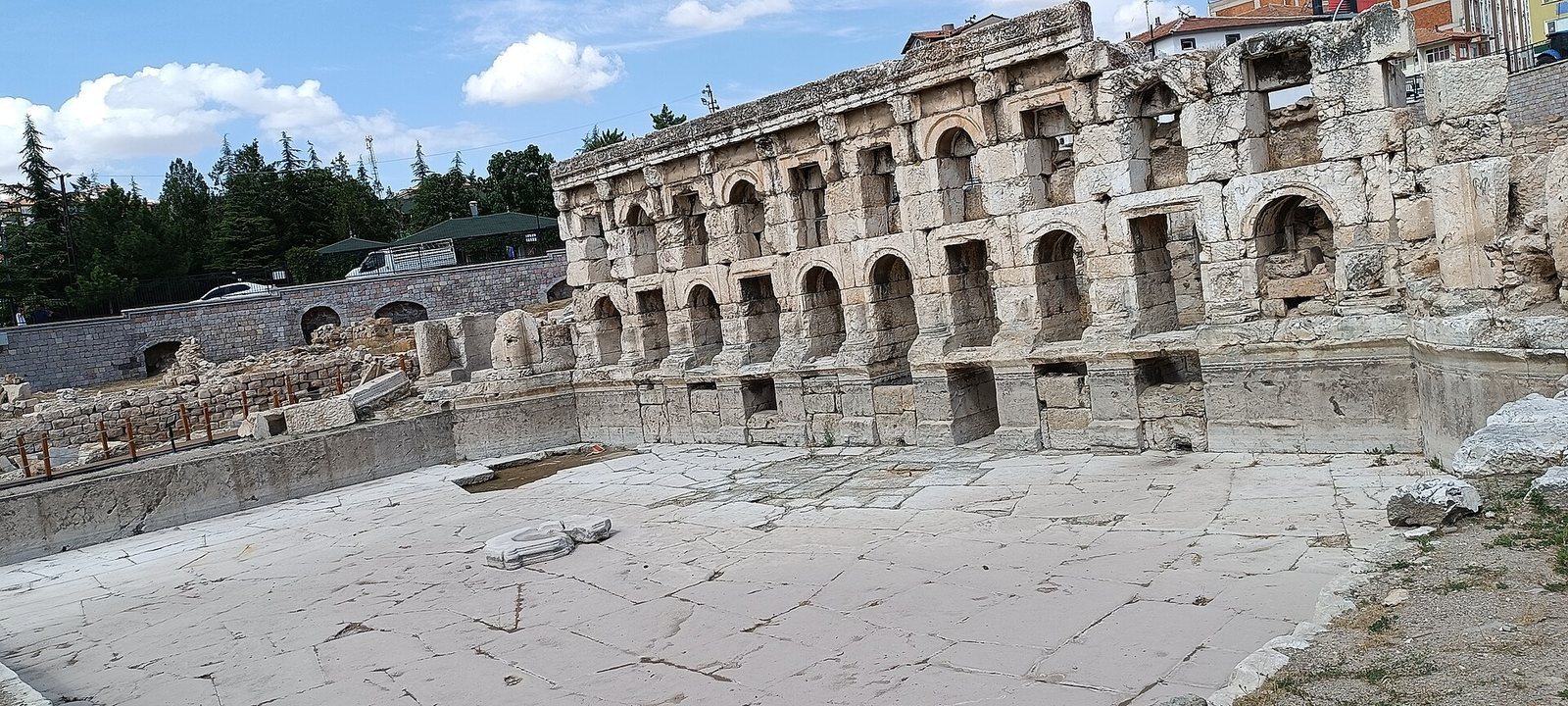
The bath was constructed from marble and limestone. Its surviving layout includes three pools, arches, two curved apse walls, and other wall fragments. Rising ground and roads have gradually buried the complex several metres below the surrounding surface. The adjacent church and other buildings survive as foundations and low sections of wall.
Pools and water features
The largest pool is rectangular, measuring 23.3 by 12.8 metres and 1.34 metres deep; its water is about 45°C. A smaller rectangular pool, 16 metres long and 4 metres wide, adjoins the arches as an extension of the large pool. Steps descend into it symmetrically from both sides, and water from the two pools mingles beneath the arches. A third pool lies at right angles to the inner pool. It measures 15 by 5.2 metres and has a rounded rectangular outline with semicircular ends; thermal water rises through its floor.
Baptismal stone
A marble baptismal stone from the centre of the large pool measures 120 by 140 centimetres and is 25 centimetres thick. Made of two pieces, it has a roughly oval, almost hexagonal outline and a carved cross. Converts from paganism were baptized in the pool during the Christian period.
Arcade and carved decoration
Most of the bath’s walls and arches have collapsed. The surviving western façade wall leads into a vaulted space behind it and contains a two-storey marble arcade with ten openings, built with corbelled arches, formed by projecting successive masonry courses inward. Semicircular apse walls (curved end walls) flank and support the arches. Friezes carry bull, flower, and leaf designs, while the ornamental cornice at the centre of each arch has a lion head. Column cornices feature leaves and other plant forms, bulls, and snakes associated with Asklepios, the Greek god of medicine and healing. The snake carvings have been taken to suggest that the bath also served as a healing centre.
Excavated objects
Early objects and Roman finds
A bone object dated to the first century BC is shaped like a small spoon, with circular designs along its body. A bronze coin bears a portrait of Antoninus Pius, a second-century Roman emperor, on one side and Mount Erciyes on the other; the coin helped refine the dating of the bath’s construction. A late Roman medallion has a cross motif and illegible Latin letters.
Seljuk and Ottoman objects
Finds from the Seljuk period include a patterned perfume vessel dated to the twelfth or thirteenth century and a double-sided wooden comb with two lions at its centre. Gold and silver coins from the reign of Ahmed III, an early eighteenth-century Ottoman sultan, also came from the excavations.