Saint-Michel Tumulus: A Neolithic Burial Monument at Carnac
Site at a Glance
- Country
- France
- Primary era
- Stone Age
- Eras represented
- Stone Age, Medieval, Modern
- Civilizations
- French
- Site type
- Burial
- Remains
- Burial Mound
On this page16 sections
History
The Saint-Michel tumulus is a Neolithic burial mound at Carnac, France, near the Gulf of Morbihan. The Neolithic was the later part of the Stone Age, associated in many regions with farming communities and monuments made from large stones. Raised around 4500 BC, the mound is the largest known prehistoric tumulus in France.
Neolithic construction and use
Three charcoal samples did not provide a reliable radiocarbon date for the monument, while the artifacts are broadly Neolithic. Bronze fragments from the eastern burial structure may indicate some later use. Construction is estimated to have taken nearly 300,000 hours of labour.
The arrangement of the central burial chamber and surrounding chests led archaeologist Zacharie Le Rouzic to suggest that the chamber was probably the grave of a high-ranking person. He proposed that the chests might have held people or animals intended to accompany the deceased, although he considered some could instead have been simple hearths. Valued objects brought from distant regions indicate exchange among local elites, and point to the Carnac area as a European centre of power and wealth in the early fifth millennium BC.
A local legend explains the mound through devotion to Saint Michael, the Christian archangel. It tells that pilgrims carried sacks of earth or stones to build the mound in his honour.
Conflict and nineteenth-century exploration
On 27 June 1795, Chouan insurgents fought Republican forces at the site during the Quiberon expedition, an attempt to land forces opposed to the French Republic in Brittany.
In 1862, the Société polymathique du Morbihan received permission from prefect Julien Lefebvre to investigate the mound. The society assigned the work to René and Louis Galles. After an unsuccessful attempt at the eastern end, René Galles dug shafts down from the summit and found the central burial chamber eight metres below. Through a crack he saw two axe edges and three large jasper beads.
Two years later, Galles judged that the mound was much larger than the chamber he had found and searched for further burials. His investigation of the western part revealed no additional structures, leading him to suppose that the eastern part was empty too. Le Rouzic disputed this conclusion and sought permission to excavate. Gabriel de Mortillet opposed the work until his death in 1899. Le Rouzic gained approval in 1900 with backing from several prehistorians and a pledge of joint support from industrialist Charles Keller and the Miln Museum.
Le Rouzic’s excavations
Between 1900 and 1907, Le Rouzic uncovered further burial structures. Geoffroy d’Ault du Mesnil, who chaired the commission for megalithic monuments, supervised the work and was charged with publishing its findings. He died in 1921 without publishing the excavation reports.
Protection and modern history
The tumulus has been protected as a French historic monument since 1889. During the German occupation in 1942, a proposal to build a bunker threatened the mound, but Maurice Jacq intervened and it was spared. In July 2025, it became part of the UNESCO World Heritage property Megaliths of Carnac and the shores of Morbihan.
Remains
The mound and its construction
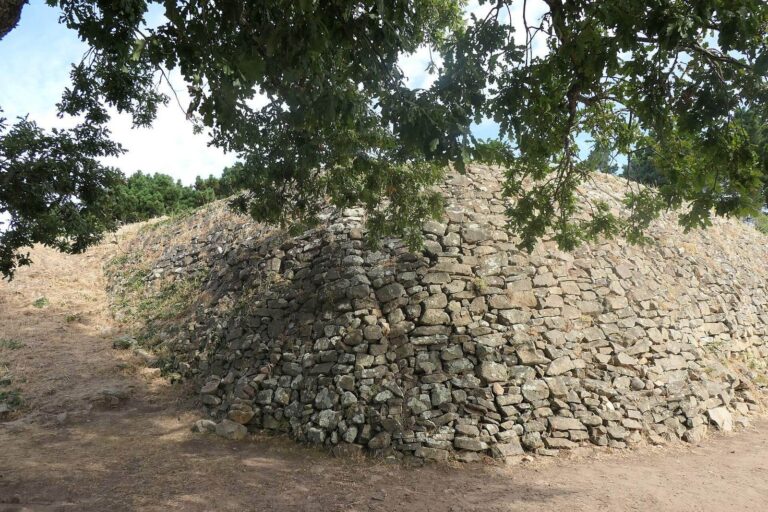
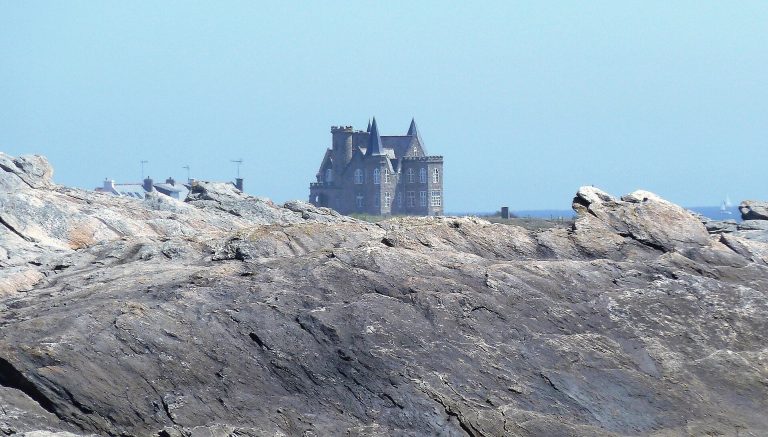
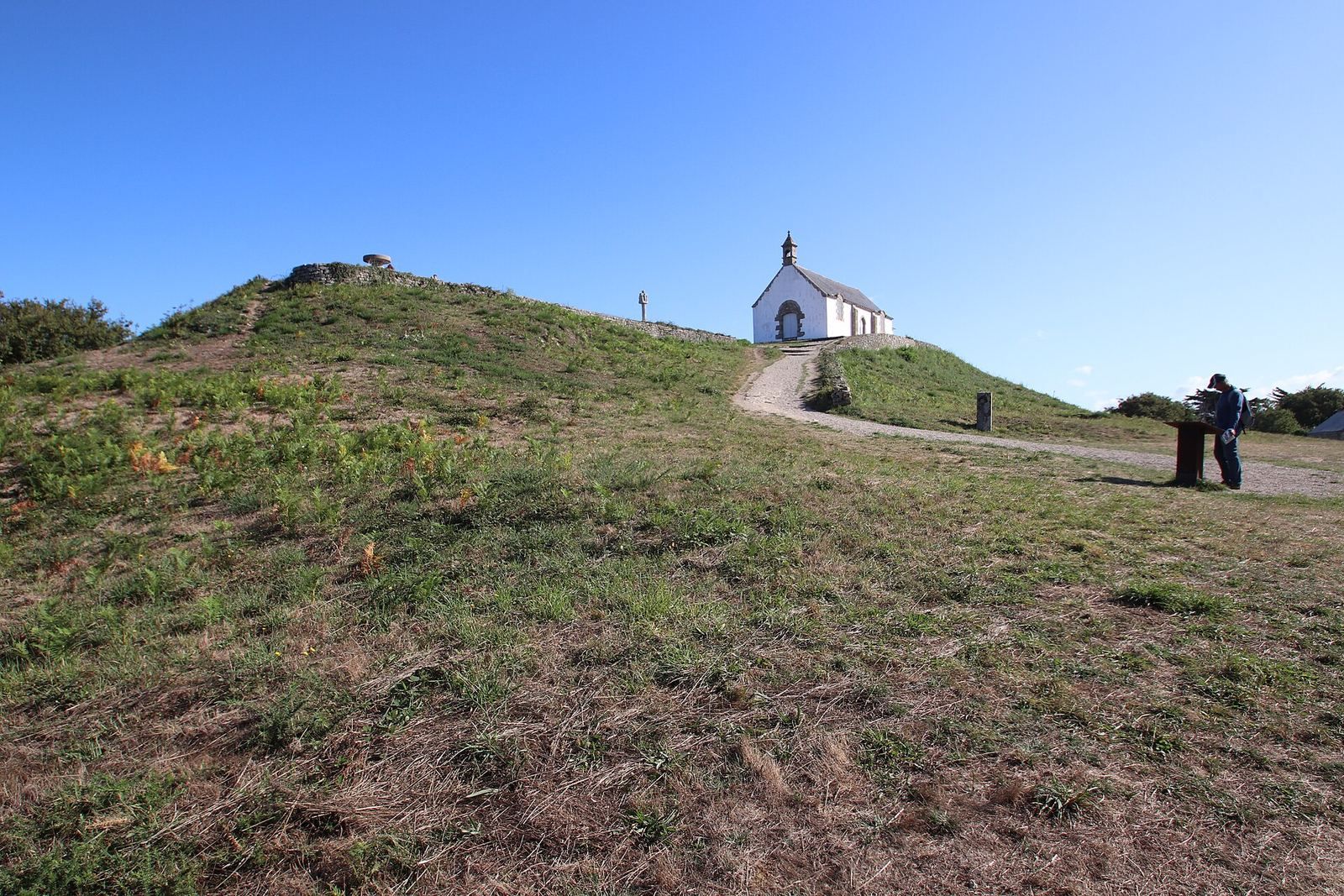
The elongated mound stands on a prominent point in hilly coastal terrain. It is about 125 metres long, 60 to 65 metres wide and 10 to 12 metres high. Detailed measurements give a base width of 65 metres, a summit width of 16 metres and a height of 12 metres. René Galles estimated its volume at about 35,000 to 40,000 cubic metres. Four similar, smaller mounds are found nearby. The tumulus can be seen from nearby coastal waters and from the Carnac stone alignments; it may have formed an architectural and ritual group with them.
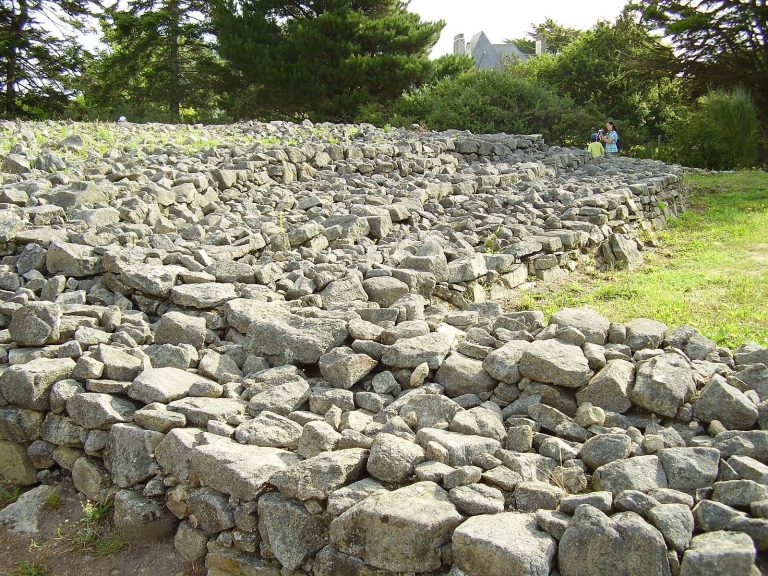
The ground was levelled and covered with an initial layer of earth. A stone mound, or cairn, about 98 metres long, 10 metres wide and 5.60 metres high at its centre forms the main core. Its stones were laid without an apparent regular pattern, except around the burial chambers. A protective layer of fine sediment covers the stones. It is about 0.60 metres thick on the east and 1.80 metres on the west, with another stone layer, about 0.80 metres thick, above it. The uppermost earth may be natural debris or may have been added during construction of the first chapel. The Neolithic mound was probably built up slightly rather than levelled down.
Burial structures
Central chamber and surrounding chests
The central burial chamber is a stone-lined room, 0.95 metres high, aligned east to west. Its trapezoidal plan measures 1.52 metres along the west side, 2 metres on the south, 2.40 metres on the north and 1.80 metres on the east. Rough paving covers the floor, and two slabs form the roof. One slab has cup-shaped hollows on its inner face.
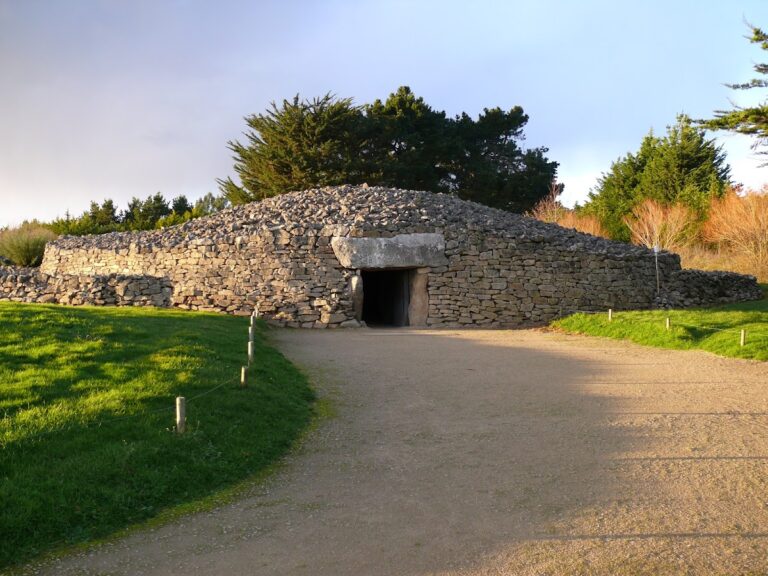
Le Rouzic’s excavations also revealed five subsidiary burial chests, fourteen irregular small chests and a small passage dolmen east of the central chamber. A dolmen is a burial chamber made from large stones; a passage dolmen has an entrance passage leading to its chamber. Short passages link some of the small chests to the central chamber, and others are stacked within the stone mound. Together, the central chamber and chests form a core distinct from the eastern dolmen. Their arrangement suggests that the eastern structure was added later rather than planned as part of the same group.
Eastern passage dolmen
Eight upright stones define the eastern dolmen’s oval chamber, which is 2.75 metres long and 1.75 metres wide. It runs north to south, with its entrance at the north end. Four roof slabs rest on inward-stepped dry-stone walls rather than directly on the upright stones. One slab has a cup-shaped hollow. The space beneath the slabs is 1.45 metres high; the floor has rough paving covered by small pebbles.
Excavation galleries and chapel
Exploration gallery
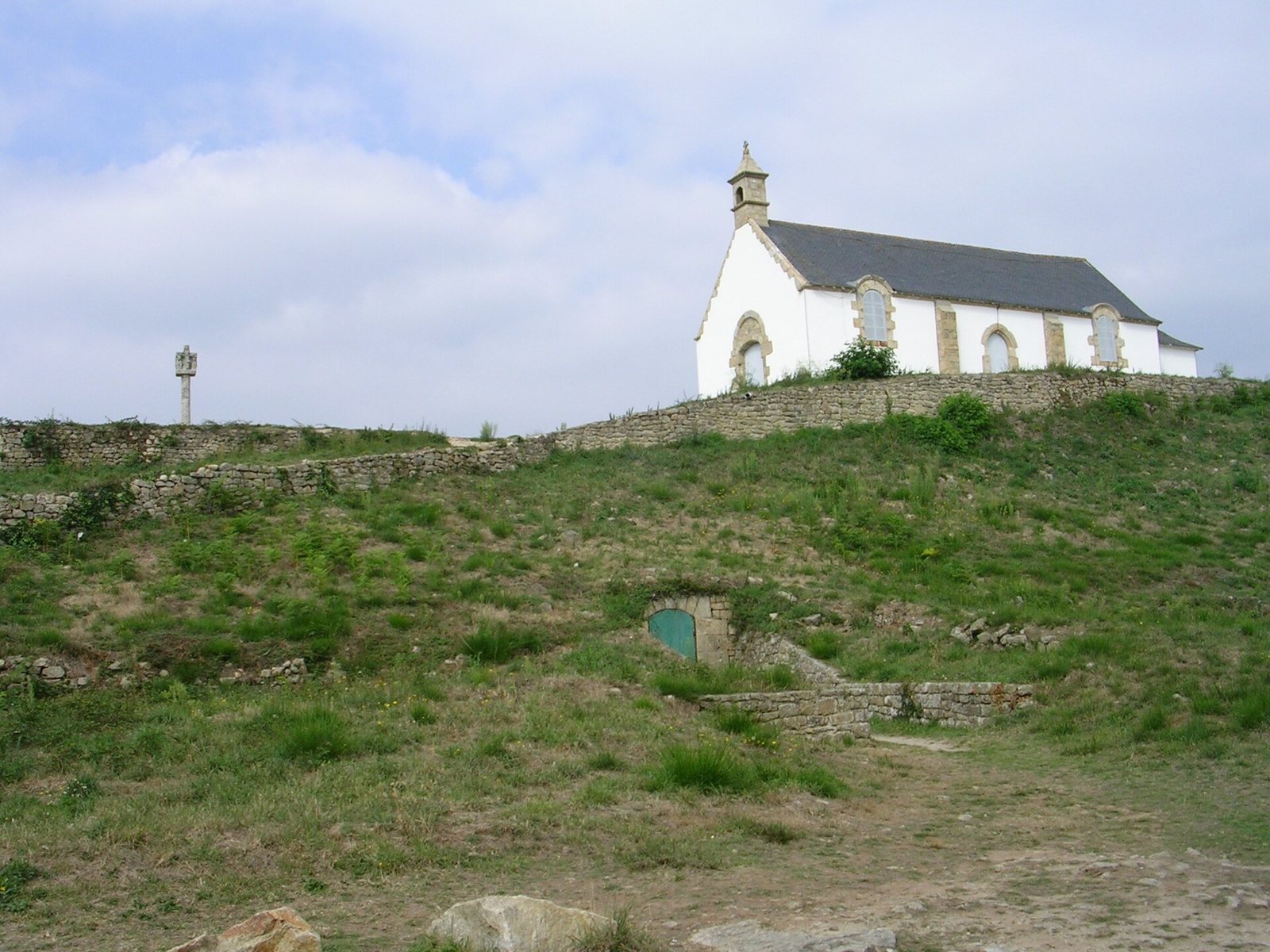
Galles’s 1864 exploration included a gallery driven from the western end towards the central chamber. It is 36 metres long and 1.30 metres wide. Galleries were also exposed elsewhere within the mound.
Summit chapel
A medieval chapel once stood on the summit and was dismantled during nineteenth-century excavations. A staircase at the site is associated with that earlier chapel. The chapel now crowning the mound was built in 1926. Some soil may have been added to the mound when the first chapel was built, possibly to make access easier.
Finds
Central chamber assemblage
Objects from the mound are held at the Museum of Prehistory in Carnac. Finds from the central chamber include eleven polished axes of jadeite, a mineral worked into tools, two of them perforated; two large broken polished axes; twenty-three small axes of tremolite, another mineral used for stone tools; two flint flakes; nine pendants; 101 variscite beads, made from a mineral used for beads; white bone beads; four quartz pounders; flint blades, flakes and cores; quartzite pebbles marked by repeated blows; and part of a polished diorite axe. Fragments of cremated human ribs and long and short bones lay beneath the chamber paving.
The jadeite axes came from Neolithic quarries at Monte Viso in the Italian Alps. Alpine stone axes measure between 9.5 and 37 centimetres. The variscite beads came from deposits at Encinasola and Palazuelo de las Cuevas on the Atlantic side of Iberia. Axes made from fibrolite, a mineral also worked into tools, may have had an Iberian origin. The polished axes were placed with their points upwards, in a position comparable to the standing stones in nearby alignments. Grave goods could sometimes be deliberately broken when deposited.
Other finds
Fragments of two bronze bells came from the eastern dolmen. A polished ceramic bowl found at the site measures 30 centimetres across and 5 centimetres deep. It may have been used to evaporate seawater and obtain salt; a reconstruction is displayed at the Carnac museum. Salt production may have been an important source of wealth for the local elite.