Vaksala Church: A Medieval Lutheran Church in Uppsala, Sweden
Site at a Glance
- Country
- Sweden
- Primary era
- Medieval
- Eras represented
- Medieval, Early Modern, Modern
- Civilizations
- Swedish
- Site type
- Religious
- Remains
- Church
On this page13 sections
History
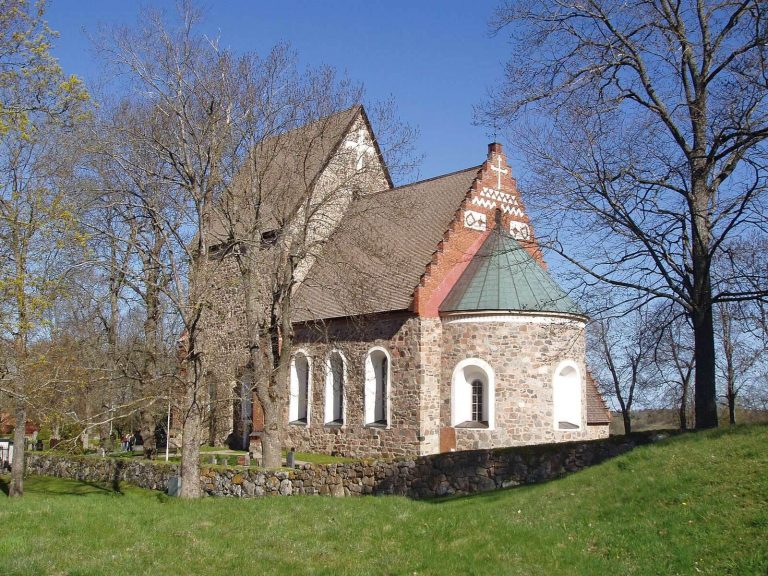
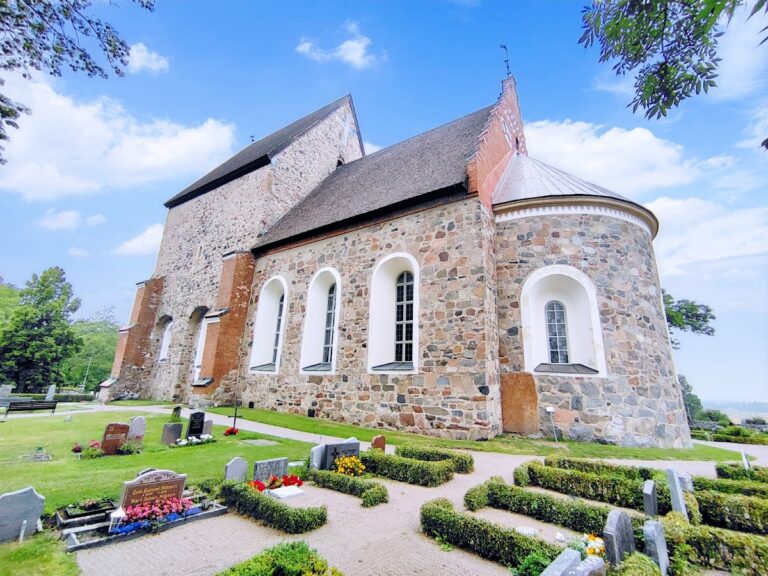
Vaksala Church is a Lutheran church dedicated to Saint Andrew in Uppsala, Sweden. Built in the late 12th century, it retains a tower and western end dating to the 12th century. Its exterior is largely Gothic in appearance, with elements of the original Romanesque church, and it is considered one of Uppland’s more unusual churches.
Before the Diocese of Uppsala was established, the church stood at the centre of one of Uppland’s hundreds, historical Scandinavian districts. It was near a thing, a local assembly dealing with legal and public matters, and an important road. A medieval guild, an association with social, economic, and religious functions, also operated in the locality. The church is now part of the Church of Sweden’s Archdiocese of Uppsala and Vaksala parish.
Medieval development
The church was enlarged in stages during the Middle Ages. A sacristy was added in the 13th century, and later that century a new choir replaced the earlier one. Around 1300, the nave walls were raised and the interior painted. Four brick rib vaults were installed in the nave and choir around the middle of the 14th century or somewhat later. Two side chapels were added in the 15th century.
North and south porches were built around 1400 and removed between 1783 and 1785. The chapels were painted in the second half of the 15th century. During restoration from 1793 to 1795, the paintings were covered with whitewash; they were uncovered in 1929.
Later alterations and restoration
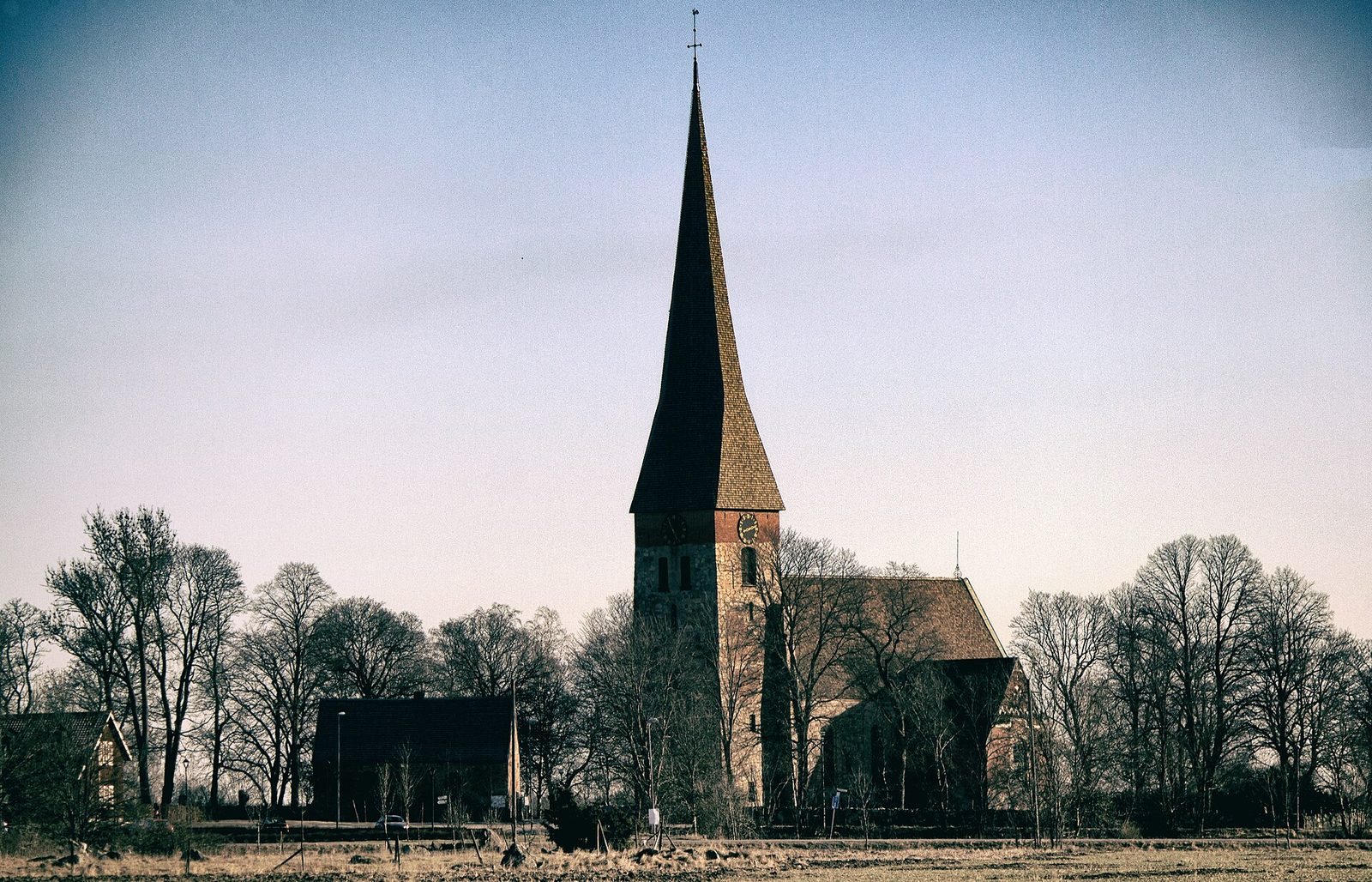
The church’s spire dates to 1692 and appears to have replaced an earlier spire of the same design. In 1749, the two bells were transferred to the church tower from a separate bell tower. Exterior work in 1810 removed the medieval crow-stepped gables, whose outer edges had been formed in steps.
A five-stop organ was given to the church in 1687 and repaired in 1765. It was sold to Börje Church in 1804, and Olof Schwan built a replacement in 1806. Bo Wedrup rebuilt that instrument in 1936. The present main organ was made in 1985, while a separate small organ dates to 1960. Renovations also took place in 1929 and 1969.
Remains
The church is built of granite and brick, with a single nave, two side chapels, and a choir. It has no apse, a recessed space at the end of a church, and its tower at the western end rises 76 metres. The building’s present plan and fabric bring together features from successive medieval alterations.
Church fabric and vaulting
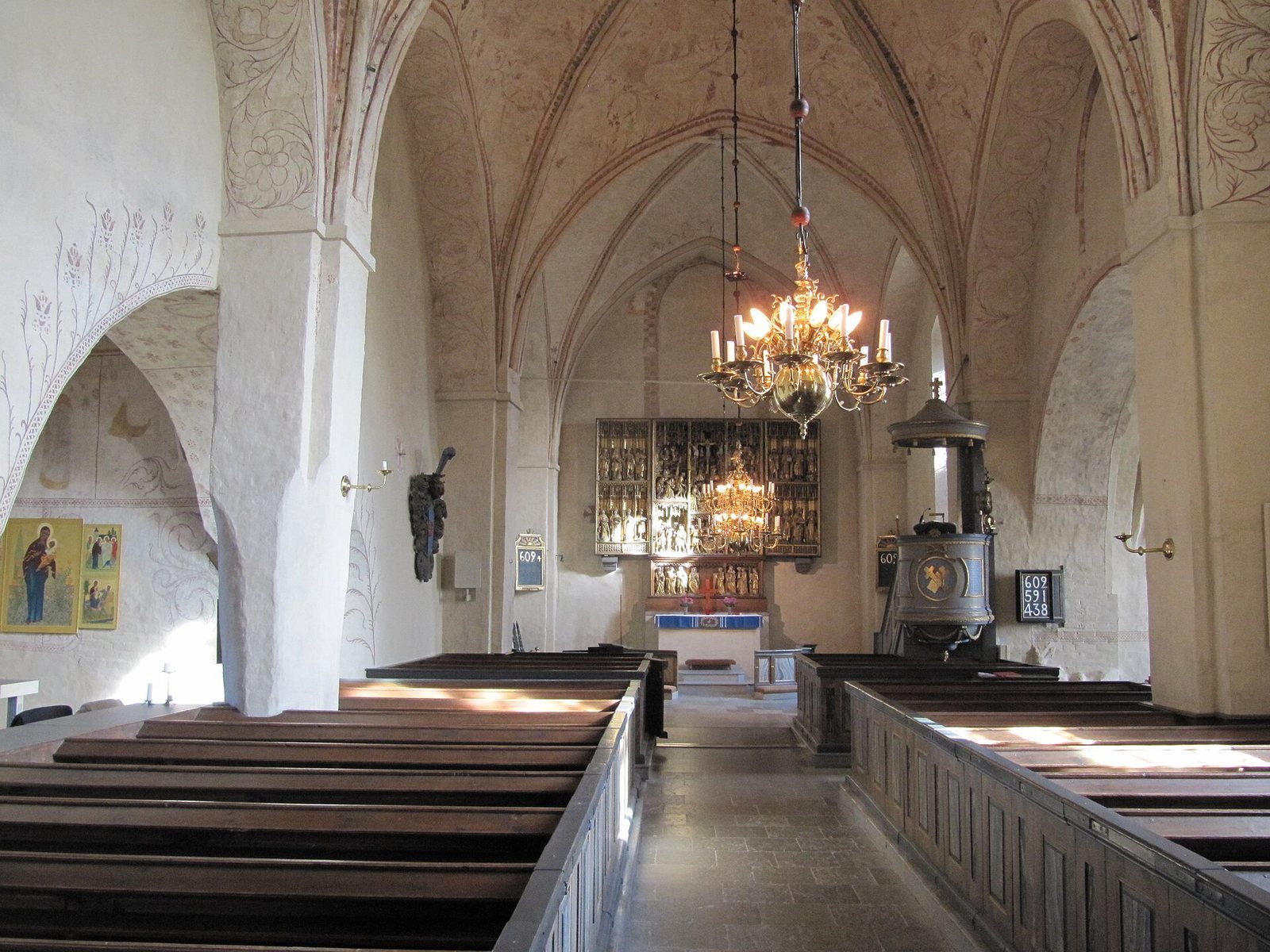
The sacristy has a barrel-vaulted ceiling, a continuous arch-shaped roof. The choir was made wider than its predecessor but is the same width as the rest of the church. The nave walls rise two metres above their earlier height. Before the present brick ceilings, the nave and choir had a high wooden barrel vault whose highest point was 3.5 metres above the current vaults. Four brick rib vaults now cover the nave and choir. The side chapels also have vaults, dating to the 14th century, earlier than was usual in the surrounding area.
Wall paintings
The oldest wall paintings date to the first half of the 14th century, with later work in the chapels. Some chapel paintings are attributed to Albertus Pictor, a Swedish medieval painter, or his workshop. Despite substantial damage, outlines of figures and traces of colour remain.
Churchyard and nearby buildings
A brick building from the late 15th century stands just west of the church. It may have been used for storage or housed the local guild. An 18th-century parsonage is northwest of the church, and the Vaksala Runestone, a stone bearing an inscription in runes, stands in the churchyard.
Interior furnishings and equipment
Altarpiece
Made in Antwerp around 1510, the carved and gilded altarpiece is among Sweden’s largest. It presents the Passion and death of Jesus, with the Crucifixion at its centre. Its wings show saints and martyrs, including Saint Andrew and Saint Bridget of Sweden, while the lower section depicts the parable of the foolish virgins.
Bench and chandeliers
The church’s oldest furnishing is a 12th-century bridal bench, also known as the bishop’s chair. It stands against the north wall of the choir. The church also has six older brass chandeliers. The large chandelier at the crossing, where the main axes of the church meet, was acquired in 1658.
Bells
The larger bell was cast in 1534 and recast in 1769 and 1844. It weighs about 2,200 kilograms and has a pitch of C-sharp 1. The smaller bell was cast in 1650 and recast in 1896 by the K. G. Bergholtz bell foundry. It weighs about 750 kilograms and has a pitch of F-sharp 1.
Organs
The present mechanical main organ has slider chests, mechanisms that direct air to selected pipes. Its compass, or playable range, is 56/30. The façade was designed by Swedish architect Olof Tempelman and comes from the 1806 organ. A separate small organ, made in Copenhagen by I. Starup & Sön, has a mechanical action, a slider chest, and a 56-note compass.
Coats of arms and burials
Four coats of arms are displayed inside the church, including those of the Duse, Transehe von Roseneck, and Rosenstielke families. Sara Christina von Linné, daughter of Carl Linnaeus, married Hans Henrik Duse in 1794 and is buried in the churchyard. She lived from 1751 to 17 January 1835. Joakim Henrik, who died on 25 February 1688, and Carl Rosinger, ennobled as Rosenstielke, are buried in the church. The Transehe von Roseneck family ended in 1710, and the Rosenstielke family in 1661.