Atiq Mosque: A Historic Mosque in Ghadames, Libya
Site at a Glance
- Country
- Libya
- Primary era
- Medieval
- Eras represented
- Medieval
- Civilizations
- Unclassified
- Site type
- Religious
- Remains
- Mosque
On this page6 sections
History
Medieval foundations and religious role
Atiq Mosque stands near the center of Ghadames Old Town in Libya. Its history is associated with the seventh-century Islamic conquests, when Islam reached the Ghadames region, while the present building was constructed principally in 1258. Ghadames was an important stop on caravan routes, and the mosque was expanded and repaired over the centuries using materials suited to the town’s traditional architecture.
The mosque has long served religious and educational purposes. It remains a principal place of worship, hosting daily and Friday prayers. Historically, it also provided instruction in the Quran and Islamic jurisprudence, the interpretation and application of Islamic religious law.
Destruction, reconstruction, and heritage status
A French air raid on Ghadames on 11 January 1943, during the Second World War, destroyed the mosque. It was later rebuilt in a way that retained its traditional architectural character.
Ghadames Old Town, including the mosque, was inscribed on UNESCO’s World Heritage List in 1986. The old town was added to the List of World Heritage in Danger in 2016 amid armed conflict and instability in Libya. In July 2025, the European Union welcomed its removal from that list after a project supporting solar-powered lighting in the town.
Remains
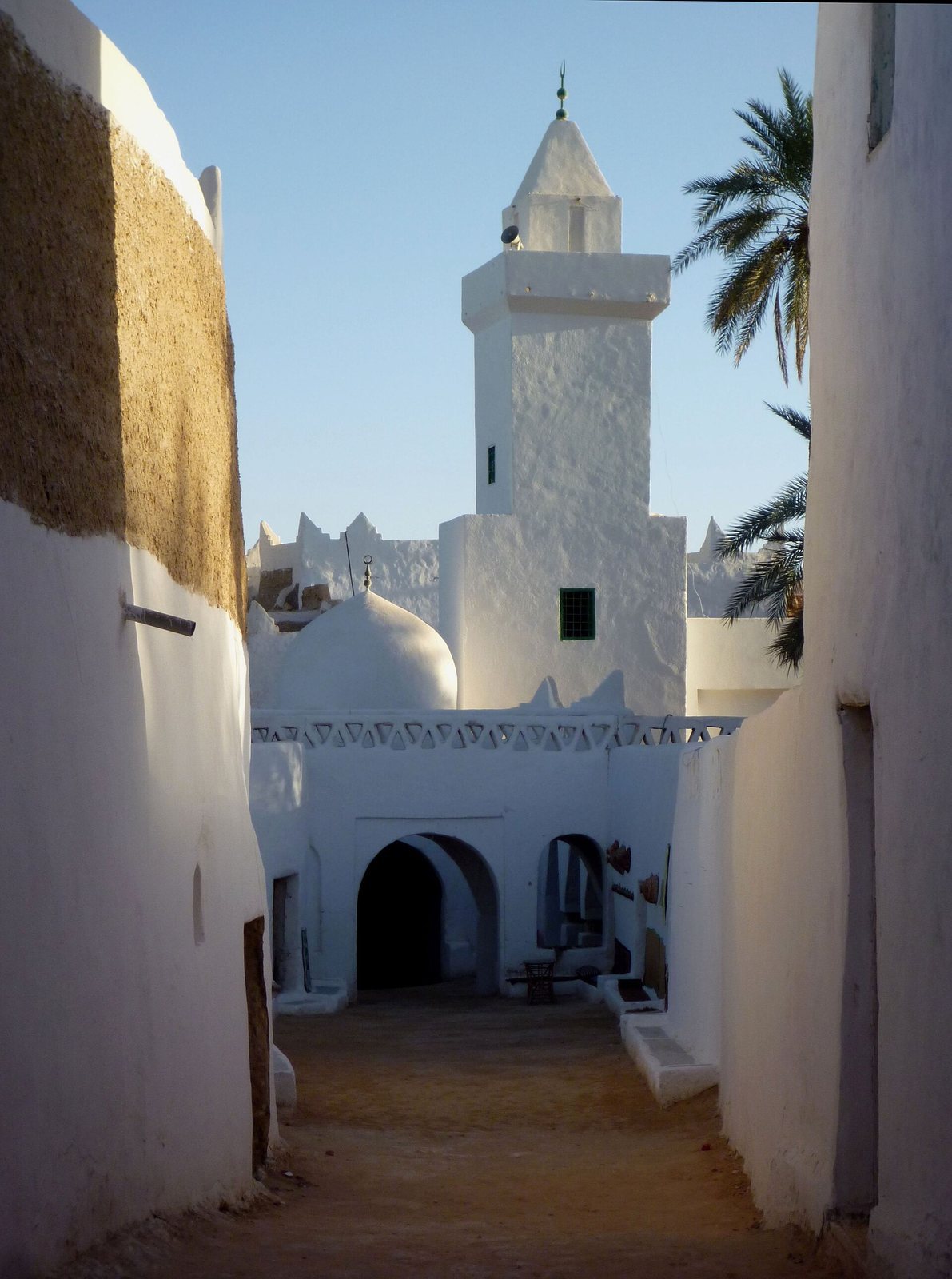
The mosque is the largest and most centrally located of the more than 20 mosques distributed across Ghadames Old Town’s six neighborhoods. Covered alleys extend from it toward the residential areas. Its traditional design combines thick mud-brick walls, a roof supported by palm timber, a simple prayer space, and a single minaret.
Walls, roof, and climate
The walls are made mainly of sun-dried mud brick mixed with straw and coated inside and out with white lime plaster. Their thickness helps keep the interior cool in the desert heat. Palm trunks and fronds support the roof, which is covered with clay and straw for insulation. Small openings high in the walls admit daylight while limiting direct sun, and help hot air escape as cooler air enters.
Prayer space and minaret
The prayer space has a simple mihrab, a niche indicating the direction of prayer, toward the qibla, the direction Muslims face toward the Kaaba in Mecca. A wooden minbar, or pulpit for sermons, serves especially for Friday prayers. The mosque’s decoration is restrained. Its minaret has a square base and rectangular shaft, and rises above the surrounding buildings as a landmark in the old town’s skyline.