Akutagawayama Castle: A Sengoku-Period Mountain Stronghold in Japan
Site at a Glance
- Country
- Japan
- Primary era
- Medieval
- Eras represented
- Medieval, Early Modern
- Civilizations
- Tokugawa
- Site type
- Military
- Remains
- Castle
On this page13 sections
History
Construction and Hosokawa rule
Akutagawayama Castle is a mountain fortress on Mount Miyoshi in northern Takatsuki, Japan. Hosokawa Takakuni built it in 1515–1516 during the Sengoku period, an era of political fragmentation and sustained warfare in Japan. The castle gave Takakuni a stronghold in Settsu, a historical province corresponding roughly to present-day Osaka and Hyogo, during his rivalry with Hosokawa Harumoto. The construction effort is traditionally said to have involved 500 laborers by day and 300 at night, although the date associated with the account of this work is considered erroneous.
In January 1516, the castle, then called the new castle, hosted a gathering attended by the poet Sōchō. The participants composed renga, a collaborative form of linked verse. The castle was then held by Nose Yorinori, who died in August and was succeeded by his son Yoriaki. Nose Kuniyori may have become its lord by 1523.
Conflict between Takakuni and Harumoto began in 1526. In 1527, Akutagawayama surrendered to Harumoto’s side along with other castles in Settsu, ending the Nose family’s control. Harumoto entered the castle in 1533 after being driven to Awaji, an island between Honshu and Shikoku. The castle prospered while he exercised effective political power. Although he moved to Kyoto in 1535, he returned repeatedly to direct military operations, and new defended enclosures were probably added during this period.
Akutagawayama has also been interpreted, together with a separate castle called Akutagawa Castle, as a political headquarters of the Hosokawa regime associated with Hosokawa Masamoto and its later Miyoshi successor. Masamoto was an earlier powerful head of the Hosokawa family and a deputy to the shogun. This interpretation links the castle’s construction with the establishment of those political regimes.
Changing control, 1539–1553
In 1539, Miyoshi Nagayoshi entered the castle during his conflict with Harumoto. A settlement on July 28 led Nagayoshi to relinquish it and move to Koshimizu Castle. A commander from the Yakushiji clan later took possession and, in 1546, sided with Hosokawa Ujitsuna, a rival of Harumoto. Harumoto’s forces besieged the castle in 1547, and its defenders surrendered on June 25.
Several commanders held the castle after that surrender, among them Akutagawa Magoshirō and Miyoshi Nagayuki. After Nagayoshi defeated Harumoto at the Battle of Eguchi in 1549, Harumoto was driven from Kyoto. Magoshirō later turned against Nagayoshi, who attacked the castle in July 1553. With provisions running short, the defenders surrendered on either August 22 or September 23. Magoshirō escaped to Awa, a historical province corresponding roughly to present-day Tokushima.
Miyoshi rule and the castle’s final years
Nagayoshi then took the castle for himself, making it a base of the principal Miyoshi lineage. In 1560, he moved his residence to Iimoriyama Castle and left his son and heir, Miyoshi Yoshioki, in charge. Yoshioki died aged 22 in 1563, and Nagayoshi died at Iimoriyama the following year. Miyoshi Nagayuki appears to have succeeded Yoshioki.
In September 1568, the forces of Oda Nobunaga, a powerful military leader, entered Settsu with Ashikaga Yoshiaki, the fifteenth shogun of the Ashikaga shogunate. On September 28, they set fire to the Akutagawa market, probably the Akutagawa post town. The following day, Yoshiaki reached Tenjin Baba and the castle’s foothills were burned. On September 30, Nagayuki and Hosokawa Akimoto fled. Yoshiaki stayed at Akutagawayama for 14 days before continuing to Kyoto.
After Yoshiaki’s departure, his senior retainer Wada Koremasa became lord of the castle. In 1569, after Nobunaga killed a member of the Irie family, Koremasa received Takatsuki Castle and had moved his residence there by June. When he was in Kyoto, he entrusted both castles to his senior retainer Takayama Hida-no-kami, whose court title was traditionally rendered Governor of Hida.
Koremasa was killed in August 1571 at the Battle of Shiraikawara while fighting the Ikeda family, whose forces were led by Araki Murashige. Koremasa’s son succeeded him, but in March 1573 a conflict with Hida-no-kami and his son Takayama Ukon, a Christian military lord, led to the son’s expulsion and the Takayama family’s control of Takatsuki Castle. Akutagawayama was abandoned around 1573, ending a history of roughly 60 years. In 2022, the site was designated a National Historic Site under the name Akutagawa Castle.
Remains
Mountain setting and layout
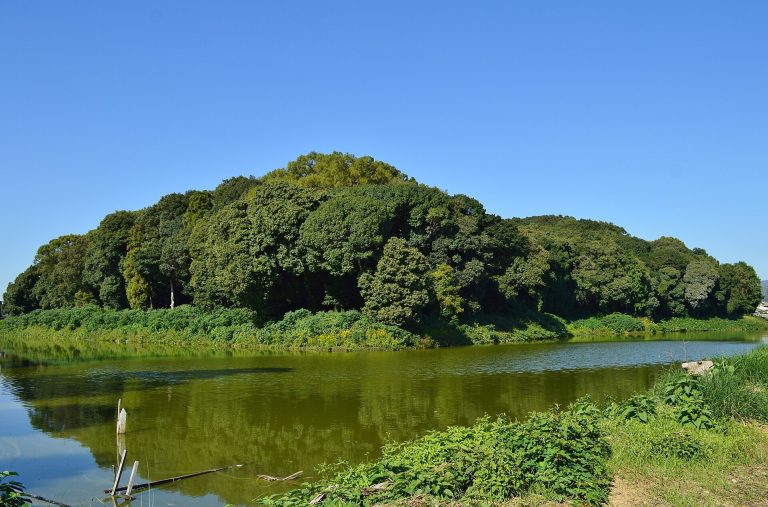
The castle is arranged as connected defended enclosures on Mount Miyoshi, whose summit stands 182.6 metres above sea level. The site is among the largest castle ruins in Osaka Prefecture, alongside Iimoriyama Castle. The Akuta River borders it to the north, west, and south, while steep slopes and the cliffs of Settsu Gorge add to the naturally defensible terrain. A neighboring mountain immediately to the east rises to 192.3 metres, but its relatively level summit was considered unsuitable for a castle. The choice of Mount Miyoshi is thought to have reflected the value of the surrounding terrain.
The enclosures form eastern, central, and western groups. Surviving features across the site include earthen ramparts, stone walls, fortified entrances, an earthen bridge, and trenches cut across ridges as defensive barriers.
Eastern enclosure group
The eastern group is approached from its east side. A surviving earthen bridge and traces of a lengthwise earthen rampart mark the boundary between this group and the central enclosures. A stone wall near the eastern entrance dates to the late Edo period, which lasted from 1603 to 1868, and was built after the castle had been abandoned.
Central enclosure group
Fortified entrance
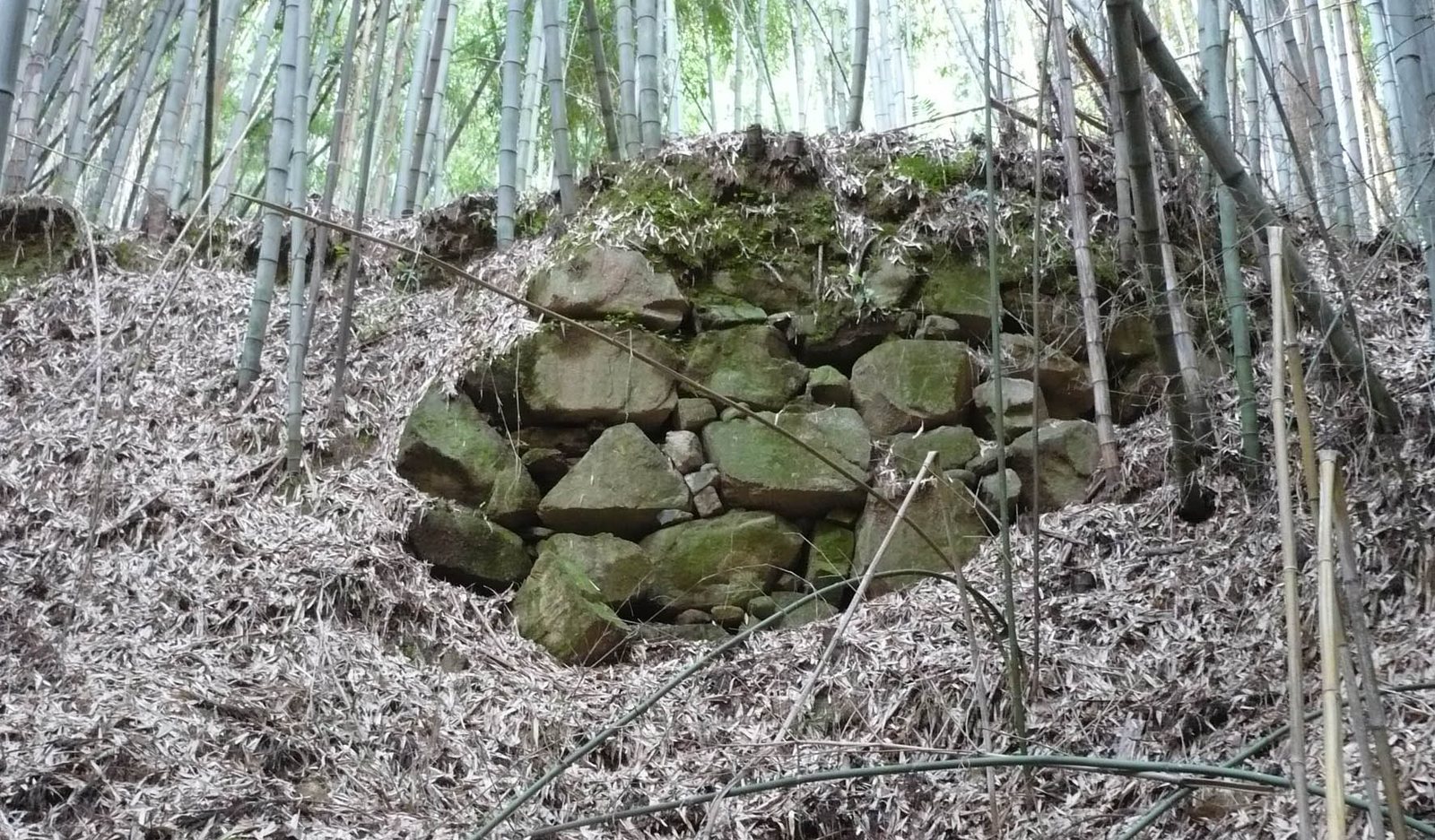
The principal approach passes through a fortified entrance in the central group. Stonework survives here, an unusual feature for a mountain castle, and its construction technique does not fit established expectations for the Sengoku period. It may date either to Nagayoshi’s time or to the later period of rule by Hida-no-kami and Ukon, when building methods associated with Nobunaga’s side may have been adopted. A defensive function has been proposed, but both the date and interpretation remain uncertain. A tower may have stood at the end of the entrance’s projecting defensive structure.
Western enclosure group
Main bailey
The western group contains a secondary enclosure and the main bailey, the castle’s principal defended enclosure, which occupies the summit of Mount Miyoshi. Excavation found foundation stones belonging to a palace-like building with residential space. This arrangement contrasts with the more usual pattern in mountain castles, where summit buildings were often simple storehouses and residences stood lower on the mountain. An investigation in 1993 revealed foundations for a building measuring about 6.6 metres east to west and 3.9 metres north to south. A fire layer dated to 1556 indicates that the building associated with these foundations was already standing by Nagayoshi’s rule.
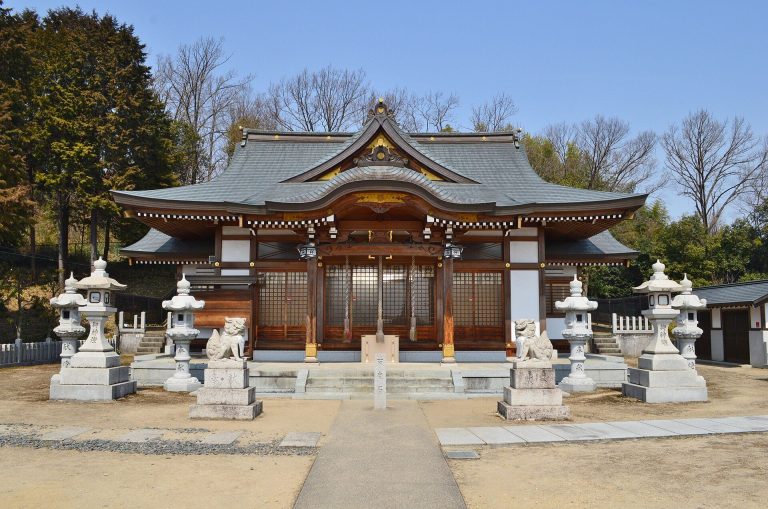
An undated map of Hara village marks a shrine to Nagayoshi in the area corresponding to the main bailey. He continues to be worshipped there.
Building south of the main bailey
An excavation in 2019, covering about 60 square metres south of the main bailey, uncovered a square building measuring 4.2 metres on each side. Bricks surrounded its stone foundations. It may have served as a storehouse for rice and valuables, as well as making the lord’s authority visible.
Excavated objects
More than 200 objects recovered from the castle include lamp dishes, dark-glazed Tenmoku tea bowls, stone inkstones, Haji pottery (unglazed earthenware), and grinding bowls. Taken together, these finds indicate that the castle served administrative purposes and was also a place where Nagayoshi and his retainers lived.