Fort Jefferson: A Brick-Masonry Coastal Fort in the Dry Tortugas
Site at a Glance
- Country
- United States
- Primary era
- Modern
- Eras represented
- Modern
- Civilizations
- Unclassified
- Site type
- Military
- Remains
- Fort
On this page16 sections
History
Fort Jefferson is a coastal fort built by the U.S. Army on Garden Key, Florida, United States, with construction beginning in December 1846 to protect Gulf Coast shipping. The brick-masonry fort was officially opened in 1847, but work continued for decades and it was never completed. It later served as a Civil War garrison and prison, a quarantine station, and a naval facility.
Surveys and construction
In late 1824 and early 1825, Commodore David Porter examined the Dry Tortugas as a possible naval station for efforts to suppress Caribbean piracy. He considered the islands too low and sandy for the purpose, noting their lack of fresh water and doubts about whether they could support fortifications. A lighthouse was built on Bush Key, later called Garden Key, in 1825 and 1826 instead.
A survey led by Commodore John Rodgers in 1829 judged the islands more suitable for a fortified harbor. Josiah Tattnall III described protected outer and inner anchorages, including deep water for large warships, and warned that an enemy based there could threaten U.S. shipping in the Gulf of Mexico. Captain John G. Barnard made a detailed reconnaissance in November 1844, and in February 1845 Captain Robert E. Lee recommended reserving the islands for military use. The federal government established the Dry Tortugas as a national military reservation on September 17, 1845.
Plans prepared by Lieutenant Montgomery C. Meigs from a design by Joseph Totten were approved in November 1846. Construction began the following month under Second Lieutenant Horatio Wright, and the fort was named for Thomas Jefferson, the third U.S. president. The Army employed civilian carpenters, masons, and other laborers, as well as enslaved people hired from owners in Key West and elsewhere in Florida. In August 1855, 233 white contract laborers were employed, while enslaved workers formed the backbone of the workforce. The Pensacola firm Raiford and Abercrombie supplied the bricks. Enslaved labor at the fort ended in 1863.
Garrison and prison during the Civil War
At the outbreak of the Civil War, fought between Union and Confederate forces, 62 men of the Second U.S. Artillery arrived under Major Lewis Golding Arnold to prevent Confederate capture. The fort’s heavy guns were first fired on January 26, 1861. Its population at the time was 168, including women and children. Army units rotated through the post: two companies of the 6th New York Zouaves arrived in July 1861, followed by the 7th New Hampshire Volunteer Infantry in March 1862, the 90th New York Volunteer Infantry in June, the 47th Pennsylvania Infantry in December, and the 110th New York Volunteer Infantry in March 1864.
Beginning in September 1861, the fort held soldiers sentenced by courts-martial, including men convicted of desertion and mutinous conduct. President Abraham Lincoln commuted execution sentences for soldiers convicted of desertion to imprisonment at the Dry Tortugas. The prison also held Confederate prisoners of war and civilians. In November 1863, 214 military convicts were held there. By June 1864 the fort housed 653 soldiers and 753 convicts; in November, 583 soldiers guarded 882 prisoners. Eight prisoners escaped. The Emancipation Proclamation, Lincoln’s 1863 order declaring enslaved people in rebelling areas free, was followed by a sharp decline in the number of Black workers at the fort. By June 1863, only 22 remained.
On July 24, 1865, four civilians convicted of conspiring in Lincoln’s assassination arrived: physician Samuel Mudd, Edman Spangler, Samuel Arnold, and Michael O’Laughlen. After Mudd tried to stow away aboard a steam transport, he was confined in the fort’s dungeon. Colonel George St. Leger Grenfell, held as a state prisoner, arrived that October. On September 25, 1865, the 82nd U.S. Colored Troops replaced the 161st New York Volunteer Infantry.
After the war, prisoner numbers fell from 273 in December 1865 to 207 in February 1866, 193 in May, and 56 in January 1867. Construction nearly stopped in the summer of 1866. During a yellow fever epidemic in 1867, Mudd helped care for the sick; the disease killed many prisoners, including O’Laughlen, as well as Joseph Sim Smith, surgeon of the 5th U.S. Artillery. President Andrew Johnson pardoned Mudd, Arnold, and Spangler, and they were released. The 3rd U.S. Artillery replaced the 5th in 1869.
Withdrawal and later uses
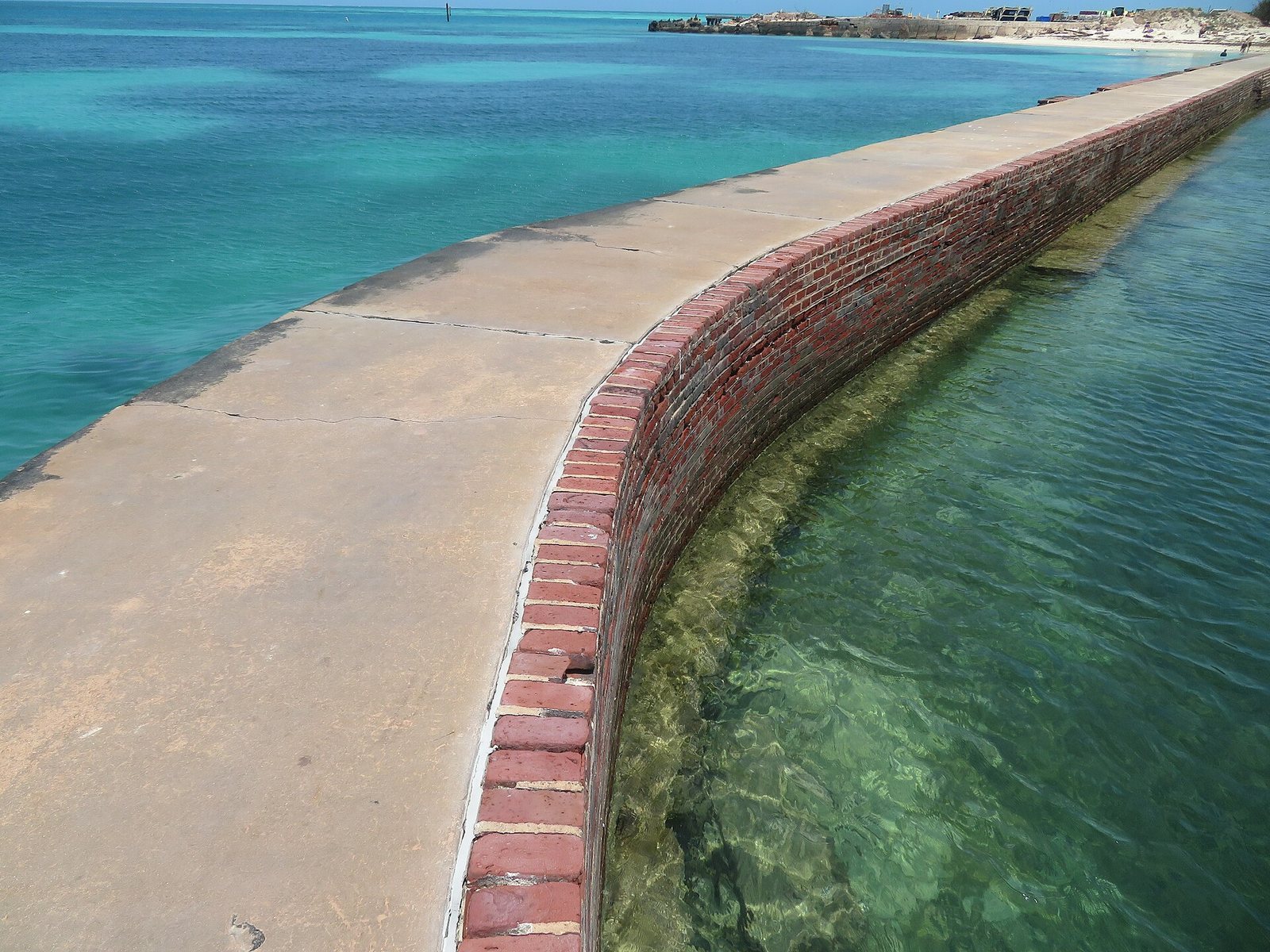
The seawall was completed in 1872, but work ended by the middle of the 1870s without completing the fort. After repeated hurricanes and yellow fever outbreaks, the War Department withdrew the garrison in 1874, leaving a small caretaker force to maintain the weapons and ammunition. In 1889, the Army transferred the fort to the Marine Hospital Service, a federal agency responsible for maritime quarantine, for use as a quarantine station. The Navy also used Garden Key as a coaling station.
During the Spanish-American War, the 1898 conflict between the United States and Spain, the U.S. fleet again used the fort. The USS Maine was among the ships that took on coal there before sailing to Havana. The property passed to the Navy Department in 1902, which built coal-loading equipment and water-distilling plants. Hurricanes destroyed these installations in 1906, and the fort was abandoned. The islands became a federal bird reservation in 1908. During World War I, the lighthouse was decommissioned, while a wireless station and naval seaplane facility operated on the islands.
Preservation
On January 4, 1935, President Franklin D. Roosevelt designated the area Fort Jefferson National Monument. From 1935 to 1938, the Works Progress Administration, a federal New Deal public-works agency, carried out structural renovation and historic-preservation work. The fort was added to the National Register of Historic Places in 1970, with the listing covering a 47.125-acre historic district. It became part of Dry Tortugas National Park when the park was established in 1992.
Remains
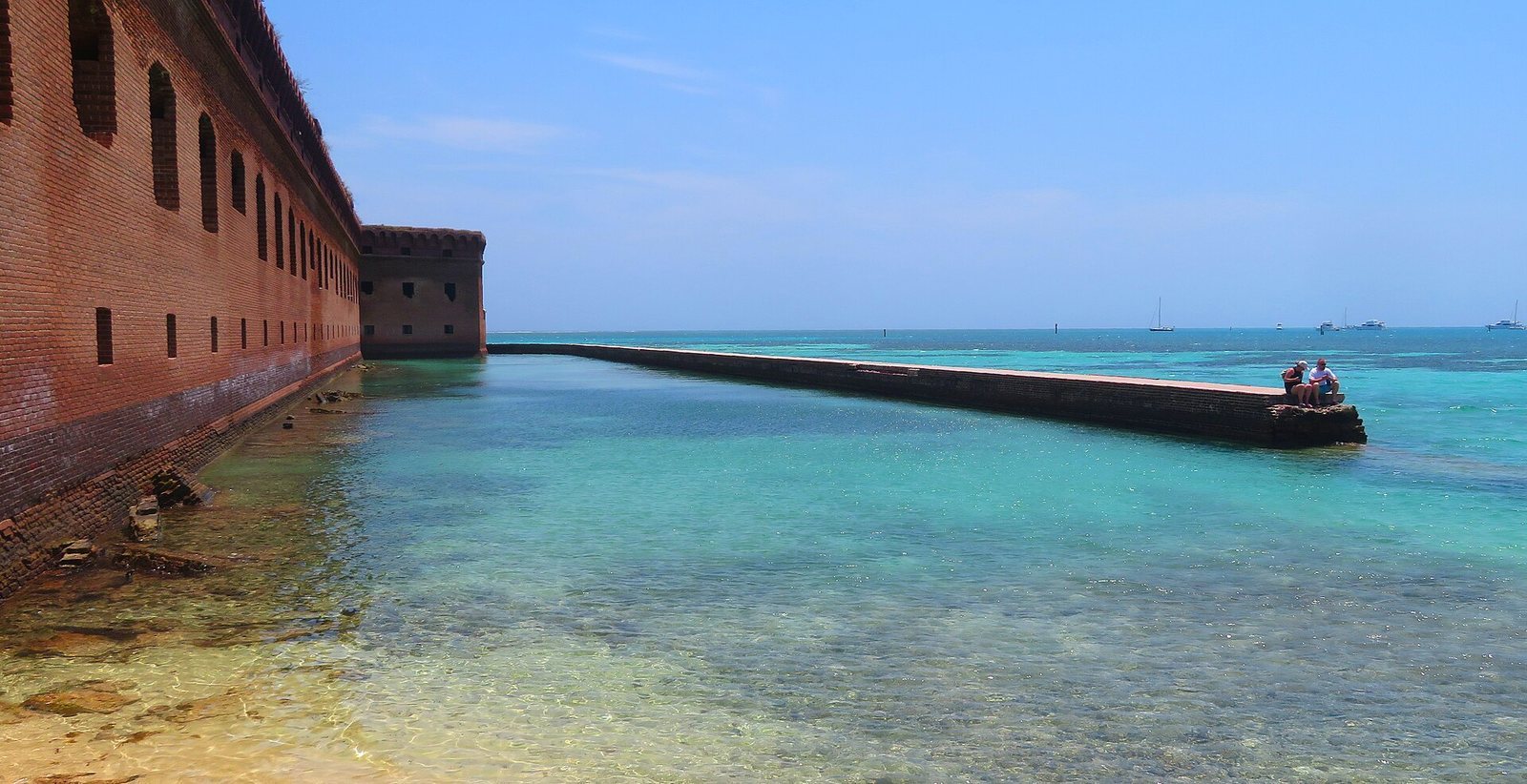
Fort Jefferson occupies about 16 acres at approximately sea level and was built with more than 16 million bricks. It is the largest brick-masonry structure in the Americas; among U.S. forts, only Fort Monroe and Fort Adams are larger. Its six-sided plan encloses a 13-acre parade ground and combines long defensive walls with projecting corner works.
Walls and gun positions
Walls and bastions
Two of the six curtain walls, the defensive sections between projecting works, measure 325 feet each; the other four measure 477 feet each. Bastions, projecting defensive structures at the corners, contain gunrooms, powder magazines, and granite spiral staircases. Their arrangement was intended to let defenders direct fire along the adjoining walls.
Gun tiers
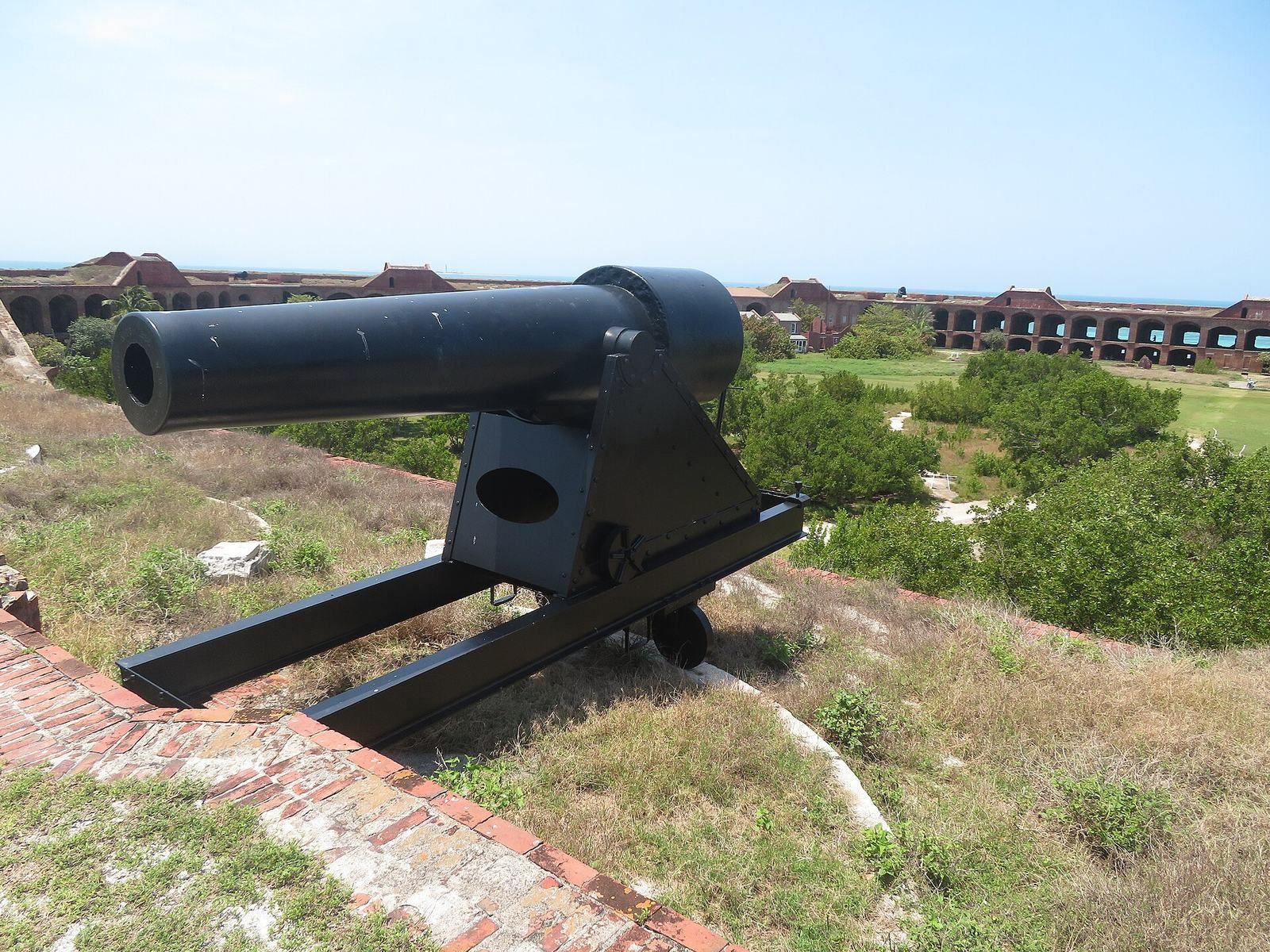
The design provided two tiers of casemates, fortified chambers for guns and their crews, with space for 150 guns in each tier and another 150 on the roof. Heavy guns faced outward through embrasures, openings through which artillery could fire. By 1872, a raised third tier, called a barbette, held six 15-inch Rodman guns, large-caliber artillery pieces developed by U.S. ordnance officer Thomas J. Rodman. The fort’s total complement of large-caliber guns was 243.
Interior facilities and water supply
Parade ground and buildings
The parade ground occupies the fort’s interior. Buildings there included additional powder magazines, headquarters, a hospital, officers’ quarters, and three large barracks.
Water system
Sand-filled columns set at intervals in the inner walls carried rainwater from the roof toward underground cisterns, filtering it along the way. Stored water often became unsuitable for drinking when it absorbed salts or entered cracked or leaking cisterns. Runoff collected beneath the parade ground provided the fort’s only fresh drinking water. During the Civil War, two steam condensers distilled 7,000 U.S. gallons of seawater per day.
Lighthouse, prison, and memorial features
Lighthouse
The Garden Key lighthouse and its keeper’s cottage stood within the fort’s walls. The lighthouse was a 65-foot brick tower with a whitewashed exterior, beside a small white cottage. A metal light tower was installed atop an adjacent fort wall in 1876, and the original brick lighthouse was dismantled the following year.
Dungeon inscription and monument
Mudd’s dungeon bears the inscription, "Whoso entereth here leaveth all hope behind." The words echo Canto III of Dante’s Inferno, the first part of The Divine Comedy. A monument to surgeon Joseph Sim Smith and his son stands on the parade ground.
Condition
Hurricanes and tropical storms damaged the brick and concrete and bent the fort’s girders. Vandalism also contributed to its deterioration.