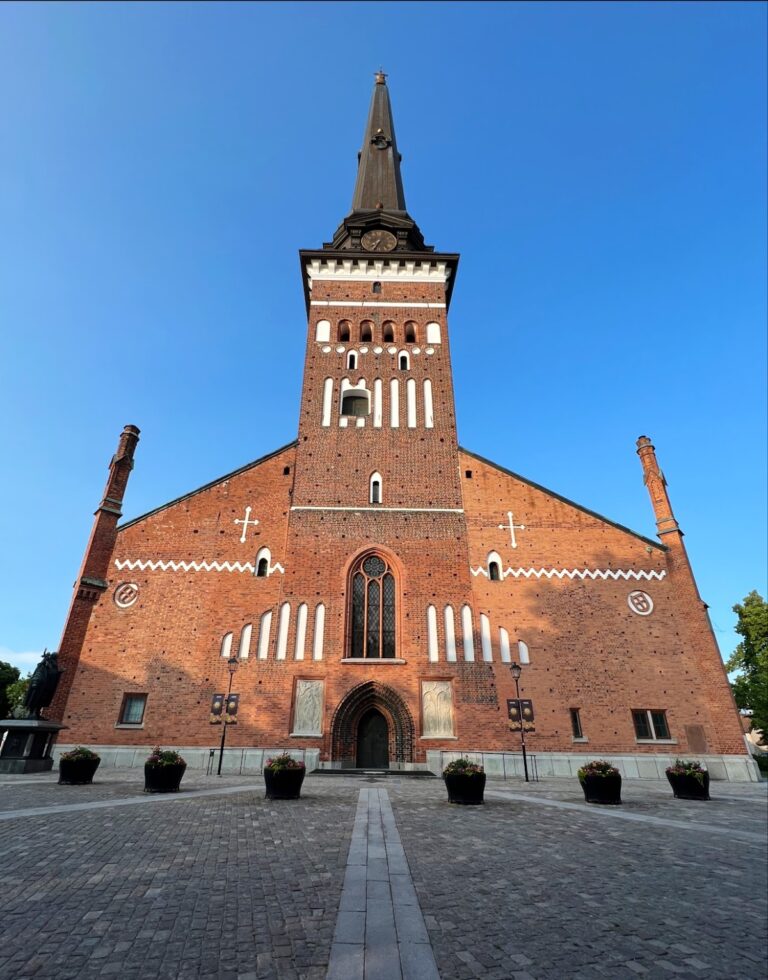
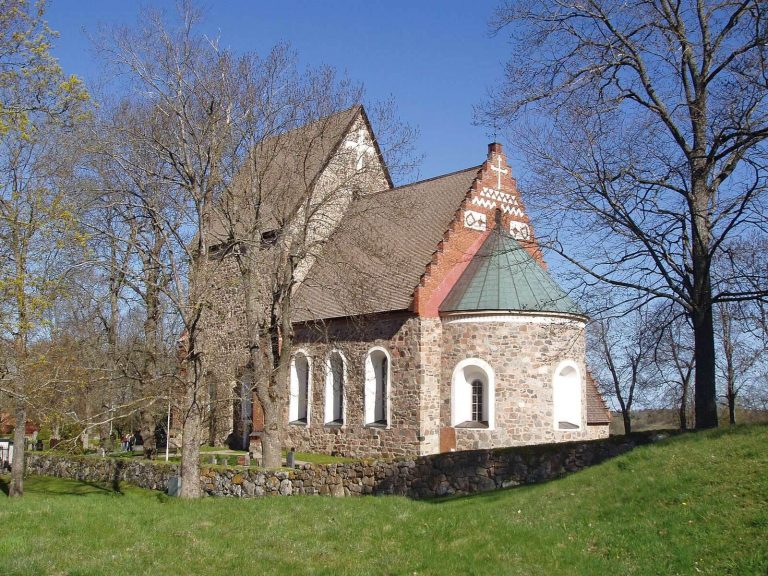
Enåker Church: The Medieval Parish Church of Runhällen, Sweden
Site at a Glance
- Country
- Sweden
- Primary era
- Medieval
- Eras represented
- Medieval, Early Modern, Modern
- Civilizations
- Swedish
- Site type
- Religious
- Remains
- Church
On this page14 sections
History
Enåker Church is the medieval parish church of Enåker in Runhällen, Sweden. A parish existed here by the 13th century, probably with a church, and the present church dates to the 14th century and was consecrated around 1300. It serves Enåker Parish in the Lutheran Church of Sweden and belongs to the Uppsala Archdiocese.
Medieval church
Around 1475, builders replaced the church’s earlier wooden barrel-shaped ceiling with stone cross vaults. Wall and ceiling paintings followed soon afterward, and a further major phase of painting took place in the early 16th century.
Changes from the 18th to the 19th century
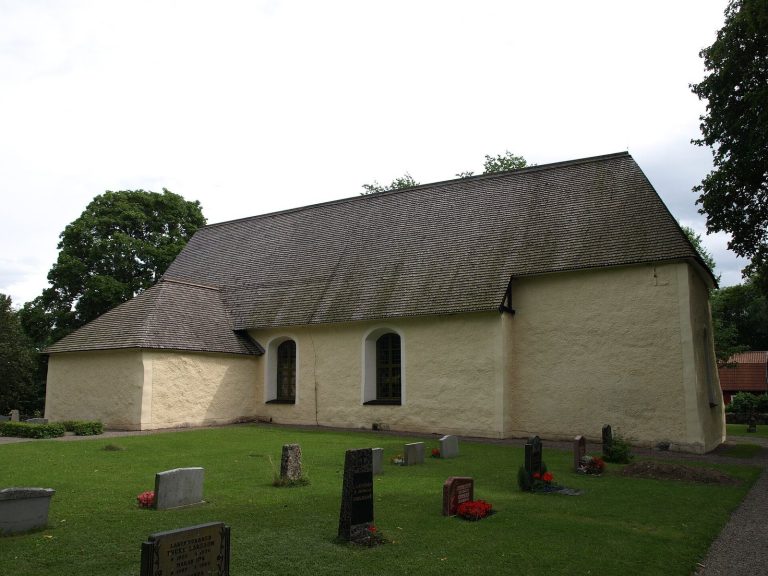
During the 18th century, the interior gained new furnishings, including a gallery at the west end, and took on a light neoclassical character. Plaster was applied over the medieval paintings. In 1794, the southern porch was demolished and replaced by one at the west end. Workers rendered the exterior walls, limewashed the interior, and opened two windows in the south wall. Two more openings were made in the north wall in 1796.
At a visitation in 1846, Archbishop Carl Fredrik af Wingård judged the church too small for its parish population and its detached bell tower to be in poor condition. He urged enlargement and the addition of a church tower. Plans were drawn up in 1851, and rebuilding followed in 1854–55. The exterior and chancel interior were recast in Gothic Revival style, a 19th-century movement that revived medieval Gothic forms. The older sacristy and west porch were removed, and a new sacristy was built beside the enlarged chancel.
A major restoration in 1890 replaced fixed 17th-century seating with open pews. Oil paint applied to the walls and vaults damaged the medieval paintings. The chancel windows received colored glass, its ceiling was painted to resemble a starry sky, and the nave was given a cement floor.
Restoration and later discoveries
Soot from stove heating had darkened the walls and ceilings, prompting interior restoration in 1925. In 1931, the tower spire’s zinc covering was replaced with copper and its cross was gilded. Lightning damaged the church in 1937, leading to immediate repairs.
A major restoration began on 7 January 1955, and the church was reconsecrated on 30 October that year. The work brought some medieval paintings back to view, although the oil paint had fused layers of plaster and restricted their recovery. In 1958, copper sheeting replaced the wooden shingles on the roof. Renovations in 2013 revealed coins, including medieval examples, and graves beneath the church floor, among them children’s graves.
Remains
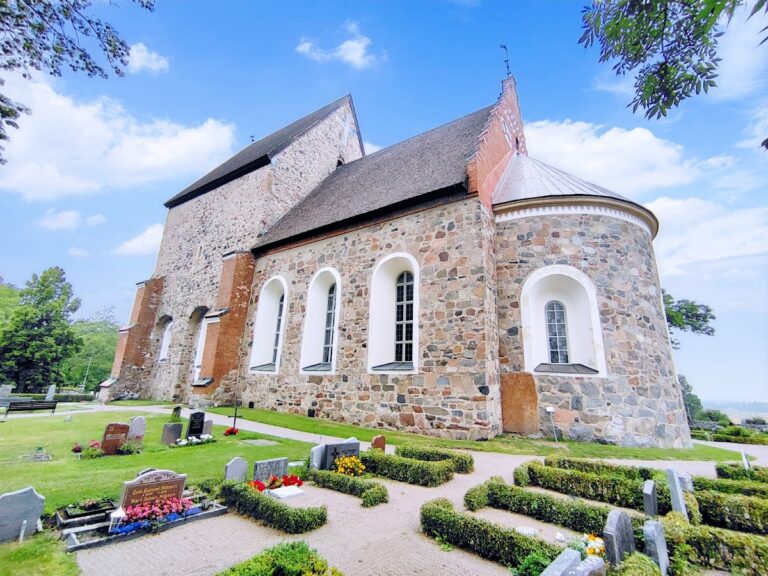
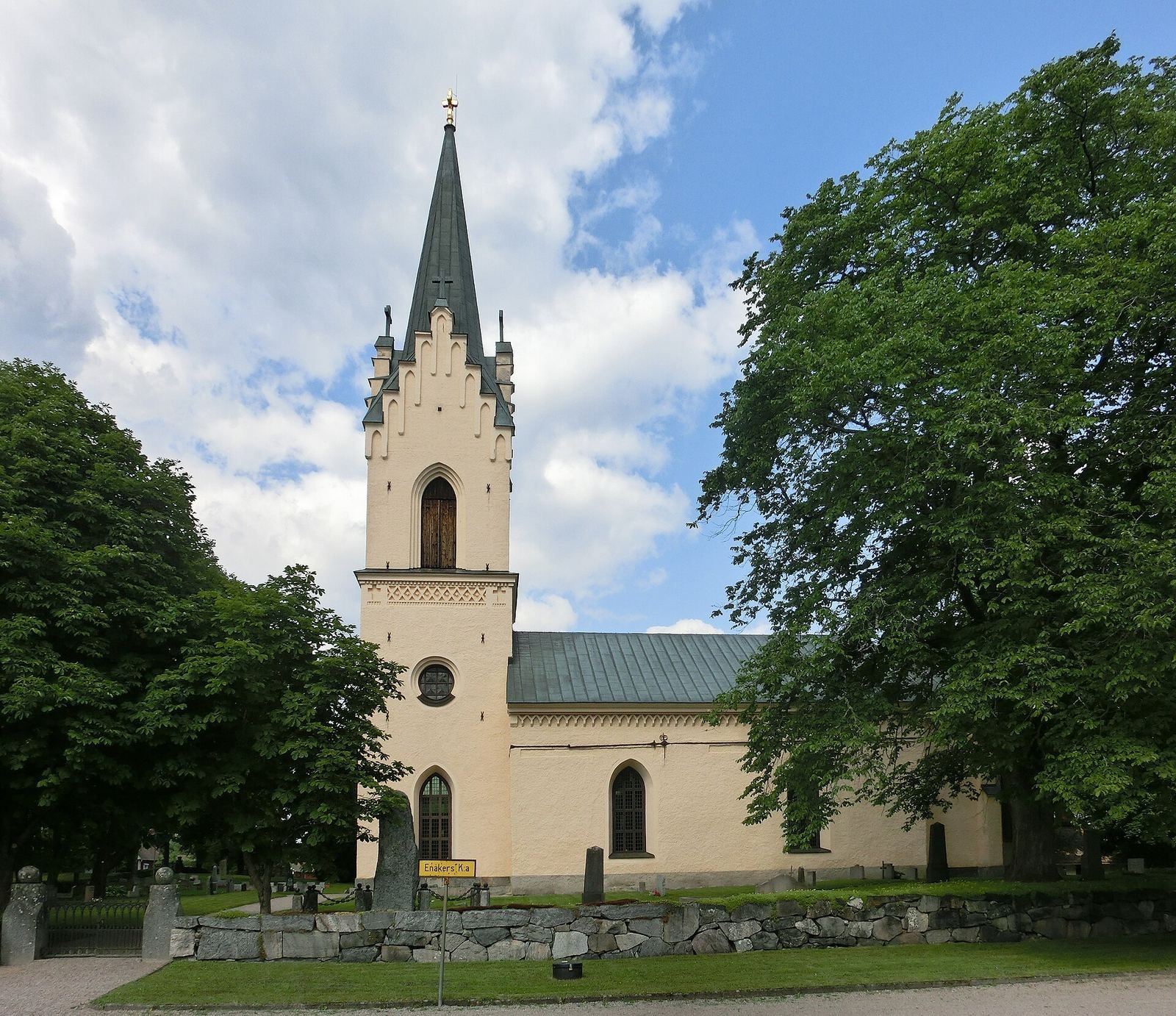
The church is arranged around a rectangular nave, the main space for the congregation, and a narrower chancel, the area around the altar, which ends in three sides to the east. A sacristy, a room for preparing services and keeping religious objects, adjoins the chancel on the north. The nave is the oldest part and is built of grey stone. Its shallow-pitched roof and the lower roof over the chancel are copper-clad. At the west end, a tower with corbie-stepped gables, whose outer edges rise in steps, carries a tall copper-covered spire and has an entrance on its west side.
The church began as a single-nave building, with one principal worship space and no side aisles, and a straight eastern wall at the chancel. The surviving nave formed part of that original church, and its eastern section once served as the chancel. The first sacristy stood to the northeast and a porch to the southeast. Rows of shallow, non-opening arches decorated the outside walls; plaster later covered them.
Medieval vaults and paintings
Stone vaults
The nave retains its medieval cross vaults, formed where curved ceilings intersect. Small sculpted figures known as vault men decorate the ribs. Fragments of painting remain on the vaults, including simple designs on the arches and supports.
Wall and vault paintings
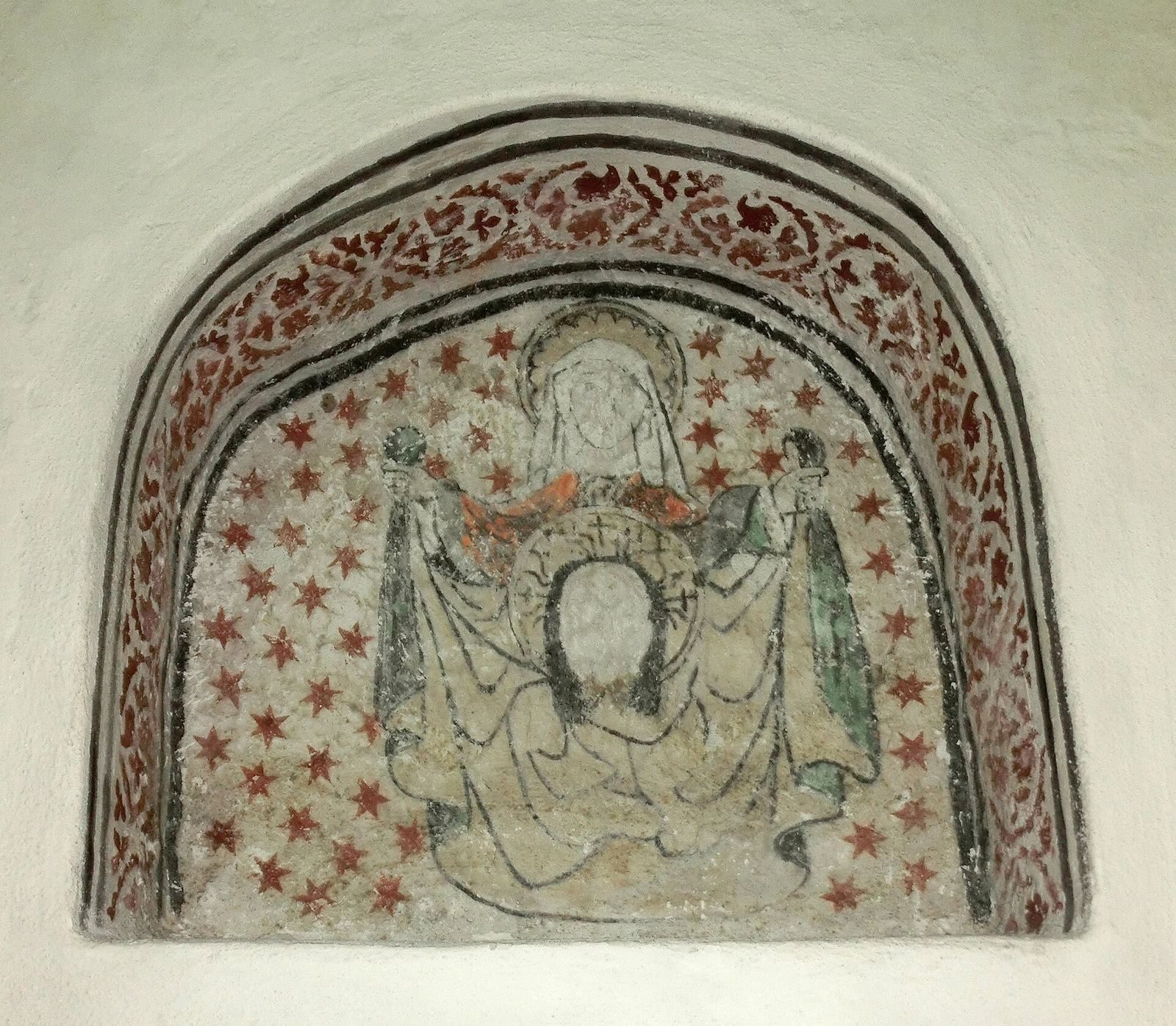
Some paintings show the Veil of Veronica, a Christian tradition about an image of Christ’s face on a cloth. They are attributed to the Tierp group, a label for medieval painters associated with the Tierp region, or to a master painter of that group. Much of the 15th-century painting was recoverable, while fragments from the 16th-century work remain on the south wall. That later painting had been applied over another layer of plaster. A medieval window opening uncovered in the south wall has grey and red decoration in its recess.
Chancel and furnishings
Chancel and altar
The chancel interior reflects the 19th-century rebuilding. Its three windows contain stained glass designed by Julia Lüning in 1955. The eastern window, once bricked up, was reopened during that restoration. In the nave, a brick floor replaced the cement one in 1955. At the east end, a raised masonry platform supports the medieval baptismal font. The separate altar, also made in 1955, is built of brick and topped with a limestone slab. It bears a silver cross set with seven rock crystals, designed by Bo Råman and made by Stockholm silversmith Pierre Forssell. The crystals refer to Jesus’s seven last words on the cross.
Font and devotional images
The 13th-century baptismal font is the church’s oldest furnishing. Made in Gotland, it has a limestone base and stem and a four-lobed bowl of red-brown marble with white veining. A hand-worked brass baptismal bowl made by Stockholm artist Bo Råman in 1949 accompanies it, and a silver candlestick beside the font was donated in 1971. Above the font stands a wooden image of Saint Bridget of Sweden, a 14th-century Christian mystic and founder of the Bridgettine order. The large crucifix traditionally placed between nave and chancel, known as a triumphal cross, dates from the late 13th century and was altered in the 15th.
Pulpit and altarpiece
The ornate Baroque pulpit dates from 1708. Above it, the sounding board is topped by the Lamb of God resting on a book with seven seals, imagery from the Book of Revelation; a globe appears beneath the figures. The altarpiece is of North German type and was probably made in Sweden in the 1480s. Its central sculpture depicts Mary’s Coronation, and saint figures survive on its folding wings.
Lighting and communion vessel
A brass chandelier with eight arms hangs in the chancel. Made in the mid-17th century, it is topped by a pelican. Another brass chandelier, dating from 1890, has twelve arms arranged in two rings and hangs at the far end of the central aisle. The church also has a gilded-silver communion vessel made by Bengt Collin in Uppsala in the early 18th century.
Organ
Niclas Söderström of Husby built the first organ in 1784. Johan Samuel Strand of Västra Vingåker supplied a replacement in 1825 with five or six stops, each controlling a set of pipes, and Johan Vesterlund of Lövstabruk enlarged and rebuilt it in 1938. The present organ, supplied by Jehmlich Orgelbau of Dresden in 1960, has 19 stops and two manuals, or keyboards. It has mechanical action, slider chests that control which pipes sound, and a compass of 56/30. Its façade comes from the 1825 instrument.
The pews installed in 1955 are closed in form and draw on 17th-century seating, with a 17th-century bench screen serving as their model. Two decorative pyramids from the 17th century stand on the front pews.