Hjälsta Church: A Medieval Parish Church in Sweden
Site at a Glance
- Country
- Sweden
- Primary era
- Medieval
- Eras represented
- Medieval, Early Modern, Modern
- Civilizations
- Swedish
- Site type
- Religious
- Remains
- Church
On this page16 sections
History
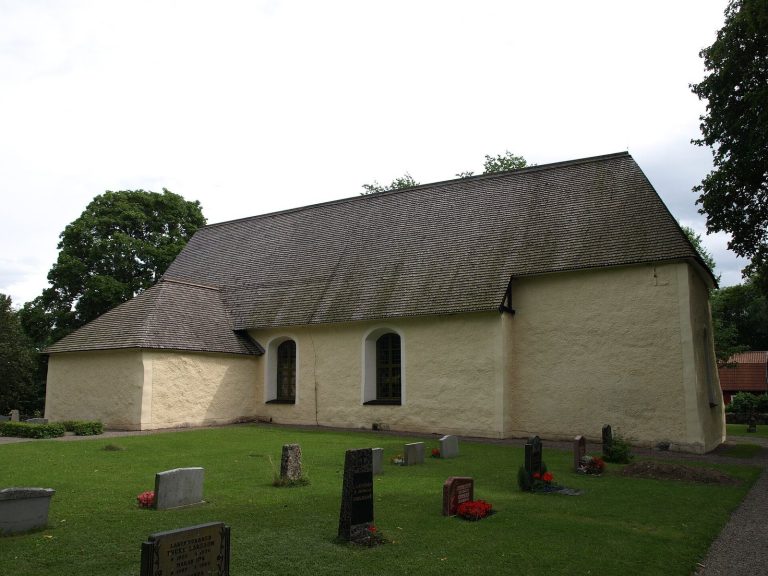
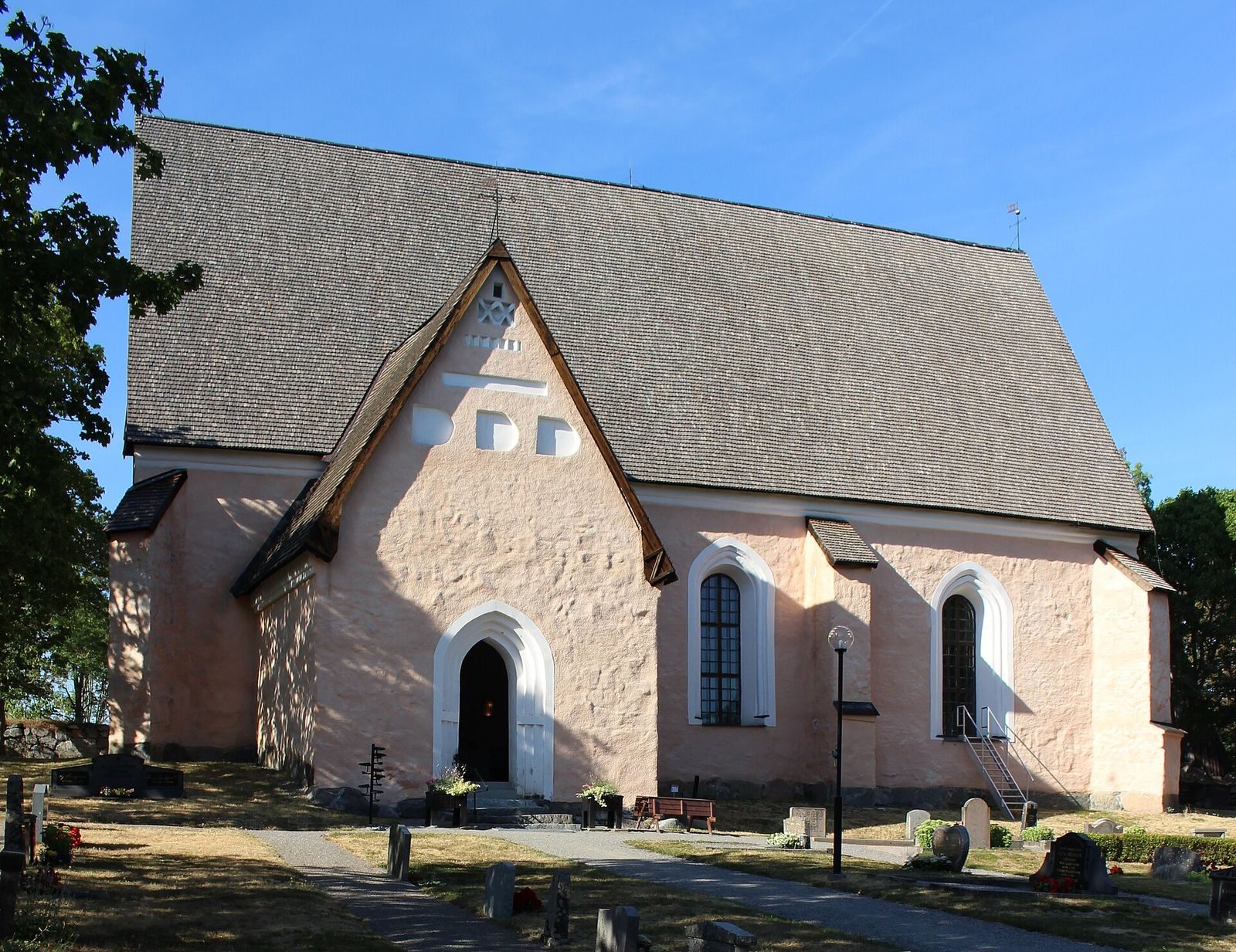
Hjälsta Church is a medieval parish church in Örsundsbro, Sweden, built in the 15th century for Lagunda parish in the Diocese of Uppsala and the Church of Sweden. It replaced an earlier church at Skönsberg farm, about 600 metres to the south.
The earlier church and parish
The church at Skönsberg was in use from the 13th century until the 15th century, when the present church came into use. Its porch and sacristy, a room used for clergy and church objects, reportedly remained standing into the 18th century.
A tradition recorded by Johan Peringskiöld, a Swedish antiquarian and historian, in SvioGothica links the move to rising water in Lake Mälaren. The old site was said to have become marshy, so the new church was built on higher ground. Hjälsta parish appears to have formed through the merger of the older parishes of Tuna and Julbovik by the late 13th century. This merger was separate from the later relocation of the church.
Construction and consecration
Work on the nave, the main worship space, and chancel, the area around the altar, began shortly before 1470 and continued for about twenty years. The sacristy and south porch followed, with the building work complete around 1490. The exact date of consecration, the formal dedication of a church, is unknown. It probably took place in the 1480s, once the nave and chancel were finished, with Jakob Ulvsson, Archbishop of Uppsala, officiating.
Restoration and continued use
The church has remained relatively little altered since the medieval period, though window openings were changed during the 18th and 19th centuries. A restoration in 1895 gave the interior a modernist character. From 1951 to 1955, architect Cyrillus Johansson led another restoration that removed furnishings from the 1895 work. Electric heating was installed in 1951, closed pews returned in 1955, and the church was reconsecrated on 28 August that year.
Remains
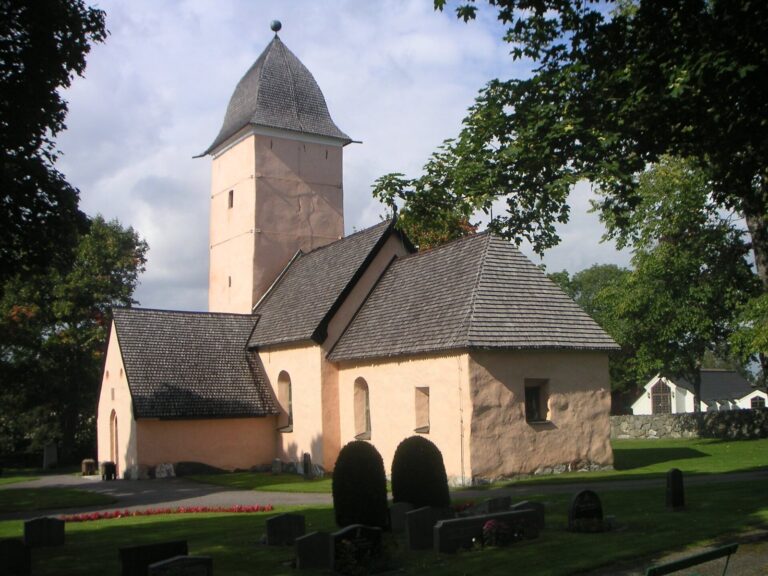
The church stands on a juniper-covered hill a couple of kilometres inland from the northern tip of Hjälstaviken. Built of fieldstone, its plan consists of a nave, a sacristy attached on the north side and a porch on the south. The sacristy was included in the original plan, although it was built after the main church.
Vaults
The ceilings were built with the church and rest directly on its walls. The nave has an eight-part cross-shaped vault and a second vault with star-forming ribs. In the chancel, a star pattern is arranged around a square centre. The porch has a star design with a four-lobed motif and faces of old men, while the sacristy has a cross-shaped vault.
Interior furnishings
Baptismal font
The sandstone baptismal font dates to the 13th century and was brought from one of the earlier churches. It has a drainage outlet and a plain surface. Removed from the church during the 19th century, it returned to use in 1925 after a visit by Nathan Söderblom, Archbishop of Uppsala and a Lutheran theologian.
Crucifix
The triumphal crucifix probably dates from the second half of the 15th century. Its cross arms end in plates, and the bottom of the cross has a projecting joint, or tenon, made to fit another part. It came to Hjälsta in 1925 and was hung in the arch between the nave and chancel during the 1951–1955 restoration.
Pulpit
The 17th-century pulpit is in Renaissance style. It was acquired in 1895 from Fittja Church, which was then deserted. Before that, it stood in the castle chapel at Biskops-Arnö. Tradition holds that it had been taken there as war booty from Poland.
Altar and paintings
An altar was built in the sacristy during the 1951–1955 restoration, using broken pieces of a medieval altar slab. The present altarpiece, added during the same work, has oil paintings by Sister Marianne, a religious sister and painter associated with Alsike Convent. It replaced a cross dating from 1895, which was moved to the rear of the church.
Organ and chandeliers
The present organ was acquired in 1847. The Stockholm firm Blomquist & Lindgren made its five-stop mechanism, and architect Carl-Gustaf Blom-Carlsson designed its case. Three chandeliers hang in the church: the oldest, in the chancel, is dated 1677, and the large central chandelier was purchased in 1710.
Communion silver and bridal crown
The earlier church silver was stolen on the night of 16–17 February 1855. Until 1950, the congregation used nickel-silver communion vessels; that year, the Hjälsta Church Sewing Association gave the church a new set made by the Markström goldsmith firm in Uppsala. Designed for Hjälsta, it includes communion vessels, a plate for the bread, a wine jug and a wafer box. An early 19th-century chalice for communion visits to the sick also survives. The association gave the church a bridal crown in 1948, made by Atelier Borgila.
Associated structures
Bell tower
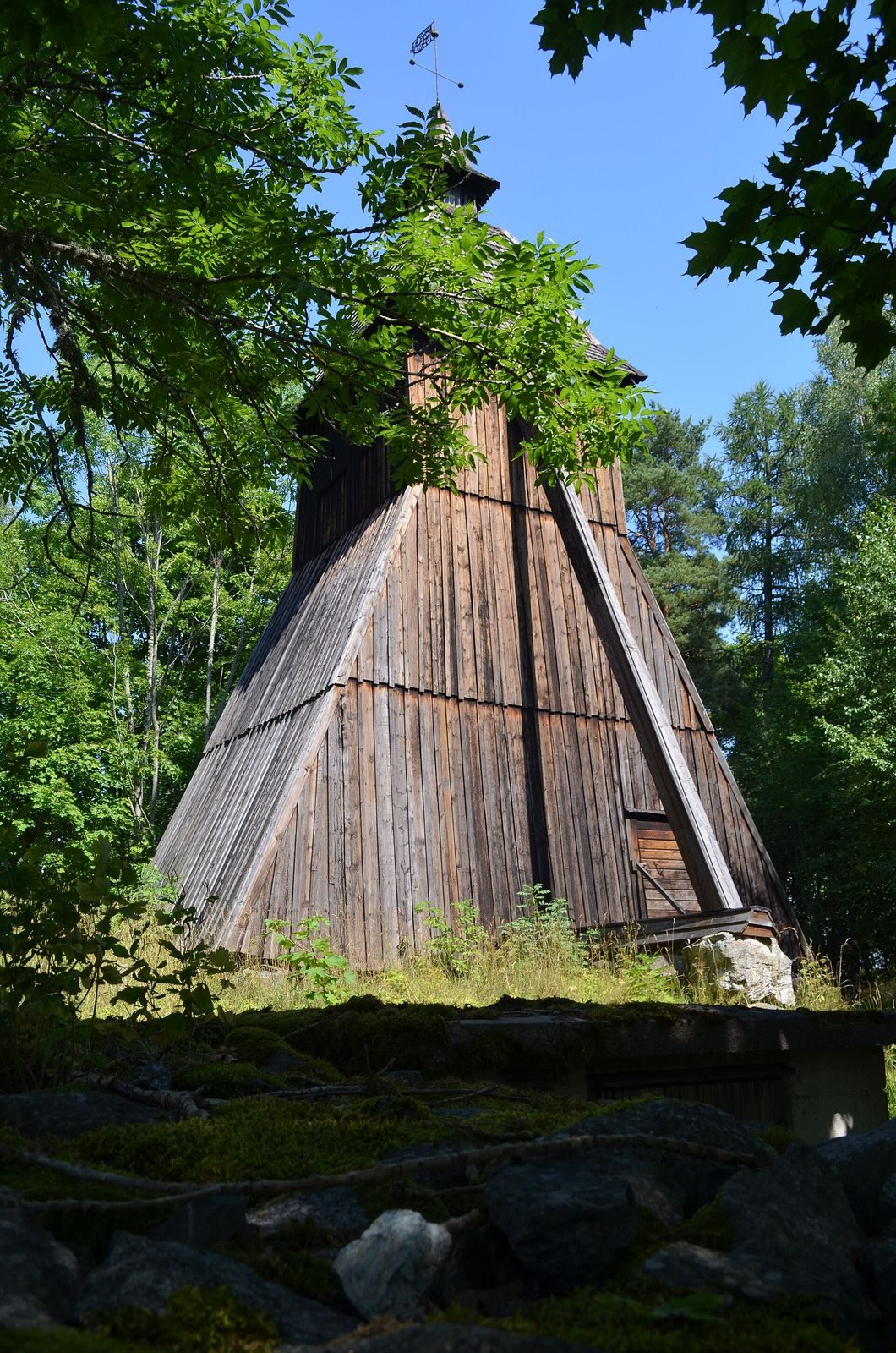
The bell tower stands outside the cemetery wall on its north side. Built in 1739–1740, it is clad in boards and has a shingle-covered hood. Its weather vane is a replica of a corroded vane from the 17th century. The larger bell was cast in 1649 by Jorgen Putensen; the smaller was cast in 1727 by Eric Näsman.
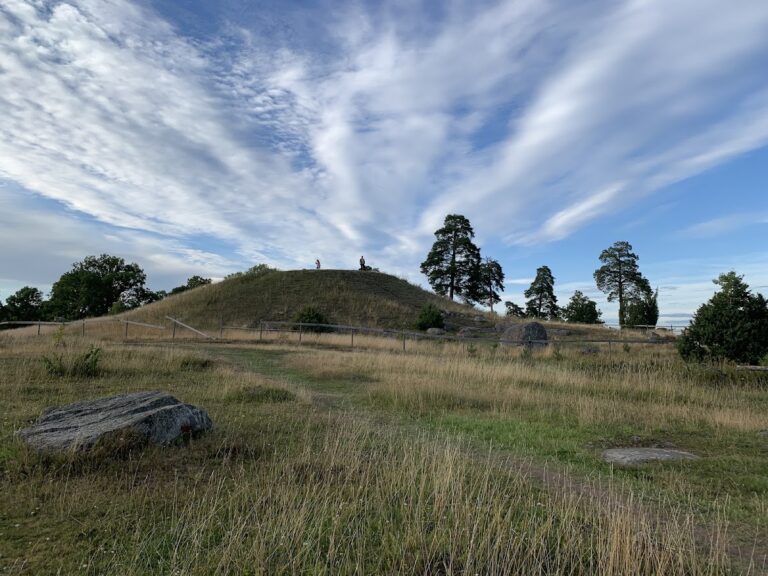
Earlier church site
At Skönsberg farm, about 600 metres south of the present church, traces of the earlier church’s foundation remain, along with a churchyard enclosed by a boundary wall. The site was archaeologically investigated in 1994.