Castillo de San Marcos: Spanish Colonial Fort in St. Augustine
Site at a Glance
- Country
- United States
- Primary era
- Early Modern
- Eras represented
- Early Modern, Modern
- Civilizations
- Spanish
- Site type
- Military
- Remains
- Fort
On this page20 sections
History
Castillo de San Marcos is a Spanish-built masonry fort in St. Augustine, Florida, United States. Construction began on October 2, 1672, and was completed in 1695. It is described as the oldest masonry fort in the continental United States, and its walls withstood two major British attacks in the early 18th century.
Spanish foundation and construction
Pedro Menéndez de Avilés, a Spanish admiral and conquistador, founded St. Augustine in 1565 on the site of the Indigenous village of Seloy. Over the next century, the Spanish built nine wooden forts at different locations. Francis Drake’s attack in 1586 and English privateer Robert Searle’s destructive raid in 1668, which damaged the existing wooden fort, helped lead to plans for a permanent masonry defense.
Queen Mariana of Austria approved the project, and Governor Francisco de la Guerra y de la Vega ordered its construction. Work continued under his successor, Manuel de Cendoya, to a design by Spanish engineer Ignacio Daza. The workforce included Indigenous laborers, workers brought from Havana, and Africans enslaved by the Spanish.
Sieges and rebuilding
In November 1702, during Queen Anne’s War, the North American theater of the War of the Spanish Succession, Carolina governor James Moore led British forces against St. Augustine. About 1,500 residents and soldiers sheltered in the fort for two months. British cannon fire had little effect on its walls. The siege ended when a Spanish fleet from Havana trapped British ships in the bay. The British burned their vessels and withdrew overland. Spanish and English forces partly destroyed St. Augustine during the attack.
From 1738, Spanish engineer Pedro Ruiz de Olano supervised a major reconstruction of the fort’s interior. The changes strengthened its protection against bombardment and made it possible to position cannon along the gun deck rather than only at the fort’s corners.
In June 1740, during the War of Jenkins’ Ear, a conflict between Britain and Spain, Georgia governor James Oglethorpe led a British fleet in a 27-day assault on the fort and town. About 300 soldiers and 1,300 residents took refuge inside. When bombardment failed to break through the walls, Oglethorpe blockaded the inlet and roads, seeking to starve the town into surrender. The blockade disrupted supplies, although some reached St. Augustine by river. British supplies and morale also declined, and Oglethorpe withdrew. Spain later built Fort Matanzas to guard the inlet, which could provide a way around St. Augustine’s main defenses.
British and Spanish rule
Under the 1763 Treaty of Paris, Britain gained Florida in exchange for returning its conquests of Havana and Manila to Spain. On July 21, 1763, the Spanish governor handed over the fort. St. Augustine became the capital of British East Florida, and the British renamed the fort Fort St. Mark. They repaired and extended it.
During the American Revolution, the British used the fort chiefly as a prison. Those held there included South Carolina lieutenant governor Christopher Gadsden and captured revolutionaries from Charleston: Thomas Heyward Jr., Arthur Middleton, and Edward Rutledge. After Spain declared war on Britain in 1779, troops withdrew from the fort, though British rule in Florida continued. A British operation that included troops from St. Augustine joined the campaign for Savannah, but the troops arrived after forces from New York had captured the city.
The 1783 Peace of Paris returned Florida to Spain. Spanish troops came back to St. Augustine on July 12, 1784, and the fort regained its original name. Spain retained improvements made during British rule. Under the 1819 Adams–Onís Treaty, Spain agreed to cede Florida to the United States; the transfer took place in 1821.
United States rule and Seminole prisoners
The United States renamed the fort Fort Marion, honoring Revolutionary War general Francis Marion, known as the “Swamp Fox.” It became a military prison, first for Seminole prisoners and later for members of other Indigenous nations. During the Second Seminole War, a conflict between the United States and the Seminole in Florida, Seminole leader Osceola was captured in October 1837 while attending a peace conference under a flag of truce near Fort Peyton. He was imprisoned at Fort Marion with followers including Uchee Billy, King Philip, and Coacoochee, then transferred to Fort Moultrie, where he died.
After Osceola’s death, physician Frederick Weedon removed and preserved his head. Weedon also kept the skull of Uchee Billy, who had been captured on September 10 and died at Fort Marion on November 29, 1837.
On November 19, 1837, Coacoochee and 19 other Seminole prisoners, including two women, escaped. The escapees reached their band’s camp near the headwaters of the Tomoka River, about 40 miles south of St. Augustine. They vowed to continue fighting in response to their treatment, and the war continued for four more years.
Civil War and military imprisonment
On January 7, 1861, three days before Florida seceded from the United States, 125 Florida militiamen took the fort for the Confederacy under an order from Governor Madison S. Perry. The Union caretaker agreed to surrender only after receiving a receipt from the Confederacy. The transfer occurred without gunfire. General Robert E. Lee ordered most of the cannon sent to other forts, leaving five in the waterfront battery.
On August 5, the St. Augustine Blues militia unit was enrolled at the fort as Company B of the Third Florida Infantry. Its members served in Tennessee and elsewhere; more than a dozen former members were later buried in a row at Tolomato Cemetery. Union forces regained control on March 11, 1862, after Confederate troops left the previous evening, ahead of the fleet’s arrival. Acting mayor Cristóbal Bravo formally surrendered the city to fleet commander Christopher Raymond Perry Rodgers. The fort and city returned to Union control without a shot, and the fort continued as a military prison.
Indigenous prisoners and Fort Marion
Beginning in 1875, prisoners from Indigenous nations of the western United States were held at Fort Marion in the aftermath of the Indian Wars. Many were Plains Indians, including White Horse, a Kiowa chief, and Grey Beard, a chief of the southern Cheyenne. Richard Henry Pratt supervised the prisoners. He removed their shackles, allowed them out of the fort’s protected chambers, and sought to increase their independence through education and cultural programs. Volunteers taught English, Christianity, and aspects of American culture. Pratt and other officials believed that assimilation was necessary for Indigenous survival.
Prisoners created hundreds of drawings, helping establish Ledger Art, a drawing tradition associated with Indigenous artists of the Plains. St. Augustine residents and visitors raised college funds for nearly 20 former prisoners. Seventeen attended Hampton Institute, while others studied at private colleges in New York State. David Pendleton Oakerhater, a Cheyenne religious leader, studied with support from Senator George H. Pendleton and his wife. He became an Episcopal priest, returned west as a missionary to Indigenous communities, and was later recognized as a saint by the Episcopal Church.
Pratt’s experience at Fort Marion informed his efforts to establish Indigenous boarding schools. In 1879 he founded the Carlisle Indian Industrial School, a model for other government-funded schools that operated until 1918. Their assimilation policies banned Indigenous languages and religions. Children were forcibly separated from their families or removed under threats to withhold food.
From 1886 to 1887, about 491 Apache prisoners were held at the fort, including members of the Chiricahua and Warm Springs bands from Arizona. Eighty-two were men, and the rest were women and children; 14 of the men had previously served as paid U.S. Army scouts. The prisoners included members of Geronimo’s band, including his wife. Geronimo himself was sent to Fort Pickens, contrary to the terms of his surrender. The fort could not accommodate everyone indoors, so many prisoners camped in tents. At least 24 Apache prisoners died and were buried at North Beach.
Final military service and later history
More than 200 deserters from the Spanish–American War were imprisoned at the fort in 1898, among its last uses as an active military base. It left active service in 1900, after 205 years of military service under five flags. Military possession ended in 1933, after 251 years, when the War Department transferred the property to the National Park Service.
The fort became a National Monument in 1924, and Congress restored the name Castillo de San Marcos in 1942. It was added to the National Register of Historic Places in 1966 and designated a Historic Civil Engineering Landmark by the American Society of Civil Engineers in 1975. The National Park Service manages it together with Fort Matanzas National Monument.
In 1964, the tree known as the Freedom Tree on the fort green became a gathering place for civil-rights demonstrators who were not welcome across the street under segregation. Protests in St. Augustine led by Robert Hayling, Hosea Williams, and Martin Luther King played an important role in the passage of the Civil Rights Act of 1964, which prohibited racial segregation and discrimination in public life.
Remains
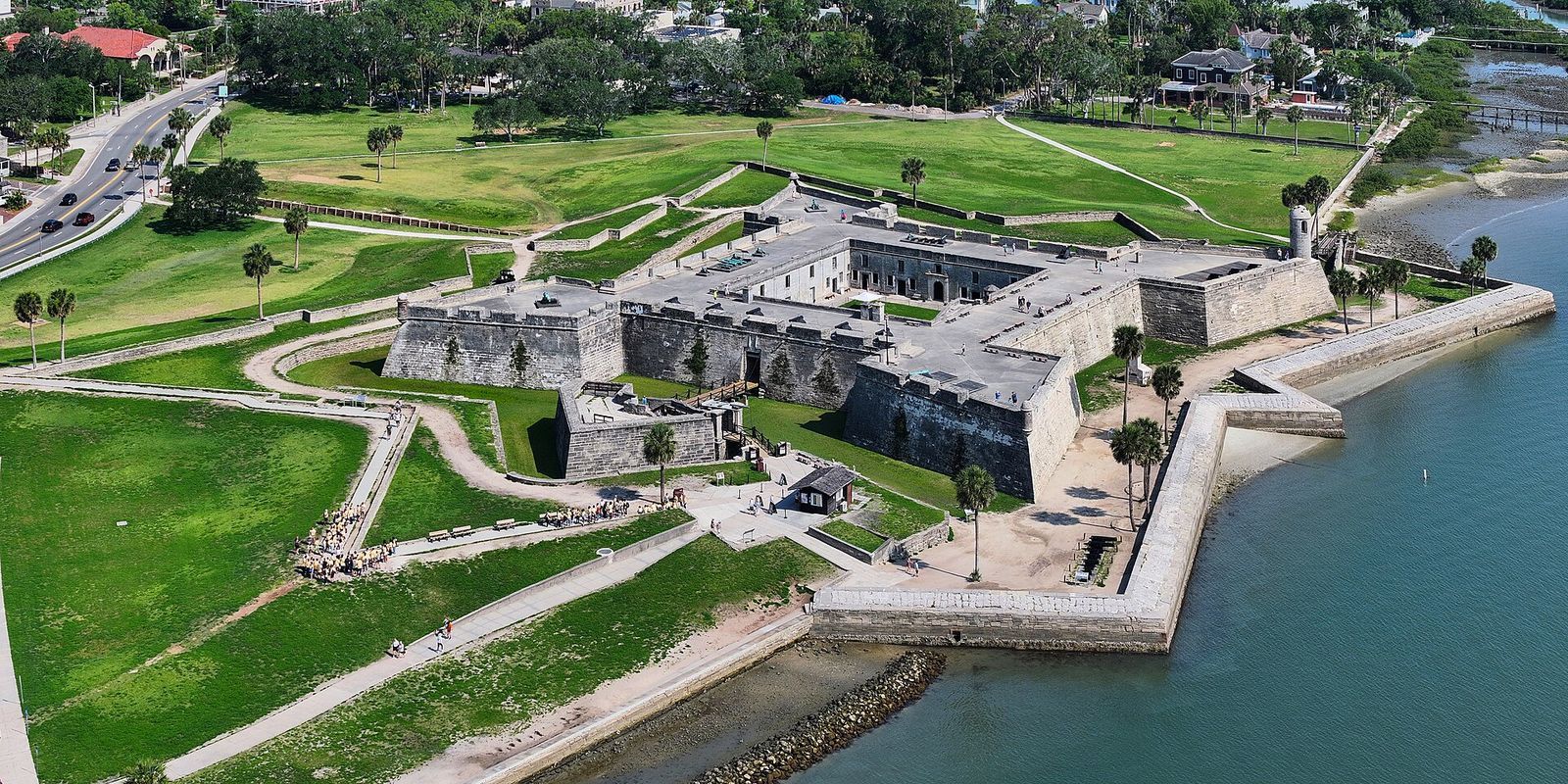
The fort occupies about 1 hectare (2.5 acres) on the western shore of Matanzas Bay; the National Monument covers 8.29 hectares (20.48 acres). Its star-shaped plan is built of coquina, a sedimentary rock formed from ancient shells. The stone came from King’s Quarry on Anastasia Island, across the bay, and was transported by boat to the building site.
Plan and outer defenses
The fort’s four corners, entrance defenses, sloping earthworks, and surrounding moat form a connected system. Cannon openings along the walls and in the corner defenses cover approaches to the structure.
Walls and corner defenses
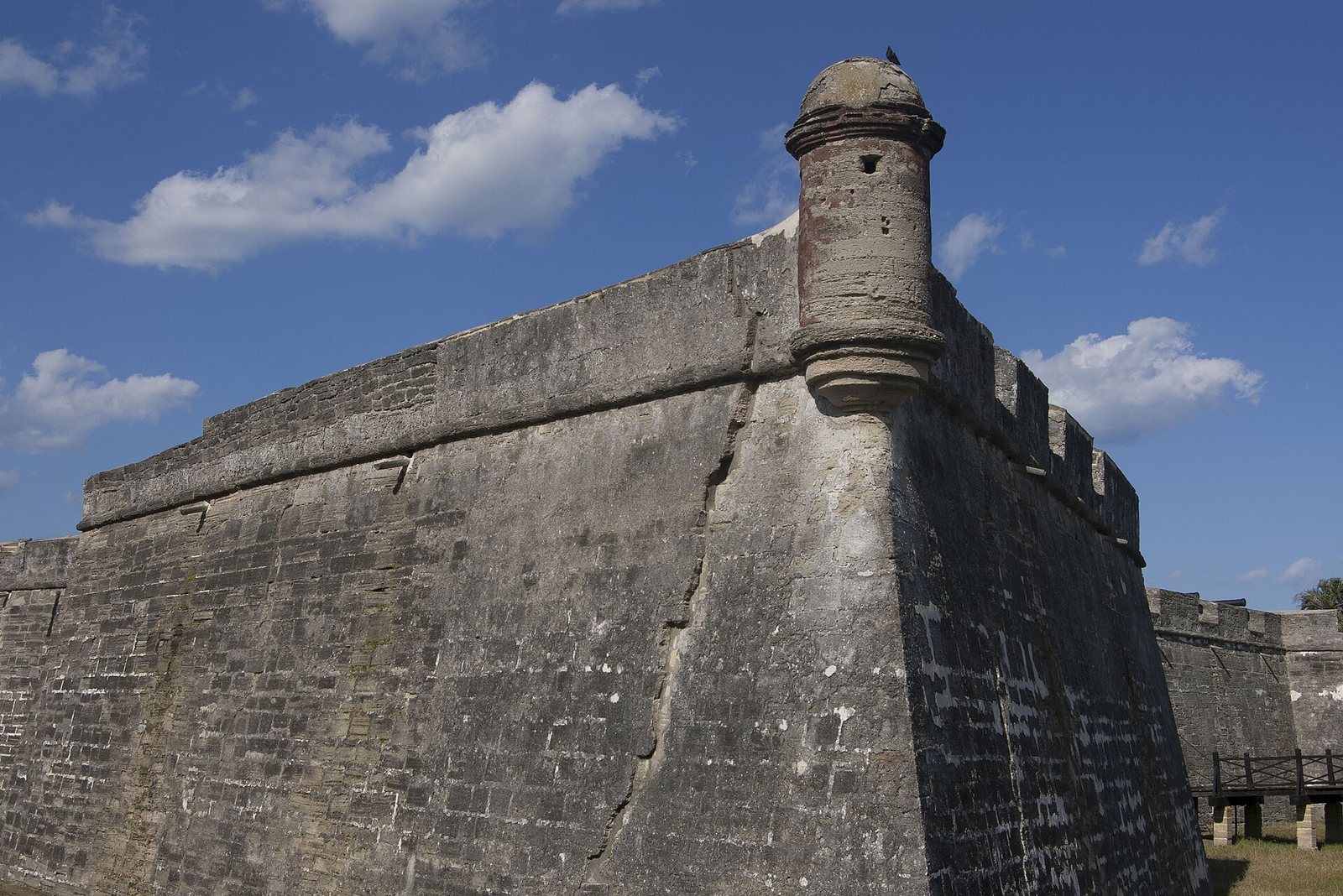
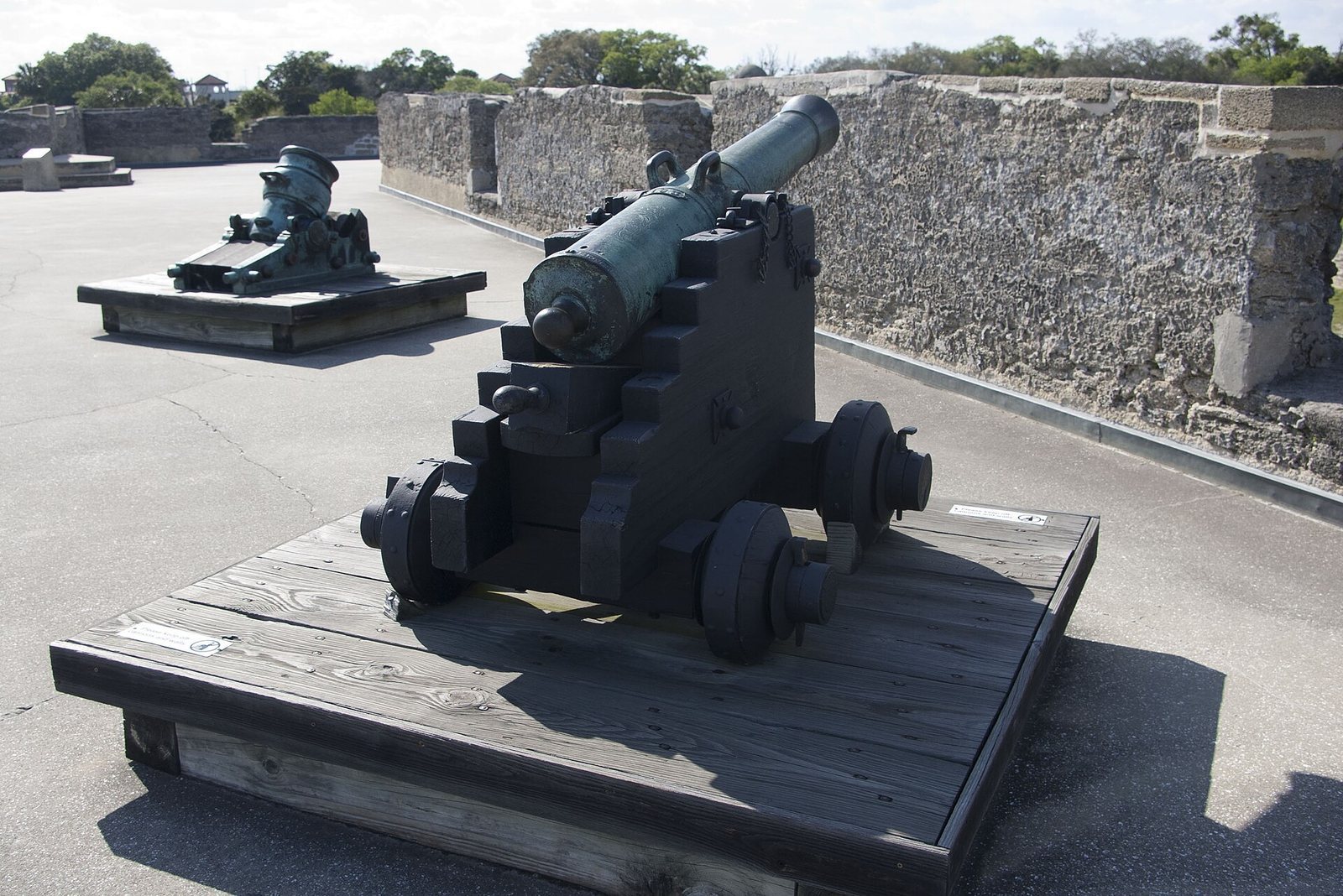
Four projecting corner fortifications, called bastions, are named San Pedro to the southwest, San Agustín to the southeast, San Carlos to the northeast, and San Pablo to the northwest. Cannon openings line the upper edges of the walls between them and continue within the bastions. Lower openings in the walls allowed muskets to be fired. A level fighting platform runs along the top of the walls.
Entrance defenses
A ravelin, an outer defensive work protecting an entrance, shields the controlled passage through the fort, known as the sally port. The entrance gate opens toward the ravelin, with the sally port beyond it. The fort also includes the north wall and the lower sidewall of the ravelin.
Glacis and moat
A broad glacis, a sloping earthwork that exposes attackers to defensive fire, extends along the two landward sides. Its incline forced attackers uphill toward the fort’s cannon while allowing defenders to fire downhill; the raised earth also shielded the walls from direct cannon fire. A moat immediately surrounds the fort. Usually dry, it could be filled to a depth of about one foot with water from Matanzas Bay through gates in the seawall.
Interior and later alterations
Rooms and gun deck
The interior rebuilding begun in 1738 made the rooms deeper and replaced the original wooden ceilings with vaulted ceilings. This stronger construction allowed cannon to be positioned along the gun deck. The exterior walls were raised from about 8 metres (26 feet) to 10 metres (33 feet).
Seawall and artillery battery
Under United States control, part of the moat was filled to form an artillery battery, and the original Spanish seawall was taken down to ground level. A new seawall was built immediately on its seaward side. A hotshot furnace, which heated cannonballs to ignite wooden ships, stood in the filled part of the moat behind the new battery.
Prison cell and courtyard
Storerooms were converted into prison cells. One cell had an opening about eight inches wide, high in its wall. Coacoochee later said that he and Talmus Hadjo squeezed through it and used a makeshift rope to descend into the moat. The account of the escape method was considered doubtful, and Hadjo did not appear on the official prisoner list. During the fort’s use as a military prison, the central courtyard held cannon and cannonballs that were no longer operational weapons.
Drawings and the fort green
Indigenous drawings
Hundreds of drawings made by Indigenous prisoners at Fort Marion belong to the Ledger Art tradition. Some of the collection is held by the Smithsonian Institution.
Freedom Tree
The fort green contains the tree known as the Freedom Tree, a named physical feature of the site.