Fort Loudoun: A Pennsylvania Frontier Fort
Site at a Glance
- Country
- United States
- Primary era
- Early Modern
- Eras represented
- Early Modern
- Civilizations
- British
- Site type
- Military
- Remains
- Fort
On this page13 sections
History
Fort Loudoun was a British colonial frontier fort in Pennsylvania, United States, built by the Second Battalion of the Pennsylvania Regiment during the French and Indian War. Construction began in 1756: most buildings were finished by late December, while work on the stockade continued until early spring 1757, with additions made through 1758. The war was the North American conflict between Britain and France that formed part of the wider Seven Years’ War. Fort Loudoun guarded a frontier route and later served as a supply post for the British campaign that drove the French from Fort Duquesne.
Frontier defense and construction
After British General Edward Braddock’s defeat left Pennsylvania without a professional military force, raids on settlements in western and central parts of the colony increased concern about frontier defense. In late 1755, Colonel John Armstrong proposed building a chain of blockhouses. Fort Loudoun was intended to replace a small stockade built privately at McDowell’s Mill. In February 1756, Lenape chief Shingas and about 80 warriors attacked the mill and nearly captured it before a blizzard interrupted the fighting.
The destruction of Fort Granville in August 1756 raised doubts about the spacing and supply of Pennsylvania’s forts. After the September assault on Kittanning, Armstrong selected a location midway between Shippensburg and Fort Lyttleton. Governor William Denny consulted British Army engineer Lieutenant Elias Meyer, and in November a site near Parnell Knob on farmer Matthew Patton’s land was chosen. Armstrong incorporated Patton’s partly built farmhouse into the fort. Governor Robert Hunter Morris named the post for John Campbell, 4th Earl of Loudoun, a Scottish nobleman and British military commander. The name was also spelled Fort Loudon, following the modern spelling of the town.
Military service
Fort Loudoun became a post on the Forbes Road, a military route built for the British campaign against French-held Fort Duquesne. Troops often camped there before the 1758 Forbes expedition, which drove the French from the fort. In May 1757, soldiers mistook Cherokee visitors for enemies and set out to attack their camp. An interpreter stopped them, and Denny offered the Cherokee guns and gunpowder in return for scouting. Cherokee warriors later served as rangers and scouts, although the military considered them unreliable. In June 1758, Colonel Henry Bouquet met more than 100 Cherokee warriors who had offered to join the expedition.
The fort initially had a garrison of 100 soldiers. In October 1758, Bouquet recommended keeping 100 men plus officers there, but after the Treaty of Easton the garrison was reduced to 14. Toward the end of that year, a light-cavalry troop replaced one company. Patton returned in 1759 and sought compensation from the provincial government for damage to his property. With no other home available, he was permitted to stay at the fort while rebuilding his farmhouse.
Fort Loudoun remained occupied during Pontiac’s War, an Indigenous resistance to British rule following the French and Indian War, and served as a base for Bouquet’s 1764 campaign. A detachment of the 42nd Royal Highland Regiment of Foot, commonly called the Black Watch, later garrisoned the fort.
The Black Boys Rebellion and the fort’s closure
The 1765 Black Boys Rebellion was a Pennsylvania frontier uprising sparked by settlers’ opposition to trade with Indigenous communities. The Royal Proclamation of 1763 barred sales of goods including guns, knives, tomahawks, gunpowder, lead, rum, and whiskey. Trader and Indian agent George Croghan, who sought land rights in the Ohio Country, hoped such goods would win favor with Shawnee and Lenape leaders before settlers moved west. When a pack fell open and exposed scalping knives, magistrate William McDowell tried to stop the train for inspection, but its drivers continued toward Fort Pitt.
In March 1765, ten armed settlers led by James Smith intercepted a pack train during a snowstorm and asked that its goods be held at Fort Loudoun while their legality was decided. When the drivers refused, Smith’s men killed several pack horses and burned the cargo. The drivers fled to the fort. Lieutenant Charles Grant sent Sergeant Leonard McGlashen and a platoon to search for the suspected attackers. They detained eight people for questioning and returned to the fort.
In May, Smith’s men stopped another train bound for Fort Pitt. Shots were exchanged at a farmhouse and one man was wounded. Soldiers from Fort Loudoun seized the settlers’ weapons and returned to the post. That November, Governor John Penn decided to transfer the garrison to Fort Pitt. Smith assembled more than 100 men and besieged Fort Loudoun, demanding nine guns and the surrender of Grant and McGlashen. His men fired for two nights. Short of powder and ammunition, the garrison answered with only one shot. On November 17, Grant handed the confiscated guns to McDowell, and the soldiers withdrew to Fort Bedford.
The fort was never garrisoned again. It was used for storage after 1765, and Patton demolished it in 1767, reusing some of its lumber for a new home.
Excavation and reconstruction
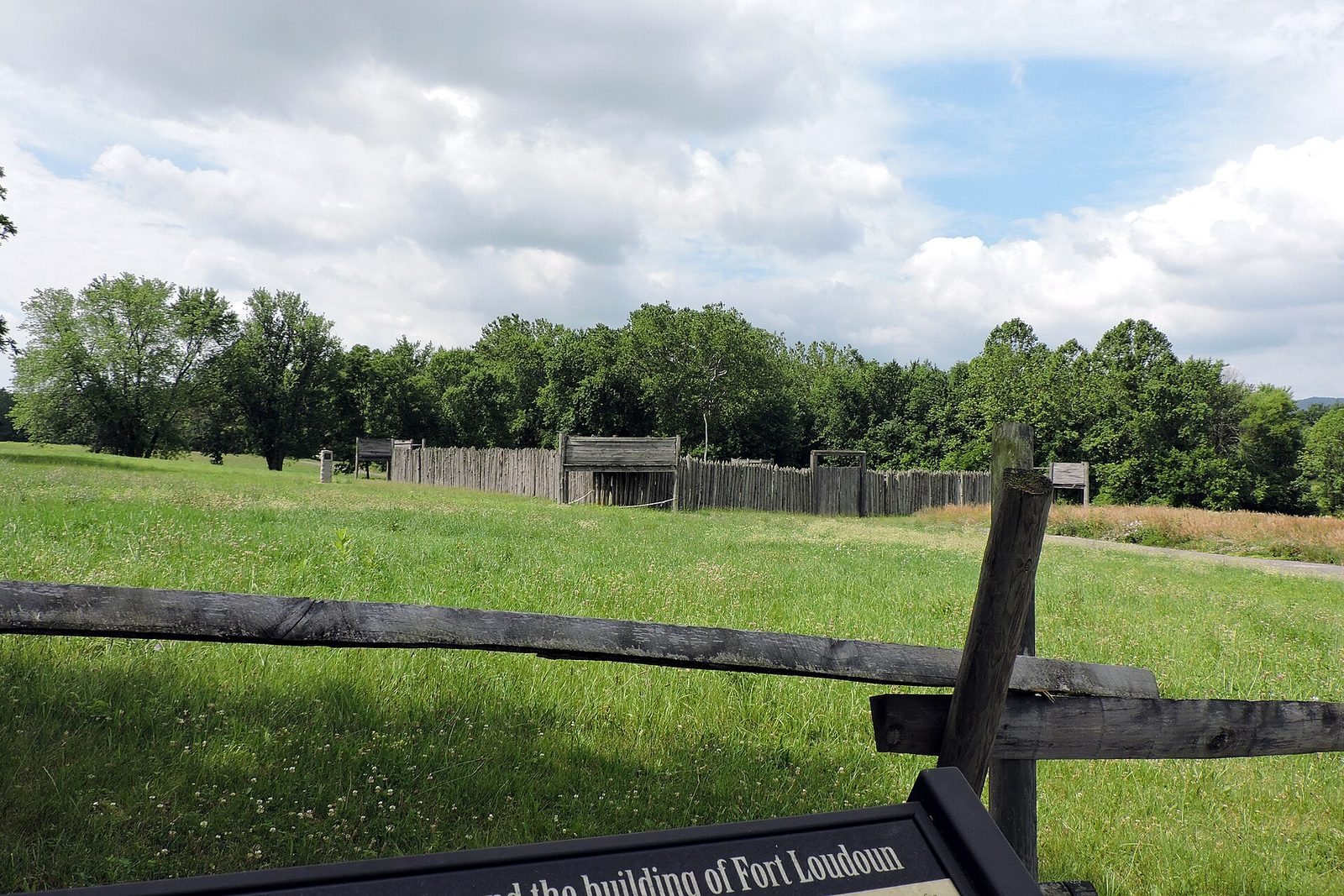
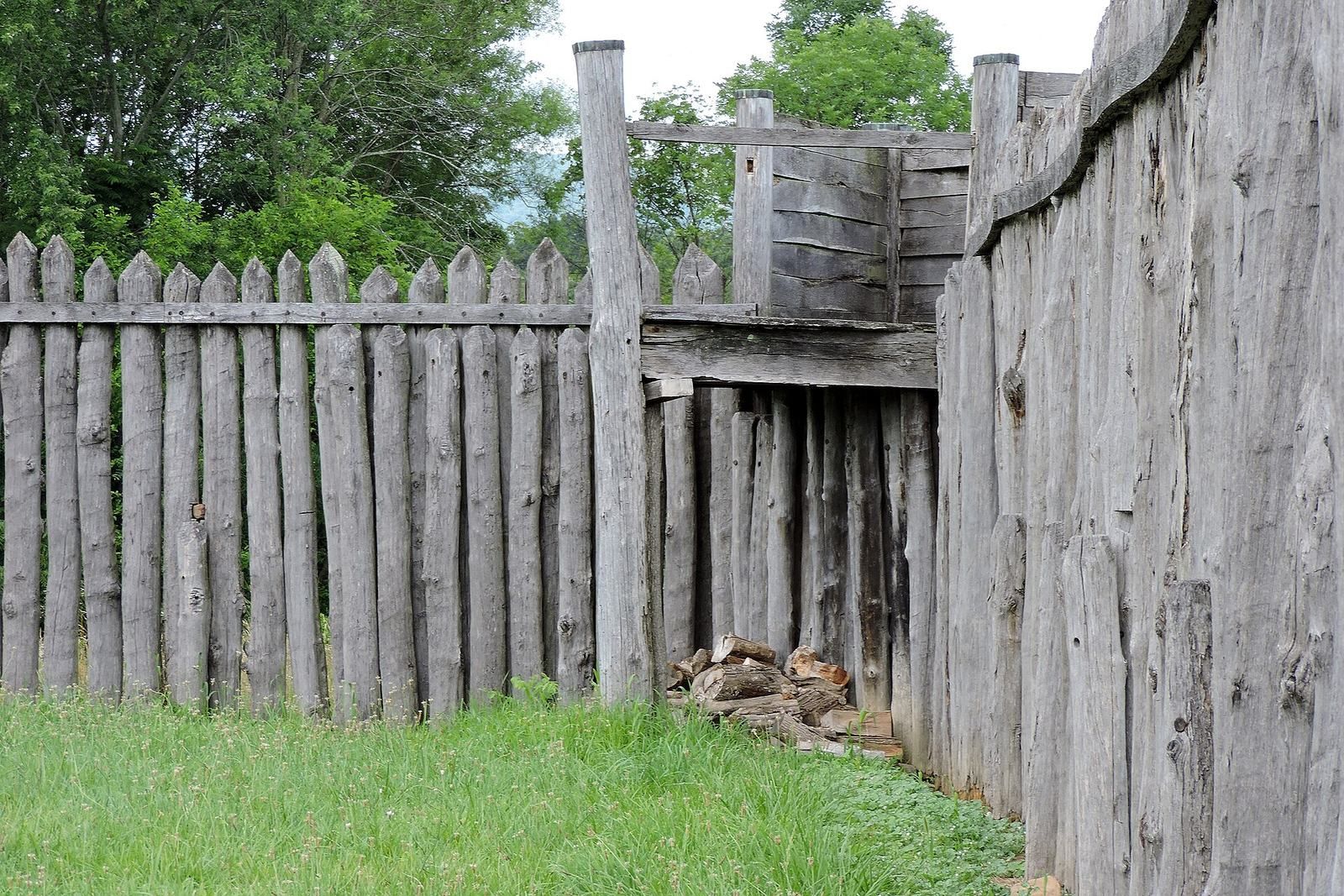
Pennsylvania purchased the farm containing the fort site in 1967. Archaeological investigations in 1977 and 1980–82 exposed the stockade trench and other remains. The Fort Loudoun Historical Society built a replica on the original site in 1993. The stockade wall and gun bastions were replaced in 2018–19, and local volunteers later reconstructed several buildings and period-style features.
Remains
The fort’s layout centered on a square wooden stockade with defensive projections at its corners and buildings inside. A typical plan called for an enclosure about 100 feet on each side, while excavation exposed a trench measuring 127 by 127 feet. The replica stands on the original site, alongside archaeological evidence of the earlier fort and nearby buildings.
Original fort and excavated features
Stockade and defenses
The stockade was built with upright posts measuring eight inches, backed by smaller posts measuring three inches. Archaeologists found three of its four corners; each was angled, and possible shooting platforms were identified at the northeast and southwest corners. The gate was in the northern wall. A bastion, a projecting defense that let soldiers cover the approaches, was part of the fort’s planned design.
The Reverend Thomas Barton, an army chaplain stationed at the fort, described it in 1758 as irregularly built and poorly situated at the foot of a hill, where damp and noxious vapors were a problem. He described a square redoubt, meaning a small enclosed fortification, about 120 feet across. Its bastion-like structures rested on supports that Barton believed an enemy could cut, causing them to collapse.
Buildings and interior features
The planned interior included barracks, officers’ quarters, a kitchen, a storehouse, and a magazine, a place for storing gunpowder or ammunition. In 1764, the storehouses were described as ruinous. They had begun as small log huts for provincial soldiers and were infested with rats.
Excavations uncovered postholes, molds associated with structures, root cellars, and drains, including a drainage trench. A stone-lined well contained debris, and its original bucket was found in water at the bottom. The excavators also found the remains of Matthew Patton’s first house and a separate house that had been burned by Indigenous people.
The Bower
A separate building called the Bower stood outside the fort. It was built as a meeting place for conferences with Indigenous people and later converted into a summer house for visiting officers and other dignitaries.
Reconstructed structures
Replica fort
The replica includes a stockade and gun bastions, along with reconstructed barracks, a storehouse, and a guardhouse. Its other period-style features include a blacksmith’s forge, a wood-fired baking oven, and a hand-dug well.
Patton house
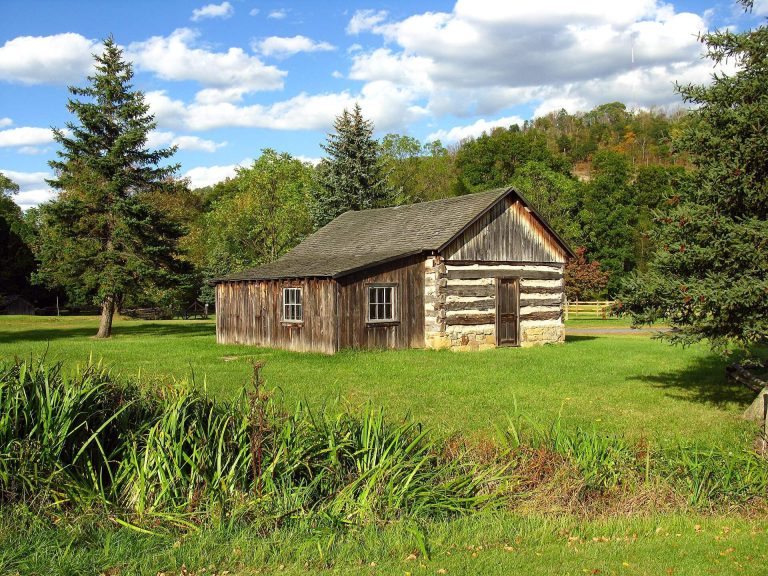
A restored Patton house dating to 1780 also stands at the site and serves as a museum and welcome center.