Fort Hays: A U.S. Army Post in Kansas
Site at a Glance
- Country
- United States
- Primary era
- Modern
- Eras represented
- Modern
- Civilizations
- Unclassified
- Site type
- Military
- Remains
- Fort
On this page13 sections
History
Establishment and relocation
Fort Hays was a United States Army post near Hays, Kansas, established first as Fort Fletcher in 1865 to protect stagecoach and freight traffic on the Smoky Hill Trail. The Army opened the post on October 11, naming it for Missouri governor Thomas C. Fletcher. Lieutenant Colonel William Tamblyn and three companies of the 1st U.S. Volunteer Infantry established it, while detachments of the 13th Missouri Cavalry also served there.
Raids on the route continued, and the Butterfield Overland Despatch soon went bankrupt. As travel along the trail ceased, the Army closed Fort Fletcher on May 5, 1866. It reopened on October 11 at the meeting of Big Creek and its North Fork, this time to protect workers building the Union Pacific Eastern Division railway westward. In November, Major General Winfield Scott Hancock renamed the post Fort Hays, honoring Brigadier General Alexander Hays, a Union officer killed at the Battle of the Wilderness during the Civil War.
A major flood on June 7, 1867, nearly destroyed the post and killed nine soldiers and civilians. The railway was about five miles north, and the flood-damaged position was poorly placed to support its construction. On Hancock’s orders, Major Alfred Gibbs selected a new site roughly 15 miles northwest. The Army occupied that location on June 23, 1867, where the historic site stands today.
Army service and the Indian Wars
As the railway extended west into Colorado Territory, Fort Hays served as a base for troops sent into the field during conflicts between the United States and Indigenous peoples, often called the American Indian Wars. It also supplied Fort Dodge and Camp Supply to the south and was intended to serve as a regional depot near the railway. The 5th Infantry Regiment was assigned to protect the rail line. Settlers arrived around the post, establishing Rome and Hays City; the latter took its name from the fort.
A cholera epidemic struck the area in the late summer of 1867. Elizabeth Polly, a hospital matron who cared for the sick at the post, died and was buried at the foot of a nearby hill. Local folklore later linked her to the “Blue Light Lady,” a ghost people claimed to see near the fort.
Fort Hays became an important Army installation during the Indian Wars. Major General Philip Sheridan used it as his headquarters during the 1868-1869 campaign against the Cheyenne and Kiowa, Indigenous peoples of the Great Plains. Lieutenant Colonel George Custer and the 7th Cavalry Regiment served under him. In the winter of 1868, Sheridan planned a campaign against the Cheyenne camp of Black Kettle, a Cheyenne leader, on the Washita River. Custer and the 7th Cavalry led the operation.
Custer and the 7th Cavalry continued operating from Fort Hays after Colonel Nelson Miles took command in April 1869. On May 3, a gunfight in Hays between soldiers of the 38th Infantry and civilians left five civilians wounded and a 7th Cavalry soldier seriously wounded in the head. In 1871, the 7th Cavalry was reassigned to the South, while Miles and the 5th Infantry headquarters moved to Fort Leavenworth. Elements of the 10th Cavalry, a Black regiment associated with the nickname “Buffalo Soldiers,” and the 38th Infantry also served at the post. The garrison changed with military needs and averaged about 200 soldiers, alongside some civilians.
Closure and later use
Army use continued through June 1, 1889. The post was formally closed and abandoned on November 8, after General John Schofield ordered its garrison withdrawn and reassigned elsewhere. The Kansas Legislature sought the property for a soldiers’ home, but the Department of the Interior took custody of the land and buildings. A later request, made in 1895 for educational and recreational purposes, also failed. In 1899, the department opened the land to settlement.
Congress transferred the reservation to Kansas on March 28, 1900, for an agricultural experiment station and a branch of the Kansas State Normal School, a teacher-training institution. The state established the station and set aside land for the school in 1901. The school opened in June 1902 and eventually became Fort Hays State University; Kansas State University continues to operate the experiment station. Most fort buildings were auctioned or sold for scrap in 1902.
The grounds reopened as Frontier Historical Park in 1929, and a museum followed in 1955. The property became a state historic site in 1967 and was acquired by the Kansas Historical Society, which operates it as the Fort Hays State Historic Site. It joined the National Register of Historic Places in 1971.
Remains
Grounds and layout
The original military reservation, meaning land set aside for an Army installation, covered about 7,500 acres in a roughly triangular area. The post grew to around 45 buildings and had the character of a frontier settlement, with a blockhouse serving a defensive purpose. The present historic site covers 177 acres at an elevation of 2,024 feet, southwest of Hays on the south side of the U.S. Route 183 Bypass. Fort Hays State University’s main campus lies north of the site, across the bypass and Big Creek.
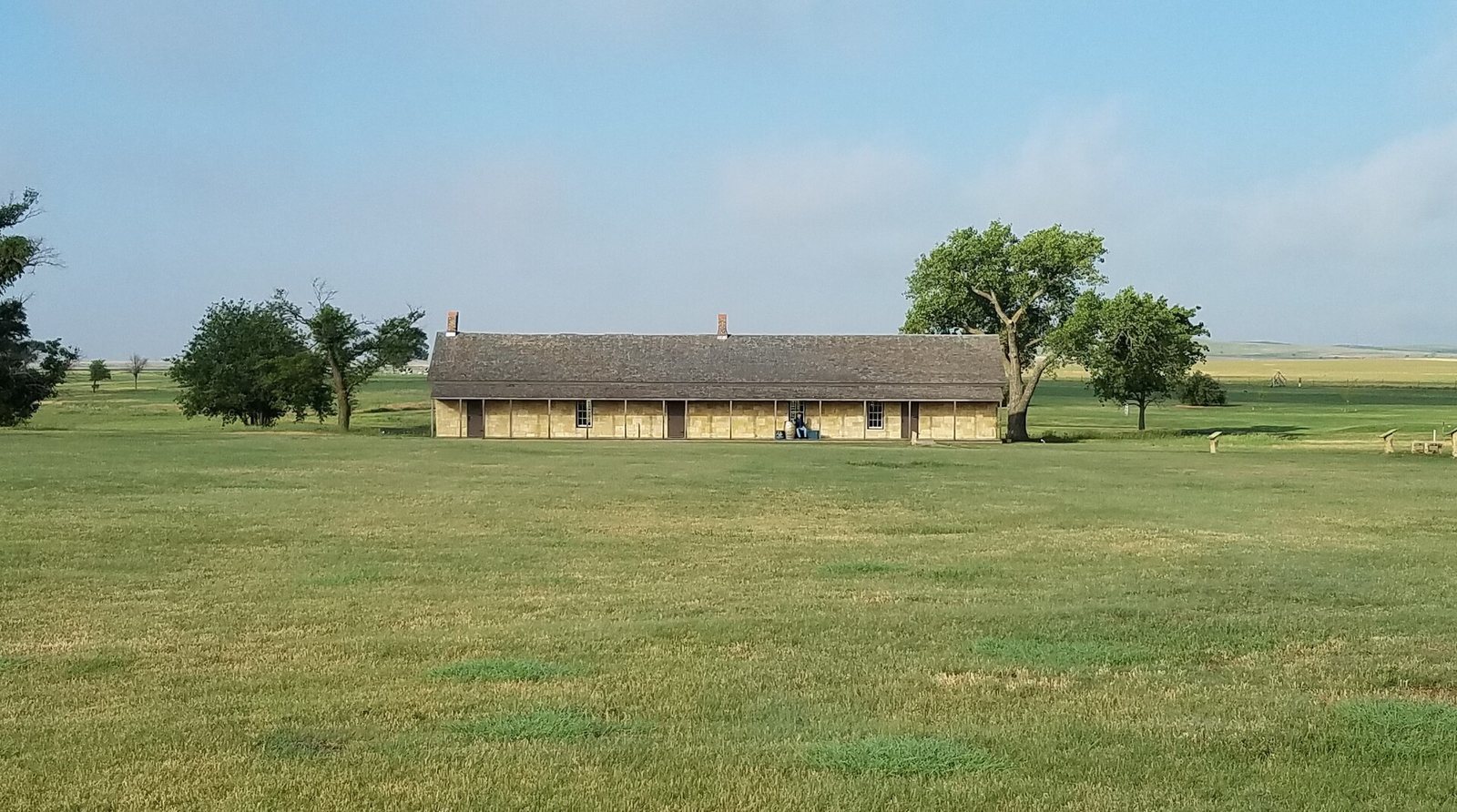
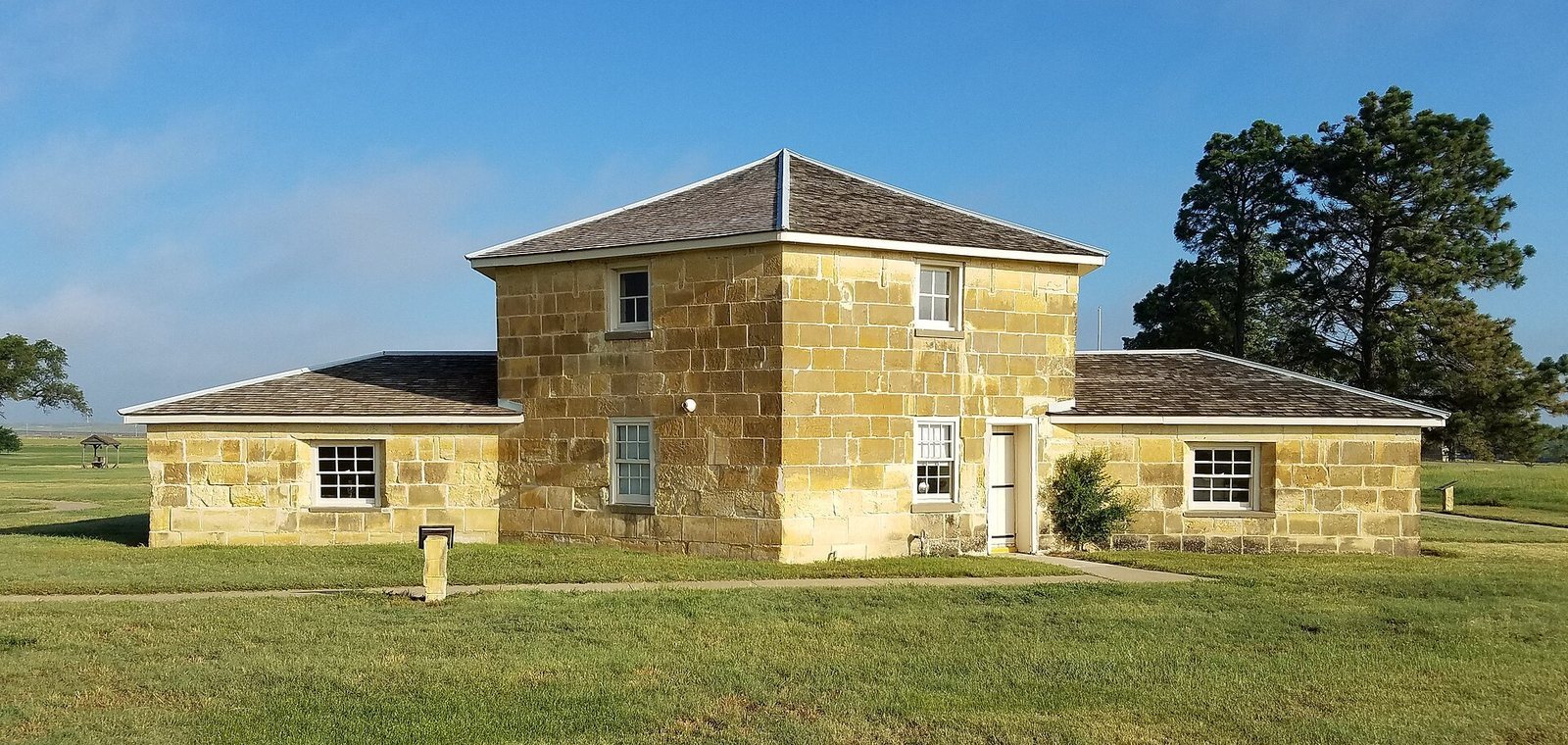
The grounds include the parade ground, an open space used for formations and drills, along with a visitor center and four original fort buildings. The surviving buildings are the blockhouse, guardhouse, and two officers’ quarters.
Original fort buildings
Blockhouse
Built of stone in 1867, the blockhouse is the fort’s defensive building. It now contains exhibits about the post’s history, construction, and soldiers’ lives.
Guardhouse
The guardhouse dates to 1872 and also houses exhibits on the fort and the people who served there.
Officers’ quarters
The two restored officers’ quarters contain furnishings from the fort’s active period, which extended from the 1860s into the 1880s.
Exhibits and memorial
Visitor center and grounds exhibits
Built in 1967, the visitor center presents exhibits on conflicts between the United States and Plains Indigenous peoples, as well as Indigenous artifacts from the period. Other exhibits on the grounds represent civilians who lived and worked at the post and mark the locations of additional original buildings.
Monarch of the Plains
The sculpture Monarch of the Plains was installed for the fort’s 1867-1967 centennial and overlooks the highway beside the historic site.