Fort Kearny: A U.S. Army Post on the Great Platte River Road
Site at a Glance
- Country
- United States
- Primary era
- Modern
- Eras represented
- Modern
- Civilizations
- Unclassified
- Site type
- Military
- Remains
- Fort
On this page13 sections
History
Fort Kearny was a United States Army post on the Platte River in Nebraska, United States, established there in 1848. It became the eastern anchor of the Great Platte River Road, an overland corridor along the Platte, and for roughly two decades supported both military operations and civilian travel. The post was intended to assist and protect westbound emigrants, while also protecting Indigenous communities from migrants and rival groups.
Founding and relocation
The Army first established a post called Fort Kearny at Table Creek, near the Missouri River. Colonel Stephen Watts Kearny had scouted the area in 1838, and the War Department ordered an outpost there in 1846. Few westbound emigrants traveled past the location, so construction stopped after temporary quarters were prepared for soldiers who spent the winter of 1847–1848 there. The Army abandoned this first post in May 1848.
In September 1847, Lieutenant Daniel P. Woodbury chose a new location where westbound routes from Independence and from Omaha and Council Bluffs came together. The Army moved there in June 1848, and Woodbury directed 175 men in building the post. He initially named it Fort Childs, after Colonel Thomas Childs, his father-in-law. A War Department order instead assigned the new post the name Fort Kearny, honoring General Stephen Watts Kearny.
The new location lay in territory identified as having been ceded by the Pawnee to the United States in October 1833. In August 1848, a treaty with the Pawnee secured U.S. rights to the military reservation, land set aside for military use, and to Grand Island. Jeffrey Deroine, a formerly enslaved diplomat, interpreted during the treaty negotiations.
Emigrant travel, mail, and supply
Fort Kearny served travelers on the westbound routes, including emigrants headed for California. By June 1849, about 4,000 wagons had passed the post that year. During peak trail traffic in the 1850s, as many as 2,000 emigrants and 10,000 oxen could pass in a single late-May day. Colonel Benjamin Bonneville took command in early summer 1849, as people known as Forty-Niners traveled toward California’s goldfields. Travelers could obtain food and other supplies, repair equipment, exchange livestock for fresh animals, send mail, and rest. The commander could sell goods at cost or give them away to people in hardship.
Regular stagecoach mail between Independence, Missouri, and Salt Lake City began in 1850, establishing the first regular mail service along the trail. Nebraska’s first telegraph line reached Fort Kearny late in 1860. The post also served the Pony Express, a short-lived horseback mail relay, and the Overland Stage, which carried passengers and mail by stagecoach. It was also an important freighting station.
Conflict and military service
After the creation of Nebraska Territory in 1854, conflict involving Cheyenne and Lakota communities increased in the surrounding region. During the Civil War, the struggle between the Union and the seceding Confederate states, armed secessionists took Fort Kearny on the night of February 15, 1861, and raised a palmetto flag. Unionists retook it the following day and raised the United States flag. Several former Confederate soldiers known as Galvanized Yankees also served at the post.
In 1864, attacks on wagon trains along the Platte and Little Blue rivers led soldiers from Fort Kearny to escort wagon trains and shelter refugees. The Army sent the First Nebraska Cavalry and Seventh Iowa Cavalry to the post. Pawnee scouts were enlisted and armed, and during the 1860s rode out against traditional enemies among Lakota and Cheyenne communities. Fort Kearny supplied several military campaigns against Indigenous communities but was never attacked. By 1865, the conflict had shifted westward. From the mid-1860s, soldiers also protected workers building the Union Pacific across Nebraska. Completion of the transcontinental railroad in 1869 reduced the Army’s need for the post.
Abandonment and preservation
The Army ordered Fort Kearny abandoned on May 22, 1871. In 1875, buildings were dismantled and their materials reused in barracks at North Platte and Sidney. Soldiers were reassigned to Omaha, and stores were transferred to Fort McPherson, about 70 miles west. In December 1876, the grounds passed to the Department of the Interior for settlement under the Homestead Act, a law allowing settlers to claim public land under specified conditions.
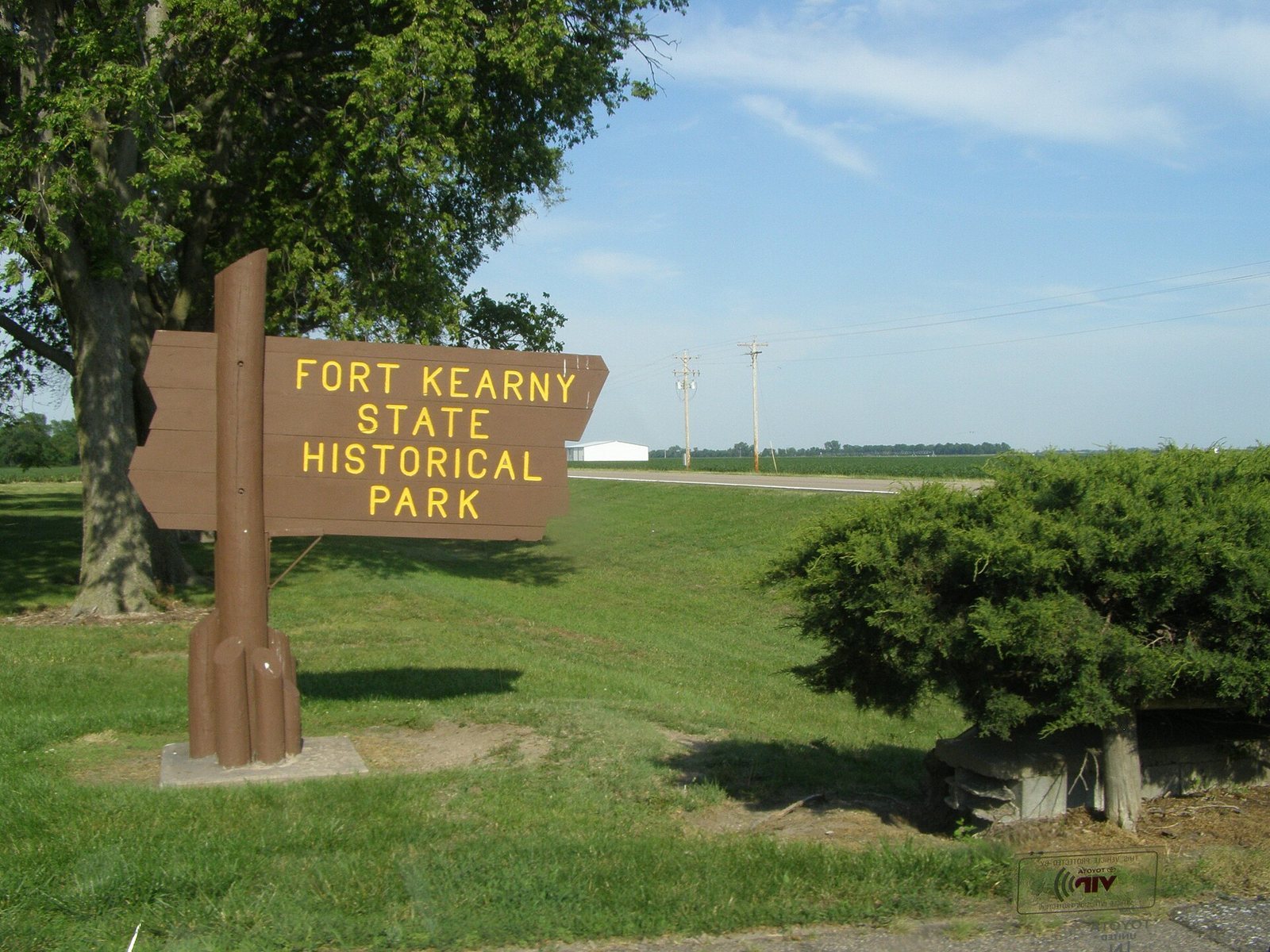
The Fort Kearny Memorial Association formed in 1928 to acquire and restore part of the original grounds. The State of Nebraska’s acquisition of 40 acres became final on March 26, 1929. Part of the historic site is now Fort Kearny State Historical Park, operated by the Nebraska Game and Parks Commission, and the site is listed on the National Register of Historic Places. Archaeological investigations have continued at the grounds.
Remains
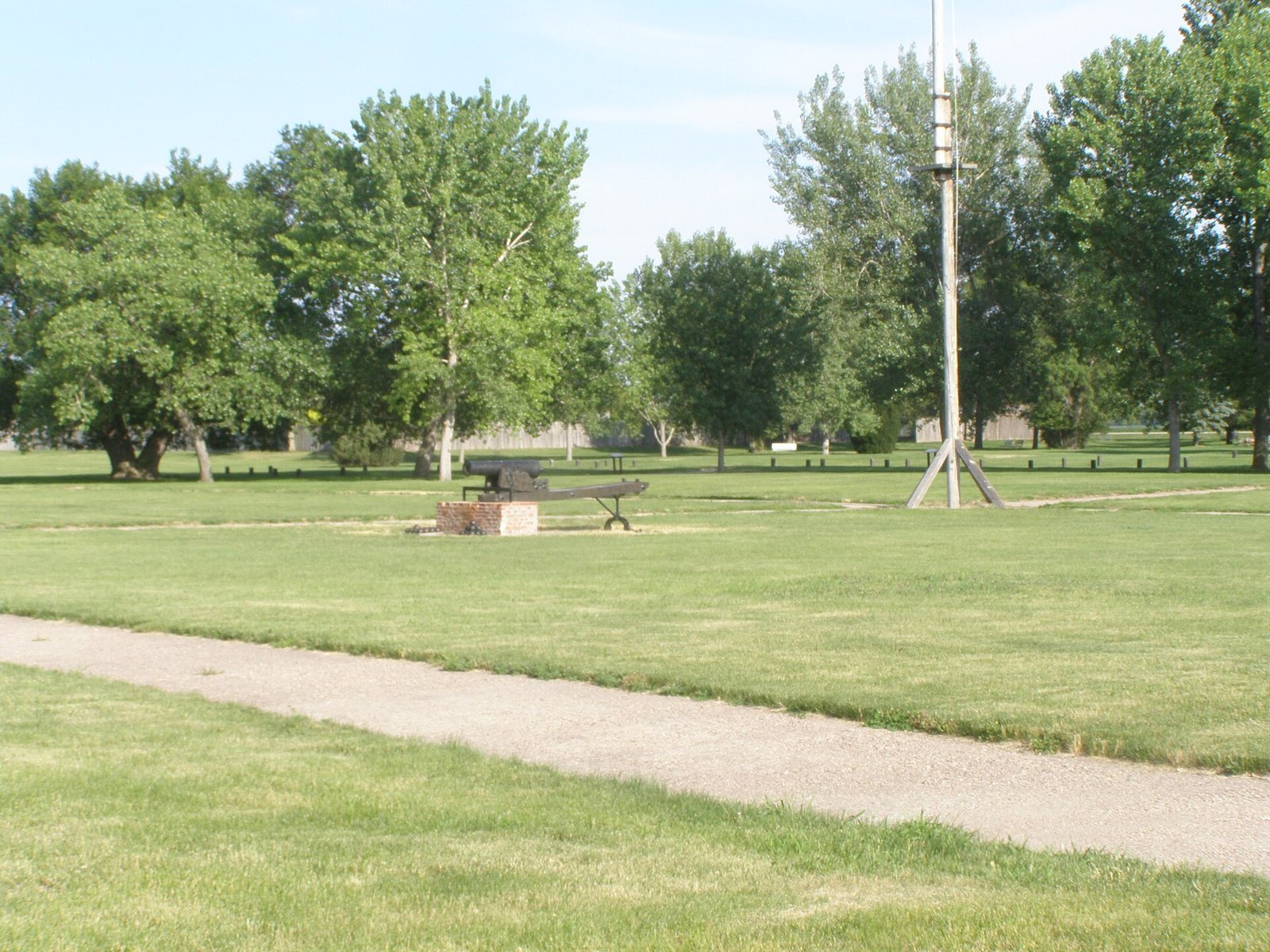
The post stood about a kilometer south of the Platte River, with its buildings arranged around a four-acre open parade ground, an area used for military formations. Cottonwood trees bordered the ground. Early structures included sod buildings, followed by adobe and wood construction; wooden frames became the main building method over time. By the summer of 1849, a small infirmary and about 20 houses had been completed. Further construction brought the total to more than 30 buildings by the end of the post’s military use.
Reservation and routes
The 10-by-10-mile military reservation extended north of the Platte into territory associated with the Pawnee and included part of Grand Island, a narrow island more than 60 kilometers long. The Mormon Trail ran roughly parallel to the river north of the fort, while the Oregon Trail passed south of the river and by the post’s buildings. A wagon track connected the post eastward with the former Fort Kearny site, later Nebraska City, and Fort Leavenworth; westward, it led toward Fort Laramie.
Defenses and services
Earthwork and stockade
In 1864, a small defensive enclosure made of upright stakes, or stockade, was built on an earthwork with an outer ditch. The earthwork and stockade were called Fort Mitchel and protected only a small area in the post’s southeast corner. The earthwork remained visible after the Army abandoned Fort Kearny.
Water and medical care
Wells as deep as six meters supplied the post with water. Waste was carried away and dumped on the prairie, while root vegetables and other produce came from Omaha. After the post hospital burned, a barracks building was used for medical care.
Archaeological remains
Foundations and grounds
Archaeological work has uncovered and marked the foundations of the headquarters, officers’ and troops’ quarters, and storage buildings. Investigators have also marked the parade ground and the enclosure used for livestock, helping outline the arrangement of the former post.
Reconstructed buildings and collections
Several buildings have been reconstructed, including a blacksmith shop. Period cannons, caissons, wheeled carriers for artillery ammunition, horse tack, equipment used with horses, and other objects are kept with the shop. A museum on the grounds holds collected artifacts.