Fort McHenry: A Coastal Defense Fort
Site at a Glance
- Country
- United States
- Primary era
- Modern
- Eras represented
- Early Modern, Modern
- Civilizations
- Unclassified
- Site type
- Military
- Remains
- Fort
On this page10 sections
History
Fort McHenry is a coastal fort on Whetstone Point in Baltimore, United States, built between 1798 and 1800 to strengthen the defenses of the city’s increasingly important port. Its defense of Baltimore in the War of 1812, a conflict between the United States and Britain, became closely associated with the origins of the U.S. national anthem.
Fort Whetstone and federal construction
Fort McHenry replaced Fort Whetstone, which occupied the site and defended Baltimore from 1776 to 1797. Fort Whetstone had been built hastily after a British ship sailed up Chesapeake Bay, exposing the city’s vulnerability. In 1793, amid conflict between England and France, control of the Maryland fortification passed to the federal government. Congress approved a broader program of Atlantic coastal defenses the next year.
Secretary of War Henry Knox appointed Major John Jacob Ulrich Rivardi to oversee construction. French engineer Jean Foncin designed the fort in 1798, and work continued through 1800. It was named for James McHenry, a Maryland delegate to the Continental Congress, a signer of the U.S. Constitution, and Secretary of War from 1796 to 1800 under Presidents George Washington and John Adams.
The defense of Baltimore in 1814
On September 13–14, 1814, Fort McHenry defended Baltimore Harbor against a British attack from Chesapeake Bay. British warships commanded by Vice Admiral Alexander Cochrane opened fire at 6 a.m. on September 13 and bombarded the fort for 25 hours. The American defenders, led by Major George Armistead, had cannon firing shot that weighed 18, 24, and 32 pounds. A defensive line of 22 sunken ships, together with the fort’s guns, stopped British vessels from entering the harbor.
British guns could reach about two miles, and rockets about 1.75 miles, but the weapons were inaccurate. The ships could launch rockets and mortars only from the limit of their range. The bombardment caused little damage, and the British withdrew on the morning of September 14 after running short of ammunition. Return fire struck one British bomb vessel, a ship equipped to launch explosive shells, and wounded a sailor.
Four defenders were killed and 24 wounded. Among the dead was a woman carrying supplies to the troops; among the wounded was Private William Williams, a Black soldier who had escaped enslavement. A bomb entered the fort’s ammunition store, but rain may have put out its fuse, or the bomb may have failed to explode.
A smaller storm flag flew during the bombardment. Early on September 14, it was replaced by a larger garrison flag, a large flag flown at a military post. Its continued display showed that the fort remained in American hands and helped prompt the British withdrawal. Francis Scott Key, an American lawyer and poet, watched from a nearby truce ship while negotiating for the release of civilian prisoner Dr. William Beanes. The flag’s survival at dawn inspired Key to write “Defence of Fort M’Henry,” set to the tune “To Anacreon in Heaven.” The song later became “The Star-Spangled Banner,” the U.S. national anthem. Flag maker Mary Pickersgill had sewn the larger flag in anticipation of the attack for $405.90.
The fort during the Civil War
During the Civil War, fought between the Union and the Confederacy, Fort McHenry served as a military prison for Confederate soldiers and Maryland political figures suspected of supporting the Confederacy or opposing President Abraham Lincoln. Those detained included Baltimore Mayor George William Brown, the city council, Police Commissioner George P. Kane, members of the Maryland General Assembly, newspaper editors and owners, and Francis Scott Key’s grandson, Francis Key Howard.
During Maryland’s 1861 secession crisis, Union General John A. Dix made the fort his headquarters and directed its guns toward the harbor entrance and the city. Six members of the state legislature were imprisoned there to prevent the assembly from meeting. The fort also trained artillery during the war, a use associated with the Rodman guns displayed there today.
On May 25, 1861, Union forces arrested John Merryman in Baltimore County for helping destroy bridges to impede Union troop movements and imprisoned him at the fort. Chief Justice Roger B. Taney granted Merryman’s petition for a writ of habeas corpus, a procedure requiring authorities to bring a detainee before a court to review the legality of the detention, and ordered him brought to court the next day. General George Cadwalader refused to comply with federal marshals seeking to enforce the order, citing Lincoln’s suspension of habeas corpus. The resulting case, Ex parte Merryman, remained unresolved, and the executive branch did not follow Taney’s ruling.
Twentieth-century uses and preservation
During World War I, about 100 additional buildings were erected around the fort to create a large U.S. Army hospital for troops returning from Europe. Most were later removed, and the original fort was preserved and restored to approximately its condition during the War of 1812. In World War II, it served as a Coast Guard base and training facility.
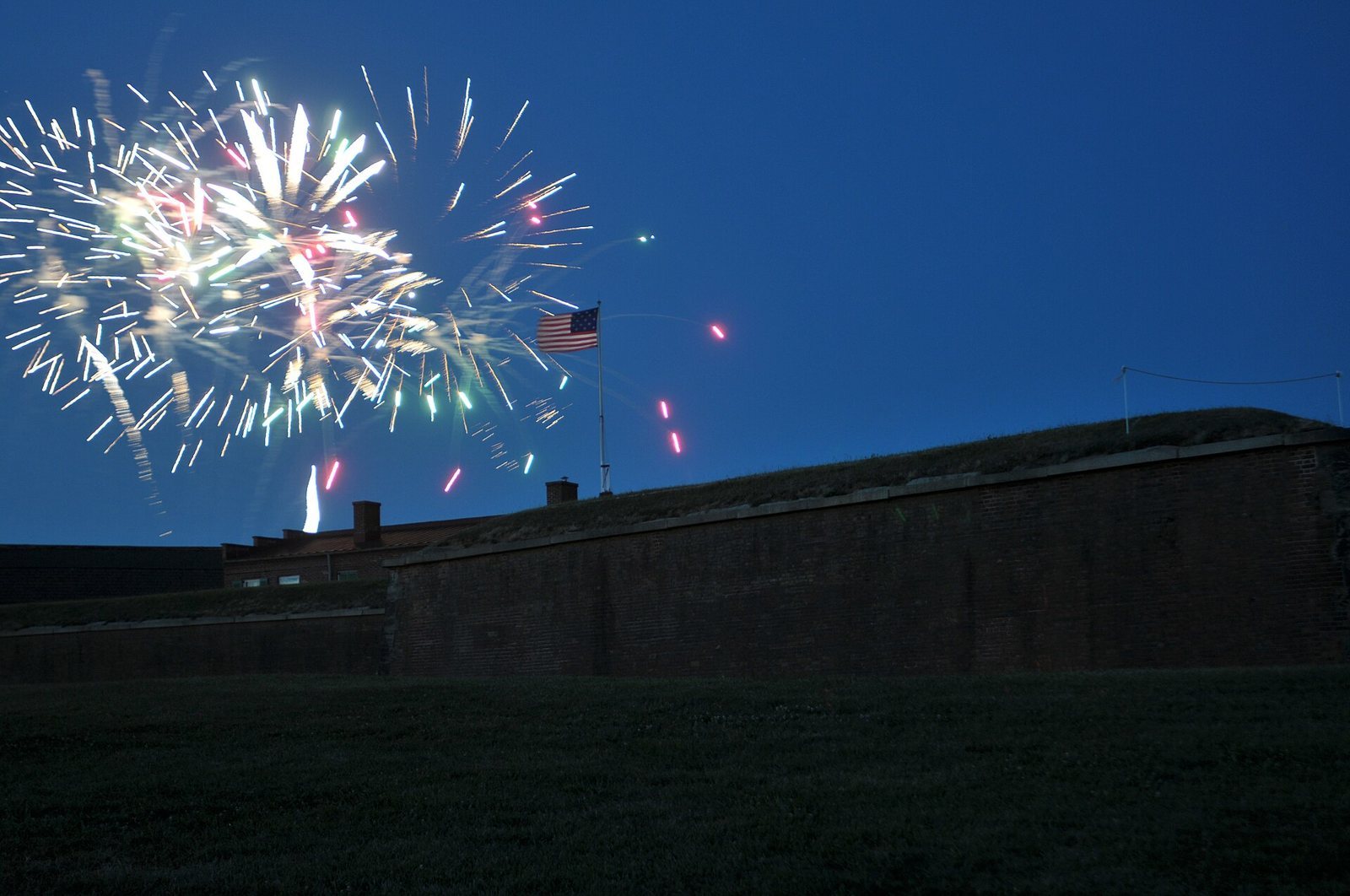
Fort McHenry became a national park in 1925. On August 11, 1939, it was designated a National Monument and Historic Shrine, a combination held by no other U.S. site. It joined the National Register of Historic Places, the federal list of historically recognized properties, in 1966 and is administered by the National Park Service, the federal agency responsible for national parks and historic sites. Authorized archaeological excavations have recovered artifacts, and conservation work begun in 2015 focused on preserving the fort’s original brickwork, chiefly by replacing mortar. A national tradition holds that each newly designed U.S. flag is flown first over the fort; Baltimore also marks the battle each September on Defenders Day.
Remains
Setting and defensive plan
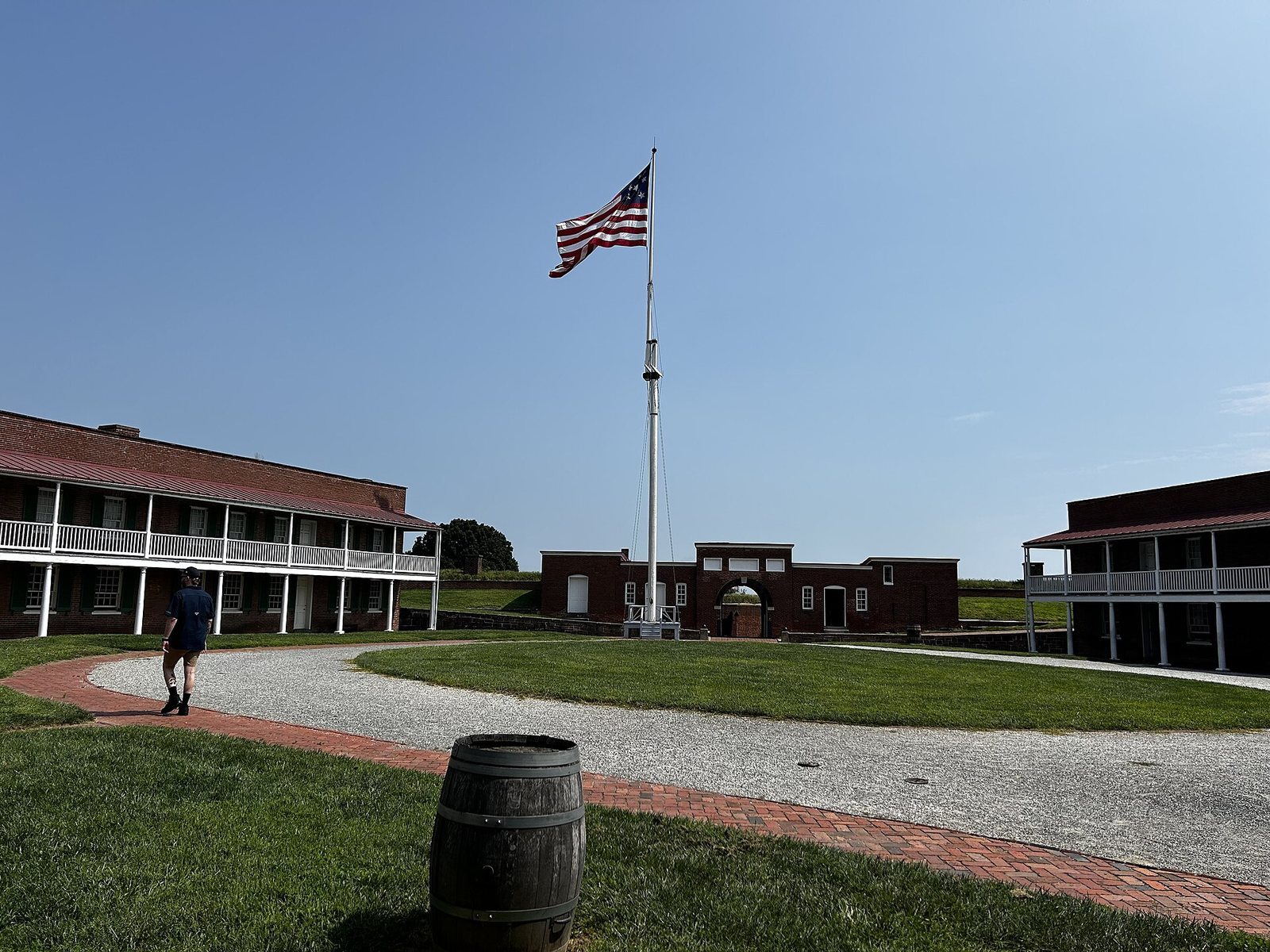
The 43.26-acre fort stands on a peninsula projecting into the entrance to Baltimore Harbor. The harbor basin and Northwest Branch lie to its north; the Middle and Ferry branches of the Patapsco River, now called the Southern Branch, lie to the south. The fort has a pentagonal plan with bastions, projecting sections that let defenders fire along nearby walls and approaches. A broad, deep dry moat, a defensive trench without water, surrounds it and could shelter infantry against an attack from land. The bastions allowed cannon and small arms to cover adjoining approaches. In 1811, Secretary of War William Eustis described plans for 30 guns at the fort, a separate 10-gun naval battery near the water, and buildings and stores for two companies.
Prison cells
Cells used to hold military prisoners during the Civil War survive within the fort. They are among the remaining physical features associated with the site’s wartime prison use.
Artillery and archaeological displays
Rodman guns, a type of heavy American artillery, are displayed at the fort. Buildings around the Parade Ground and the Visitor Center contain exhibits about its changing uses. A building near the Parade Ground also displays artifacts recovered in archaeological excavations.
Flags and memorial
The storm flag flown during the 1814 attack measured 17 by 25 feet, while the larger garrison flag measured 30 by 42 feet. The larger flag is now extremely fragile. After restoration at the National Museum of American History, it was placed on display there at a slight angle in dim light. The first official U.S. flags with 49 and 50 stars were flown over Fort McHenry and remain on its grounds. A nearby monument to Orpheus, the musician and poet of Greek mythology, honors the fort’s soldiers and Francis Scott Key.