Fort Bullen: A British Fort at the Mouth of the Gambia River
Site at a Glance
- Rating
- 5
- Popularity
- Very Low
- Country
- Gambia
- Primary era
- Modern
- Eras represented
- Modern
- Civilizations
- British
- Site type
- Military
- Remains
- Fort
On this page8 sections
History
Fort Bullen is a British fort at Barra Point, near Barra in The Gambia. Construction began in 1826 and was completed around 1833–34. It was built to support the British garrison at Bathurst, now Banjul, and to help secure the Gambia River mouth after the British Empire prohibited the slave trade in 1807.
Construction and the Barra War
Commodore Charles Bullen, a senior British naval officer, oversaw the fort’s construction. Portuguese and French slave traders continued to travel downriver from the hinterland and trade with Albreda. Bathurst’s six-gun battery could not cover the estuary, which is roughly five kilometres wide, so traders could pass north of its mouth. The British chose Barra Point for a fort that could help close this route.
Building the fort and reducing customs duties angered Niumi’s ruler. Niumi was a historic kingdom in what is now The Gambia. In August 1831, the dispute became the Barra War, when local forces besieged the fort and briefly drove the British out.
Abandonment and military reuse
An official navigation light began operating at Barra Point in 1863, initially attached to a flagpole at the fort. After the regional slave trade ended, Britain abandoned the fort in 1870 as its strategic interest in the site declined. During the Second World War, Allied forces, including the 1st Coast Battery, an artillery unit, used it again as a defensive base, observation post, and gun position against possible attacks from Senegal.
Heritage protection and conservation
On 8 June 1999, The Gambia’s National Assembly declared the fort and its adjoining 62,965-square-metre area national cultural heritage. The fort is also protected as a national monument under legislation based on the National Council for Arts and Culture Act of 1989, revised in 2003. In 2003, Fort Bullen was inscribed on the UNESCO World Heritage List with Kunta Kinteh Island and related sites. The recognition addresses the area’s connections with the slave trade and its suppression, colonialism, African resistance, and relations between Africa and Europe.
Coastal erosion threatened the water-facing wall, and sections collapsed. About 20 metres of wall were rebuilt in 2000. In 2003, the World Heritage Committee called for stronger conservation and management that included the cultural landscape along the Gambia River. UNESCO approved international assistance for conservation and partial restoration in 2011, then assistance to revise and implement the management plan in 2013.
Remains
The fort enclosure
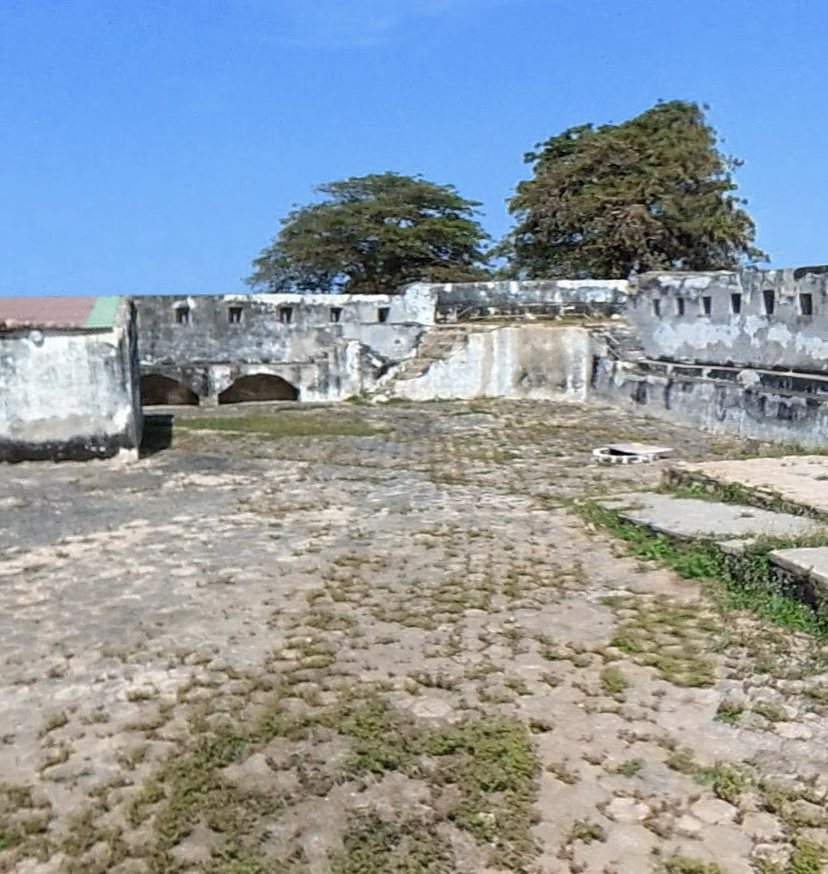
The surviving fort is arranged around a square courtyard enclosed by massive defensive walls. A circular bastion, a projecting defensive position, occupies each corner. An anti-aircraft gun survives on one of them. The earliest installation was a small military post, with a few huts grouped around two cannon and a small number of soldiers.
Lighthouse
A square steel-lattice lighthouse tower stands in the courtyard near the north-western wall. It is about 14 metres high. The light has a focal height, the elevation of its light source, of 18 metres and a range of 10 nautical miles. The Gambia Ports Authority operates it.
Museum
A small museum inside the fort presents its history and the history of the slave trade.