Gremi: A Royal Capital and Trading Town in Georgia
Site at a Glance
- Country
- Georgia
- Primary era
- Early Modern
- Eras represented
- Medieval, Early Modern, Modern
- Civilizations
- Georgian
- Site type
- City
On this page20 sections
History
Early settlement and the rise of the capital
Gremi is a former royal town in Georgia that developed in the fifteenth century and became the capital of Kakheti in 1466. That year, George VIII, the last king of a unified Georgian kingdom, became Kakheti’s first king as George I. The town’s royal center and principal architectural complex took shape under King Levan, who commissioned the Church of the Archangels in 1565.
People had occupied the area in the late Bronze Age and again between the twelfth and fourteenth centuries. A reference in a medieval chronicle to the archangels Michael and Gabriel has been interpreted as possibly referring to an earlier church at Gremi, perhaps dating to the eleventh century. The present church was built over an earlier one.
As a royal residence, Gremi also prospered as a trading town on a branch of the Silk Road, the network of long-distance routes connecting parts of Asia and Europe. Under Levan, trade reached Russia and Asian countries. His policy of peaceful relations with neighboring states is credited with supporting the town’s prosperity.
Royal learning and cultural life
Gremi had an educational and literary life as well as a royal and commercial role. Local tradition describes an academy there comparable to the one at Gelati Monastery, a medieval Georgian religious and educational center. Manuscripts were copied in the town from the fifteenth century. Queen Ana, the wife of Alexander I, commissioned a chronicle of Kakheti that has not survived. In 1535, Queen Tinatin sponsored a synaxarion, a collection of saints’ commemorations arranged by the church calendar.
King David I translated the Persian work Kalila and Dimna, while Teimuraz I began composing poetry at Gremi. The town also had a substantial Armenian community. In the 1630s, that community included an Armenian church and a walled courtyard near the royal court, with as many as ten Armenian churches in the surrounding area.
Invasion, destruction, and decline
Shah Abbas I, ruler of the Safavid dynasty of Persia, invaded Kakheti repeatedly. His campaigns of 1614 to 1616 devastated the region. During the particularly destructive attack of 1616, more than 100,000 people were taken captive and Gremi was destroyed. Although a smaller settlement developed at the site, it was repeatedly attacked by Lezgins, an ethnic group of the eastern Caucasus, and was eventually destroyed during Teimuraz I’s reign.
Gremi was still regarded as Kakheti’s capital in the mid-seventeenth century, but its population and influence had fallen, and the capital moved to Telavi. The Church of the Archangels survived the town’s destruction and remained an important Christian center in Kakheti. It continues to function as a church, with services held there.
Excavation, restoration, and heritage status
Archaeological excavations were led by A. Mamulashvili from 1939 to 1949 and by P. Zak’araia from 1963 to 1967, with investigations continuing afterward. The men’s monastery was restored in 1999. Extensive restoration began in 2011 and included the church, bell tower, royal residence, city wall, and wine cellar.
Gremi was designated a cultural monument of national importance in 2006. Its royal palace and church were added to UNESCO’s World Heritage Tentative List in 2007. A Tentative List entry is not a World Heritage inscription.
Remains
The former town covered about 40 to 50 hectares in the Alazani Valley, near the meeting of the Bolia and Ints’obi rivers. Its elevated royal center overlooked quarters extending along the valley, and estimates place the town’s population at about 100,000. The urban layout is described through the Archangels’ complex, the royal residence, and the commercial district, alongside a separate fortified area on the Sameba ridge. The noble quarter lay northeast of the commercial area, between the rivers and below the royal center; a rocky ridge separated it from the southwestern commercial and craft district.
The Archangels’ complex
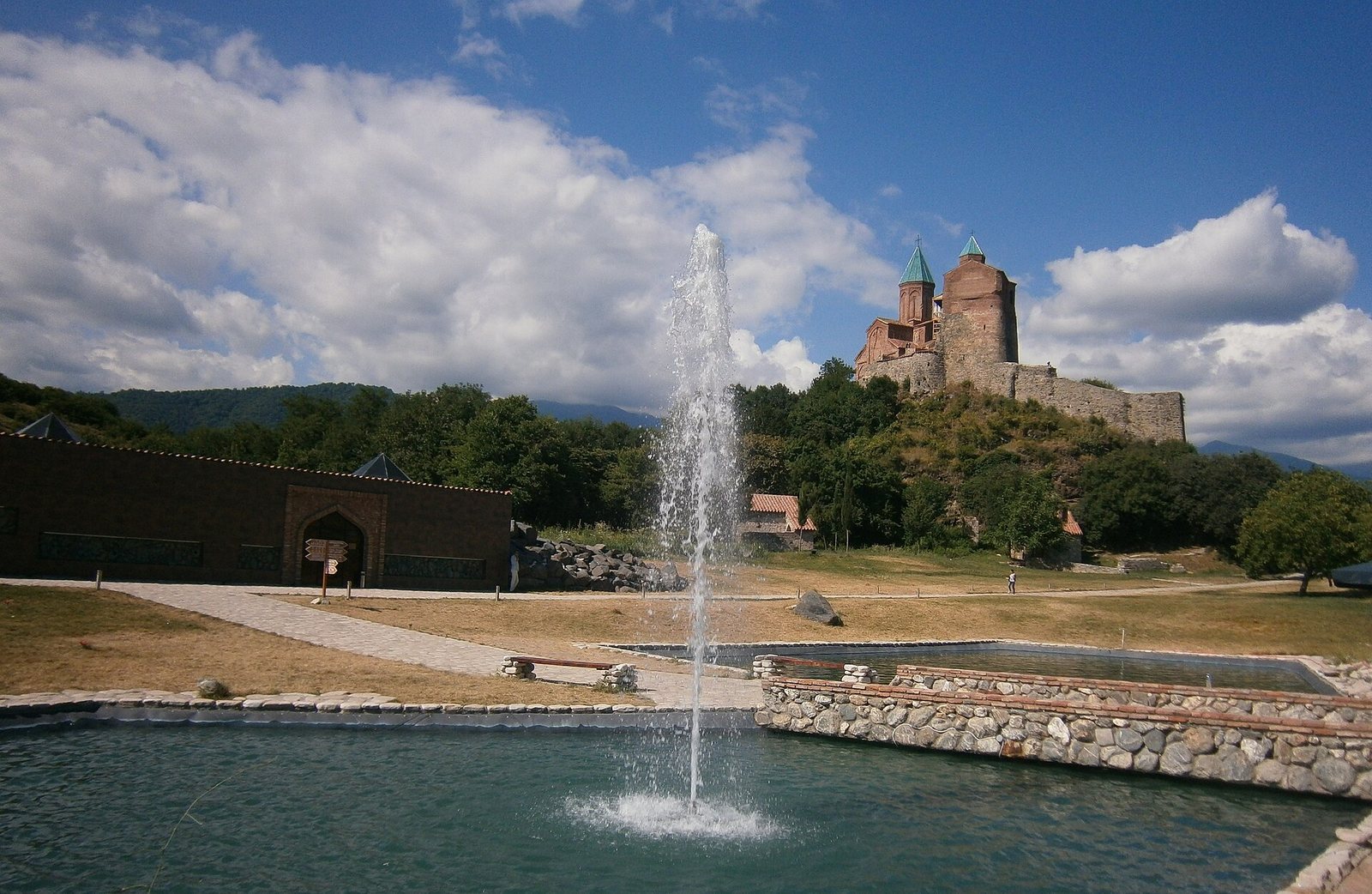
The complex brings together the Church of the Archangels Michael and Gabriel, a bell tower, a palace, a wine cellar, and service buildings. Towers and narrow openings in an enclosing wall provided defense around the compound. Remains of a stone-lined passage lead toward the Ints’obi River.
Church of the Archangels Michael and Gabriel
Standing on a hilltop, the church measures about 16 by 12 metres and rises approximately 27 metres. Built in 1565 and painted by 1577, it is a nearly square, cross-shaped building with a central dome. Georgian brick and stone, including river stone in places, are set in lime mortar. Its design combines Georgian church forms with Iranian architectural influence. The main entrance is on the west, with smaller entrances to the north and south. The dome rests on the corners of the altar area and on two additional supports, above a particularly tall, narrow main interior.
The wall section beneath the dome has eight narrow windows and a decorative row of arches. On the exterior, brick façades are organized into three arched sections. Decorative arches that do not open through the wall, recessed and raised crosses, and rectangular niches enrich the surfaces. On the east face, one cross is set back into the wall while another projects in relief; other façades have large crosses within false arches.
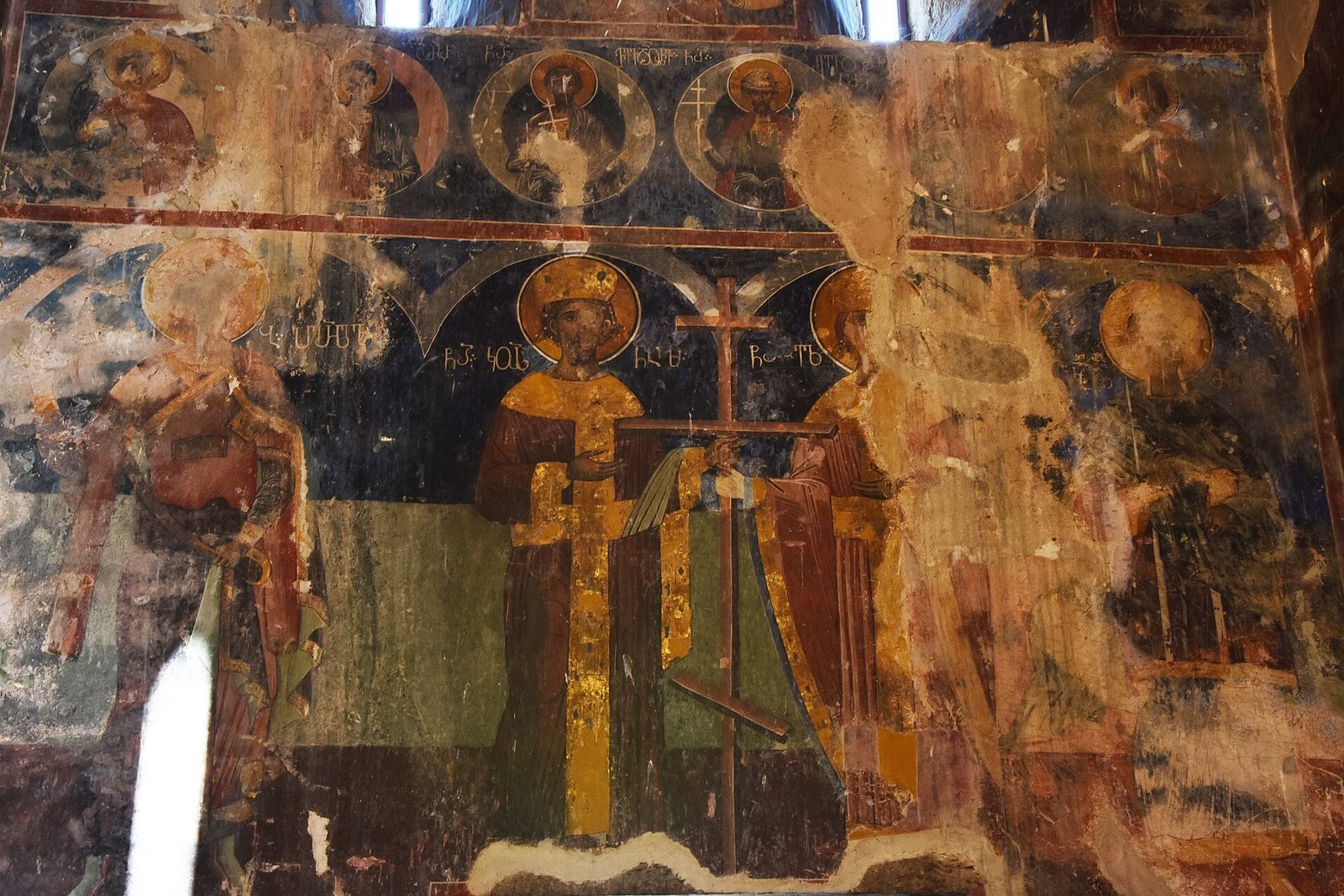
Frescoes cover the interior walls and remain in relatively good condition. The paintings follow post-Byzantine Greek Christian traditions that continued after the Byzantine period. They include portraits of Kakhetian kings, Christ and saints, full-length images of Constantine and Helena, and a scene of Peter’s denial. Figures appear at full length and in shorter portrait formats. Inscriptions beside them are in Greek and Georgian; the Georgian writing uses Asomtavruli, an early Georgian script. A western-wall fresco shows Levan holding a model of the church. He is buried inside, where a fresco portrait marks his tomb.
Bell tower and service buildings
The nearby bell tower contains archaeological exhibits, including a sixteenth-century cannon found during excavation. Modern paintings of Kakhetian kings by Georgian artist Levan Chogoshvili decorate its walls; one series dates to 1985. The complex’s wine cellar and service buildings form part of the group enclosed by the defensive wall.
Royal residence, noble quarter, and water supply
Palace and royal grounds
The royal residence occupies elevated ground and includes a rectangular, three-storey tower-palace. Above it, a later addition forms a six-sided bell tower with an open arcade. The complex also contained service buildings, a wine cellar, grape presses, a water reservoir, a dressing room, and a raised seat possibly used by the king. Other remains in the royal-residence area include a fountain building, an octagonal tower, and a brick bath.
The restored palace has a first-floor museum about the Kakhetian rulers who governed from Gremi, including Levan, Alexander II, David I, and Constantine I. A separate museum at the complex presents the history of the town. Excavations have yielded household vessels, swords, and ancient coins; some domestic objects and weapons are displayed in the museums.
Noble quarter
The northeastern quarter developed from an area of ordinary homes into a district of palaces associated with Levan, Alexander II, and Teimuraz I. It also included residences and reception buildings for royal associates and prominent residents, as well as baths, fountains, entertainment pavilions, and a royal garden.
Water system
An underground route associated with the palace also carried water under Levan’s rule. Ceramic pipes brought water from the river by way of the Lopota gorge, supplying household and drinking needs as well as baths, fountains, and gardens. The route could also be used by troops or trusted messengers. Across the wider town, ceramic pipes distributed drinking water, smaller channels served communal needs, and a larger channel irrigated the surrounding area.
Commercial district
Market
The covered market was built around a central courtyard, with rows of vaulted stone shops enclosing it on all four sides. Excavations identified 30 shops across the rows. Each measured about 10 square metres and had a single room and a balcony opening onto the courtyard; some also had cellars.
Merchants’ inns and bath
East of the market stood an elongated caravanserai, a lodging and service complex for travelling merchants and their animals. It measured about 80 metres in length, with a corridor bordered by 16 small rooms on each side. Another merchant inn and further commercial passages in a Persian style stood beyond the bath.
The district’s two-storey bath was intended for foreign visitors. Its lower level provided heat, while the upper level contained the bathing facilities. Deposits in the pipes indicate prolonged use of the building.
Other religious and archaeological remains
Churches and fortified enclosures
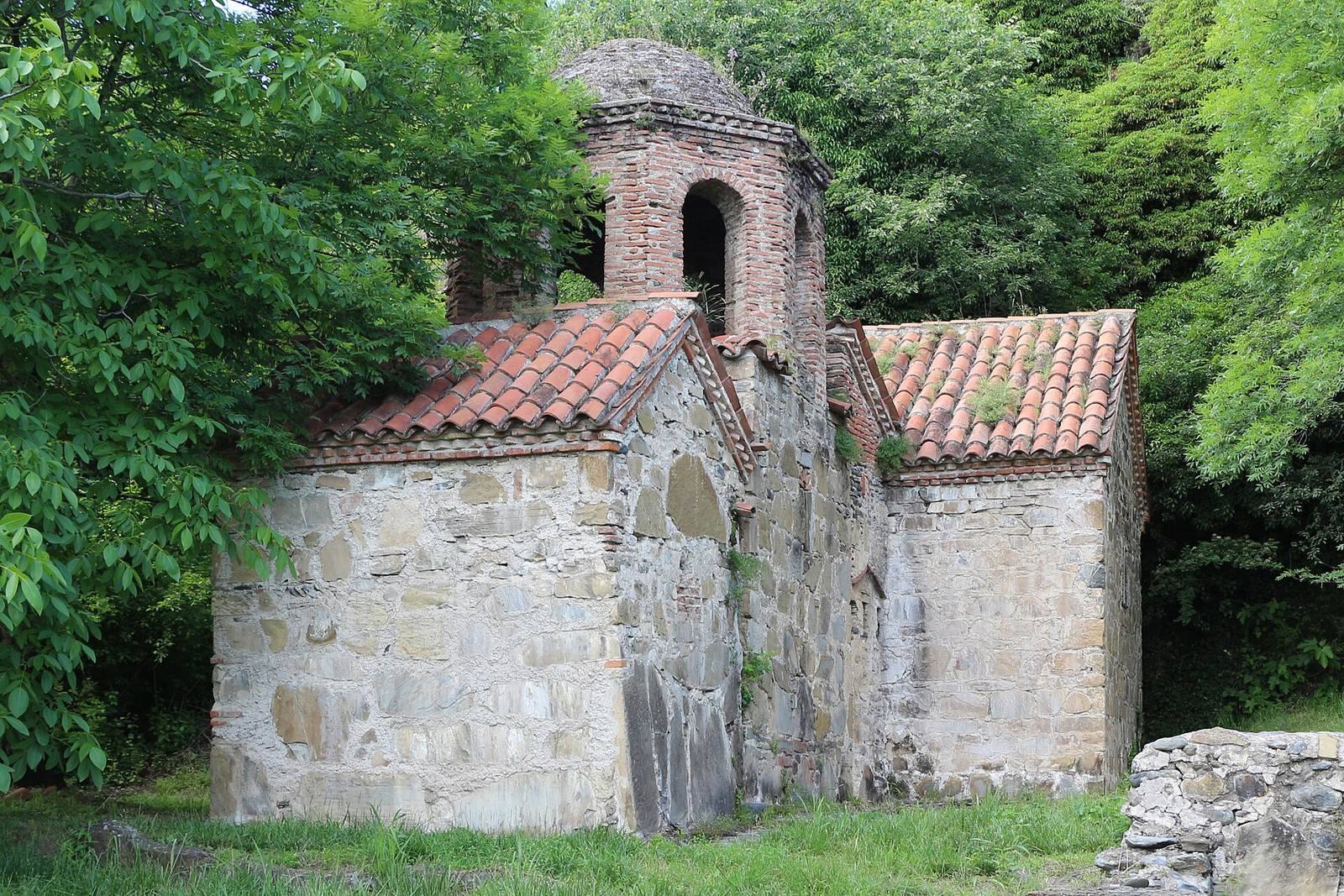
At least 15 small church ruins survive across the former town. Some walls carry Georgian, Armenian, or Arabic inscriptions and ornament. In the center of one quarter, an enclosed precinct contains a stone-and-brick church. An inscription above its entrance, in Georgian, Armenian, and Persian, states that Matarasi, secretary to King Alexander II, built it in 1623.
A separate enclosed brick church stood in the western part of the town and dates to the sixteenth century. Its enclosure, pierced by narrow defensive openings, also served as a fortification and was repaired under Heraclius II. On the western slope stood a small chapel dedicated to Saint George, with a tower. Higher on the Sameba ridge was a round-plan Church of the Holy Trinity.
Temple, cemeteries, and finds
An ancient temple dedicated to the Sun was excavated near the church built in 1623. Three old cemeteries, Georgian, Armenian, and Jewish, and the ruins of a fortification also lie around the former town. Excavated bronze dagger fragments and black-polished pottery are associated with late Bronze Age activity. Other finds include imported Persian and Chinese ceramics, household objects, weapons, and coins.
Sameba ridge fortifications
The fortified area on the Sameba ridge contained the Church of the Holy Trinity, palaces, service buildings, and defensive works. It was also called Gremi Narikala, a comparison with Narikala, the historic fortress of Tbilisi.