Fort Bridger: A Fur-Trading Outpost and Military Post in Wyoming
Site at a Glance
- Country
- United States
- Primary era
- Modern
- Eras represented
- Modern
- Civilizations
- Unclassified
- Site type
- Military
- Remains
- Fort
On this page10 sections
History
Fort Bridger is a historic fur-trading and military post on Blacks Fork of the Green River in Wyoming, United States. Fur traders Jim Bridger and Louis Vasquez established it in 1842, when the area belonged to Mexico. It later became an important resupply point for travelers on the Oregon, California, and Mormon Trails.
Fur trade and emigrant routes
In 1845, writer and western-route promoter Lansford Hastings advised California-bound emigrants to leave the Oregon Trail at Fort Bridger and follow a new route across the Wasatch Range and the waterless Great Salt Lake Desert. The route passed around the Ruby Mountains before joining the California Trail about seven miles west of present-day Elko. The Donner-Reed Party took this route. On July 12, party members received a letter from Hastings saying he would wait at Fort Bridger to guide emigrants along the way. The nearby town later took its name from the post.
Latter-day Saint settlement and the Utah War
Members of the Church of Jesus Christ of Latter-day Saints, commonly called Mormons, arrived in 1847, and tensions developed between them and Bridger. In 1853, a Mormon militia sought to arrest him for selling alcohol and firearms to Native Americans in violation of federal law. Bridger escaped and returned east for a time. The settlers established Fort Supply on Willow Creek, about 12 miles southwest. In November 1853, church leader Orson Hyde arrived at Fort Bridger with 39 settlers.
Mormons took control of Fort Bridger in 1855, apparently paying $8,000 in gold coins. They said they had bought it from Vasquez, but Bridger disputed the claim. A deed dated August 3, 1855, and registered in Salt Lake City in 1858 purported to convey the fort to the church. H. F. Morrell signed Bridger’s and Vasquez’s names under a claimed power of attorney. Bridger was away in 1855, guiding Sir St George Gore.
The Utah War was an 1857–58 conflict between the federal government and Mormon leadership over federal authority in Utah Territory. President James Buchanan sent the army into the territory to install Alfred Cumming as governor in place of Brigham Young. As federal troops approached in 1857, Mormon forces burned the fort’s buildings to prevent their capture. Colonel Albert Sidney Johnston used the stone walls that remained to shelter supplies and a garrison while the army spent the winter at nearby Camp Scott. In September, the Mormons had abandoned both Fort Bridger and Fort Supply. On November 18, Bridger leased his surveyed land to the United States, but payment was withheld until he could establish his title.
Army post, treaty, and transportation routes
The army established an official post at Fort Bridger in 1858. Major William Hoffman commanded its depot from June 7 to August 17, when Brevet Lieutenant Colonel Edward Canby took over. Soldiers built storehouses and quarters, and in 1859 the army set aside a 500-square-mile military reservation, meaning land reserved for military use. Civilian merchant William A. Carter became the post sutler, a trader who supplied an army post, in 1858. After his death in November 1881, his wife, Mary Elizabeth Hamilton Carter, continued the business as sutler and later post trader until 1890.
Federal troops withdrew east at the start of the Civil War in 1861. Carter organized mountain men to defend the post until volunteer soldiers from Nevada and California arrived. In 1862, Colonel Patrick Edward Connor sent two companies to restore the army presence, and volunteer units remained at Fort Bridger during the war. Regular army troops returned in 1866, including companies of the 18th U.S. Infantry.
On July 3, 1868, Shoshone leader Washakie signed the Treaty of Fort Bridger at the post. The treaty ceded Shoshone and Bannock lands in southwestern Wyoming and established the Wind River Indian Reservation. From 1867 to 1869, troops also helped protect construction of the Union Pacific Railroad’s Overland Route and the Overland Stage and Mail route. The railroad reached the region in 1869, reducing the post’s isolation. In August 1860, traveler Richard Francis Burton had described the area as neutral ground among Native peoples, naming Snake and Crow peoples to the north, Oglala and other Sioux to the east, Arapaho and Cheyenne to the south, and Ute to the southwest.
In 1870, Yale professor Othniel Charles Marsh used the fort as a base for a geological expedition. Geologist Ferdinand Vandeveer Hayden’s survey was based there from September 12 to October 1. As railroads expanded, western army posts became less necessary. Fort Bridger was abandoned in 1878, reopened as a post in 1880, and closed by the army in 1890, the year Wyoming became a state.
Reuse and preservation
After the army departed, the buildings were sold and the site developed as a cattle town. The former commanding officer’s quarters became a hotel, and the stone barracks later served as a dairy barn. On June 27, 1928, Wyoming’s Historical Landmark Commission acquired the site and its remaining buildings for preservation. Dedication ceremonies in 1933 established it as a state historical landmark and museum. Fort Bridger is now a state historic site and was added to the National Register of Historic Places in 1969.
Remains
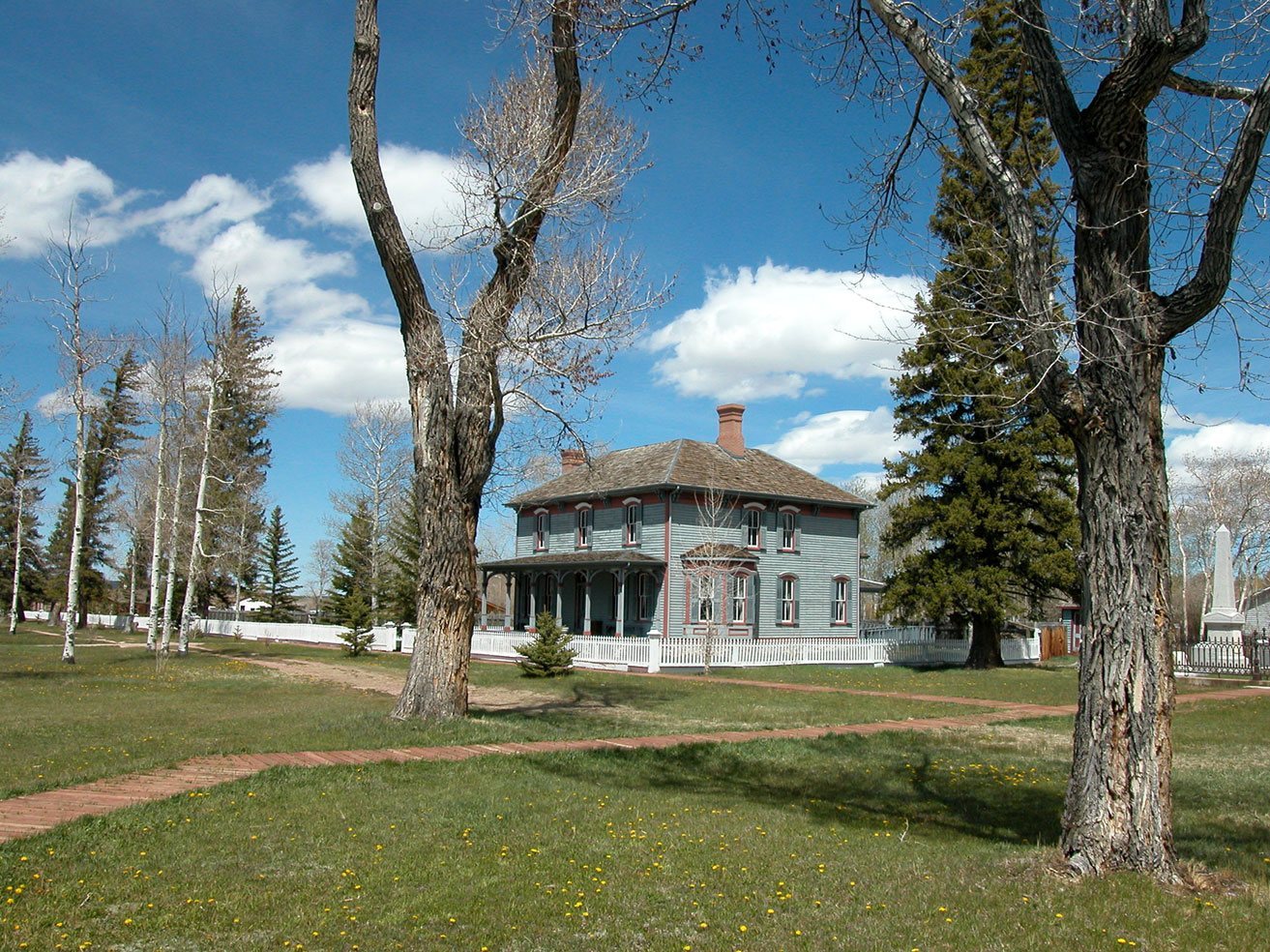
The remains reflect successive fur-trading, Mormon, and army phases rather than a single unchanging plan. Early structures were built of logs, while stone walls and buildings belong to later phases. The present site includes surviving historic features, restored buildings, a reconstructed trading post, and an interpretive archaeological area.
Early timber enclosure
In a December 1843 letter, Bridger described a small fort with a blacksmith shop and iron supplies. One later description presents an eight-foot stockade, a defensive wall of upright logs, with a corral to the north and four log cabins with flat dirt roofs. The cabins served as Bridger’s forge and workshop, his store, his family’s home, and his partner’s residence. Orson Pratt’s account of July 7, 1847, instead describes two adjoining log houses and a small enclosure of upright logs about eight feet high; he also noted nine Native lodges nearby. In 1852, Mrs. Benjamin G. Ferris described a long, low log building surrounded by a high wall of upright logs.
Walls and surviving features
The 1857 fire destroyed the fort’s wooden buildings, but stone walls remained. The Mormon defensive wall and a Pony Express barn are among the older features that survived at the site. The Pony Express was a nineteenth-century mail service that carried messages across the western United States by horse and rider.
Stone barracks
Built in 1888, the large stone barracks later served as a dairy barn. They now house a museum with artifacts from different periods of Fort Bridger’s history.
Restored and reconstructed features
Several original buildings have been restored, and a trading post has been reconstructed. Archaeological work begun by Dudley Gardner and his students in 1990 uncovered parts of the original trading post, the Mormon fortification, and the later army occupation. An interpretive archaeological area presents this evidence at the historic site.