Shravasti: Capital of Kosala and Buddhist Centre
Site at a Glance
- Popularity
- Very High
- Country
- India
- Primary era
- Medieval
- Eras represented
- Iron Age, Classical, Medieval, Modern
- Civilizations
- Gupta
- Site type
- City
On this page12 sections
History
Shravasti was an ancient city in present-day Uttar Pradesh, India, and the capital of Kosala, a kingdom in northern India. By the Buddha’s era in the fifth century BCE, it stood where three major routes across the Indian subcontinent met. It became a prosperous Buddhist centre, active from around that time through at least the twelfth century CE.
Religious life in the Buddha’s era
Traditions differ about who founded the city. The Hindu text known as the Bhagavata Purana attributes its construction to King Shravasta, a figure of the legendary Ikshvaku royal line. Other Hindu texts name Sravasta, or Sravastaka, son of King Srava. Buddhist texts call the city Savatthi, while other explanations connect its name either to a sage or to a Pali expression meaning “everything is available.”
Buddhist tradition places many of the Buddha’s teachings in Shravasti and says that he spent 25 rainy-season retreats there. During this monsoon period, monks stayed in one place. The tradition assigns 19 of the Buddha’s retreats to Jetavana and six to Pubbārāma. Anathapindika, a wealthy supporter, gave the Buddha the Jetavana grove and residences; the lay devotee Visakha supported the Buddhist community and established Pubbārāma. King Prasenajit, who ruled Kosala from Shravasti, was another leading patron.
The city is also linked in Buddhist tradition with the Buddha’s “great miracle” and “twin miracle.” The Shravasti miracle story later inspired Buddhist artworks beyond India. Its religious importance drew followers of Jainism and Ajivika, an ancient religious movement. Kosalan rulers are described as supporting Buddhist, Jain, and Ajivika communities, while also maintaining Vedic rites and schools.
Kosala’s political fortunes
Traditions connect Shravasti’s royal court with that of Magadha, a neighbouring kingdom. They relate that Magadha’s ruler Bimbisara married Videhi, Prasenajit’s sister, and that territory in Kasi was transferred as a marriage gift. Accounts also describe conflict between Prasenajit and Bimbisara’s son Ajatashatru over Kasi. Prasenajit is said to have captured Ajatashatru, spared him, restored his kingdom, and arranged his marriage to Prasenajit’s daughter.
Later traditions say Prasenajit was displaced by his son Vidudabha and died outside Rajagriha while seeking Ajatashatru’s help. They also recount Vidudabha’s attack on Kapilavastu and the massacre of the Shakya clan, followed by a flood that swept away Vidudabha and his army. Ajatashatru then took Shravasti and annexed Kosala. As political and commercial influence shifted first to Rajagriha and later to Pataliputra, Shravasti ceased to serve as a capital, though Jetavana continued as a religious centre for a time.
Jain traditions and pilgrimage
Jain traditions identify Shravasti as the birthplace of Sambhavanatha, the third Tirthankara, and Chandraprabha, the eighth. In Jain belief, a Tirthankara is a spiritual teacher who has attained liberation and shown others the way. Jain accounts also say that Mahavira, the twenty-fourth Tirthankara, visited the city repeatedly and spent his tenth rainy-season retreat there as the guest of the merchant Nandinipriya. They place debates between Mahavira and Gosala Mankhaliputta, founder of the Ajivika movement, in Shravasti. Jain tradition further traces a monastic branch associated with the city to the early third century BCE.
Jain accounts associate the city with other teachers and events, including the birth of Gosala Mankhaliputta and the initiation of Sambhavanatha. They also describe Jain rulers as patrons in the ninth and tenth centuries CE. A temple containing an image of Sambhavanatha was renovated several times before being desecrated during the rule of Alauddin Khilji, a sultan of the Delhi Sultanate. Jain monks writing in the seventeenth and eighteenth centuries continued to describe Shravasti as a pilgrimage destination. Between 1975 and 1987, Jain temples and statues underwent major restoration.
Descriptions and archaeological investigations
The Chinese Buddhist pilgrim Faxian travelled in India from about 399 CE and recorded a route from Shravasti to Kapilavastu. In the seventh century, another Chinese Buddhist pilgrim, Xuanzang, described Shravasti as largely deserted, with some residents remaining and more than a hundred monasteries, many in poor repair. His account also noted the decaying remains of Prasenajit’s palace. The city’s religious life persisted for centuries, but the wider site was later covered by mounds and destroyed sometime in or after the thirteenth century.
Alexander Cunningham recognized the site’s archaeological potential in 1863, connecting it with a colossal Bodhisattva image bearing an early Kushan inscription that had been found nearby. His partial excavation in 1876 uncovered stupas and small shrines. In 1885, archaeologist Hoey excavated part of a monastery and found an inscribed stone dated to 1176 in the Vikram era, placing the complex in the early twelfth century CE. Excavations led by Vogel around 1908 confirmed that Saheth-Maheth was the Shravasti known from Buddhist literature. Work in 1910 recovered monuments and objects dating from the first century CE onward.
Further excavations refined the picture of the city’s long history. Work led by Sinha in 1959 identified three phases of construction and repair to the city walls. Nine seasons of excavation led by Yoshinori Aboshi between 1986 and 1996 used carbon dating and indicated occupation from the eighth century BCE through the first millennium CE. The results traced extensive monastery building after the Kushan period, a decline around the fifth century CE, and renewed expansion from the seventh through the twelfth centuries, followed by burning. The Sambhavanatha birthplace area is now under the care of the Archaeological Survey of India.
Remains
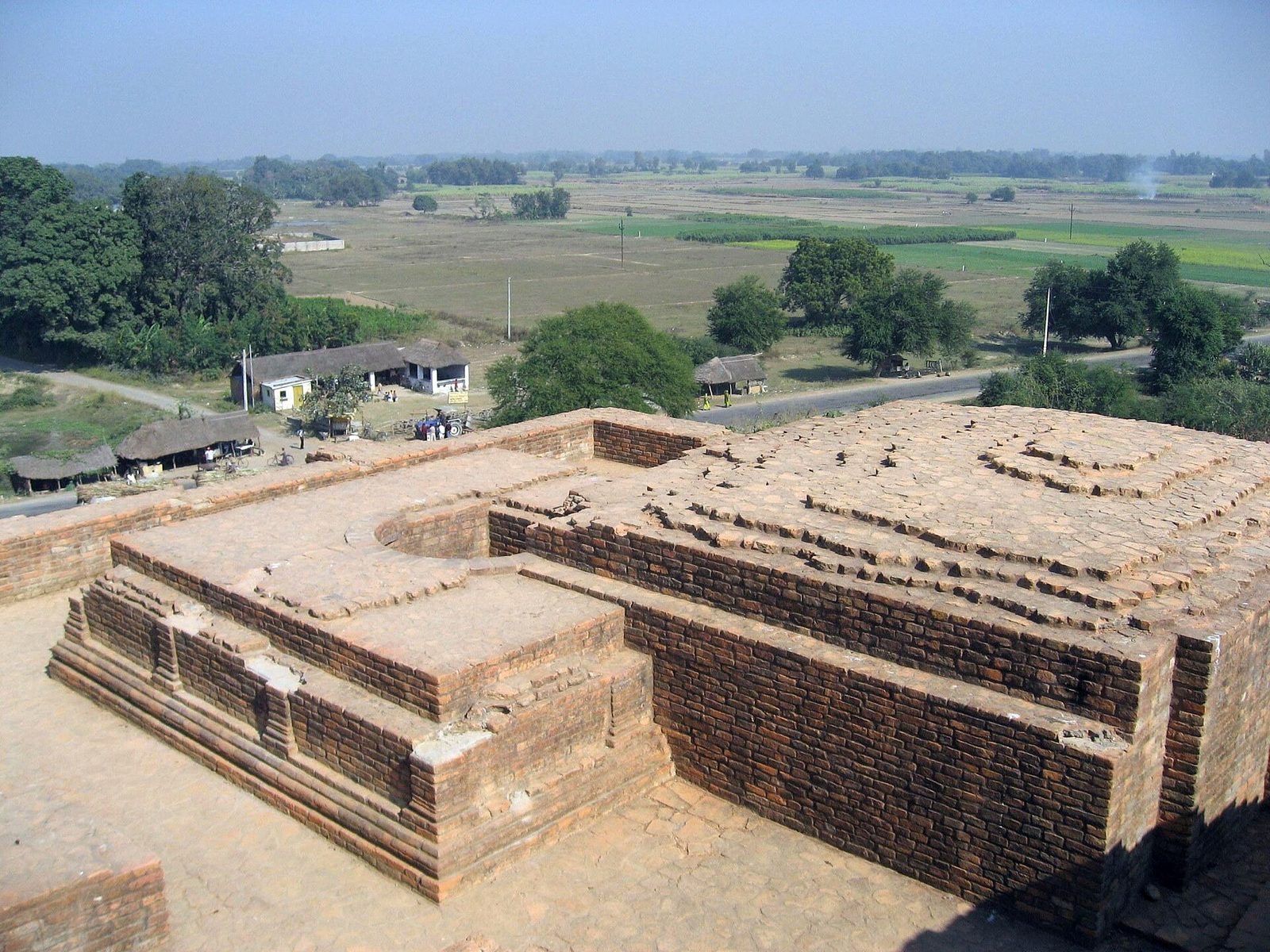
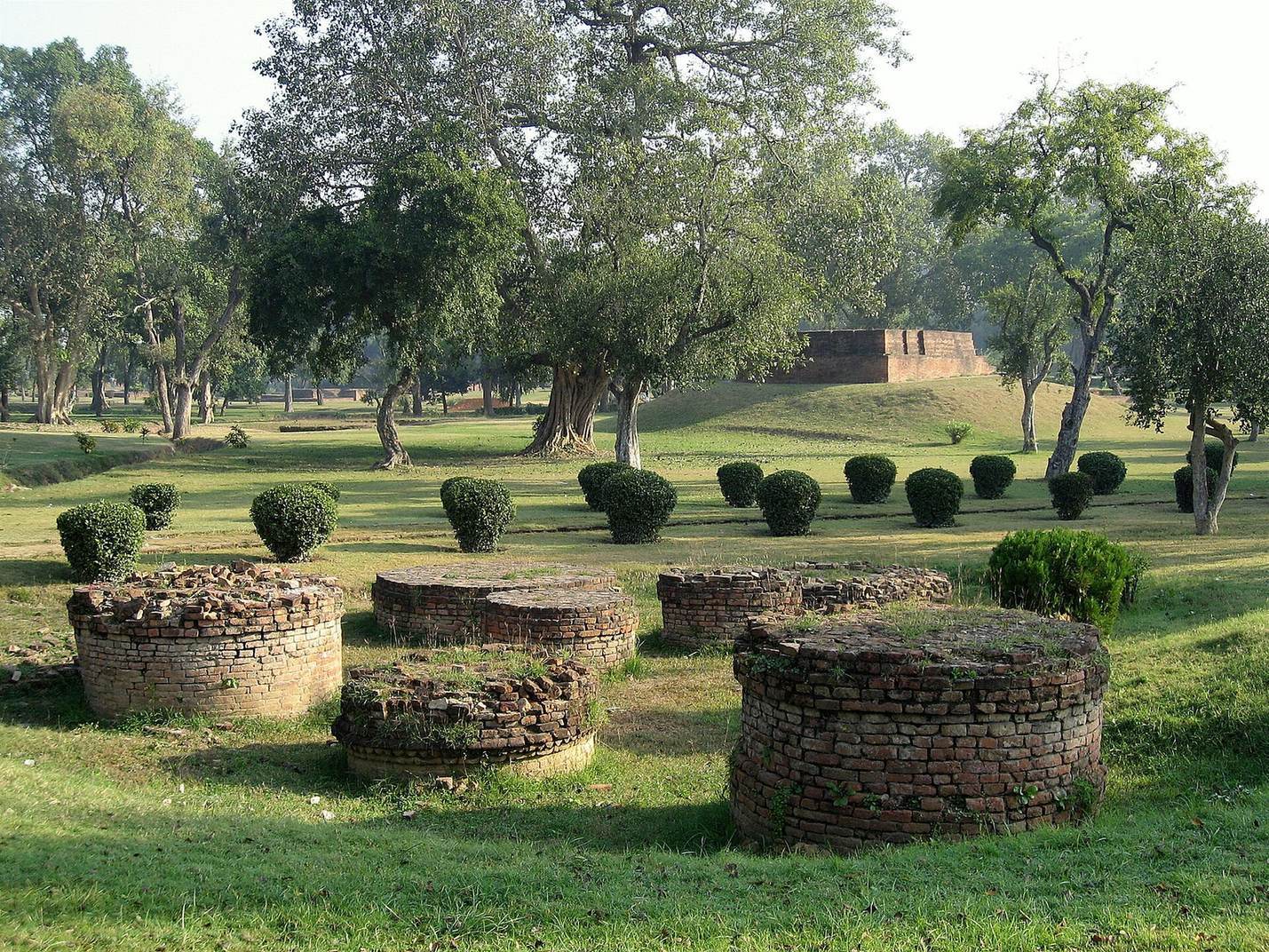
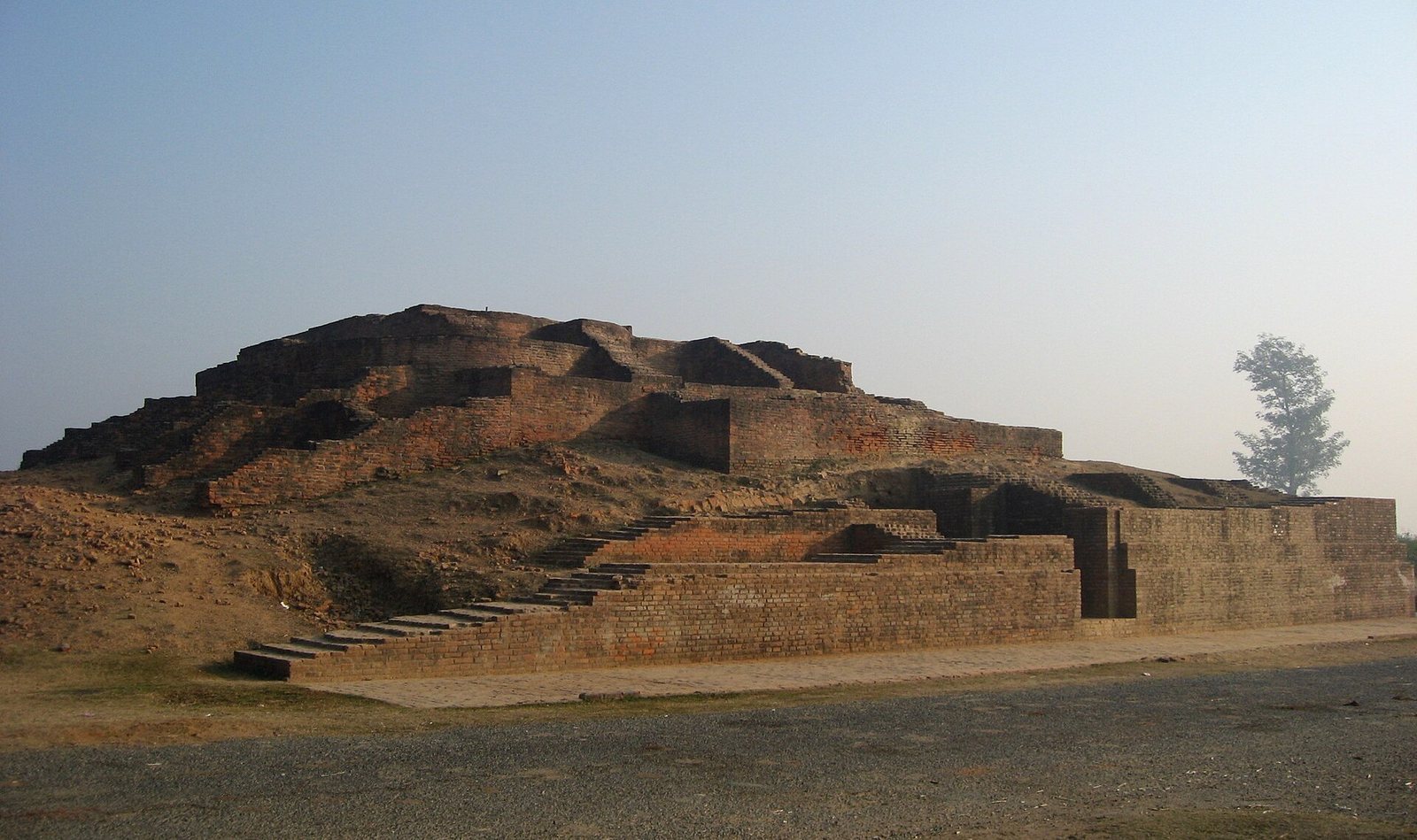
The archaeological site, also called Saheth-Maheth, lies south of the seasonal Rapti River. Its two main areas are less than two kilometres apart: Saheth contains the Jetavana monuments, while Maheth holds the walled city within a damaged ancient earthen fortification. The river lies to the north, and the Himalayan foothills frame that side of the landscape. The Rapti may have changed course over the past two millennia; medieval Islamic tombs stand northwest of, and beside, Maheth.
Maheth and the ancient city
Ruined walls, reported to have reached about 60 feet in height, enclosed the city. Their construction and repair took place in phases between the third century BCE and about the first century CE. Excavations also identified a crescent-shaped earthen rampart with a circumference of about 5.2 kilometres, enclosing roughly 160 hectares. Remains within the city include a gate and a palace associated with Prasenajit, whose decayed state Xuanzang described in the seventh century. A stupa, a Buddhist mound monument, is associated with Anathapindika’s residence, and another with the house of Angulimala’s father. A place in front of Jetavana is linked by tradition to the story that the earth swallowed Devadatta.
Jetavana and Buddhist monuments
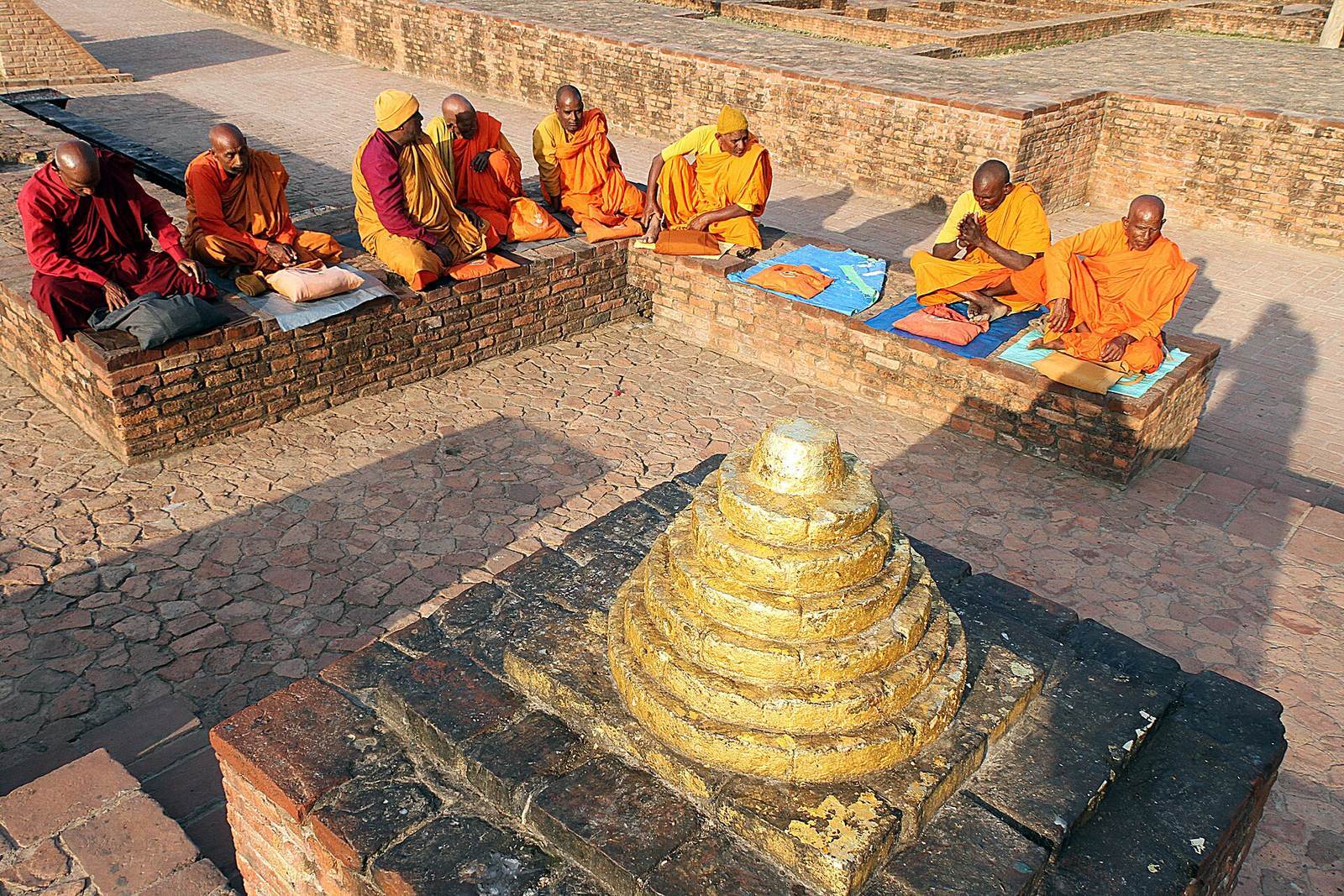
Outside the ancient city, Jetavana contains monastery remains and the structure identified as the Gandhakuti, or the Buddha’s hut. The Anandabodhi tree also stands within the precinct. Xuanzang described two pillars about 70 feet tall in front of a dilapidated monastery, one topped by a carved wheel and the other by a bull. He also recorded a Buddhist temple about 60 feet high with a seated Buddha image and a similarly sized shrine to a deity; both were in good condition at the time. Outside Shravasti, a stupa is associated with the Buddha’s twin miracle.
Excavated buildings and burning
Excavations from 1986 to 1996 uncovered a nearly square bathing tank about 25 metres on each side, a large chaitya, or Buddhist place of worship, four additional stupas, and other monuments. A later monastic complex had a square platform and 28 vihara cells, or monks’ residences, each about 2.6 metres square. Brick and wood formed the building. A thick layer of charcoal and undisturbed traces of burning above the platform indicate that the monastery burned before its monks abandoned it. About 100 metres away, another large chaitya was covered by charcoal and combustion residue of the same age. Similar deposits at separated locations suggest that several Buddhist complexes may have burned at roughly the same time. Monuments also show repeated flood damage between the first and tenth centuries CE, followed in some cases by rebuilding.
Jain temples and images
The remains of a Jain temple known today as Shobhnath form part of the archaeological complex. The Sambhavanatha shrine was rebuilt in the twelfth century CE and incorporates Iranian architectural influence; several other temple remains survive in the area. Excavations yielded five idols dating to the eleventh century CE, images of 24 Tirthankaras from different periods, and a paired image of Tirthankaras in the kayotsarga posture, a motionless upright stance used in Jain meditation. Two of the excavated images date to about 300 BCE.
Inscriptions, artworks, and other finds
Finds from the site include Buddhist sculptures, inscriptions, coins, seals, and terracotta objects, as well as Hindu artworks such as Ramayana panels and images of deities. A separate excavation area yielded marked pottery, jewelry, short inscriptions in Brahmi, an ancient South Asian script, terracotta figures of a mother goddess and a naga, a serpent being in South Asian religious traditions, and plaques showing mithuna couples. The colossal Bodhisattva image with an early Kushan inscription was found near the site.
Later Buddhist monasteries
Buddhist communities from Thailand, South Korea, Sri Lanka, Myanmar, Tibet, and China have established monasteries in Shravasti. The Thai Jetavana Mahavihara, begun in 2006, stands within the ancient Jetavana precinct, near the stupa associated with the twin miracle and stupas associated with the Buddha’s disciples Sariputta and Moggallana.