Gamla Uppsala: An Ancient Religious and Political Centre in Sweden
Site at a Glance
- Popularity
- Very High
- Country
- Sweden
- Primary era
- Medieval
- Eras represented
- Medieval, Modern
- Civilizations
- Norse, Swedish
- Site type
- City
On this page28 sections
History
Gamla Uppsala is an ancient settlement and archaeological site in Uppsala, Sweden, and a major religious, political, and economic centre from at least the third century AD. It is often described as the cradle of Sweden, though other parts of the country have also claimed that distinction. The settlement was associated with the kings of the legendary Yngling dynasty and served as a centre for Svealand, or at least for Uppland.
Early settlement and farming
After the last glaciation, rising land gradually brought parts of the local ridge above the water. Human traces in the area date to the early Bronze Age, around 1700 BC, when the site lay within an archipelago. By about 1000 BC, bronze was being worked at Bredåker, north of Gamla Uppsala. Copper and tin had to be obtained through trade, since neither was produced in Sweden.
Forest clearance and more intensive farming began around AD 1. From about AD 200 to 400, agriculture and population were unusually concentrated for Uppland. At least five nearby villages specialized in different products and exchanged them, rather than depending mainly on self-sufficient farms. Their large, terraced plots point to social hierarchy and may indicate that a local authority was based near the present church.
A royal centre and assembly
Between about AD 400 and 600, nearby settlements were abandoned as people gathered at Gamla Uppsala. This change probably formed part of a wider reorganization of power in the Mälaren region, amid conflict and the growing influence of powerful leaders. The concentration of settlement may reflect the emergence of a central authority, perhaps a king. A severe climate downturn began in 536 and was worsened by another volcanic eruption in 540. Failed harvests and deaths may have hastened this shift and strengthened religious practices, including the offering of valuable possessions.
During the Vendel Age, a Scandinavian period that preceded the Viking Age and lasted approximately from AD 550 to 800, warrior elites displayed their standing through large burial mounds. The royal mounds were probably built in stages, with later generations enlarging some of them. Each mound is estimated to have required about 10,000 workdays.
Gamla Uppsala remained a centre of Norse religion during the Viking Age and was associated with the assembly of the Swedes. This public gathering, held from prehistoric times into the Middle Ages, took place in late February or early March alongside the Disting fair and the religious observance known as Dísablót. The Uppland Law says that the king announced the summer fleet levy at the assembly, where decisions were made about ships, crews, rowers, and commanders.
Legend and religious traditions
Medieval traditions connected Gamla Uppsala with the Norse gods Odin and Freyr, the latter associated with fertility and prosperity, and with the legendary Yngling kings. The poem Ynglingatal, composed around AD 900, and later sagas linked the site to rulers including Aun, Adils, and Egil, also called Ongentheow. These accounts mix historical tradition with myth. Archaeology confirms that elite burials were made in the area, but does not establish that the named legendary kings were buried in the mounds.
Medieval Norse and Christian traditions also associated Uppsala with sacrifice. Adam of Bremen, an 11th-century cleric and historian, described a major festival held every nine years, animal and human sacrifices, and a temple, grove, and spring. The existence and location of the temple, as well as the reliability of these descriptions, remain contested. Sven the Sacrificer is traditionally said to have carried out the last sacrifices at Gamla Uppsala in 1087.
Christianization and the archbishopric
Sweden’s conversion to Christianity brought conflict over religious ceremonies. Olof Skötkonung, baptized around AD 1000, is traditionally regarded as Sweden’s first Christian king. According to Adam of Bremen, Anund Jacob was forced out of the country after refusing a pagan ceremony. Bishop Adalvard the Younger planned to destroy the temple but was dissuaded by King Stenkil. Stenkil’s son Inge I was later driven from the throne for refusing the ceremony. Sven the Sacrificer took his place, but Inge killed him after about three years and regained power. Inge is traditionally credited with ending pagan ceremonies and destroying the temple in the 1080s.
The bishopric was moved from Sigtuna to Gamla Uppsala, probably in the 1130s. Sweden’s church had previously been under the archbishopric of Hamburg-Bremen and, from 1104, that of Lund. A meeting in 1153 considered where to establish a Swedish archbishopric. Sverker I may have favoured Linköping, while Eric IX may have supported Uppsala. Uppsala was selected and became Sweden’s first archbishopric in 1164.
Eric IX was killed on 18 May 1160 while attending Mass at the Church of the Holy Trinity in Östra Aros, about five kilometres south of Gamla Uppsala. Östra Aros later became the town of Uppsala. Magnus II, a Danish claimant to the Swedish throne, was responsible for Eric’s death. A legend says that a spring appeared where Eric’s blood fell and that a blind woman regained her sight after applying the blood to her eyes. Eric became a Swedish saint and patron. His relics were kept at Gamla Uppsala until their transfer to the new cathedral in 1273; Archbishop Valerius was also buried at the church.
Relocation and the medieval village
Östra Aros grew into a trading town because the Fyrisån was navigable there and connected the settlement to Lake Mälaren and the Baltic Sea. Post-glacial land uplift gradually made travel by water more difficult. Artisanal activity at Gamla Uppsala had probably shifted to Östra Aros by the middle of the 12th century.
In 1215, the pope authorized moving the archbishopric to Sigtuna, but the plan was not carried out. A major fire damaged Gamla Uppsala’s cathedral around the middle of the 13th century. In 1258, the pope authorized transferring the archbishopric to Östra Aros, provided that it kept the name Uppsala. The archiepiscopal seat and Eric’s relics moved in 1273, and a new cathedral was built at Östra Aros. The name Uppsala went with the seat, while the older settlement became known as Gamla Uppsala. The relocation of the town to the site of present-day Uppsala is dated to 1274.
The departure of the archbishopric reduced Gamla Uppsala’s importance, and farming became the village’s main activity. Some royal lands passed to the cathedral. Land west of Vattholmavägen belonged to Uppsala öd, royal property that supported the king. In 1302, Archbishop Nils rediscovered Eric’s grave beneath the church, renewing the site’s role as a pilgrimage destination. The church was gradually repaired but did not regain its earlier scale. The village endured later population changes, including the Black Death, and was among the largest in the region in the 16th century.
National memory and archaeological study
Gamla Uppsala and its mounds became part of Swedish national history, sometimes through elaborate accounts of the country’s origins. In the 16th century, Johannes Magnus claimed that Uppsala had been founded by Ubbe, supposedly a great-grandson of Noah. In the 17th century, Olof Rudbeck identified it as the capital of Atlantis. King Gustav I Vasa may have addressed peasants from Tingshögen on several occasions.
In the 19th century, debate over whether the mounds were natural or human-made led to an investigation ordered by the future King Charles XV. Bror Emil Hildebrand began excavating the Eastern Mound in 1846, and his son Hans Hildebrand excavated the Western Mound in 1874. Their work established that the mounds contained cremation burials and high-status grave goods. Sune Lindqvist excavated part of the church in 1926. Some later readers of his plans proposed that they showed a square temple beneath the church. Else Nordahl and Magnus Alkarp challenged that interpretation, while Anders Kaliff disputed their conclusions.
On Easter Monday in 1943, a Nazi group demonstrated at the Eastern Mound despite prohibitions by the city council and the Swedish National Heritage Board; the parish priest had granted permission. About 2,000 counter-demonstrators gathered. Police arrived from Stockholm, and many counter-demonstrators were injured in an attack. In 1989, Pope John Paul II held an open-air Mass at the Royal Mounds. The Gamla Uppsala Museum opened in 2000, and the Swedish Asatru Society resumed holding Norse religious offering ceremonies at the mounds that year.
Remains
The surviving landscape combines burial mounds, church remains, traces of timber structures, and a former royal estate on the cultivated Fyris plain. Its topography is shaped by Uppsalaåsen, a long ridge of sand and gravel deposited by glacial meltwater. Högåsen, where the principal mounds stand, and Tunåsen farther west are both part of this ridge. The Fyrisån and traces of an earlier water route help explain how the site’s setting changed as the land rose.
Landscape and former waterways
Ridges and shoreline
In the early Bronze Age, the area formed part of an archipelago. Studies place the water level near the elevation now represented by the 20-metre contour. The ridge’s two local heights, Högåsen and Tunåsen, shape the setting of the burial landscape and the settlement. A stone-and-gravel threshold associated with a former water route remains visible.
Water approach
The Fyrisån connected Östra Aros toward Lake Mälaren and the Baltic Sea, providing a navigable approach to the region. As land uplift created a stone-and-gravel shoal, boats had to be hauled farther north. Falls at Ulva, about three kilometres away, and at present-day Uppsala may also have made travel toward the sea difficult. Flooded meadows around Svartbäcken offered another place where boats could be hauled across land; the king’s share of one former meadow became Kungsängen.
Burial mounds and cemeteries
The Royal Mounds
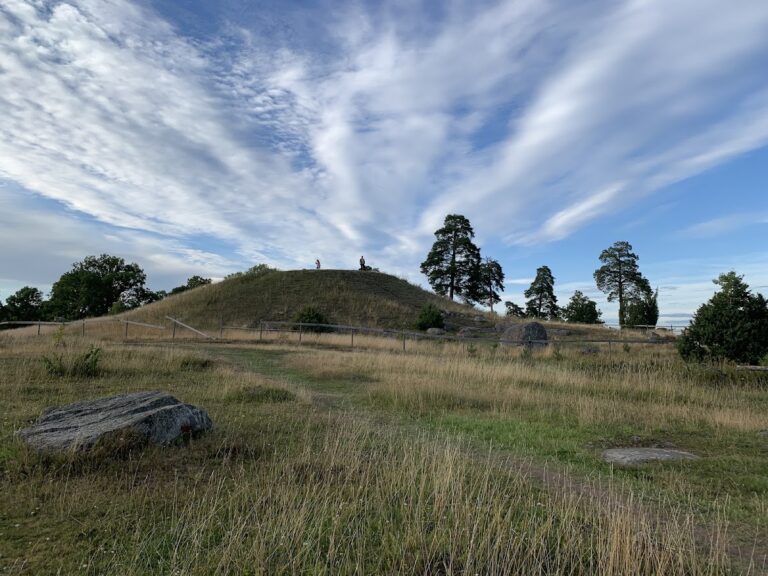
The three Royal Mounds stand on Högåsen. The Western Mound is about 10 metres high, while the Eastern and Middle Mounds are smaller. Each is approximately 70 to 80 metres in diameter and contains about 10,000 cubic metres of earth. Excavation of the surrounding ridge makes the mounds rise about 15 metres above the neighbouring ground. Before later enlargement, the Western Mound may have measured about 4 metres high and 37 metres across at its base.
The Eastern Mound
The Eastern Mound dates to approximately 550–600. Its cremation burial held the remains of two people, possibly a boy aged about 10 to 14 and a woman aged about 20 to 30; their identities and relationship are uncertain. The grave goods included a helmet, a single-edged knife, a gaming piece, glass, and probably a bone sceptre. Decorated bronze panels depicting a spear-bearing dancing warrior may have belonged to a helmet. Gold fragments could have come from a weapon or belt. Two dogs, a horse, a bird of prey, and meat were cremated with the dead.
The Western Mound
The Western Mound dates to approximately 575–625. Excavation in 1874 revealed successive construction layers. The burial fire was intense enough to turn the surrounding clay into brick. The remains were first interpreted as those of a man and a woman; later analysis suggested a single adult. Grave goods included a Frankish sword decorated with gold and garnets, an expensive garment woven with gold thread, a belt with an elaborate buckle, ivory game pieces, and four carved cameos from the Middle East, probably once part of a casket. Animal remains were also present.
Tingshögen
Tingshögen lies east of the Eastern Mound. Its flat summit is linked with assemblies and may have served as a platform. A partial excavation found medieval earth above older layers and a stone structure. The mound may have begun as a burial place and later taken on an assembly function.
The North Mound
The North Mound lies just north of Tingshögen. It was probably levelled during medieval cathedral construction and was initially mistaken for a terrace. Its stone core is about 30 metres wide, compared with roughly 20 metres for the Eastern Mound’s core. The North Mound dates to the middle of the 7th century.
Other burial areas
Four mounds, each about 20 to 40 metres in diameter, continue west from the Royal Mounds, alongside smaller Viking Age mounds. Gullhögen, excavated in 1846, contained imported luxury goods and dates to approximately 560–700. The burial ground south of the Royal Mounds dates to the Roman and Germanic Iron Ages, while uncremated Viking Age graves have been excavated near the vicarage. Archaeologists have found 215 graves on the ridge. Some burial fields are thought to have held 200 to 300 graves, and the wider area may once have contained 2,000 to 3,000 mounds. Erosion, farming, gardens, quarries, and other human activity have altered the burial landscape; about 250 barrows survive. More than 1,000 archaeological remains are preserved in the parish.
Timber rows and royal estate
Rows of wooden pillars
Excavations in 2012–13 revealed foundations for two long rows of wooden pillars dating to the Vendel Age. One row extended 724 metres east to west south of the mounds; another extended 862 metres north to south east of the present church. The pine pillars stood about six metres apart and were probably about eight metres high. Each rested on a stone foundation about one metre deep and 1.5 metres across, using roughly a tonne of stone, much of it probably taken from the ridge.
Animal remains, especially horses but also cattle, sheep, and goats, were found near the rows. Their heads had been separated from their bodies, a pattern consistent with ritual activity; horse heads may have been placed on the pillars. The purpose of the rows is uncertain. The north–south line probably ran parallel to a route corresponding to the present road toward Vattholma. The rows may have marked a royal processional route, shaped an enclosure, or impressed people arriving at the settlement.
Royal hall and land
A clay plateau beside the church, known as the Plateau of the Royal Estate, contains the remains of a large hall. The wider royal estate also included land west of Vattholmavägen, within the holdings known as Uppsala öd.
Gamla Uppsala Church
Church structure
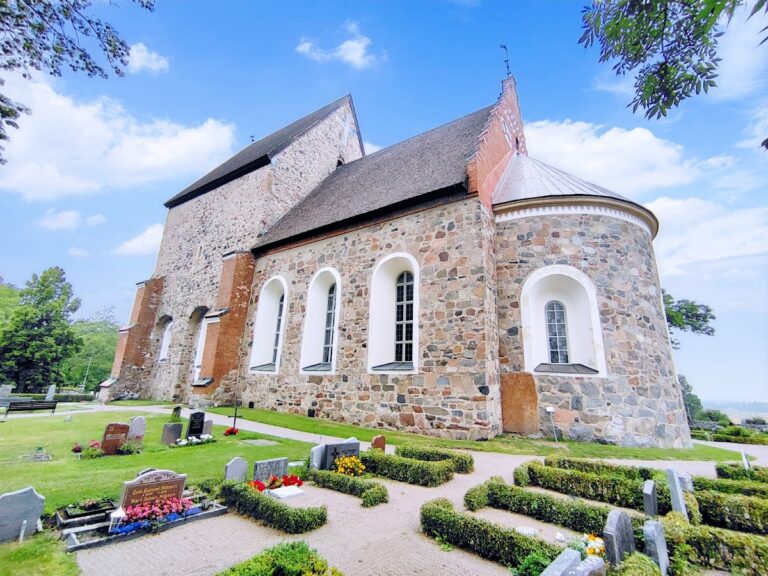
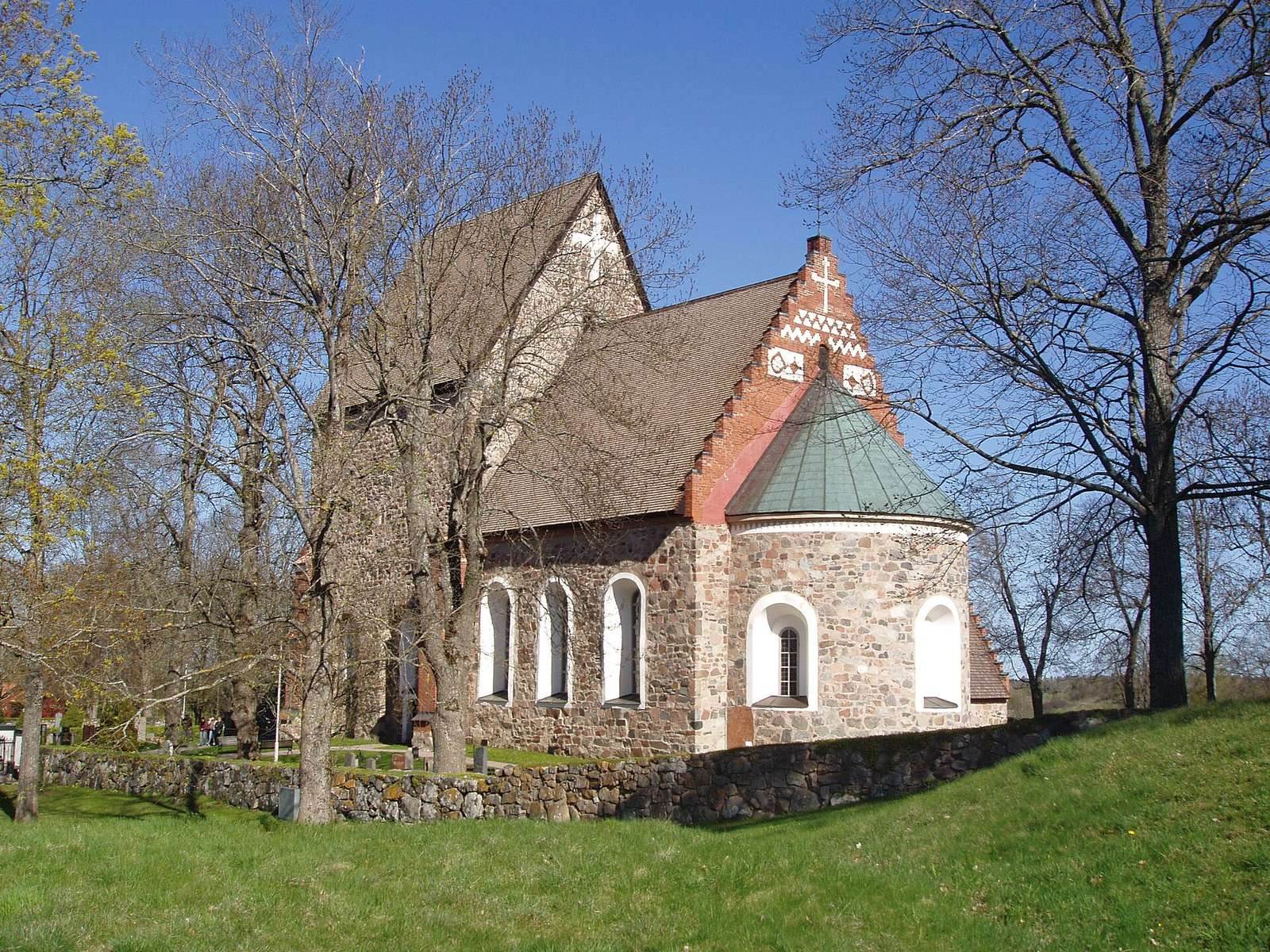
The stone church was probably begun in the 12th century. Its original plan measured about 64 metres long and 34 metres wide, with walls up to two metres thick and a central tower about 31 metres high. It was once the largest church in the Swedish kingdom. The original building had a central nave with side aisles and crosswise arms ending in semicircular projections. After a severe fire around the middle of the 13th century, the nave and crosswise arms were removed. The present church consists of the shortened central tower and a choir with a semicircular end. A sacristy and porch contribute to its exterior, while vaulted ceilings and chalk paintings date to the 15th century.
Earlier buildings beneath the church
Remains of one or more large wooden buildings lie beneath the present church. They may have belonged to a pre-Christian sanctuary or to an early Christian wooden church, but neither identification is established. The interpretation of the church excavations and their plans has remained disputed.
Sculptures and interior features
The church contains three medieval wooden crucifixes dated to the 12th, 13th, and 15th centuries. Its other features include an altarpiece, pulpit, nave ceiling, and bell tower. Anders Celsius and his grandfather Magnus Celsius are buried there.
Railway corridor
Station and former track
The railway between Uppsala and Gävle opened in 1874 with a station at Gamla Uppsala. Passenger service later ended, but the station remained a passing point until 1994, when its passing track was removed. The old station building still stands beside the former trackbed, which now serves as an emergency route for the railway tunnel.
Railway tunnel
A 600-metre railway tunnel opened beneath part of Gamla Uppsala in 2017, and the former surface track was removed.