Nineveh: The Assyrian Empire’s Capital in Iraq
Site at a Glance
- Popularity
- Very High
- Country
- Iraq
- Primary era
- Iron Age
- Eras represented
- Stone Age, Bronze Age, Iron Age, Classical, Medieval
- Civilizations
- Assyrian, Parthian
- Site type
- City
On this page30 sections
History
Nineveh is an ancient city at Mosul in present-day Iraq, with settlement dating back to the seventh millennium BC. It became the capital of the Assyrian Empire around 700 BC, when King Sennacherib expanded it into the empire’s principal royal and administrative center.
The city grew near the meeting of the Tigris and Khosr rivers, beside routes connecting northern Mesopotamia with the Taurus Mountains, the Iranian plateau, the Euphrates, and the Mediterranean. This position helped make Nineveh a prosperous regional center. The earliest known settlement was on the mound of Kuyunjik, where occupation began around 6500–6000 BC during the Hassuna period. Later layers show activity associated with the Samarra and Halaf periods, followed by Ubaid-period settlement around 5500–4500 BC.
Early settlement and regional kingdoms
During the fourth millennium BC, southern Mesopotamian influence increased. Nineveh may have been an Uruk-period settlement: administrative devices and pottery found at Kuyunjik are associated with that culture. By then, habitation on the mound may have covered about 40 hectares. The Ninevite 5 phase, around 3000–2500 BC, followed. Finds indicate continued occupation at Kuyunjik and probably the first settlement in the lower town. Impressions from cylinder seals point to exchange with the Diyala region and Susiana.
Nineveh was probably a largely Hurrian settlement in the late third and early second millennia BC, although its political position in this period is not always clear. Later inscriptions credit Manishtushu, a king of the Akkadian Empire, with building or restoring the temple of Ishtar, but no contemporary building inscription from Nineveh confirms the work. A bronze head portraying an unidentified Akkadian ruler was found at the site.
Texts from the early second millennium BC place Nineveh in the Hurrian kingdom of Nurrugum, where it was an important religious center. Around 1780 BC, Samsi-Addu of Ekallatum conquered the kingdom and made his home at Nineveh. He restored its principal temple to Ishtar, who was also known there by the Hurrian name Shaushga. Later, Hammurabi’s law-code prologue included Ishtar of Nineveh and her temple among the Babylonian king’s major cults.
Assyrian rule before the imperial capital
Nineveh came under Mitannian rule during the fifteenth and early fourteenth centuries BC. The Mitannian king Tushratta sent the city’s statue of its goddess to the Egyptian pharaoh Amenhotep III, evidence of her following beyond the region. Around the middle of the fourteenth century BC, the Assyrian king Ashur-uballit I brought Nineveh into the Assyrian kingdom.
Assyrian rulers repeatedly renewed the Ishtar temple. In the thirteenth century BC, Shalmaneser I and Tukulti-Ninurta I undertook major renovations. Shalmaneser’s work followed an earthquake that had damaged buildings. Nineveh also had a building for the akītu, a major Mesopotamian festival commonly associated with the New Year, and royal palaces were established there. The lower town spread, while Tell Nebi Yunus probably began to serve a military purpose.
Nineveh remained under Assyrian control through periods of political difficulty. In the Neo-Assyrian period, the empire’s later imperial era, the city gained wealth and influence, though it was not always the royal capital. Ashurnasirpal II transferred the capital from Ashur to Kalhu, and Sargon II later moved it from Kalhu to his newly founded city of Dur-Sharrukin. Both kings nevertheless carried out building work at Nineveh, as did their successors.
Nineveh under Sennacherib and his successors
From about 700 BC, Sennacherib made Nineveh the capital of the Assyrian Empire and greatly enlarged it. It became the empire’s chief royal and administrative center. His projects reshaped both the city and its surroundings through new waterworks, expanded cultivation, and royal parks. Construction drew materials and workers from across the empire, including deportees and possibly Assyrian subjects required to perform compulsory labor.
Sennacherib’s successors continued to build and restore the city. Esarhaddon expanded the military complex at Tell Nebi Yunus, while Ashurbanipal restored the North Palace at Kuyunjik and assembled large collections of tablets within the royal precinct. Estimates of Nineveh’s population at its height reach about 75,000, but the figure is very uncertain.
Fall, reuse, and later communities
After Ashurbanipal’s death, civil conflict weakened Assyria. The Medes attacked Nineveh in 614 BC but failed to capture it. In 612 BC, Babylonian and Median forces besieged the city for about three months. The Assyrian king Sîn-shar-ishkun died during the fighting; the victors plundered and destroyed Nineveh, bringing the Assyrian Empire to an end. Biblical and classical traditions also connect the city’s fall with flooding, though the part flooding played is uncertain.
The city was devastated but not entirely deserted. Parts of the Nabu temple and the Southwest Palace, as well as eastern Kuyunjik, were reused as dwellings. People continued to live in the surrounding countryside during the Achaemenid period, the era of the Persian Empire. Around 400 BC, the Greek writer Xenophon described passing the ruins of a city generally identified as Nineveh; its walls apparently provided shelter for people living nearby.
Nineveh revived under Hellenistic and Parthian rule. A Greek-speaking community lived there, although it is unclear whether it began under Seleucus I or one of his successors, or later under the Armenian king Tigranes II. Greek inscriptions, coins, and other finds attest to that community. The city prospered under Parthian rule and may have had a local mint. In AD 116, during the Roman emperor Trajan’s invasion, it briefly formed part of the Roman province of Assyria. Under the later Sasanian Empire it had a border garrison but no longer served as an administrative center. A Byzantine–Sasanian battle took place on the plain in 627, and Arab-Muslim forces captured Nineveh either in 637–638 or 641–642.
By Late Antiquity, the transition between the ancient and medieval worlds, Nineveh was an important Christian city with a substantial Jewish community. It was the seat of both East Syriac and Syriac Orthodox bishops. Isaac of Nineveh held the Syriac Orthodox see for five months in the seventh century. A monastery on Tell Nebi Yunus was associated with the tradition that the prophet Jonah had visited the city. Christian communities were tolerated under Sasanian and early Muslim rule, while some inhabitants gradually converted to Islam.
After the Arab conquest, neighboring Mosul became the region’s political and military center, and Nineveh declined. Its East Syriac bishopric joined Mosul’s in the ninth century. Tell Nebi Yunus remained a pilgrimage destination because it was believed to contain Jonah’s tomb. A mosque replaced the monastery, and a hostel for pilgrims stood nearby in the tenth century. People also visited a thermal spring in the area seeking healing. The name Tell Nebi Yunus was associated with the Hill of Repentance, while Kuyunjik was called the Citadel of Nineveh. A village later stood on Kuyunjik; its Yazidi residents were killed in 1836, and the settlement was destroyed.
Rediscovery, excavation, and damage
Medieval travelers, including Benjamin of Tudela in 1170 and Petachiah of Regensburg soon afterward, knew the location of Nineveh. Carsten Niebuhr recorded it during a Danish expedition in 1761–1767. Claudius James Rich visited Kuyunjik in 1820, mapped the site, and noted sculptures, but did not excavate. In 1842, French consul Paul-Émile Botta began searching for Nineveh at the mounds. The sacred character of Nebi Yunus made excavation there difficult. After limited results at Kuyunjik, Botta moved to Khorsabad and initially mistook its remains for Nineveh before identifying them as Dur-Sharrukin.
Austen Henry Layard began excavating Kuyunjik in 1847 and returned in 1849 with Hormuzd Rassam. Their discoveries included Sennacherib’s palace, reliefs showing the siege of Lachish and Ashurbanipal’s campaigns in Elam, and an initial group of cuneiform tablets from Ashurbanipal’s collections and the royal archives. Many finds went to the British Museum. These excavations helped establish Kuyunjik as the site of ancient Nineveh. In 1853, Rassam excavated the northern part of the mound and found part of Ashurbanipal’s North Palace, further reliefs, lion-hunt scenes, and additional tablets. The British excavation ended in 1854 for lack of funds. William Kenneth Loftus later worked on more of the palace. In 1855, a shipwreck on the Shatt al-Arab destroyed reliefs from Nineveh and Khorsabad that were being transported to museums.
George Smith worked at Nineveh in 1873–1874. After translating a passage about the Flood from a tablet found there in 1872, part of the Epic of Gilgamesh, he returned to search for a missing section and recovered it. Rassam excavated again from 1878 to 1882, followed by campaigns led by E. A. Wallis Budge. From 1889 to 1899, Carl Bezold published a five-volume catalogue covering nearly 15,000 tablets and fragments in the Kuyunjik collection.
Leonard William King and R. Campbell Thompson resumed work at Kuyunjik in 1903–1905, finding more than 850 tablets and examining buildings, particularly the Nabu temple. Thompson returned between 1927 and 1932 to investigate the Nabu and Ishtar temples, other structures, and earlier layers. Max Mallowan’s deep excavation reached 27.5 metres, establishing evidence for early occupation including Hassuna, Gawra, Uruk, and Ninevite 5 material. Further digging became unsafe before the earliest occupation was reached.
Iraq’s Department of Antiquities began excavations in 1951 under Mohammed Ali Mustafa. Tariq Madhloom led work in 1967–1971, and Iraqi archaeologists continued in later decades, investigating Kuyunjik, Nebi Yunus, the lower town, walls, and gates. The work identified a Parthian-period temple and was followed by restoration of some gates. David Stronach directed the last regular Berkeley-funded excavations in 1987–1990, including work at the Halzi Gate and a survey of the northern lower town. The Gulf War brought that campaign to a halt.
After 2014, Islamic State (ISIL) inflicted major damage on Nineveh. On 24 July 2014, it destroyed two mosques, including the shrine associated with Jonah’s tomb. In February 2015, it destroyed Assyrian statues and artworks in the Mosul museum; some objects were looted or sold, and some of the destroyed works came from Nineveh. In 2016, ISIL demolished the Adad and Mashki gates and sections of the walls, destroyed the Nergal Gate, and damaged its sculptures. Tunnels dug at Nebi Yunus apparently sought objects for sale. UNESCO denounced the destruction of cultural sites as a war crime. Poor maintenance, looting, and nearby urban growth have also threatened the site.
After Mosul’s liberation, German teams investigated tunnels beneath the destroyed Jonah shrine in 2018, and excavations followed from 2019. Iraqi, Italian, German, and American teams have since worked in different parts of Nineveh. An Iraqi–Italian expedition investigated, conserved, and presented 19 areas of the lower town between 2019 and 2023. It reached late seventh-century BC layers across those areas and, in two locations in the lower town predating Sennacherib, layers from the eleventh century BC. Restoration of damaged reliefs in the Southwest Palace’s throne-room wing began in 2021. Excavations at the North Palace began in 2022, work at the damaged Nergal Gate in 2023, and a University of Chicago team continued investigating the eastern lower town from 2024.
Remains
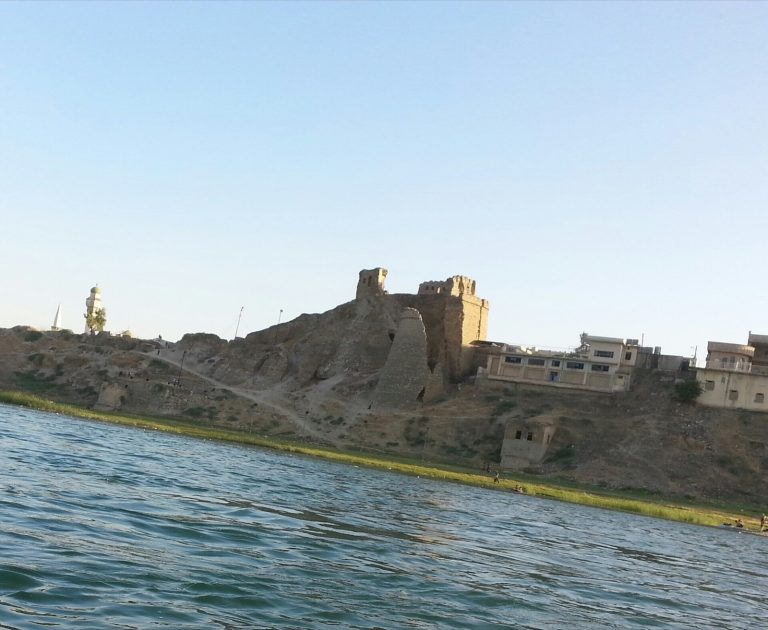
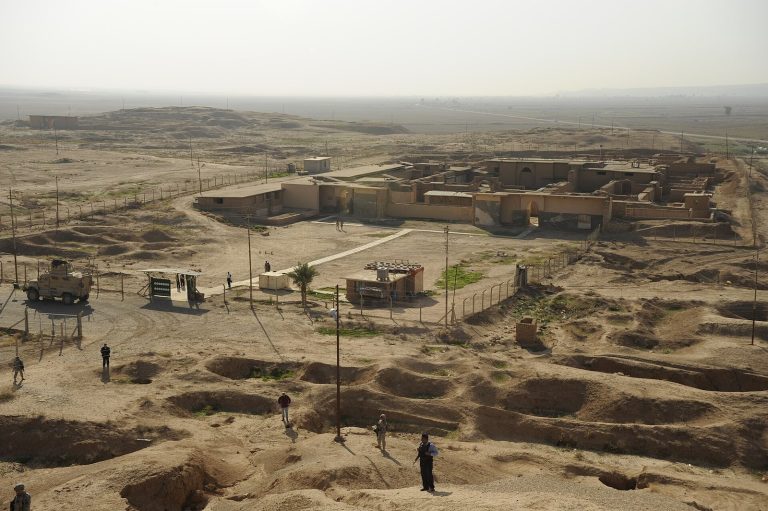
Ancient Nineveh covered about 750 hectares within a defensive circuit roughly 12 kilometres long. The Khosr crossed the city from east to west, while the Tigris ran outside its western edge. The principal mounds were Kuyunjik, north of the Khosr, and Nebi Yunus, more than a kilometre to the south; the lower town extended eastward from them. The city’s defenses combined limestone blocks with mudbrick, while its temples, palaces, roads, canals, and residential districts occupied the mounds and surrounding plain.
City plan and defenses
Walls and outer defenses
Sennacherib enlarged the city’s perimeter from about 5 kilometres to 12 kilometres, extending it south beyond the Khosr and northeast. The resulting enclosure was about 5 kilometres long and approximately 2 kilometres wide in the northeast. Its roughly trapezoidal defensive circuit had east and west sides of about 5 and 4.1 kilometres, respectively, with north and south sides measuring about 2 kilometres and 800 metres. A ditch roughly 55 metres wide ran outside the walls, and bridges are identified opposite the Shamash and Halzi gates. Kuyunjik and Nebi Yunus also had separate enclosures.
The walls used large limestone blocks quarried upstream on the Tigris, with mudbrick above. One description gives a stone retaining wall about 6 metres high and a mudbrick wall roughly 10 metres high and 15 metres thick above it. Sennacherib claimed that the walls reached 25 metres in height; in some places their thickness approached 45 metres. Stone towers projected at intervals of about 18 metres, and stepped battlements crowned the walls. Texts assign 18 gates to the outer wall, while another count identifies 15 major gates; about a dozen have been located with certainty.
Halzi Gate
On the southern part of the eastern wall, the Halzi Gate formed a rectangular complex extending about 70 metres along the wall. Its original entrance was about 7 metres wide and approached by a bridge. Inside, a central court measured about 45 by 19 metres, and 22 upright stone slabs lined its western wall. Eight towers defended the gate. During preparations for the final siege, the entrance was narrowed to about 2 metres. Human remains found in the passage are associated with the fighting that ended in 612 BC.
Adad Gate
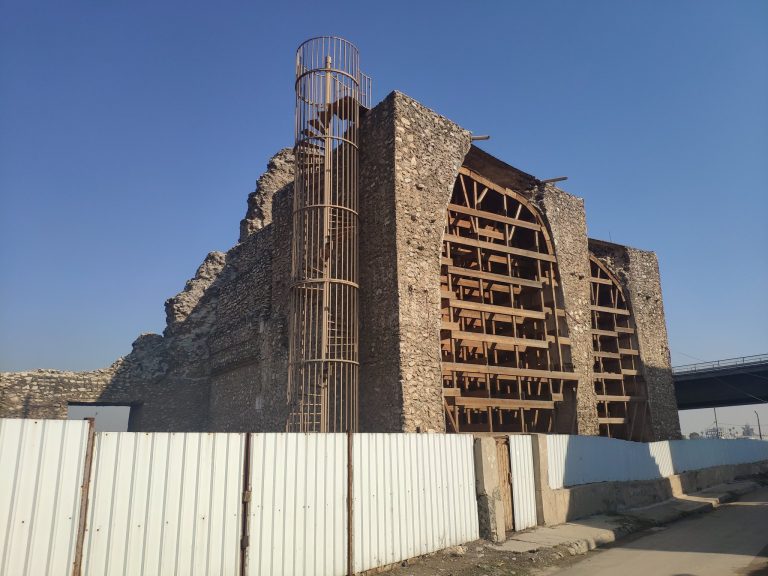
The Adad Gate, named for the storm god, had an outer vaulted passage and a vaulted stairway to upper levels. Its entrance was reduced from 4 metres to 2 metres with hastily laid mudbrick, apparently during the final siege. A partial reconstruction in the 1960s combined concrete and eroded mudbrick, exposing some original Assyrian brickwork. After the 2016 destruction, the Iraqi–Italian expedition re-excavated, conserved, and repaired the gate, and investigated a stairwell 7 metres deep.
Shamash Gate
The Shamash Gate, named for the sun god, opened onto the road to Erbil. Its stone retaining wall projects about 20 metres beyond the principal wall line and extends roughly 70 metres across. Parts of the stonework and the mudbrick structure above it were rebuilt in the 1960s; the rebuilt mudbrick has since deteriorated.
Mashki Gate
The Mashki Gate probably provided a route for taking livestock toward the Tigris, which now flows about 1.5 kilometres to the west. It was rebuilt in fortified mudbrick up to the top of its vaulted passage, and its original surface may have been plastered and decorated. Following its demolition in 2016, restoration and excavation uncovered seven damaged alabaster carvings from Sennacherib’s reign in 2022.
Nergal and other gates
Layard excavated the Nergal Gate in the mid-nineteenth century, and it was reconstructed in the mid-twentieth century. Its reconstruction is conjectural. It was the only known gate flanked by stone sculptures of winged bull-men; ISIL later destroyed the gate and damaged the sculptures. A possible Sîn Gate has been identified at the northwestern end of the site. In 2021, another gate was found north of the Shamash Gate and south of the Khosr, beside a water tunnel 42 metres long beneath a section of wall 31 metres thick.
Streets, neighborhoods, and waterworks
Lower town and roads
The Khosr divided the lower town, where bridges connected its two sides. Several broad avenues, some paved, linked major gates. The Royal Road was about 29–31 metres wide and bordered by standing stones. Sennacherib’s inscriptions threatened severe punishment for anyone who encroached on it. A major route also connected the Nergal Gate with Kuyunjik.
Surveys north of Kuyunjik identified a residential district with large houses arranged around courtyards and broad streets, probably an elite neighborhood. Nearer the northern wall, a more densely built area included craft activity. Excavators identified pottery and metalworking workshops, as well as further pottery workshops in the northeast. South of the Khosr, a building with pillar bases has been proposed as a Syrian-style columned building, but the available evidence does not establish that identification. Nearby, a palace-like building had at least one large court and yielded two cuneiform tablets. Horse troughs bearing Sennacherib’s name were found near the wall north of Nebi Yunus.
Public spaces and gardens
An elevated feature in the eastern lower town, known as the Eastern Terrace, may have served as a public viewing area, garden, or space for ceremonies, trade, or recreation; its precise use is uncertain. Gardens were located, or are thought to have been located, within the city and beyond its walls, including areas near the Tigris and canals.
Canals and aqueduct
Sennacherib’s regional water program, carried out principally between 702 and 688 BC, controlled the Khosr with two new dams and brought water from uplands to the north. The Kisiri Canal connected northern Nineveh to the Khosr at the Shallahat dam, about 13 kilometres upstream. A further dam stood at Ajileh, just above the city. Canals and channels extending about 100 kilometres carried water from streams northeast of Nineveh. The Khinis Canal drew on the present-day Gomel for more than 50 kilometres and was probably the longest and latest major canal. Another system brought water from farther northwest, toward Maltai. Channel sizes varied: the Khinis Canal began at about 6 metres wide and 2 metres deep, later broadening to around 20 metres, while some cleared canal corridors measured 70–100 metres across.
At Jerwan, an aqueduct carried a canal across a valley. The structure measured about 280 by 22 metres and used roughly two million stone blocks. A stream valley and probably a track passed beneath its center through vaulted openings. Sennacherib commemorated the construction in an inscription.
Temples and royal buildings at Kuyunjik
Ishtar temple
The central sacred precinct on Kuyunjik included the principal temple of Ishtar and a temple to Nabu. The Ishtar temple was a rectangular building aligned southwest to northeast, about 55 metres wide and at least 106 metres long. Its reconstructed plan places an entrance at the southwestern end, leading into two courts. Excavators identified about 30 building phases, extending from at least the fourth millennium BC to the sixth century BC, although the dating and interpretation of some phases remain debated.
Nabu temple
The Nabu temple was probably built by Adad-nerari III around 788–787 BC and later renovated by Ashurbanipal. The excavated part formed a trapezoidal complex on a terrace around a court measuring about 35 by 26 metres. The temple was associated with a collection of tablets.
Southwest Palace
Sennacherib’s Southwest Palace, which he called the Palace Without Rival, stood along the southwestern edge of Kuyunjik above the Khosr. It was built between about 700 and 691 BC on the site of an older palace damaged by river erosion. The earlier building was demolished and the river diverted so the new palace could rest on broader, raised foundations. Sennacherib’s accounts give differing dimensions; one describes a final extent of about 500 by 200 metres. Excavation has uncovered a small part of the complex, leaving its complete plan uncertain.
The excavated rooms were arranged around a court about 38.5 by 42.5 metres, with smaller courts, parallel halls, and suites. A hall about 51 by 12 metres may have served as the throne room. Inscriptions link another suite, arranged around a court, with Sennacherib’s wife, Tashmetu-sharrat. The palace may have connected to a separate building about 300 metres northeast, called the Eastern Palace. The wider complex may have stretched about 500 metres along the mound’s edge and contained more than 200 rooms and several large courts.
North Palace
Ashurbanipal first used Sennacherib’s palace before establishing his residence in the North Palace, adapted from an earlier building known as the House of the Heir. The North Palace occupied at least about 250 by 150 metres, and its entrance was probably on the east. Excavated central rooms included audience suites and a throne room between two large courts. Ashurbanipal restored the building, and excavations there began again in 2022.
Other temples and royal buildings
Inscriptions identify a palace built under Ashurnasirpal II at Kuyunjik; he may have lived there early in his reign. Decorative fragments include rosettes, human figures, and military scenes painted on upright stone slabs. Texts also name temples dedicated to Ashur, Kidmuri, the Sibitti, Sîn, Shamash, and Adad. A tiered temple tower dedicated to Ishtar stood beside her temple and was enlarged or restored by successive rulers, including Samsi-Addu, Shalmaneser I, and the Sargonid kings. An Ishtar festival building was also associated with Kuyunjik, though its precise location there is uncertain; another building for the festival, attributed to Sennacherib, stood outside the city walls.
Palace sculpture and tablet collections
Stone reliefs and palace entrances
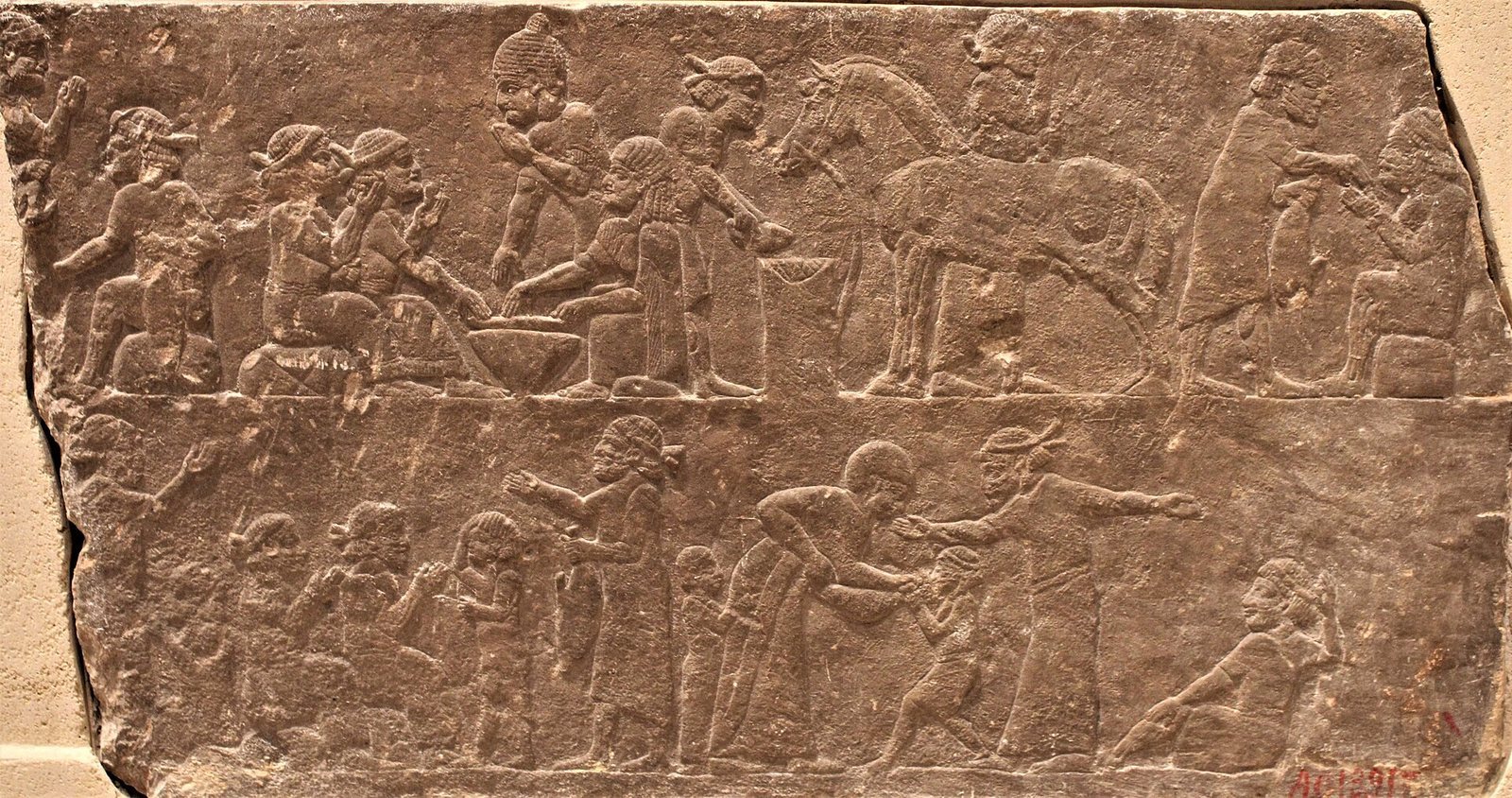
Upright stone slabs lined rooms in both major palaces, carrying long sequences of carved scenes. Layard estimated that reliefs in Sennacherib’s palace extended for more than 3 kilometres across nearly 70 rooms. Their subjects include royal campaigns, building projects, and court life; short inscriptions alongside the scenes help identify their narratives. One sequence portrays the 701 BC siege of Lachish, including the attack, the treatment and deportation of captives, the Assyrian camp, and Sennacherib receiving prisoners and tribute. Other panels show the quarrying and transport of colossal winged bulls and Sennacherib overseeing the work.
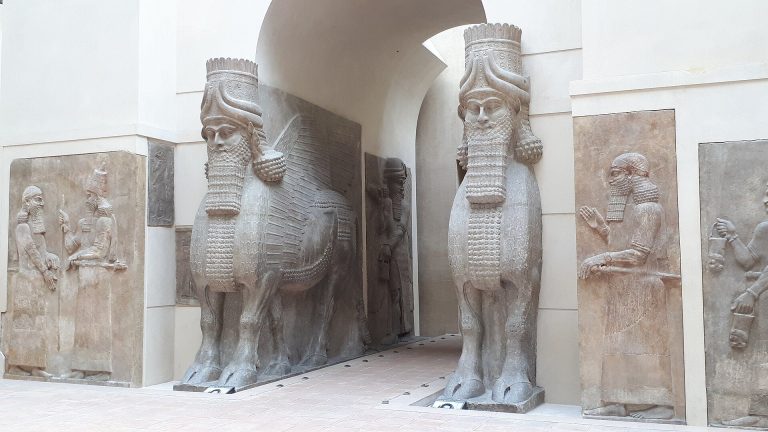
Reliefs made under Ashurbanipal depict campaigns in Elam, including a battle by the Ulai River and the destruction of Hamanu. The North Palace also contained hunting scenes in which the king pursues lions and other animals. In Room C, lions released from cages are hunted from a chariot, and a lioness is shown dying from arrow wounds. Sculpted winged bulls or lions with human heads, protective figures known as lamassu, decorated palace entrances and interiors. Many of Nineveh’s reliefs are now in the British Museum. The surviving palace remains have suffered damage; the throne-room wing of the Southwest Palace was bulldozed in 2016, and restoration of damaged reliefs began in 2021.
Tablets and other finds
More than 30,000 cuneiform tablets and fragments came from the royal precinct. Most date to the Neo-Assyrian period, though some are from the second millennium BC. They include letters, legal and administrative records, treaties, and literary and ritual works. The collections known collectively as the Library of Ashurbanipal came from several palace and temple locations rather than a single building. Most of the texts concern religion, ritual, divination, or word lists. Among the finds are a version of the Flood story in the Epic of Gilgamesh, a celestial planisphere, divination texts, and a clay model of a sheep’s lung inscribed with omens. Tablets from Sargon II’s correspondence may have been transferred from Dur-Sharrukin, and many of the tablets were sent to the British Museum.
A bronze head of an unidentified Akkadian ruler, possibly Naram-Sîn, was found in the temple precinct. It is regarded as a notable Mesopotamian artwork and may have arrived at Nineveh long after it was made. Inscriptions also describe large metal sculptures cast using the lost-wax process, including eight copper lions and two bronze columns. The very large weights given for these works in ancient accounts have not been independently verified.
Nebi Yunus and later archaeological evidence
Assyrian military complex
Tell Nebi Yunus covered about 14 hectares and lay roughly a kilometre south of Kuyunjik. It contained an Assyrian military complex traditionally identified as the arsenal. The complex included storage buildings, weapons workshops, horse stables, and residential structures resembling a palace. Sennacherib built there after demolishing an earlier structure of unknown type. Esarhaddon substantially enlarged the complex and developed its residential section into a royal palace; Ashurbanipal also carried out work there.
A monumental entrance on the complex’s northeastern side was flanked by human-headed bulls. Iraqi excavations recovered tablets, an inscribed prism of Esarhaddon, three statues of the Egyptian pharaoh Taharqa, and a bronze statuette of the goddess Anukis. A relief fragment found during restoration work in the 1970s depicts figures leading horses. Tunnels dug beneath the Jonah shrine later exposed parts of Esarhaddon’s palace. Investigations recovered relief fragments and wall inscriptions, while excavations in 2018 beneath the shrine revealed a palace with reliefs depicting rows of women and protective winged figures.
Small temple and later burials
A small temple excavated in the lower town north of Nebi Yunus measured about 3 by 4.4 metres and followed a plan resembling older Assyrian temples. Nearby finds include a limestone statue about 50 centimetres high, made in the first or second century AD by Diogenes, depicting Heracles Epitrapezios. A column dedicated to gods by Apollophanes, a city official, and an Assyrian altar reused after its dedication to Sennacherib were also found in the area.
Later remains at Kuyunjik include Parthian pottery, fragments of columns and statues, and two third-century AD hoards of Roman and Parthian coins. Tombs from the early second century AD lay over the Ishtar temple ruins and contained gold and precious-stone jewelry. Tombs with vaulted roofs were also found east of Kuyunjik on the right bank of the Khosr. Finds from the Sasanian and early Islamic periods include coins, seals, glass, pottery marked with equal-armed crosses, a copper-alloy lamp bearing a cross, and stucco plaques with varied cross designs.
The surviving remains have been affected by looting, exposure, erosion, and modern construction. In the late Ottoman period, stone from Ashurbanipal’s North Palace was reused in piers for the old bridge across the Tigris at Mosul. Restoration and excavation at damaged gates have exposed further material, including the alabaster carvings found at Mashki in 2022. At Nebi Yunus, modern buildings around the shrine and mosque have shaped the conditions for archaeological work.