Wasit: An Umayyad Administrative City and Garrison in Iraq
Site at a Glance
- Popularity
- Very High
- Country
- Iraq
- Primary era
- Medieval
- Eras represented
- Medieval
- Civilizations
- Abbasid, Ilkhanate, Umayyad
- Site type
- City
On this page14 sections
History
Foundation and Umayyad government
Wasit is the archaeological site of a fortified Umayyad administrative city in Wasit Governorate, Iraq, founded by the governor al-Hajjaj ibn Yusuf. Its foundation is traditionally dated to 694–697, while the main building works began in 702 or 703, after the suppression of the revolt led by Ibn al-Ash’ath. The city’s fortifications were completed in 705. The name Wasit means middle, reflecting its position between important centers including Kufa and Basra. The Umayyads were one of the successive caliphates, Islamic states led by a caliph, and Wasit became a political and administrative center for Iraq under their rule.
Al-Hajjaj established Wasit opposite the older city of Kashkar, linking the settlements with a bridge of boats. The new city was initially organized separately, but eventually incorporated Kashkar and took its name. Wasit’s foundation continued the growth of fortified Arab urban centers in the region after Basra and Kufa. Its design was later regarded as a precursor to Baghdad, which the Abbasid caliph al-Mansur founded in 762–763.
Wasit remained an intermittent seat of provincial government after al-Hajjaj’s death in 713. In 715, the governor’s residence shifted to Khurasan, a historical region in northeastern Iran and adjoining parts of Central Asia. Under the caliph Umar II, Iraq was divided into the provinces of Kufa, Basra, and Khurasan, and the Syrian garrison at Wasit was withdrawn. The city was demilitarized, but regained the provincial seat under Maslama ibn Abd al-Malik in 720 and Umar ibn Hubayra in 721–723. Later governors moved between Wasit, Kufa, and Hira.
Wasit survived the revolt of Yazid ibn al-Muhallab in 721 and became involved in the revolt of Zayd ibn Ali in 739. Zayd was an Alid, a member of the family of Ali ibn Abi Talib, whose descendants claimed leadership of the Muslim community. Under Governor Khalid al-Qasri, who held office from 723 to 737, agricultural development in the Sawad, the fertile region of southern Iraq, contributed to changes in Wasit’s urban life. The district of Kaskar retained an administrative identity separate from the Sawad districts associated with Kufa and Basra.
Wasit was also a major Umayyad mint. The caliph Abd al-Malik introduced an inscription-based gold dinar in 696–697, and al-Hajjaj introduced an inscription-based silver dirham in 697–698 as part of efforts to standardize silver coinage and gather older Sasanian and Arab-Sasanian coins for re-minting. During Ibn al-Ash’ath’s revolt, al-Hajjaj centralized coin production at Wasit in 702 and closed other mints in his territories. This gave him greater control over the money supply, although the resulting shortage may have hindered trade. He reopened mints in several eastern provinces in 709 but retained Wasit as Iraq’s principal mint.
After al-Hajjaj’s death in 714, minting elsewhere in Iraq resumed briefly before contracting. As mints in Khuzestan, Jibal, and Fars closed between 716 and 718, Wasit became the dominant mint in the eastern territories. Umar II later closed it while reopening the mints at Kufa and Basra; the caliph Yazid II briefly reopened it in 721. From 721–722 until the end of Umayyad rule in 750, Wasit produced much of the eastern caliphate’s dirham coinage.
Abbasid rule and regional wealth
Late Umayyad conflicts between provincial governors and Kharijite rebels, an early Islamic movement that challenged caliphal authority, damaged Wasit. Rebels held the city until Governor Yazid ibn Umar ibn Hubayra retook it in 746. In 750, Abbasid forces besieged and captured Wasit, ending the last major resistance to their rule in Iraq. The Abbasids succeeded the Umayyads as the ruling caliphate. Local support for an Alid revolt in 762–763 was an unsuccessful challenge to the new government.
Baghdad’s foundation in 762 reduced Wasit’s political and military weight, leaving it mainly a local administrative center. The Abbasid rulers took over former Umayyad estates around the city. Agricultural expansion under al-Mansur and al-Mahdi, together with evidence of land-tax revenue in 788, points to regional prosperity during the reign of Harun al-Rashid. Wasit’s crops supplied food to Baghdad and helped build reserves for other cities during famine. River and land routes also supported commerce, caravan traffic, and shipbuilding. A school of Islamic religious learning, or madrasa, attracted scholars; Ibn Battuta later described Quranic study and recitation in Wasit as a reason students came from elsewhere.
Wasit’s mint reopened briefly in 815 and 818 during an Abbasid civil war and subsequent revolts in Iraq. Coins from these issues bear the names of al-Hasan ibn Sahl and al-Fadl ibn Sahl, and may have served as emergency payments for the caliphal army. The mint resumed under the caliph al-Mu’tazz, producing dirhams in 867 and dinars in 868. Over the following century it became one of Iraq’s active mints, striking dirhams and occasional dinars under Abbasid and Buyid rule.
From the second half of the ninth century, the Abbasid caliphate weakened and agricultural production and tax revenues declined across Iraq, although Wasit and its region remained particularly important to the government. Under al-Mu’tasim, military commanders received assignments to collect land taxes in Kaskar. The Zutt raided the region in 834. An epidemic sharply reduced Wasit’s population in 871, and the Zanj rebellion, a major uprising in southern Iraq from 869 to 883, brought further devastation. Wasit was destroyed in 877, especially in its eastern section. Land-tax collection and assignments of land revenue to military officials increased again under al-Mu’tadid and al-Muqtadir.
Floods damaged Wasit’s monuments in 904 and caused further destruction in 922, but the city continued to supply food to Baghdad. In 936, Caliph al-Radi raised the local governor Ibn Ra’iq to the title of emir of emirs, the leading military commander and effective power behind the caliph. This promotion may reflect Baghdad’s reliance on the resources of the surrounding region.
Buyid and Seljuk rivalries
During the Buyid period, from 945 to 1055, Wasit’s agricultural wealth made it an object of competition among regional powers, including the Baridis of Ahvaz and the Mazyadids, a dynasty based at Hilla. Between 949 and 971, the Buyid rulers Muizz al-Dawla and Izz al-Dawla used Wasit as a base in their conflict with Imran ibn Shahin, ruler of the marsh region of Batihah. Despite wider economic decline and population loss in Iraq, Wasit continued to supply Baghdad with food. The geographer al-Muqaddasi described it in 985 as comparatively resilient.
After the Buyid takeover, Wasit’s coin production became less regular. Output declined in the 970s and 980s as Basra and Ahvaz developed as commercial centers, and the mint then remained inactive for about three centuries. In the mid-eleventh century, governor Ibn Fasanjas ordered that the Fatimid caliph al-Mustansir be named in the Friday sermon, a public proclamation of political allegiance. The Fatimids were a Shiite caliphate based in North Africa and Egypt. The local mosque was painted white, a color associated with Shiites in Egypt, amid Fatimid influence and Mazyadid ambitions.
Seljuk forces, belonging to a Turkic dynasty that established power across much of the region, attacked Wasit in 1055 and secured it after a long siege in 1057. The Fatimid-aligned commander al-Basasiri briefly recovered the city, but his campaign ended in 1059 amid severe drought and famine. Following the Seljuk sultan Malik Shah’s death in 1092, disputes between Seljuk princes and the Mazyadids over land taxes and military land assignments accompanied economic and population decline. Muhammad I Tapar granted the assignment to the Mazyadids in 1107.
Abbasid revival and Mongol conquest
During the Abbasid revival under al-Mustarshid, Seljuk and caliphal forces repeatedly besieged Wasit. Fighting damaged the city in 1140, 1154, 1156, and 1158. Abbasid control afterward brought a period of relative peace. By the time the geographer Yaqut al-Hamawi visited in 1225, Wasit had regained some prosperity. It expanded again between the reigns of al-Nasir and al-Musta’sim, who visited in 1248.
Wasit resisted the Mongol army led by Hulagu in 1258, but the city was destroyed and suffered heavy loss of life. The reported death toll of about 40,000 is likely exaggerated. Under the Ilkhanids, the Mongol-ruled dynasty established in Iran and Iraq after the conquests, Wasit was attached to the province of Baghdad and partly rebuilt. Mongol raids contributed to the ruin or disappearance of its western section.
The Ilkhanid mint at Wasit reopened after a coinage reform in 1298–1299 led by the vizier Rashid al-Din under Ghazan. Wasit, Hilla, and Basra became mints again, although Baghdad remained the province’s principal center. Baghdad and Wasit were the only Iraqi mints to issue silver dinars valued at six dirhams. Wasit produced coins under Ghazan, Oljeitu, Abu Sa’id, and their Jalayirid successors. Political disorder after Timur’s invasion probably ended production there.
Later rule and abandonment
The Jalayirids gained control of Wasit in 1339 and maintained its importance as a mint. Timur placed a garrison in the city in 1385 and again in 1405. His campaigns and occupation of Iraq between those years damaged buildings. Under the Qara Qoyunlu, a Turkmen confederation, Wasit declined amid repeated attacks by the Musha’sha, a Shiite religious and political movement. Its founder, Sayyid Muhammad ibn Falah, attacked after 1438 and again in 1440 and 1442. His son Ali attacked in 1453 or 1454, completing the city’s ruin and prompting its inhabitants to leave.
After Ali’s death, some refugees returned and probably settled in a nearby village, which was still recorded in 1534 and 1553, during the early Ottoman period. From the fifteenth century, the Tigris gradually shifted away from Wasit; its course moved further in the sixteenth and seventeenth centuries, leaving the old city beside a dry riverbed. By the seventeenth century the settlement was described as lying in the desert, and it was abandoned by the early eighteenth century.
Archaeological surveys and excavations took place from 1936 to 1942 and again in 1985. The Iraqi Department of Antiquities led six expeditions during the earlier campaign, the last directed by F. Safar. Reconstruction and restoration work followed from 1937 to 1965. In the early 2000s, Wasit was added to UNESCO’s World Heritage Tentative List as a cultural site under criteria i, ii, and iv.
Remains
The ruins extend for about three kilometres from east to west along the dry bed of the Diala, a principal branch of the medieval Tigris. The site lies in the fertile alluvial plain of the Sawad, near saline marshes, reed beds, and steppe; drier steppe and desert stretch to the west. Wasit occupied the western bank of the medieval river opposite Kashkar, and its wider plan included districts on both banks. The Tigris later shifted away from the settlement.
City plan and defenses
Wasit’s plan included twelve quarters, six in each part of the city, crossed by four main avenues. Its circumference was about 16 kilometres. Walls enclosed three sides, with a moat outside them and the river forming the remaining boundary. The walls measured about 2 metres high and 4.5 metres thick, and six gated entrances controlled access. Most buildings were made of brick.
The city’s gates were later removed and transferred to Baghdad under Abbasid rule. Doors for the citadel and principal mosque were reportedly brought from Zanzaward and reused at Wasit.
Mosque and governor’s palace
Principal mosque
Al-Hajjaj’s principal mosque was built in 702 along the south wall of the governor’s palace. It measured roughly 200 yards square. Three later mosques occupied the site: Mosque II, dated between 1009 and 1155; Mosque III, built around 1155; and Mosque IV, constructed under the Ilkhanids between 1258 and 1335.
Governor’s palace
The adjacent palace measured about 400 yards square and had a green dome reportedly visible from 25 kilometres away. Parts of the palace adjoining the mosque have been excavated. The mosque and palace were regarded as models for buildings in Baghdad.
Other excavated and surviving buildings
Al-Manara, tomb, and school
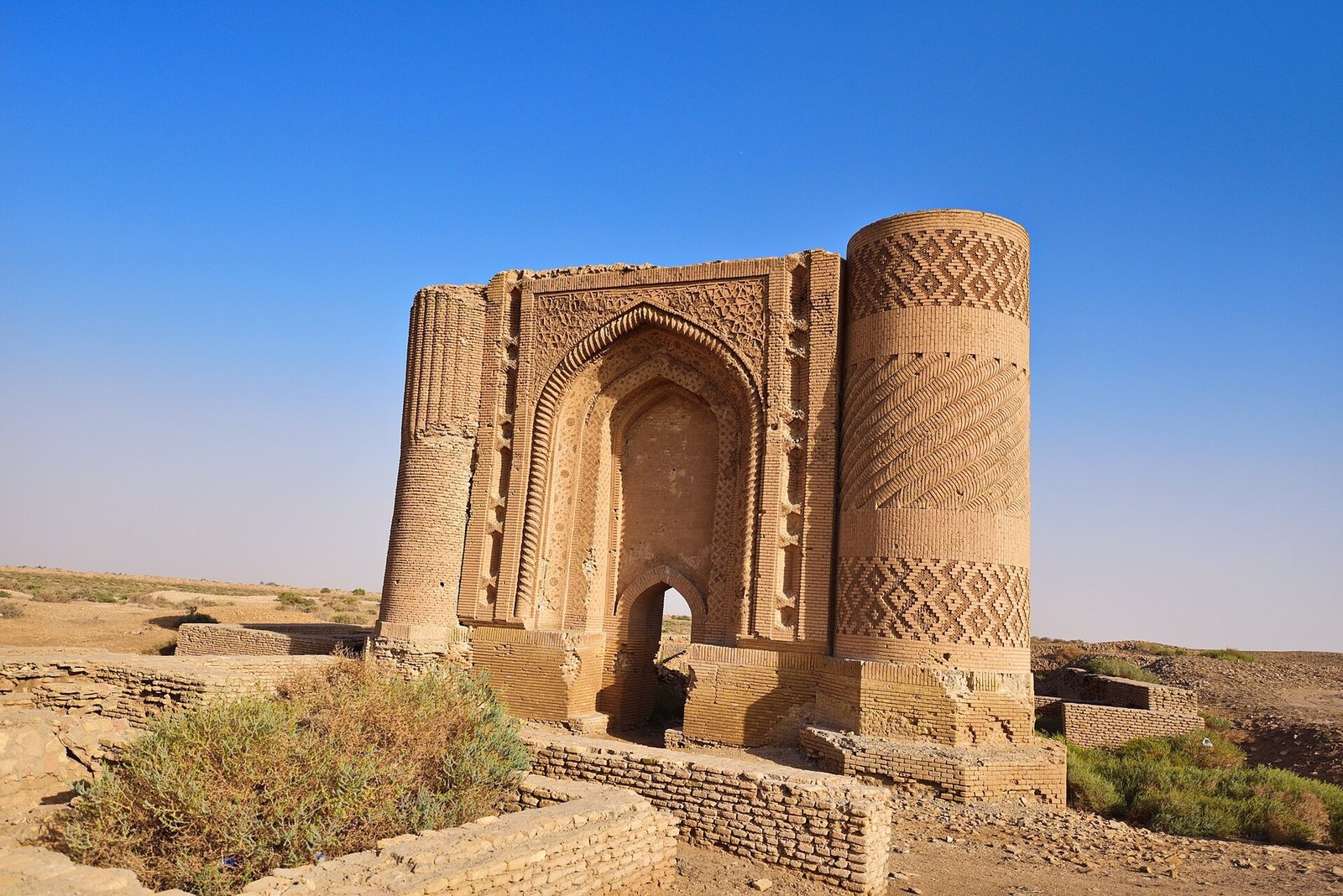
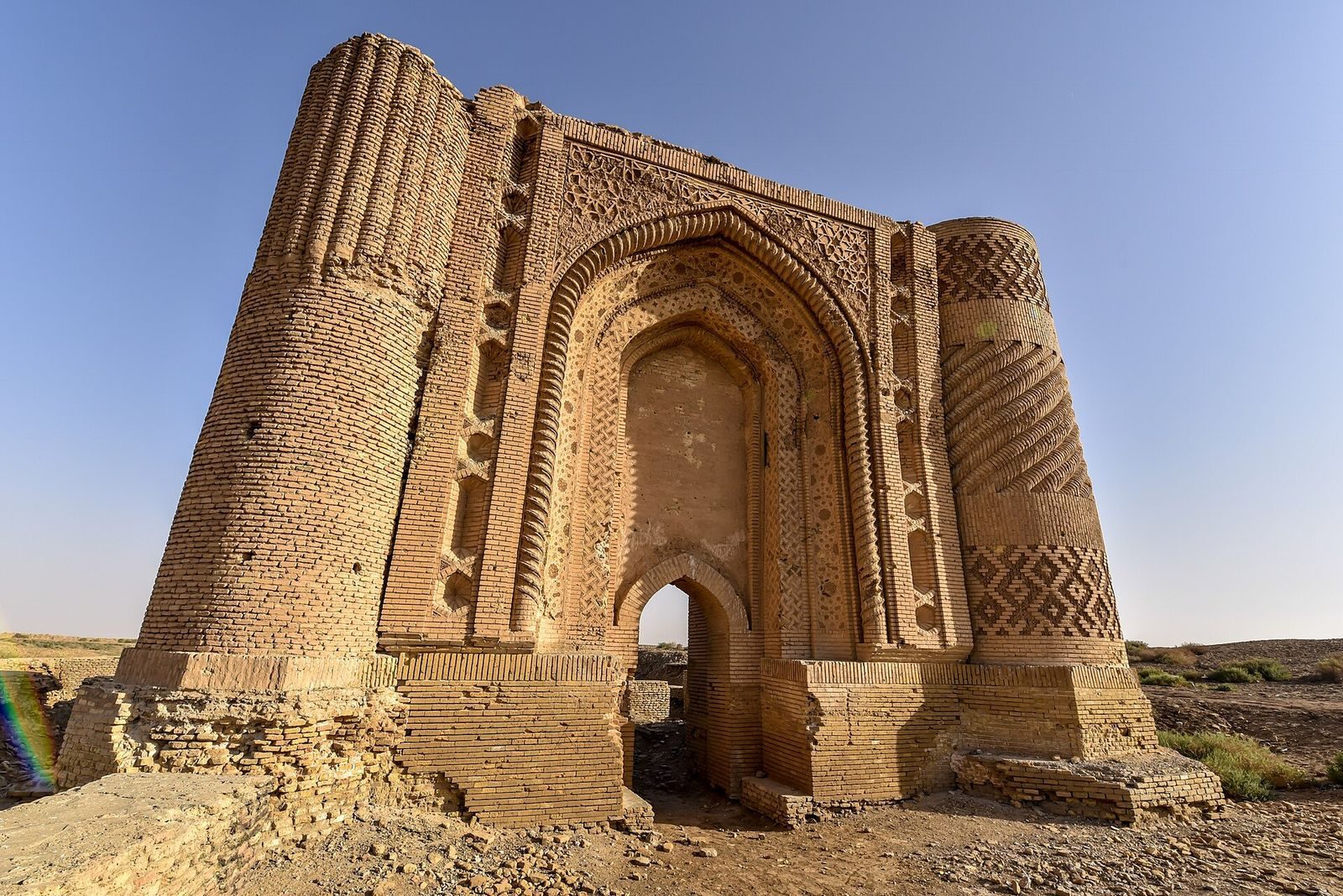
At the northeast of the site, the entrance to a thirteenth-century building known as al-Manara survives, flanked by two minarets. Excavations in the area also revealed a tomb and a school dating to the thirteenth century.
Sharabiya Madrasa gate
A gate believed to belong to the Sharabiya Madrasa is among the visible remains. A residential district was cleared during excavations in the late 1930s. The remains are generally exposed and weathered; the site’s isolation has limited human damage, and parts of the standing minaret received partial protection against wear.